
Is employee monitoring legal at all in the first place? In most cases, it is, and we will dive deeper within this blog.
Employers in the US, the EU, the UK, and India can usually monitor company devices during work hours if they inform their employees that they are being monitored and that there is a legitimate business reason for it. Where the problem begins is when tracking extends into personal devices and is done covertly, sometimes even after people have logged off work.
This blog doesn’t aim to provide legal advice. Employee monitoring laws vary by country and state, so it is always recommended that you check with local lawyers regarding legal compliance when in doubt.
Key takeaways
- One universal rule is to inform staff that they are being monitored. In fact, some US states require an explicitly written notice to that effect.
- In the European Union, it is expected that companies show that monitoring is necessary and proportionate in the situation in which it is being implemented.
- In India, the DPDP Act lets employers process staff data for employment purposes without demanding their consent, but it too has its limitations.
- Tracking on personal devices and off-the-clock work are where most employers get into legal hurdles for crossing personal boundaries.
Is employee monitoring legal in the United States?
If one adheres to the rules that have been announced by the state concerning those machines and gadgets that are solely under the control of the firm, then normally there won't be any legal problems at all.
There is no federal law that bans workplace monitoring explicitly. The Electronic Communications Privacy Act of 1986 limits intercepting communications, but its business-use and consent exceptions usually pertain to those employers who monitor their own devices (18 U.S.C. §2511).
Labor law, however, is a different matter. The National Labor Relations Act protects employees who discuss pay or organize, and watching that specific activity can be considered an unfair labor practice.
- New York: Since May 7, 2022, employers that monitor phone, email, or internet use must give written notice at the time of hiring, get an acknowledgment, and subsequently post a public notice informing them of the same (NY Civil Rights Law §52-c).
- Connecticut and Delaware: both require notice before any form of electronic monitoring starts (19 Del. C. §705).
- California: State privacy law already covers employee data since January 1, 2023, so staff can ask what’s collected and request deletion if they find that it violates any statute or personal law (CPPA, 2023).
Two new workplace surveillance laws were signed on September 30, 2026, and take effect January 1, 2027. AB 1331 bars employers, public and private, from using surveillance tools to monitor employees in workplace bathrooms, and AB 1883 bars, with some exceptions, AI surveillance tools that recognize an employee’s emotional state or collect neural data (AB 1331; AB 1883).
Is employee monitoring legal in the EU and UK?
Under GDPR employee monitoring rules, you need to show that it is proportionate and warranted.
You need a specific purpose and should collect only what you need according to the law (GDPR Art. 5). Consent rarely works, because an employee is assumed to not be able to decline their boss freely, so most employers rely on legitimate interests (Art. 6(1)(f)). Systematic monitoring usually calls for a data protection impact assessment (DPIA). This is done before monitoring is turned on (Art. 35).
Fines can reach €20 million or 4% of worldwide annual turnover, whichever is higher (Art. 83). In Germany, and in French companies with 50 or more employees, works councils also get a say in the above. (BetrVG §87; Labor Code L2312-38).
Regulators are seen to be lenient a lot, but they do enforce this. In France, CNIL fined Amazon France Logistique €32 million in December 2023 over warehouse monitoring (CNIL, 2023). The Conseil d’État cut that to €15 million in December 2025 after it was appealed, but it was determined that Amazon had retained too much productivity data for more than a month at one point in time; hence, the court threw out CNIL's findings on the tracking indicators themselves (including the 10-minute idle flag) and upheld the breach for keeping all indicators for 31 days. (Conseil d’État, 2025).
The EU AI Act has banned emotion recognition at work since February 2, 2025, and treats AI that monitors or evaluates workers as high-risk, with that coming into force on December 2, 2027 (AI Act; Regulation 2026/1744). In the UK, the ICO’s 2023 guidance says covert monitoring belongs only in exceptional cases (ICO, 2023). The ICO in the UK and the GDPR require organisations to process personal data lawfully, fairly, and transparently for specific purposes. This should be done while keeping it secure, accurate, and limited to only what is necessary.
Is employee monitoring legal in India?
Monitoring for employment purposes is generally allowed, and the DPDP Act governs how that data is handled and expects companies to follow suit, which will come into effect in 2027. So, it is legal as of today.
Monitoring for employment purposes is generally allowed, and the DPDP Act governs how that data is handled and expects companies to follow suit, which will come into effect in 2027. So, it is legal as of today.
The Digital Personal Data Protection Act, 2023 (DPDP Act) lets employers process personal data “for the purposes of employment” without separate consent required (DPDP Act, s. 7(i)). For DPDP Act employee monitoring, security and breach-reporting duties still apply, with penalties that can go up to ₹250 crore (DPDP Act, Schedule).
The DPDP Rules were notified on November 13, 2025, and most obligations begin around May 13, 2027 (DPDP Rules, 2025). Until then, Section 43A of the IT Act mandates reasonable security for sensitive data (DPDP Act, s. 44(2)).
What is off limits almost everywhere?
- Covert monitoring without a serious reason, such as a crime that is suspected
- Personal devices and accounts should not be monitored
- Cameras or audio in bathrooms and changing rooms are a direct violation of privacy
- Watching union activity is also considered a breach of trust
- Tracking location after hours or when the monitoring software is switched off is not acceptable
What should you do before you start monitoring?
Keep a written record of each step.
- Write down the reason why monitoring is valid in your organization
- Collect the minimum data that is required to satisfy the conditions
- Check local law and, where mandated, complete a DPIA.
- Consult works councils or unions when and where required and abide by labor laws
- Meet employee monitoring notice requirements, which require telling people in writing first, collecting acknowledgments, and then publishing a notice
- You will need to restrict the number of people with access to your information and also reduce the period for which this information is kept. If you have a simple hierarchy of information sharing, the accountability process will be much clearer and easier to monitor. This makes it easier to track who did what in case of legal issues that may crop up later.
- Keep a human in the loop to make the important decisions that shouldn’t be in the hands of AI agents alone.
How Hyring Insight handles this
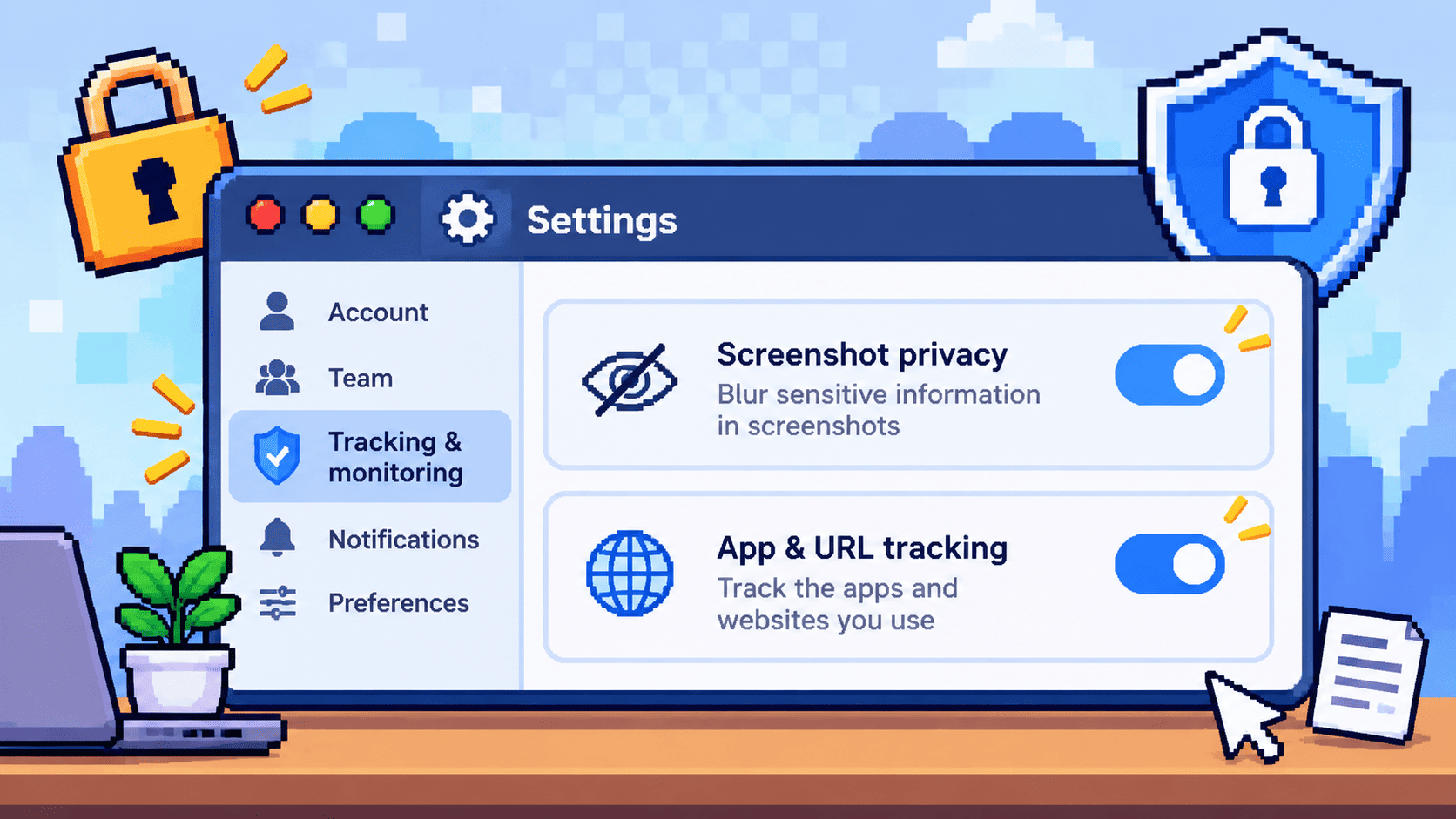
These have been highlighted previously. The Hyring Insight desktop app always appears in the menu bar or tray and doesn’t run covertly. It records nothing while the timer is stopped, and members see their own data. It offers a 'tell your team' guide and a DPA (custom DPA on Enterprise). Hyring Insight is SOC 2 and ISO/IEC 27001 certified and offers a data processing agreement, but it still doesn’t replace the need for a legal review that has to be conducted independently by your own lawyers. See our legal and compliance help page, what Hyring Insight collects, and our Privacy Policy.