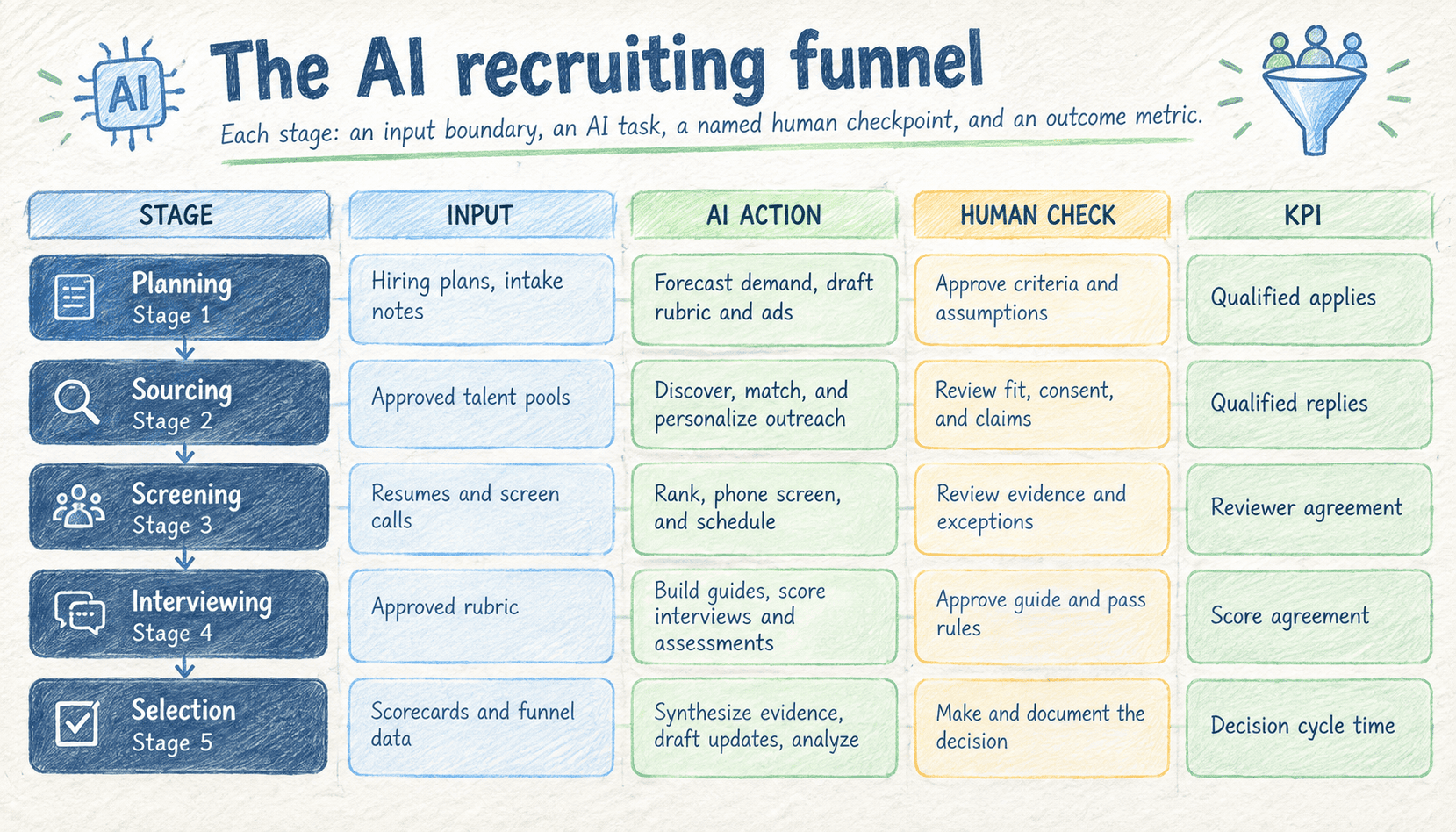
AI can support the full recruiting funnel, but the control point changes with the impact of each task.
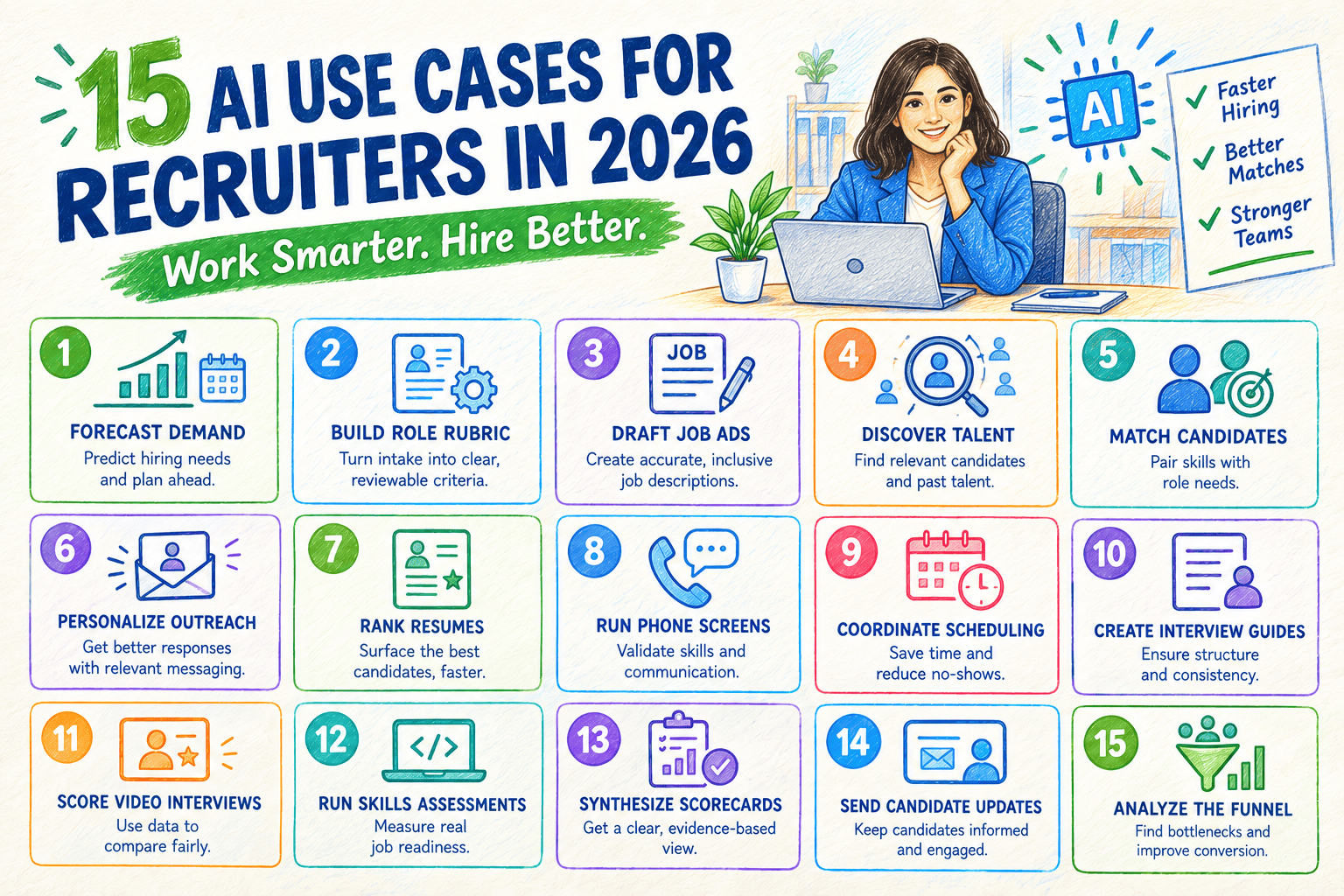
The optimal use of AI by recruiters in 2026 includes candidate discovery, candidate matching, resume prioritization, telephone interviews, scheduling, structured interviews, assessments, evidence summarization, candidate communication, and funnel analysis. Utilize AI in gathering evidence and performing repetitive tasks. Leave humans in charge of criteria, accommodations, exceptions, and decision-making.
What are the best AI use cases for recruiters in 2026?
It is not the use case that creates the most impressive result. It gets rid of a known delay, gives evidence that the recruiter can verify, and helps to better an existing measure within the team’s control. This table summarizes each AI recruiting workflow, the primary metric that shows whether it's working, and the point where human judgment remains essential.
| Use case | Primary KPI | Human checkpoint |
|---|
| 1. Forecast demand | Forecast error | Approve assumptions |
| 2. Build role rubric | Rubric agreement | Approve criteria |
| 3. Draft job ads | Qualified applications | Check accuracy |
| 4. Discover talent | Qualified profiles | Review fit |
| 5. Match candidates | Match-to-screen rate | Review rationale |
| 6. Personalize outreach | Qualified replies | Approve claims |
| 7. Rank resumes | Reviewer agreement | Review exceptions |
| 8. Run phone screens | Completion rate | Review evidence |
| 9. Coordinate scheduling | Time to schedule | Handle exceptions |
| 10. Create interview guides | Question coverage | Approve guide |
| 11. Score video interviews | Score agreement | Review report |
| 12. Run skills assessments | Job relevance | Set pass rules |
| 13. Synthesize scorecards | Decision cycle time | Make decision |
| 14. Send candidate updates | Update SLA | Review sensitive messages |
| 15. Analyze the funnel | Stage conversion | Choose action |
Treat AI as a measured recruiting system, not a collection of clever prompts. Operating principle for this guide
Planning and Job Design
Better hiring starts before a job is posted. These uses turn business demand into clear, reviewable criteria.
1. Forecast headcount and hiring demand
AI factors in your hiring plans, turnover rates, seasonal patterns, open roles, and recruiter capacity to highlight potential workload shortages. Instead of relying on a single forecast number, you can plan using a flexible target range.
Agencies can use this model to predict client demands and backfill the bench without compromising on client information.
Measure: forecast error and recruiter load.
Human check: approve source data and business assumptions.
2. Turn Role Intake Into A Success Profile
Outcome, must-have skills, trainable skills, evidence, and disqualifiers should be derived from notes done during intake. The AI system can point out inconsistencies, like when the junior level has senior requirements. The hiring manager/client will approve the rubric before sourcing.
Measure: intake-to-approval time and interviewer agreement.
Human check: sign-off criteria and weighting.
3. Draft Accurate Job Descriptions And Ads
Turn the approved role rubric into tailored job posts and a simplified version. Include confirmed details on pay, location, accessibility, and employment terms, with a recruiter verifying all information before posting.
Measure: qualified application rate, not total applications.
Human check: verify requirements, pay, and employment terms.
Sourcing And Candidate Engagement
Here, AI earns its place by finding relevant people and improving response quality without inventing personalization.
4. Discover Candidates And Rediscover Past Talent
Search authorized talent pools according to skills, accomplishments, location, availability, and related experience. Rediscovery benefits agencies with extensive databases and internal teams featuring previous finalists. Document reasons for rediscovery of each individual’s profile.
Measure: qualified profiles per recruiter hour and redeployment rate.
Human check: review consent, freshness, and fit.
5. Match candidates to roles with evidence
Compare each profile with the approved presets and return matches based on evidence, gaps (if present), and questions to verify. A score isn't a judgement here. Agencies should show clients the rationale behind choosing the match.
Measure: match-to-screen and submission-to-interview rates.
Human check: inspect reasons and false negatives.
6. Personalize outreach and answer candidate FAQs
Use information from your confirmed profile and job description, along with voice guidelines, to create personalized outreach. Use a controlled FAQ assistant to address process, location, timing, and benefit questions; then you can tackle route policy or accommodation questions to an individual.
Measure: qualified reply rate and unanswered-question rate.
Human check: approve claims and escalation rules.
Each stage needs an input boundary, an AI task, a named human checkpoint, and an outcome metric.
Screening and workflow coordination
Screening AI should make evidence easier to inspect. It shouldn't hide the basis for a recommendation.
7. Parse, score, and rank resumes
Use an approved role rubric to pull evidence, justify each fit score, and separate missing data from failed criteria. An AI resume screener can apply that rubric to every applicant, then score, rank, and summarize each resume and sync results with your ATS.
For the full workflow, see our guide to AI-powered resume screening.
Measure: reviewer agreement, false negatives, and time per resume.
Human check: review edge cases and accommodations.
8. Run first-round phone screens
AI phone screening can ask consistent questions, capture transcripts, score approved criteria, and produce a report. Run at scale, it clears first-round volume while recruiters decide the next step.
Measure: completion rate, recruiter agreement, and time to first screen.
Human check: review evidence and disputed results.
9. Coordinate scheduling and stage handoffs
AI interview scheduling software can help with availability collection, time zone usage, panel reservation, reminder alerts, and workflow status updates and can create exception handling for accessibility, rescheduling, and delays. A failed calendar action should not disqualify a candidate from consideration.
Measure: time to schedule, reschedule rate, and no-shows.
Human check: own exceptions and service recovery.
Interviews and skills assessment
AI can improve consistency when questions and scoring rules come from the job description and not from a generic template.
10. Create structured interview guides
Translate the accepted rubric into questions, performance samples, probing questions, and scorecards anchored to criteria. Assign a single criterion per question. Interviewers reach agreement on scoring and collect evidence without consulting the other panelists' scores.
Measure: criterion coverage and panel score agreement.
Human check: approve questions and scoring anchors.
11. Conduct video interviews with evidence-based scoring
An AI interviewer can ask consistent questions, adapt approved follow-ups conversationally, and produce an evidence report. It can run in asynchronous and live formats, while recruiters still review context and candidate concerns.
Measure: completion rate, review time, and score agreement.
Human check: review evidence before advancing or rejecting.
12. Run coding, English, and role-specific assessments
Use work samples that reflect the job. For technical roles, an AI coding interviewer lets candidates write and run real code in an executable IDE, so you judge working solutions, not just answers. For customer-facing roles, an English proficiency test scores spoken English against global CEFR levels, giving every candidate the same benchmark. Offer an accessible alternative when needed.
Measure: completion, job relevance, and later job performance.
Human check: set pass rules and review accommodation needs.
Selection, communication, and funnel improvement
Late-stage AI should reduce information loss and expose bottlenecks. People still own the employment decision.
13. Synthesize scorecards and prepare a shortlist
AI can assemble scorecards, quote evidence, flag missing ratings, and show disagreement. It shouldn't infer evidence or average away a serious concern. A named owner reviews the record and documents the decision.
Measure: decision cycle time, missing evidence, and override rate.
Human check: make and document the decision.
14. Draft candidate updates, agency submissions, and feedback
Create stage updates, next-step messages, client submissions, and feedback drafts from approved facts. Remove private panel comments, unsupported claims, and sensitive data before any message leaves the system.
Measure: update SLA, client response time, and candidate complaints.
Human check: review rejection and sensitive messages.
15. Analyze funnel health, source quality, and recruiter capacity
Ask AI to find delays, source patterns, aging roles, workload imbalances, and outcome differences. Require links to the records. Agencies compare clients only when contracts and access rules allow it. A person chooses the response.
Measure: stage conversion, aging, source yield, and recruiter load.
Human check: validate causes before changing processes.
Among staffing recruiting professionals integrating or testing generative AI, 72% expected improved hiring efficiency.
LinkedIn, Future of Recruiting 2025, Search & Staffing report
What Should Recruiters Automate, Assist, Or Keep Human?
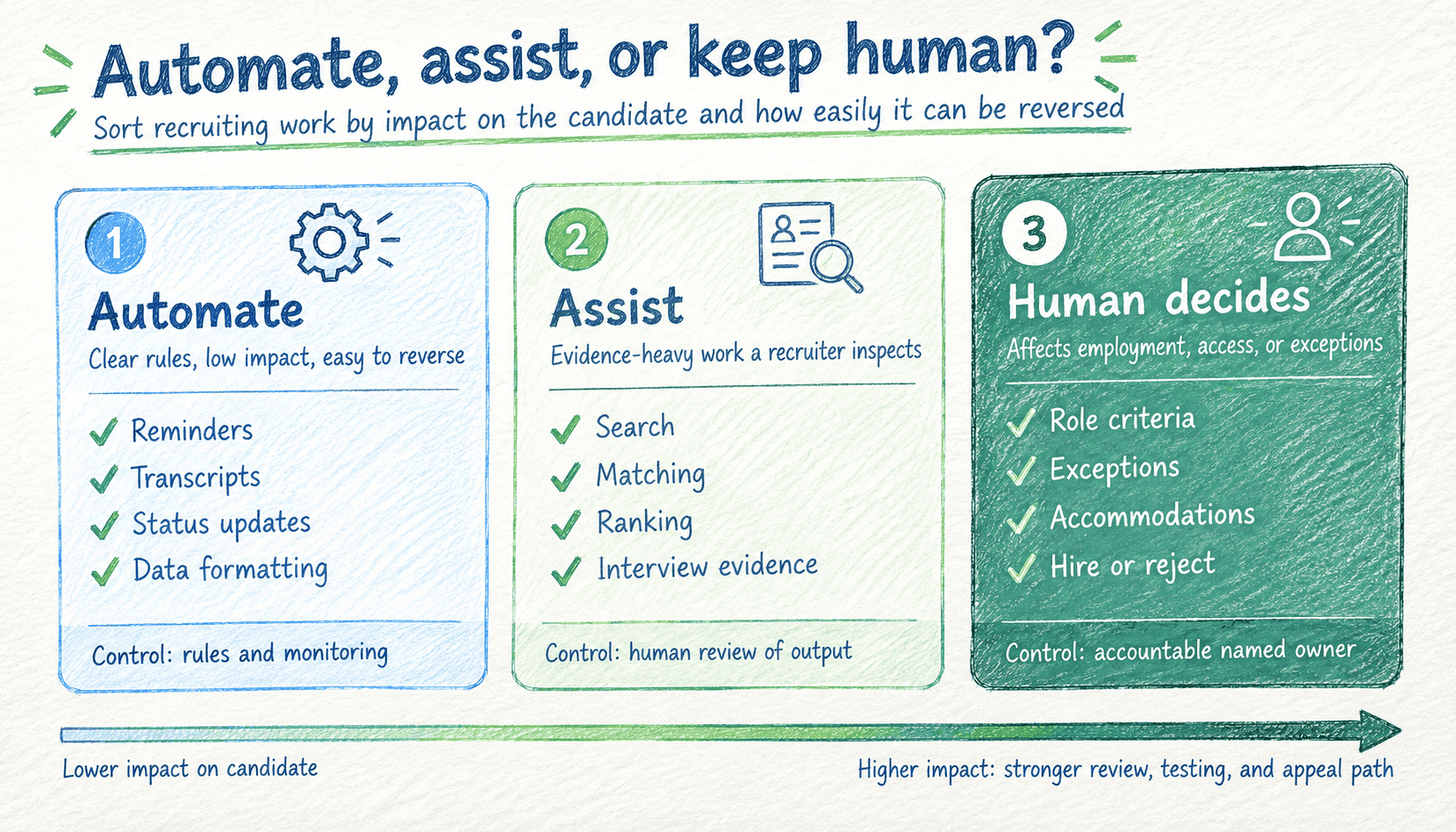
Categorize work based on its effect and reversibility. Routine actions performed by administrators, which are governed by certain rules, could be automated. Work that is heavy on evidence requires assistance. Work having an impact on employment, accessibility, accommodations, or exemptions requires human accountability.
The greater the impact on a candidate, the stronger the review, testing, and appeal path should be.
Start with the tool's actual function. A writing assistant, ranking model, and automated interview don't create the same risk. Use the NIST AI Risk Management Framework's govern, map, measure, and manage functions as a practical control cycle, then apply the law in every hiring location.
| Region | Recruiter action | Primary source |
|---|
| United States | Test procedures that result in discrimination, make provisions for reasonable accommodation, and review state and local regulations. NYC Local Law 144 introduces requirements for bias audits and notice when using automated employment decision tools. | EEOC; NYC DCWP |
| United Kingdom | Explain data use, collect only needed data, define controller and processor roles, set retention limits, and test for unfair outcomes. The ICO's recruitment AI audit produced almost 300 recommendations. | ICO audit |
| European Union | Treat recruitment and employment AI as a possible high-risk use. Check the system classification, provider and deployer duties, data governance, records, human oversight, and the latest application timeline. | European Commission |
Minimum control set: documented purpose, approved data, candidate notice, accommodation route, access controls, retention rule, outcome testing, audit trail, named reviewer, and a way to correct or contest the result.
How Should A Recruiting Team Launch Its First AI Workflow?
- Pick one bottleneck. Use stage data to choose a repeated, measurable problem.
- Write the boundary. State what the AI can do, what data it may use, and what it can't decide.
- Set a baseline. Record the current time, quality, conversion, and candidate experience metric.
- Run a controlled pilot. Compare AI-assisted work with the existing process on a defined sample.
- Audit outcomes. Review errors, group differences, overrides, complaints, and accommodation requests.
- Expand only after review. Train users, assign an owner, monitor drift, and keep a rollback path.
If there is any kind of blockage that exists through the process of screens and interviews, then Hyring will put all those processes, such as resume rankings, telephone screenings, video screening, coding, and the English Proficiency Test process, in one recruitment process. It is important to start from where you can measure the outcome.
Frequently Asked Questions
1. What are the most useful AI use cases for recruiters?
The best use cases are that they are brilliant at eliminating repetitive tasks while retaining the human element. They include - identification of talents, ranking resumes, telephone screenings, scheduling, interview proof, candidate feedback, and funnel analyses. Begin with one slow process, one KPI, and a defined reviewer for decisions.
2. How can staffing agencies use AI in recruitment?
Staffing agencies can use AI to rediscover candidates, match profiles across roles, personalize outreach, run first screens, format client submissions, and find productive sources.
Separate client criteria from suggestions made by AI. Measure submission-to-interview rate, redeployment, and recruiter capacity.
3. Should AI make final hiring decisions?
AI should not make the final decision but must be used to organize evidence, apply an approved rubric, and flag gaps; a person should make the final hire or reject decision.
Human review is also needed for accommodations, disputed results, unusual histories, and incomplete evidence.
AI performance should be measured by pairing an operational metric with an outcome metric. Measure screen time with recruiter agreement, or response rate with qualified-response rate. Track by role, source, location, and relevant candidate groups. Compare against a baseline and review errors, overrides, complaints, and accommodations.
Compliance checks depend on the tool, location, and decision. Common controls include a documented purpose, lawful data use, candidate notice, accommodations, outcome testing, retention limits, security review, vendor role clarity, audit records, and human oversight. Get legal advice for each jurisdiction.