Insight by Hyring · Timesheets
Timesheet Software
The timesheet fills itself. Insight by Hyring assembles the record from tracked work, then hands it to the employee to review, which removes the two things that make manual timesheets wrong.
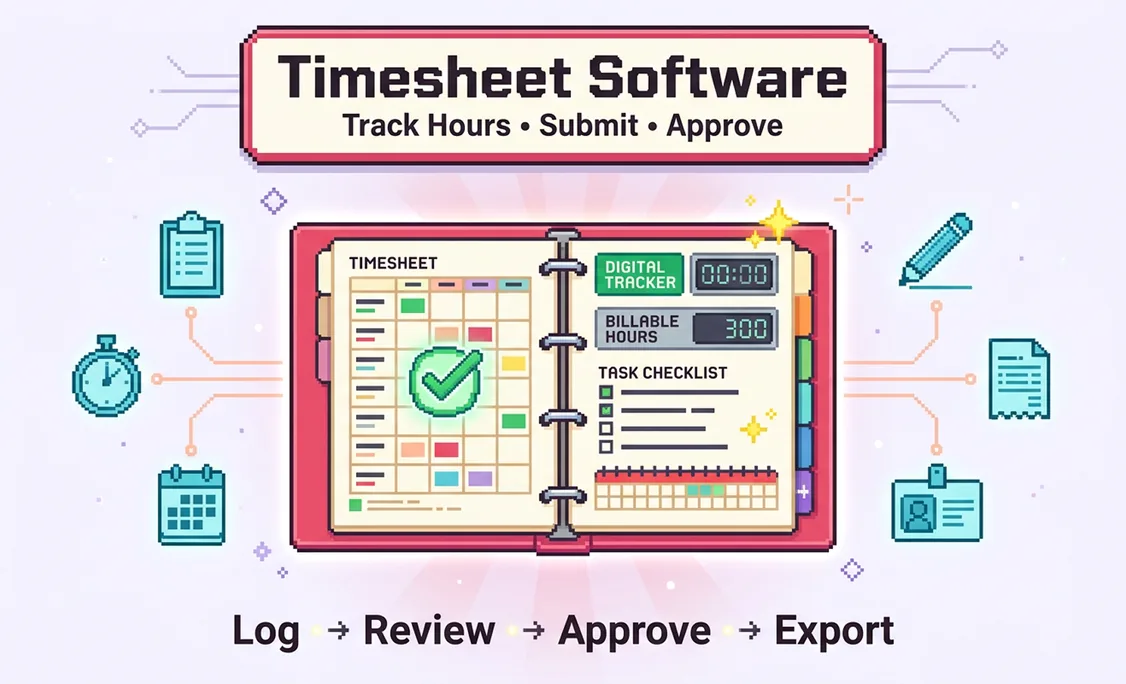


Assembled
Not typed from memory
Review
Not reconstruction
Auto
Billable split by context
Employee
Corrects before submission
Direct answer
Timesheet software records the hours people work against projects, clients, or tasks and produces a reviewable record for billing, payroll, or capacity planning.
Insight by Hyring differs from conventional timesheet software in one respect: the employee does not fill it in. The record is assembled from tracked work as it happens, then presented to the person for review and correction. Pro is $7 per user per month, with 30 days free first.
| Weekly reconstruction | Highest error, consistently downward |
|---|---|
| Daily entry | Better, still memory-dependent |
| Manual timer | Accurate when used, forgotten often |
| Passive capture with review | Lowest error, no entry burden |
What Timesheet Software Is
A system of record for hours worked, and in most products, a data entry task attached to it.
Conventional timesheet software gives people a grid and asks them to fill it. The grid may be well designed, the categories may be sensible, and the reporting on top may be excellent, but the input remains a human recalling what they did and typing it somewhere. Everything downstream inherits the quality of that recollection.
Why Manual Timesheets Are Wrong
Error grows with the distance between the work and the record, and it grows in one direction.
| Filled weekly from memory | 100 |
|---|---|
| Filled daily from memory | 62 |
| Manual timer, started and stopped | 34 |
| Passive capture, reviewed by the employee | 8 |
This is a model rather than a measurement. The mechanism it illustrates is well established in any organisation that has run manual timesheets: recollection degrades with time, and it degrades asymmetrically, because people forget work they did rather than inventing work they did not.
The asymmetry is the part that costs money. Forgetting is not random. People omit the short call, the quick review, the fifteen minutes spent unblocking a colleague, and they round to convenient numbers. They do not invent work that never happened. So the aggregate is always low, and for anyone billing by the hour, always low means always under-invoiced.
The Automatic Alternative
Assemble the record from the work, then let the person check it.
Insight by Hyring records work as it happens: hours, activity levels, applications, and project context. At any point the timesheet already exists. The employee's job changes from reconstruction to review, which takes a fraction of the time and produces a materially more accurate record because they are confirming something rather than remembering it.
The human check stays deliberately. Automated capture without review produces a record nobody trusts and nobody can correct. Automated capture with employee review produces one both sides have looked at, which is why disputes about hours largely stop happening.
A week already built from tracked work, awaiting employee review, with one entry flagged for correction rather than a blank grid to fill.
What You Get
Automatic assembly, project attribution, and the companion layer alongside.
Nobody has to administer it
The desktop companion handles the nudging that a manager would otherwise do. In a twelve-person company that is a job nobody has time for.
Your team gets something back
Focus rooms with shared music, water and stretch reminders, and the 20-20-20 eye rule. Small teams notice when software gives rather than only takes.
Kudos that build a culture
Recognition from colleagues, recorded next to the work. In a small team this matters more than any report.
One question, one answer
Ask which client ran over or who is stretched, and read a sentence. There is no analyst on staff to interpret a dashboard.
It notices before you do
Sustained late finishes and fragmented days surface early. In a small team, losing one person to burnout is losing a tenth of the company.
Reminders people actually set
End-of-day wind-down, custom task nudges, and break prompts, all handled by the avatar rather than another tool.
Insight by Hyring runs inside Hyring, so the same data that shows who is stretched also informs what your next hire should be. For a small business making one hiring decision a year, getting it right is worth more than the software costs.
What It Does Not Do
No payroll, no invoicing, no multi-stage approval chains.
- No payroll processing. Accurate hours export to your payroll system. We do not calculate tax or run pay runs.
- No invoicing. Time data feeds your billing system rather than generating invoices.
- No layered sign-off workflows. Employees review and correct their own records and managers see team data. If you need formal multi-stage approval chains, an HR platform handles that better.
Adithyan RK is the Co-Founder and CEO of Hyring, an AI-native recruitment platform that has run over 900,000 AI interviews for companies ranging from early-stage startups to the Fortune 500. He has spent 18 years building technology businesses, starting with a digital consultancy in 2008 and a staff augmentation firm in 2017, before founding Hyring in 2022 to rebuild hiring around evidence instead of guesswork.
Expertise

Surya N is the Co-Founder and CTO of Hyring, where he architected the AI interviewing engine that has now conducted over 900,000 interviews for companies ranging from early-stage startups to the Fortune 500. A mechanical engineer who moved into artificial intelligence, he spent 6 years building AI applications inside a technology consultancy before co-founding Hyring, and wrote the first version of its AI interviewer from scratch: a system that listens, adapts its questioning in real time, and flags fraud rather than following a fixed script.
Expertise
FAQs
Software that records the hours people work against projects, clients, or tasks, and produces a reviewable record for billing, payroll, or capacity planning. Traditional timesheet software asks employees to enter that data. Insight by Hyring generates it from tracked work instead, then lets the employee review and correct it.
Useful next
8 mins Read
Employee time tracking software
8 mins Read
Attendance management software
5 mins Read
Clock in clock out app
7 mins Read
Time tracking for agencies
7 mins Read
Time tracking for law firms
Free HR Toolkit: timesheet calculators
Learn hub: guides and explainers