Insight by Hyring · Agencies
Time Tracking Software for Agencies
In an agency, unlogged time is unbilled revenue. Insight captures hours as work happens instead of asking people to reconstruct their week on Friday afternoon, and separates billable from internal automatically.


~$780K
Modelled annual leakage, 20 people
70% vs 52%
Assumed against recorded utilisation
Live
Burn against retainer
Auto
Billable split, no categorising
Direct answer
Time tracking software for agencies exists because unlogged hours are unbilled revenue, which makes capture accuracy a margin question rather than an administrative one.
Insight by Hyring captures hours as work happens instead of asking people to reconstruct a week on Friday, separates billable from internal automatically, and shows burn against retainer while a project is still running. Pro is $7 per user per month.
| Modelled leakage, 20-person agency | ~$780,000 a year at a $150 blended rate |
|---|---|
| Assumed utilisation | ~70% |
| Recorded utilisation | ~52% |
| Capture method | Passive, no Friday timesheet |
| Invoicing | Not included, feeds your billing system |
| Price | $7 per user per month, Pro |
Insight by Hyring is time tracking software for agencies: passive capture of hours against clients and projects, automatic separation of billable from internal work, and live visibility of burn against retainer while a project is still running.
Agencies are the one business where time tracking is not an HR function. It is the revenue function. Every hour that fails to reach a timesheet is money the agency earned and then declined to invoice, and it happens quietly enough that nobody notices until a quarter goes wrong. The uncomfortable part is that the leak is almost never in rate negotiation, where agency leadership spends its attention. It is in the gap between work happening and work being recorded.
Where Agency Revenue Leaks
Unlogged hours, silently absorbed scope, and retrospective write-downs account for most of it.
| Hours worked but never logged | $312,000 |
|---|---|
| Scope creep absorbed silently | $198,000 |
| Logged late, written down at invoicing | $144,000 |
| Recovered with accurate capture | $654,000 |
The first three lines are the same money, counted before and after it disappears. Agencies rarely lose revenue on rate negotiation; they lose it in the gap between work happening and work being recorded, and the gap widens the longer you leave the timesheet.
Unlogged hours are the largest and least visible. A designer takes a client call, makes two rounds of amends, and answers a Slack thread. None of it is a timesheet entry on Friday because none of it felt like a task. Half an hour a day, twenty people, a $150 blended rate, and the annual number is a hire.
Absorbed scope creep is the one that damages relationships as well as margin. Work outside the statement gets done because refusing feels petty in the moment, and by the time anyone calculates the overrun the client has been trained to expect it.
Retrospective write-downs happen at invoicing, when someone looks at 47 recorded hours against a 40-hour estimate and quietly bills 40 rather than have the conversation. Accurate live data makes that conversation happen in week two, when it is still a scope discussion rather than a billing dispute.
The Utilisation Gap
Most agencies assume roughly 70% billable utilisation and record something closer to 52%.
Where an agency week actually goes
| Assumed by leadership | Actually recorded | |
|---|---|---|
| Admin | 10% | 20% |
| Internal | 20% | 28% |
| Billable | 70% | 52% |
Typical distribution against the 70% billable target most agencies set
The eighteen-point gap between assumed and actual utilisation is the number that decides whether an agency is profitable, and most agencies discover it during a bad quarter rather than before one.
The gap is not idleness. It is internal work that nobody costed: pitch preparation, staff meetings, tooling, onboarding, and the accumulated admin that no agency includes in its capacity model. Knowing the real figure changes pricing, hiring, and which pitches are worth entering, and most agencies only discover it after a bad quarter rather than before one.
How Insight by Hyring Closes It
Passive capture fixes the revenue leak. The companion layer is why creative teams accept it.
No Friday reconstruction
Time is recorded as work happens. Nobody rebuilds a week from calendar entries and guesswork.
Billable split automatically
Application and project context separates client work from internal and admin without anyone categorising entries by hand.
Burn against retainer, live
See hours consumed against estimate while there is still time to act, rather than at invoicing.
Ask about profitability
The AI assistant answers which client absorbed the most unbilled time this quarter, in a sentence.
Contractors on the same record
Freelancers produce identical data, so reconciling an invoice against delivered hours stops being a trust exercise.
Shared focus rooms
Creative teams listen together in sync across lofi, ambient, and instrumental channels. Notifications pause automatically during a focus session.
The features that get an agency to renew are rarely the ones that got them to buy. Passive capture wins the trial. The desktop companion, the focus rooms, the wellbeing reminders, and kudos from colleagues are what stop the tool being switched off in month four.
A companion creatives tolerate
The avatar talks to its own user first and offers a sprint rather than flagging a dip. Creative teams have met bad tracking tools before and this is the difference.
Shared focus rooms
Lofi, ambient, instrumental and nature channels played in sync across the studio, with notifications muted during a session. Remote creative teams get back some of the room.
Fragmentation made visible
A designer who can see eleven context switches in a day has an argument for protected focus time. That makes the tool theirs, not management's.
Kudos across the studio
Recognition sits beside utilisation, so the record of a good quarter is not purely a billable percentage.
Ask about profitability
Which client absorbed the most unbilled time, answered in a sentence rather than a report you have to build.
Breaks that protect the work
Water, stretch, and the 20-20-20 eye rule matter in a studio where people stare at screens for nine hours.
Insight by Hyring sits inside a hiring platform, so utilisation data connects to resourcing decisions. When the answer to an overrun is another person rather than another push, you already have the evidence.
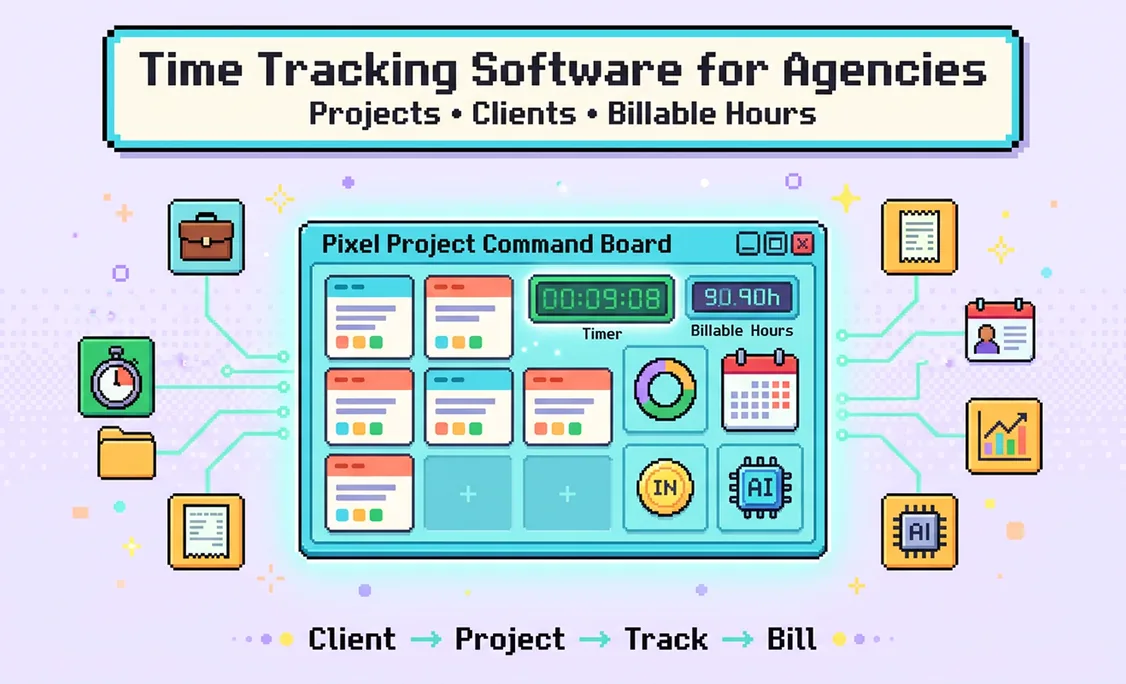
A client project at 74% of estimate in week three, with billable and internal hours split automatically and the overrun flagged before invoicing.
Tracking Creative Teams Without a Revolt
Creative staff object to surveillance, not to measurement, and the distinction is entirely in what you capture and who sees it first.
Agencies have the hardest introduction problem in this category, because creative people have usually met a badly implemented tracking tool before and remember it. Three things make the difference.
No keystroke logging, ever. Insight records activity intensity, never typed content. Say so explicitly when you introduce it, because it is the thing people assume you are doing.
Frame it as pricing, not policing. The honest reason an agency tracks time is to price work properly and stop absorbing overruns. That reason survives scrutiny. "Making sure everyone is working" does not, and creative teams detect the substitution immediately.
Give people their own data first. A designer who can see that their day is fragmented across eleven context switches has an argument for protected focus time. That makes the tool theirs rather than management's.
What Insight by Hyring Does Not Do
No invoicing, no resource scheduling, no payroll.
- Invoicing. Insight records and attributes time accurately, then feeds your billing system. If you want invoices generated in the same product, a practice management platform fits better.
- Resource scheduling. No booking of people onto future projects. That is a separate category and we do not pretend otherwise.
- Payroll. Not run here. The free lightweight HRIS covers employee records and leave.
Adithyan RK is the Co-Founder and CEO of Hyring, an AI-native recruitment platform that has run over 900,000 AI interviews for companies ranging from early-stage startups to the Fortune 500. He has spent 18 years building technology businesses, starting with a digital consultancy in 2008 and a staff augmentation firm in 2017, before founding Hyring in 2022 to rebuild hiring around evidence instead of guesswork.
Expertise

Surya N is the Co-Founder and CTO of Hyring, where he architected the AI interviewing engine that has now conducted over 900,000 interviews for companies ranging from early-stage startups to the Fortune 500. A mechanical engineer who moved into artificial intelligence, he spent 6 years building AI applications inside a technology consultancy before co-founding Hyring, and wrote the first version of its AI interviewer from scratch: a system that listens, adapts its questioning in real time, and flags fraud rather than following a fixed script.
Expertise
FAQs
One that captures time without relying on people to remember it. Agencies bill time, so unlogged hours are unbilled revenue, and the accuracy gap between passive capture and end-of-week recollection lands directly on the margin.