Insight by Hyring · Law Firms
Time Tracking Software for Law Firms
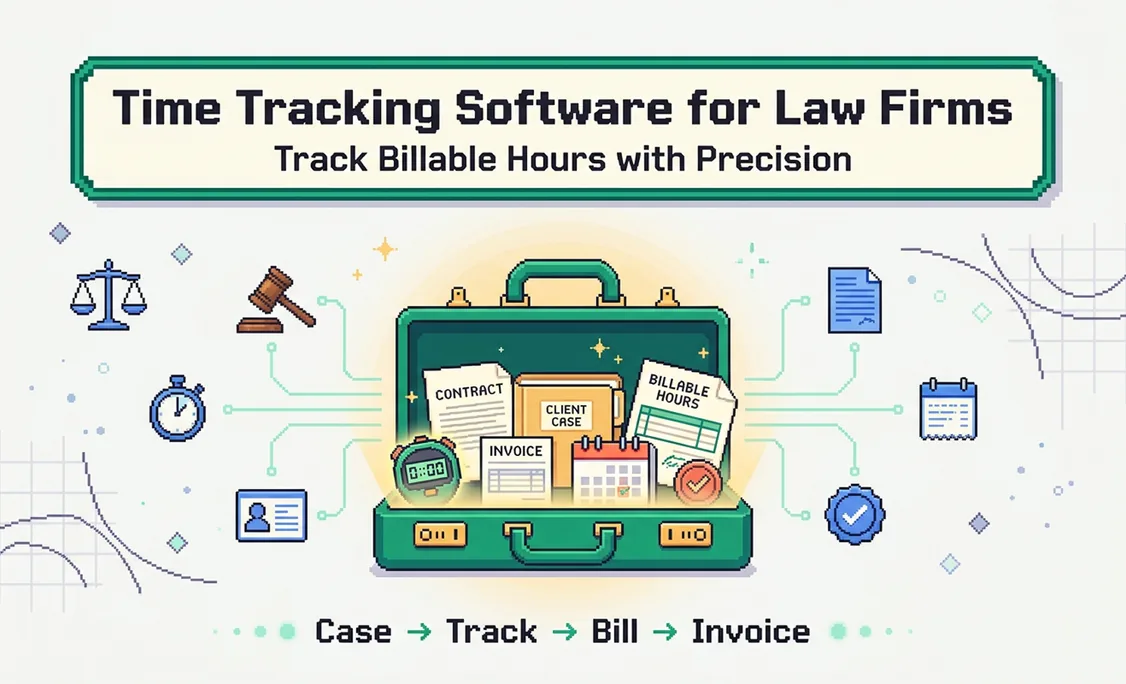
Legal time is billed in tenths of an hour and recorded from memory at six in the evening. Those two facts are incompatible. Insight captures work as it happens and attributes it to matters, then feeds your billing system.


~$105K
Modelled annual loss per attorney
7.0 vs 5.4
Assumed against recorded billable day
0
Keystrokes captured, ever
Per matter
Attribution while work runs
Direct answer
Time tracking software for law firms has to solve a specific problem: legal time is billed in tenths of an hour but recorded from memory at the end of a long day.
Insight by Hyring captures work contemporaneously and attributes it to matters, then feeds your billing or practice management system. No keystroke content is ever captured, so privileged communications are never recorded as text. Pro is $7 per user per month.
| Rounding loss modelled | ~$105,000 a year per attorney |
|---|---|
| Assumption | 2 minutes lost per entry, 12 entries daily, $350 rate |
| Assumed billable day | 7.0 hours |
| Recorded billable day | ~5.4 hours |
| Keystroke logging | Never, permanent design decision |
| Price | $7 per user per month, Pro |
Insight by Hyring is time tracking software for law firms. It records work passively as it happens, attributes time to matters and clients, and separates billable from non-billable automatically, then hands accurate data to whatever billing or practice management system you already run.
Legal is the profession where time capture matters most and is done worst. Billing runs in six-minute increments, which is a level of precision that assumes contemporaneous recording. What actually happens is that an attorney reaches the end of a fourteen-hour day, opens a timesheet, and reconstructs it from a calendar, a sent-items folder, and memory. The result is always directionally wrong in the same way, because nobody invents a call they did not take, and almost everybody forgets one they did.
What Rounding Costs a Firm
Two minutes lost per entry, twelve entries a day, at $350 an hour is roughly $105,000 a year per attorney.
| Rounded down at 3 min per entry, 12 entries a day | $157,500 |
|---|---|
| Rounded down at 2 min per entry | $105,000 |
| Rounded down at 1 min per entry | $52,500 |
| Captured as work happens | $0 |
Legal billing is measured in tenths of an hour, which means small rounding produces large annual numbers. Reconstructing a day at 6pm rounds down almost universally, because nobody inflates a timesheet from memory but almost everybody forgets a call.
The arithmetic is unforgiving because the billing unit is small. A firm that would never tolerate a 5% discount on its rate card routinely absorbs a larger figure through capture drift, and it does so silently, because there is no line item for revenue that was never recorded in the first place.
Contemporaneous capture removes the mechanism rather than exhorting people to be more diligent. A three-minute call is recorded as a three-minute call because the software saw it happen, not because someone remembered it at 6pm.
The Non-Billable Day
Most firms assume a seven-hour billable day and record closer to five and a half.
Where a billable day actually goes
| Assumed by the firm | Actually recorded | |
|---|---|---|
| Admin | 13% | 32% |
| Billable | 87% | 67% |
Recorded distribution against a 7-hour billable target
The gap is not idleness. It is intake calls, conflict checks, file management, supervision, and business development, none of which appear on a matter and all of which consume the day.
Firms frequently find this more useful than the billable numbers. The missing hour and a half is not idleness, it is intake calls, conflict checks, file administration, supervising juniors, and business development. None of it attaches to a matter and all of it consumes the day.
Knowing the real split changes three decisions: what a realistic billable target actually is, whether the firm needs another attorney or another paralegal, and which practice areas are quietly subsidising others through unbilled administrative load.
A day assembling itself against three matters, with a two-minute call captured automatically that an evening timesheet would have missed.
Capture Without Capturing Privilege
Insight records activity intensity and application context, never typed content.
No keystroke logging, ever. This is a permanent product decision rather than a configurable setting. Privileged communications, client correspondence, and draft advice are never captured as text, because a tool that recorded them would be unusable in legal practice regardless of how it was secured.
Screenshots are available and configurable, including frequency, blurring, and disabling entirely per team. Many firms run Insight with screenshots off and rely on time, activity, and application context alone, which is sufficient for accurate matter attribution and avoids the question of what a screenshot of a client document represents.
How It Works in Practice
Contemporaneous capture, matter attribution, and a companion layer built for people who work long hours.
A companion for long days
The avatar reads the day and speaks to the attorney first, offering a focused sprint rather than surfacing a dip to a partner.
Wellbeing signals that matter here
Consistent late finishes, fragmented days, and leave that quietly stops being taken. Associate attrition is preceded by months of visible signal.
Focus rooms for deep work
Shared ambient and instrumental channels with notifications muted, for drafting sessions that need genuine uninterrupted hours.
Reminders without another app
"Remind me to file by 4 PM." Held and raised by the companion, alongside water, stretch, and wind-down prompts.
Recognition inside the firm
Kudos from colleagues recorded next to the work, which in an hours-driven culture is worth more than it sounds.
Ask rather than run a report
Which matters absorbed unbilled time this quarter, answered directly.
The wellbeing layer is not a soft extra in legal practice. Associate attrition is the most expensive problem most firms have, and it is preceded by months of visible signals: consistently late finishes, fragmented days, and leave that stops being taken. Insight by Hyring surfaces those patterns to the person first and to the firm as aggregates, which is early enough to act.
Insight by Hyring runs inside a hiring platform, so capacity data informs whether the firm needs another associate or another paralegal, which is usually the more useful answer and rarely the one instinct gives.
What Insight by Hyring Does Not Do
No legal billing, no trust accounting, no conflict checking, no document management.
- Legal billing and invoicing. Insight produces accurate time data. Generating bills, applying rate tables, and handling client billing arrangements belongs to your practice management system.
- Trust and IOLTA accounting. Not in scope, and not something a time tracking product should attempt.
- Conflict checking and matter intake. Separate category entirely.
- Document management. We record that a document was worked on, not the document.
If you want one system covering matters, billing, trust, and documents, a legal practice management platform is the correct purchase, and Insight sits alongside it improving the accuracy of what flows in.
Adithyan RK is the Co-Founder and CEO of Hyring, an AI-native recruitment platform that has run over 900,000 AI interviews for companies ranging from early-stage startups to the Fortune 500. He has spent 18 years building technology businesses, starting with a digital consultancy in 2008 and a staff augmentation firm in 2017, before founding Hyring in 2022 to rebuild hiring around evidence instead of guesswork.
Expertise

Surya N is the Co-Founder and CTO of Hyring, where he architected the AI interviewing engine that has now conducted over 900,000 interviews for companies ranging from early-stage startups to the Fortune 500. A mechanical engineer who moved into artificial intelligence, he spent 6 years building AI applications inside a technology consultancy before co-founding Hyring, and wrote the first version of its AI interviewer from scratch: a system that listens, adapts its questioning in real time, and flags fraud rather than following a fixed script.
Expertise
FAQs
One that captures work as it happens rather than requiring reconstruction at the end of the day. Legal billing is measured in tenths of an hour, so the accuracy gap between passive capture and evening recall translates directly into written-off revenue.