Comparison · Zoho People Pricing
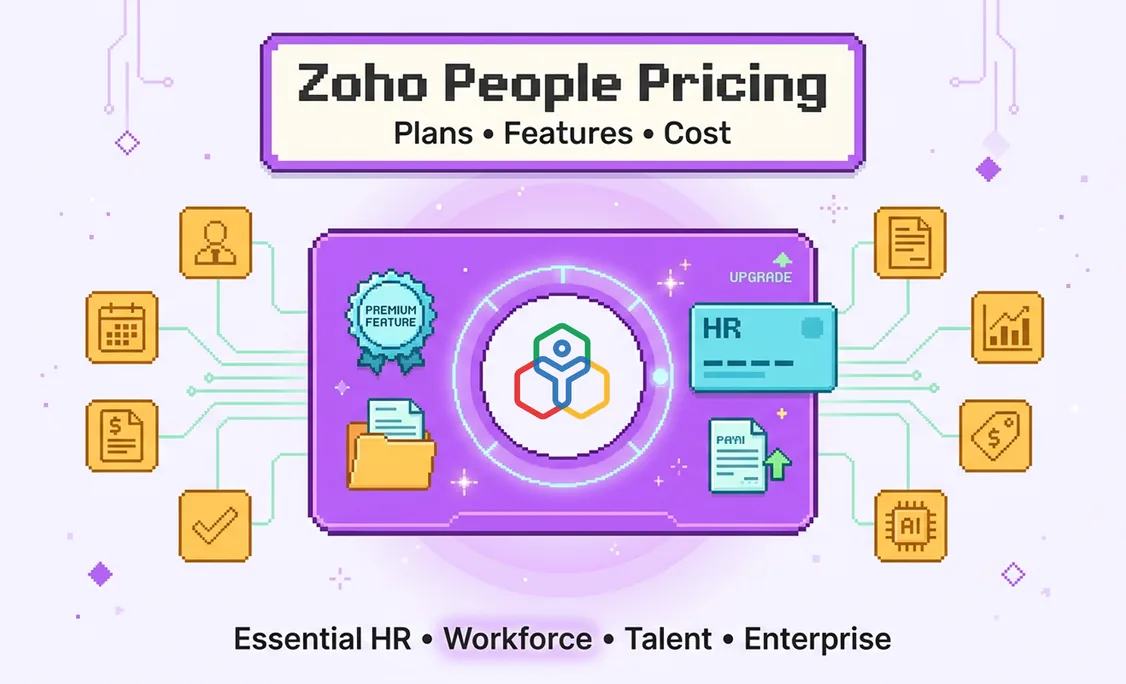
Zoho People Pricing
What Zoho People costs, what sits in each tier, and the more useful question underneath it: whether an HR suite is the right instrument for the problem you are actually trying to solve.


Suite
Full HR lifecycle, tiered
Entry
Records, leave, core HR
Mid
Timesheets and attendance
Upper
Appraisals and analytics
Direct answer
Zoho People is a human resources suite priced per employee per month, covering core HR, leave, attendance, timesheets, and performance across tiered plans.
Attendance is one module among many, which is the product's strength for HR administration and its structural limit for understanding how work actually happens. Insight by Hyring covers that narrow slice at far greater depth for $7 per user per month.
| Zoho People strength | Full HR lifecycle in one vendor |
|---|---|
| Zoho People limit | Records presence, not how work happened |
| Insight by Hyring strength | Activity context, focus patterns, AI answers |
| Insight by Hyring limit | No payroll, appraisals, or case management |
| Common structure | Run both, each doing its own job |
| Insight by Hyring price | $7 per user per month, Pro |
Zoho People is a human resources suite priced per employee per month across several tiers. The entry plans cover core HR and leave, with timesheets, shift scheduling, performance management, and advanced analytics arriving in higher tiers. Rates vary by region and billing period, so confirm current figures on Zoho's own site before budgeting.
We build Insight, which overlaps with one part of what Zoho People does, so read this with that in mind. The comparison is less about price than about scope, because these two products answer genuinely different questions and the cheaper one is not automatically the wrong one.
How the Pricing Is Structured
Per employee per month, tiered by module access rather than by usage.
The model is straightforward and the tiers gate features rather than volume. Entry plans handle employee records, documents, and leave. Middle tiers add timesheets, shift scheduling, and attendance depth. Upper tiers add performance appraisals, advanced analytics, and case management.
The step most companies encounter is the one that unlocks timesheets and attendance rules, because that is usually the reason they went looking in the first place. Worth pricing the tier you will actually need rather than the entry tier, since the gap between them is where most budgeting surprises occur.
What Zoho People Is Built to Be
An HR suite covering the employee lifecycle, with attendance as one module among several.
What Zoho People is actually built to be
Core HR
Records, onboarding, documents, org structure
Time and attendance
Shifts, attendance, timesheets, leave
Performance
Appraisals, goals, reviews, 360 feedback
Cases and workflow
Employee requests, approvals, automation
Attendance is one module among many. That breadth is the product's strength for a company standardising HR, and its weakness for a company that only needed to understand how work happens.
That breadth is the product's genuine strength. A company standardising HR administration gets records, onboarding, leave, appraisals, and workflow in one system with one vendor relationship and one price. For that job it is a sensible purchase and the alternative, four separate tools, is usually worse.
Depth on Work Tracking
Strong on attendance as administration, thin on how work actually happened.
Depth on the work-tracking question specifically
Capability against what a distributed team typically needs
- Attendance and shift records
- Leave and time-off workflow
- Timesheets against projects
- Activity and application context
- Focus patterns and overload signals
- AI answers on how work happened
The top three are strong and are the reason companies buy it. The bottom three are where an HR suite is structurally thin, because they are not HR administration problems, they are work-observation problems.
The distinction matters more than it sounds. An HR suite records that someone was present for eight hours and logged six against a project. It does not tell you that those six hours were fragmented across nineteen context switches, that the person has been finishing after nine every night for a month, or that one team is carrying twice the load of another.
That is not a criticism of the product. It is a description of what HR suites are for. Attendance in an HR system exists to feed payroll, leave balances, and compliance records. Observing work is a different discipline with different data requirements, and no amount of tier upgrading turns one into the other.
The Question Under the Pricing Question
Whether your problem is HR administration or work visibility. They rarely have the same answer.
Matching the problem to the product
| Your actual problem | Right instrument |
|---|---|
| We need one system for records, leave, and appraisals | HR suite. Zoho People is a reasonable choice |
| We need attendance to feed payroll and leave balances | HR suite |
| We need to know who is overloaded before they resign | Work tracking. An HR suite will not surface this |
| We need accurate hours for client billing | Work tracking, because manual timesheets round down |
| We need to understand a distributed team's day | Work tracking with activity context |
| We need appraisals and performance cycles | HR suite. Insight does not do this |
Where Insight by Hyring Wins
An HR suite administers people. Insight by Hyring understands work, and adds a layer no HR module has attempted.
Desktop companion
A floating avatar that reads the day and speaks to the employee before any manager sees it. Offers a sprint, checks in on suspicious perfection, celebrates a good run.
Shared focus music rooms
Teams listen in sync across curated channels, with room presence showing who is deep in work. No competitor in this category has built this.
Wellbeing reminders
Water, stretch, the 20-20-20 eye rule, end-of-day wind-down, and custom prompts, with notifications muted during focus sessions.
Kudos and team pulse
Recognition and presence in the same product as the work data, rather than a separate culture tool nobody opens.
An AI you can ask
Plain questions, plain answers. Who is closest to burnout, where did the sprint go, who is finishing after nine.
Employee-first visibility
Every person sees their own data before anyone else, and no keystroke content is ever captured. Permanent design, not a setting.
Insight by Hyring against the category
| Capability | Zoho People | Insight by Hyring |
|---|---|---|
| Desktop companion avatar | None | Nudges, checks and celebrates, privately |
| Shared focus music rooms | None | Listen in sync with your team |
| Wellbeing reminders | None | Water, stretch, 20-20-20, wind-down, custom |
| Kudos and recognition | Separate tool | Built in, beside the work data |
| AI answers on the work day | Reports and exports | Ask a question, get a sentence |
| Capture method | Manual timer | Passive, as work happens |
| Who sees data first | Manager | The employee, always |
| Keystroke logging | Common | Never, by permanent design |
| Wired into hiring decisions | No | Yes, through Hyring |
Zoho People wins on breadth, and that is a real win: appraisals, case management, onboarding workflow, and the full HR lifecycle in one vendor relationship. Insight by Hyring does none of that and does not intend to.
On the work itself, the comparison is not close. An HR suite records that someone was present. It has no companion nudging a person out of a 25-minute drift, no focus rooms a team listens to in sync, no water and stretch reminders, no kudos beside the work data, and no AI you can simply ask what happened last sprint. Those are not missing features in Zoho People, they are outside what an HR module is for.
Insight by Hyring is the only product here connected to a hiring platform, so work data flows into people decisions and into the next hire. No standalone tracker can close that loop.
The practical structure most companies land on: keep the HR suite for records, leave, and appraisals, and run Insight by Hyring for everything about how work actually happens. Thirty days free with all Pro features, unlimited users, no credit card, and Pro is $7 per user per month under the founding offer.
Pro is $7 per user per month and Enterprise is $14, under the founding offer for the first 7,000 companies. List prices are $14 and $21. Your rate is frozen for as long as the subscription stays active, not for the first year. Before that, 30 days free with every Pro feature, unlimited users, and no credit card.
Adithyan RK is the Co-Founder and CEO of Hyring, an AI-native recruitment platform that has run over 900,000 AI interviews for companies ranging from early-stage startups to the Fortune 500. He has spent 18 years building technology businesses, starting with a digital consultancy in 2008 and a staff augmentation firm in 2017, before founding Hyring in 2022 to rebuild hiring around evidence instead of guesswork.
Expertise

Surya N is the Co-Founder and CTO of Hyring, where he architected the AI interviewing engine that has now conducted over 900,000 interviews for companies ranging from early-stage startups to the Fortune 500. A mechanical engineer who moved into artificial intelligence, he spent 6 years building AI applications inside a technology consultancy before co-founding Hyring, and wrote the first version of its AI interviewer from scratch: a system that listens, adapts its questioning in real time, and flags fraud rather than following a fixed script.
Expertise
FAQs
Zoho People uses per-employee monthly pricing across several tiers, from an entry plan covering core HR through professional and enterprise plans adding performance management, advanced analytics, and case management. Pricing differs by region and billing period, so confirm current rates on Zoho's own site.
Useful next
8 mins Read
Attendance management software
7 mins Read
Keka alternatives
5 mins Read
Leave management software
9 mins Read
Employee monitoring software
Free HR Toolkit: 150+ calculators and templates
Learn hub: guides and explainers