
TL;DR
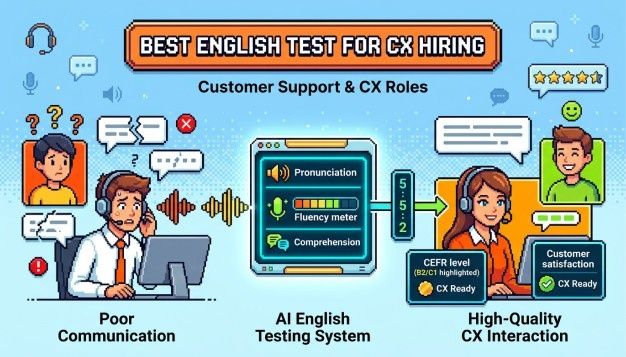
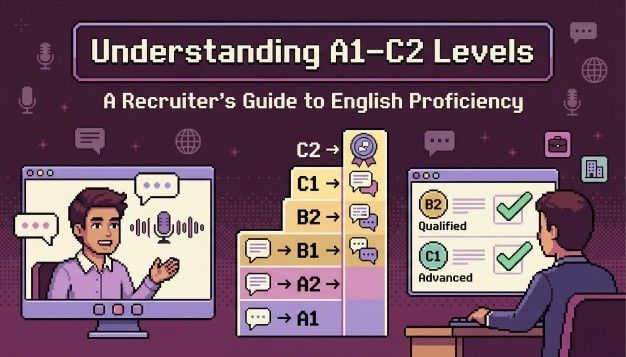
English proficiency levels tell you far more than whether a candidate 'speaks English.' They map directly to job readiness. A B1 candidate may struggle in a client-facing role that needs a C1. Understanding where each level sits and what it looks like at work separates a good hire from a costly one. Hyring's English Proficiency Test uses AI to score candidates against these benchmarks objectively and at scale.
Why English Proficiency Levels Matter More Than You Think
Two candidates can both write 'fluent English' on a resume and be worlds apart in ability. You usually don't find out until a client call goes badly or a project gets derailed.
The CEFR framework was built to fix that. It measures what someone can actually do with the language, not just what they've studied. That's the part that matters in a work setting. A candidate might have years of English classes behind them and still freeze on an unscripted client call. A proper assessment catches that early.
The scale of the challenge is real. The British Council estimates that around 1.75 billion people use English in some capacity worldwide. That's a huge talent pool. And 'speaks English' tells you very little about where someone actually sits in it.

The CEFR Framework: What Recruiters Should Know
The Common European Framework of Reference for Languages (CEFR) is the global standard for measuring language ability. Developed by the Council of Europe, it is used widely across education systems, immigration authorities, and increasingly, hiring platforms.
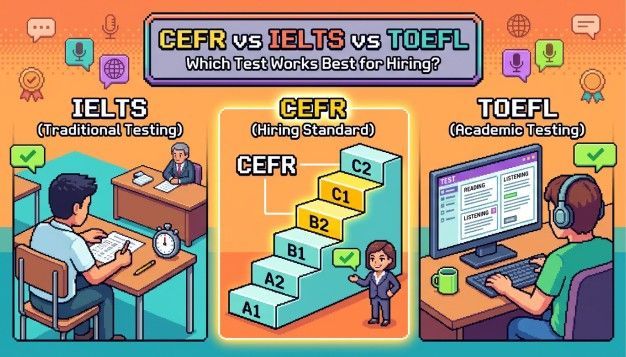
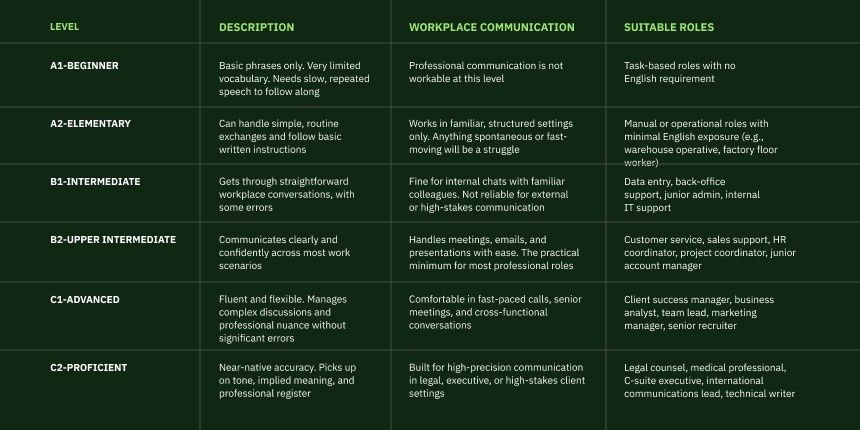
The scale runs from A1 to C2. Six levels, each defined not just by what a person knows about English, but by what they can do with it in practice.
That 'can-do' framing is what makes it useful for hiring. You're measuring functional communication capacity, which is exactly what determines job performance. Hyring's English Proficiency Test maps every candidate's score to a CEFR level, making results comparable, repeatable, and role-relevant.
Breaking Down A1 to C2: What Each Level Looks Like at Work
The Five Skills Behind Every Proficiency Score
A CEFR level is not a singular score. Hyring's test evaluates five dimensions to arrive at that score:
- Fluency: How smoothly a candidate speaks. Hesitation and unnatural pauses affect real-time communication even when vocabulary is strong.
- Vocabulary: Range and precision. True vocabulary strength is about contextual fit, not complexity for its own sake.
- Mother Tongue Influence: How a first language shapes English output. Heavy influence can affect comprehension on both sides of a conversation.
- Grammar: Correctness and structural consistency. Chronic errors in tense or agreement erode credibility in written and client-facing contexts.
- Pronunciation: Clarity and intelligibility across different listeners, not accent elimination.
Two candidates at the same CEFR level can have very different strength profiles. One might score high on grammar but low on fluency under pressure. Another might speak naturally but struggle with written precision. The sub-scores reveal what the overall level conceals.
Matching Proficiency Levels to Job Roles
There is no universal 'right' level. The right question is always whether the candidate's proficiency matches the communication demands of the specific role.
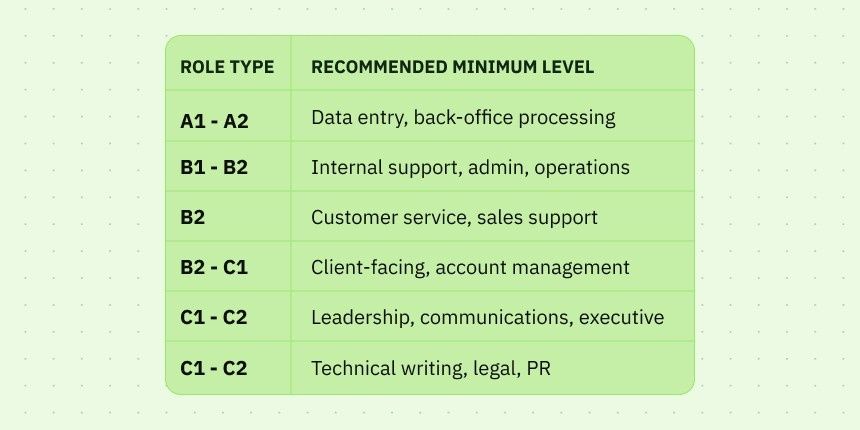
One common mistake: defaulting to C1 or C2 for every role. It narrows your talent pool unnecessarily and screens out qualified candidates who would perform well at the actual communication demands of the job.
How AI Is Changing Candidate English Assessment
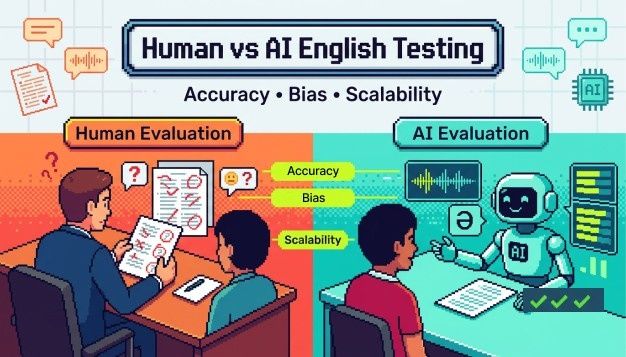
Recruiter instinct has real weaknesses: it's inconsistent, and it's prone to burnout. Two people listening to the same candidate can walk away with completely different reads. Accent familiarity, energy levels, time of day, all of it plays a role. That's not a people problem. It's what happens when assessment isn't structured.Tests like IELTS or TOEFL take weeks and aren't designed for hiring contexts.
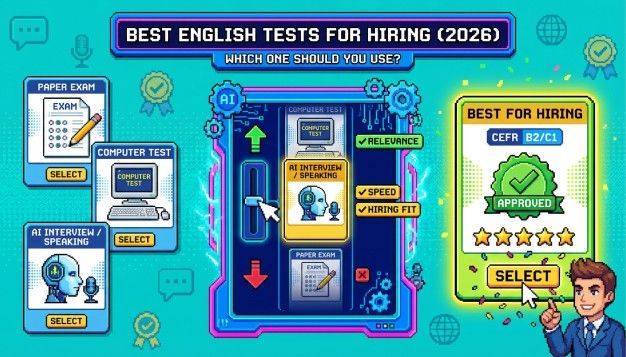
A CEFR-based hiring assessment measures every candidate against the same standard. Hyring's English Proficiency Test scores across five areas that directly affect how someone performs at work: fluency, vocabulary, grammar, pronunciation, and mother tongue influence. Each one has clear, scoreable markers. It's not a vibe check.
Consistency also matters for fairness. Research on accent bias in professional settings shows that the way someone sounds influences how competent people perceive them to be, even when that perception is wrong. A fixed framework reduces how much it affects the outcome.
At scale, this becomes even more important. Reviewing language ability manually across hundreds of applications is slow and inconsistent. Automated tools return structured, comparable scores before a recruiter has to spend a single minute on it.
Key Takeaways
Self-reported fluency is not a hiring signal. Without a standardized assessment, 'fluent in English' on a resume is functionally unverifiable.
The right proficiency level is always role-specific. B2 covers most professional environments. C1 and above are relevant when the role involves complex communication, leadership, or high-stakes written output.
Sub-scores matter. Two candidates at B2 can perform very differently depending on where their strengths and gaps sit across the five dimensions.
Don't over-index on C1 or C2. Requiring the highest levels for roles that don't demand them shrinks your pipeline without improving hire quality.
AI gives recruiters a consistent baseline at scale. What used to take multiple touchpoints can now be captured before the first human conversation.
Frequently Asked Questions
1. What is the CEFR and why do recruiters use it?
The CEFR is an internationally recognised standard for measuring language ability, running from A1 to C2. Recruiters use it because it provides a consistent benchmark that applies across candidates from different countries, educational backgrounds, and industries.
2. Which English proficiency level is sufficient for a professional role?
B2 is the practical baseline for most professional environments. Client-facing or leadership roles typically require C1. The right answer depends on what the job actually demands in terms of communication.
3. How does Hyring's English Proficiency Test work?
It assesses candidates across five dimensions using AI: fluency, vocabulary, mother tongue influence, grammar, and pronunciation. Each candidate receives a CEFR-mapped score and a sub-score breakdown. It runs within Hyring's platform and integrates with other screening tools.
4. Is AI-based proficiency testing reliable?
AI assessments are more consistent than human-led ones, which vary with interviewer fatigue and bias. As a screening tool used before human interviews, they provide a repeatable baseline that human-only screening rarely achieves at scale.