
TL;DR
AI, in my opinion, is more than just a ‘nice-to-have’ enhancement in recruitment; it's revolutionizing how English-language skills are assessed in job applicants. Standard English tests are tedious, non-specific, and lack real-world application and comprehension.
AI makes it all possible with its adaptive and real-time contextual assessment of language skills, as it happens in an actual working environment. And it does it exquisitely!
This affects areas of bias, objectivity, speed, and accessibility in talent scouting. With advancing AI technology in its respective models and assessment structures, intelligent English-language tests for talent recruitment tools, such as Hyring.com’s English Proficiency Test or EPT, have innumerable benefits over previous non-responsive tests.
The Problem With Traditional English Proficiency Testing
Long before AI entered the scene, employers used to use static tests or manual interviews to judge a candidate’s English language ability. Those methods are very familiar and sometimes effective, but they struggle with a few persistent blind spots.
A traditional exam might rely on fixed answer sets and paper or computer-based scoring that doesn’t reflect how language actually ebbs and flows. It tells you what the candidate knows, but not always how they use English under different situations - pressure, leisure, etc. - and consequently in meetings, email threads, or customer interactions.
These older tests can also be slow to process, costly, and inconsistent. Two human judges might score the same writing entirely differently. One of the tests might see polish while the other might detect the nuances.
That inconsistency has consequences. Hiring decisions, salary negotiations, and even immigration clearances may hinge on a single score that reflects narrow skills and not communicative competence.
How AI Changes the Game
Modern systems analyze language in context and are not just rigid checklists. They aren’t just faster but also think differently about how languages work and are used.
Rather than presenting the same questions to every candidate, an AI model can tailor the test itself based on how the person responds in real time. This is actually an adaptive language evaluation.
That means a candidate who breezes through basic questions will be challenged with more complex tasks as the evaluation progresses, and that better reflects real work scenarios. This is a leap toward dynamic assessment rather than just static grading.
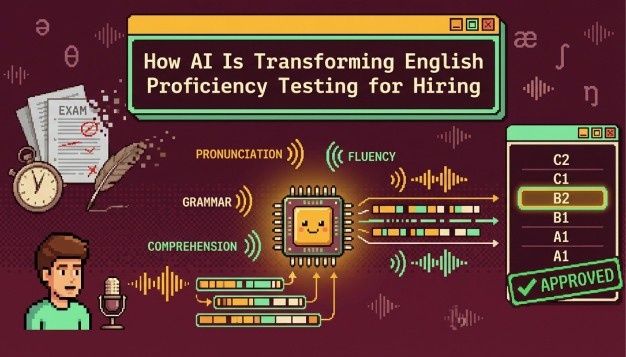
Another strength of AI is its ability to provide instant, objective scoring. Waiting days for a human evaluator to grade essays is certainly a thing of the past. AI scoring systems assess grammar, syntax, clarity, fluency, and even tonality.
This is done at scale, consistently and automatically. Automated speech recognition and natural language processing are now reliable enough that voice responses can be scored against standardized linguistic models.
Feedback Loops
AI systems also allow for feedback loops that are data-driven, and this is a very significant aspect if the AI system is to learn. In a normal report, one might read “Level B2.” In an AI system, there might be areas that are identified positively or negatively according to dimensions such as vocabulary range, coherence, or appropriateness of context, and this could be a tremendous asset to the candidate sitting for an exam or to a recruitment team.
Everything above has direct implications for an English proficiency exam for recruitment because what's usually needed in recruitment is something more than just a number or grade, both in understanding what it is to be English proficient and in determining an appropriate definition of English proficiency for an English proficiency exam for recruitment purposes.
What AI-Driven English Proficiency Testing Looks Like in 2026
Imagine if a candidate logs in and, instead of filling out the same form or ticking the same boxes everyone else has, the EPT tool begins with broad language prompts and adjusts itself as their responses come. The answers are a prelude to the next question that the AI Agent asks, not randomly, but strategically and with a certain conversational logic and thinking behind it.
This is more than adaptive testing. It’s contextual testing. For example, if a role requires client communication, the AI might simulate an email chain or a mock support call.
Even if it is something personal that the candidate chooses to reveal, it would realign itself to that context and continue from there. Let’s take, for example, a content writing position; the test could involve drafting short professional pieces. Each task is scored through AI models trained on real-life language usage patterns.
This is not just a theory that I am proposing - but research shows AI tools designed for language assessment can improve spoken proficiency and engagement metrics in learners. That holds promise, in my opinion, when repurposed for hiring contexts too.
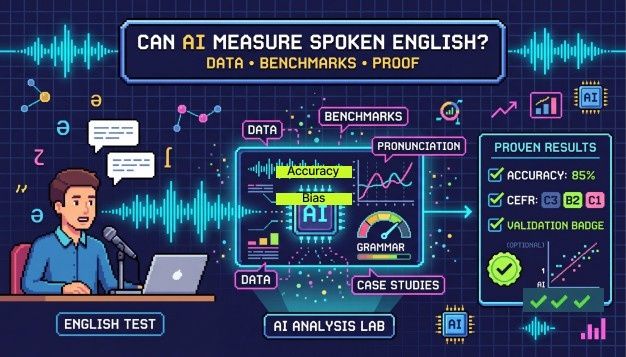
Another trend you’ll see in these AI systems is multimodal assessment. Spoken language, written responses, pronunciation accuracy, and even discourse coherence are all graded together. This isn’t just an English Grammar Test Pro. It’s a composite profile of communicative ability in the true sense.
Also Read: Why CEFR-Based English Testing Is Becoming the Global Hiring Standard
Benefits for Employers and Candidates
AI-enhanced English proficiency tests for hiring platforms, it was clearly observed, are helping organizations unlock a few key advantages that matter in more competitive markets.
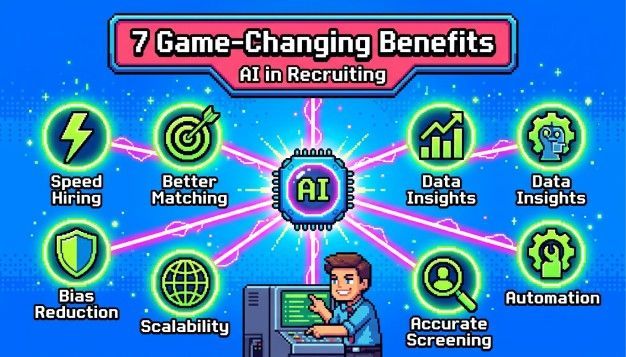
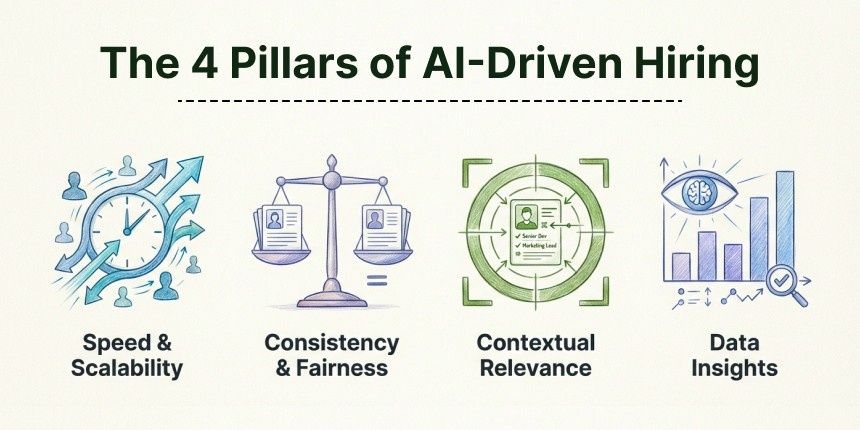
Speed and scalability: Recruiters can assess thousands of applicants with the same baseline standards and receive real-time scoring without bottlenecks from the human markers. These, I’ve seen, automatically end up fast-forwarding screening cycles.
Consistency and fairness: It is seen (through findings in various research papers) that there is a lot of bias introduced by humans in the loop. The variance introduced by mood, perception, or experience is perceptibly reduced. AI scoring models apply the same criteria across all candidates.
Contextual relevance: I've noticed that traditional tasks don’t always map to job requirements, and AI lifts that constraint by generating scenario-based tasks that reflect actual workplace communications, such as email responses, spoken interactions, and documentation tasks.
Data insights: With instant analytics, HR teams see not only scores but also patterns/trends. They see where candidates struggle with - like usage of filler words or Mother Tongue Influence (MTI) or stammers or repetitiveness - which feeds into better hiring decisions.
Studies by Duta Bangsa University on AI in language assessment research widely note that these tools can deliver real-time evaluation and generate patterns of performance that are otherwise hard to perceive at scale. I would say that this is a crucial feature in streamlining entire HR workflows.
Also, in general, I feel that the candidate experience improves, too. This means no more waiting on test results or static questions that don’t feel alive. The engagement becomes interactive, tailored, and immediate; these are traits that modern job seekers appreciate a lot.
Tangible Challenges and Ethical Boundaries
AI is simply software built on training data- loads of it. Lack of transparency or inherent bias in the data will prove to be a costly issue to tackle as AI isn't a magic wand that wishes them away!
If a model has been trained disproportionately on certain accents or dialects, it might put down speakers from underrepresented backgrounds. Without careful calibration, AI can continue to imbibe old biases in its evaluation rather than correct them.
Data privacy, I've noticed often, also remains a credible concern. Language samples are sensitive and recruiters and vendors alike must ensure compliance with privacy laws like GDPR. Also, test takers deserve meaningful transparency about how their responses are stored, used, or shared.
Lastly, there’s the perennial question of interpretability. Even if an AI system scores a candidate high, hiring teams need understandable rationale on what are the specific proficiencies that are driving the score and not just a number at the end of the day.
Research confirms these limitations and urges cautious, evidence-based implementation. English proficiency tests for hiring must therefore balance efficiency with fairness and clarity.
The Future of Hiring With AI-Enhanced Language Assessment
When you consider the future, I don’t think we can just compartmentalize EPTs to being about fast scoring alone. I feel that AI is moving towards continuous and contextual evaluations as well. Rather than a single test, evaluations could be longitudinal, integrated into job simulations that last for days or weeks.
If you would, picture an assessment solution that tracks the uses of language in onboarding exercises and tests for betterment or proficiency against actual work performance. AI can analyze email drafting, the use of team chats, and/or presentation rehearsals, but does so with the candidate's express permission and in a way that respects their right to privacy.
The role of generative AI is also expected in this domain. Rather than pre-defined question banks, solutions could include generated client conversations or challenges with situational angles that would require actual communicative agility.
If you’d ask me, I would say first and foremost, it is about validation, which is ensuring that it tests what it is intended to measure – actual knowledge of language in actual work situations.
Summary
AI has enabled English proficiency testing for recruitment from being static, slow, and shallow to dynamic, efficient, and contextual.
It’s not a superficial shift. We’re talking about adaptive testing, multimodal assessments, real-time scoring, and scenario-based assessments with a focus on the modern work environment in mind. By using a service such as those on Hyring.com’s AI-powered English proficiency assessments, you can use a set of assessments that are
- faster and more scalable,
- more consistent from candidate to candidate,
- data-rich with actionable insights, and
- more closely attuned to communication tasks as they are observed.
These developments enable companies to hire not only faster but also smarter, as they did for many working with Hyring’s English Proficiency Test.
FAQs
1. What is an English proficiency test for hiring?
It is an evaluation specifically tailored to test the candidate’s aptness in utilizing English at work. With AI, such tests now adapt dynamically in terms of content and scoring.
2. In what way can AI assist with English language proficiency evaluation?
AI technology can be used to automate the process of grading, adapt questions to the ability of the candidate, and analyze the language nuances that may not be caught in a more traditional.
3. Are AI-based tests reliable?
Functions designed and trained on representative data can provide objective and unbiased views, but problems like data bias have to be addressed.
4. Can chatbots evaluate English speeches effectively?
Yes. Contemporary AI systems incorporate speech recognition and natural language processing capabilities that evaluate pronunciation, fluency, and speech coherence.
5. Do employers believe in the English scores produced by AI tools?
Trust is on the increase, particularly if assessment is open, job-related, and grounded in some evidence or normative standards.
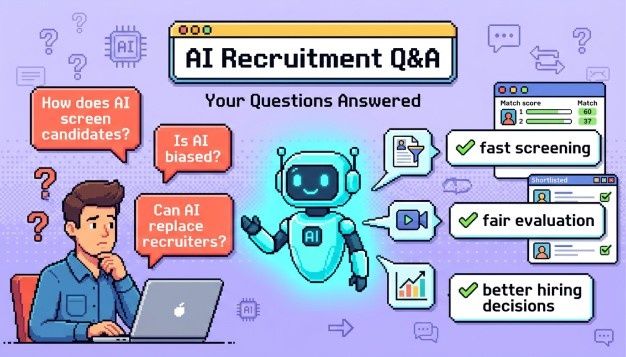
6. Is AI Replacing Human Evaluators?
Not entirely. While AI systems can augment human judgment by providing proper scores that human beings can act upon, they cannot replace humans in the loop.
7. What benefits do candidates receive with AI?
Candidates receive faster results, customized evaluations, and interactive activities modeled on real usage rather than general questions.
8. What are some dangers that organizations can fall into when testing AI?
You should avoid biased or unintelligible models and satisfy the privacy conditions. Explanation of results and comparison to human judgment are important in the explanation.