
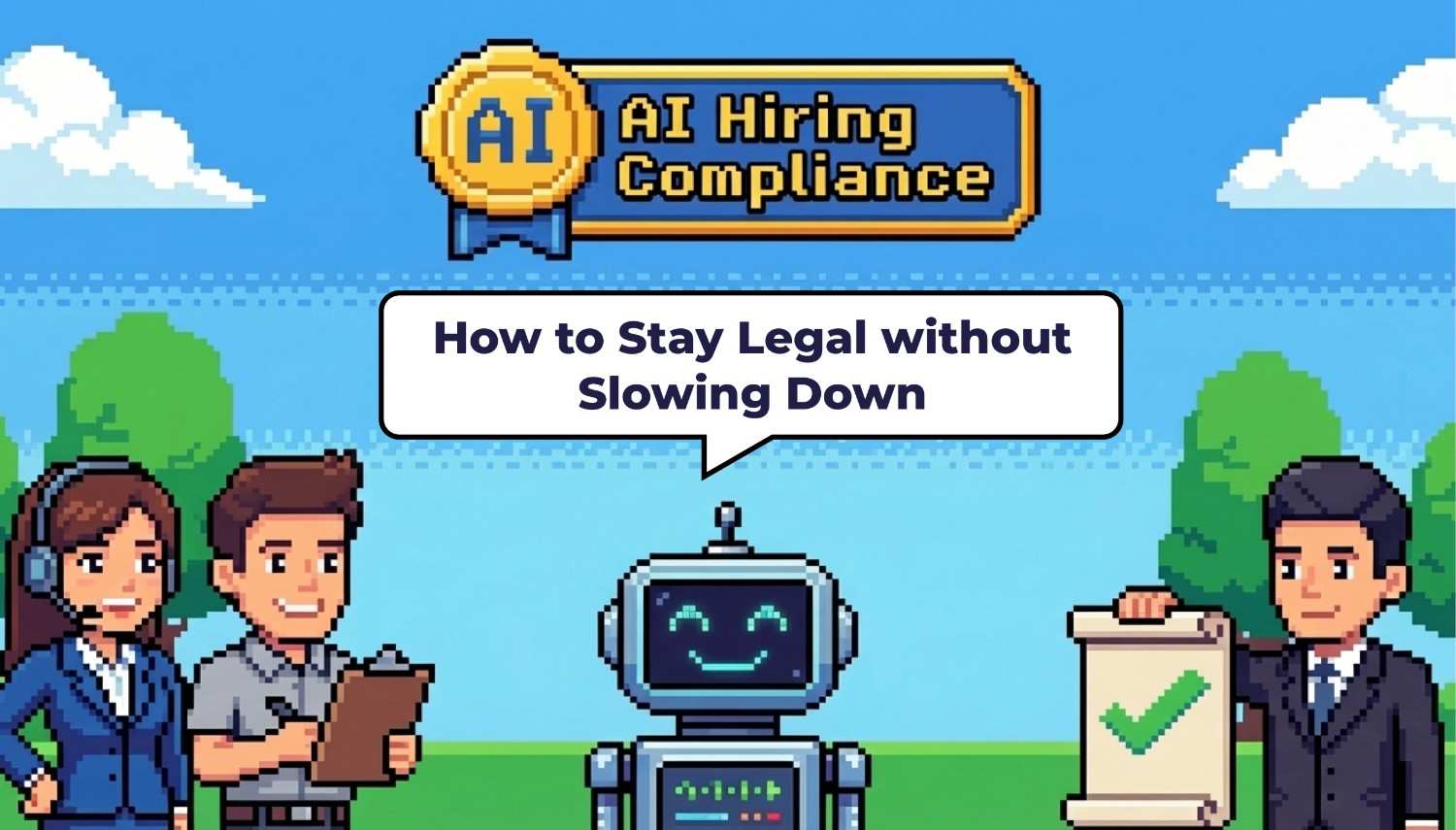
Quick Look
With the rapid advancement of AI hiring globally, compliance becomes crucial and requires a hawk-like vigilance. Adhering to Western anti-discrimination laws (like the Equal Employment Opportunity Commission EEOC Title VII) and major regional data privacy legislation, such as the General Data Protection Regulation (GDPR for the European Union (EU)) and the newly implemented India’s Digital Personal Data Protection Act (DPDP Act), becomes a dual requirement that many companies are now adapting to implement. Speed is maintained by focusing on documented consent from candidates, implementing anti-bias algorithms, and ensuring strict human oversight. Leveraging AI interviewing software allows organizations to accelerate hiring while building legally defensible and ethical techno-legal frameworks across regional jurisdictions.
The Great Race of Speed vs. Scrutiny
Over the recent years, AI hiring has turned the industry on its head. We are now experiencing a paradigm shift of sorts. This rapid adaptation has put immense pressure on organizations to compulsorily reconcile efficiency with ethics and legality.
Companies operating across geographical borders, or even entire continents, are navigating around complex, continuously evolving regulations. In general, compliance has become a live wire that one must be careful not to tread on.
The EEOC in the United States focuses on avoiding ‘disparate impact discrimination’, while in Europe, the GDPR, along with the upcoming EU AI Act, calls for strict implementation of legislation. No exceptions.
For companies in or dealing with India, the recently enacted (2025) Digital Personal Data Protection Act (DPDP Act), 2023, is the non-negotiable compliance foundation. It imposes strict rules for data handling and heavy penalties of around Rs. 250 crore for non-adherence.
While hastening talent pipelines by using AI hiring, it is understood that only by embedding legal checks into the technology itself can a company move forward.
As they say, with great (AI) power comes great(er) responsibility.
Core Legal Risks of AI in Recruiting
There are two major risks that are global: discrimination and data protection.
- Discrimination (Bias): When algorithms are trained on historical data, they risk perpetuating past biases. This may include (but is not limited to) gender, age, caste, or even sexuality, which will potentially violate the Indian Constitution’s Right to Equality or Title VII of the US EEOC.
- Data Security: The DPDP Act in India defines severe penalties (up to ₹250 crore for certain violations) for failure to secure data or obtain proper explicit consent from candidates before the interview begins. From resumes to video interview transcripts - AI tools process sensitive data and hence strict adherence to the principles of the Act, particularly those relating to purpose limitation and data minimization, is mandatory for all ‘Data Fiduciaries’, to quote the Act.
Mitigating Algorithmic Bias Without Halting Progress
The industry sees AI as a solution to human prejudice, while regulators and lawmakers are proceeding cautiously, as we are in uncharted waters now. A survey of Indian recruiters found that a remarkable 96.5 per cent believe that using AI hiring is one of the best ways to improve the recruiting funnel and reduce human errors in the process. This potential is only realized through rigorous testing and not just guesswork and random intuition.
Organizations must adopt a proactive strategy. They must conduct fairness audits that analyze outputs of the system across demographic proxies - the rigorous testing protocol.
The incorporation of built-in audit trails and bias reporting, such as Hyring's analysis features, allows businesses to defend their decisions (such as the induction of AI hiring) with objective data, creating a robust techno-legal framework that heralds the future while being transparent and fair in that process.
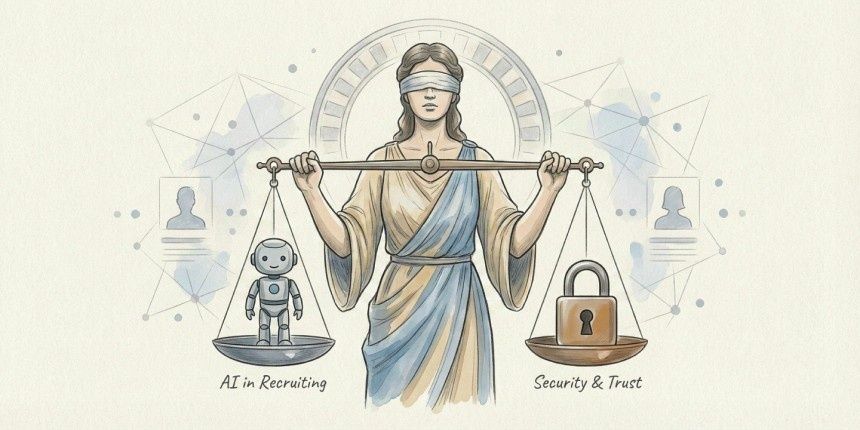
Transparency and Consent: A Transcontinental Mandate
The quickest way to ensure critical compliance when companies imbibe AI hiring across continents is by the tight management of transparency and consent. The DPDP Act defines that consent must be “free, specific, informed, unconditional, and unambiguous with a clear affirmative action."
Long story short, it means that pre-ticked boxes or vague privacy policies are glaringly insufficient. Employers must:
- Provide Ample Notice: Candidates must be informed when AI hiring is used and exactly how their data will be processed and for what purpose. This must be specified clearly.
- Obtain Explicit Consent: A clear, documented opt-in must be secured from the candidate before the interview begins and their data is processed.
Human oversight is key. AI should assist, not replace, the final human recruiter or decision maker. This gives candidates a clear avenue to contest or understand the evaluation metrics. Candidates who feel secure are more likely to give better interviews and perform better overall.
Three Actionable Steps for Seamless AI Hiring Compliance
- Prioritize DPDP Act Compliance: Since the Act has just come into force it is essential that your company is on board and an Immediate review is required. Update your consent forms and data retention policies to align with the Act’s mandates, especially regarding the explicit notice requirement.
- Conduct Data Protection Impact Assessments (DPIAs): A DPIA can be called for to identify and proactively mitigate potential privacy risks. For high-risk uses of AI hiring, this proves due diligence to regulators.
- Use Compliance-Focused Technology: Companies must invariably implement AI Interviewing software that provides Explainable AI (XAI) and automates the consent and notification process.
Compliance of AI hiring with the latest laws is a continuous pursuit. Call it an ongoing responsibility, not a one-time fix. By prioritizing ethical tech and maintaining proper documentation, you can confidently accelerate your hiring without risking any legal exposure. Hyring is continuously striving to upgrade its compliance and recommends that other companies independently implement the same.
To help you with incorporating AI hiring, you can reach out to us.
FAQs
1. What are the primary federal laws governing AI hiring in the US and India?
They are the Title VII of the Civil Rights Act and the Americans with Disabilities Act (ADA), both enforced by the EEOC. Based on certain protected characteristics, which apply equally to AI hiring, they strictly prohibit discrimination. In India it is the Digital Personal Data Protection Act (DPDP Act) that enforces similar legislation.
2. What is "disparate impact” in the context of AI bias?
If an AI tool, while claiming to be neutral, disproportionately excludes or disadvantages certain individuals from a protected class (like gender or race), that's when a disparate impact occurs. The tool need not be consistent with a business necessity or be job-related.
3. Does the GDPR apply to US companies using AI hiring?
If a US-based concern possesses or processes the personal data of candidates who are located in the European Union, the GDPR automatically applies. It requires strict rules for data handling, explicit consent, and giving candidates the option of the ‘right to be forgotten’.
4. What is the "right to explanation" for candidates assessed by AI?
Regulations like the EU’s GDPR may empower candidates to exercise their right to receive a meaningful explanation for decisions that significantly affect them that are based solely on the automated processing done by AI hiring. This makes transparency invaluable.
5. How often should I audit my AI hiring tools for bias?
It would be best if the audits are completed diligently, as soon as possible, following new local, state and federal regulations. Best practice is to do it annually and ideally before and after any major changes incorporated into the AI tool’s training data or model.
6. Can AI hiring use social media data?
Social media scraping is a risky affair. If AI infers protected classes from this data and those influence hiring decisions, it can lead to claims of discrimination and legal consequences will ensue if found to be true.