

TL;DR
CEFR-based English proficiency testing frameworks are no longer the cream of the crop amongst tools for language determination. They form the skeleton of modern hiring processes worldwide today because they align language ability with job requirements specifically. CEFR-aligned assessments are increasingly being preferred by employers, as they improve fairness, predict on-the-job success, and integrate with AI hiring platforms like Hyring’s own AI English proficiency test. Research shows that standardized frameworks work better than ad-hoc evaluations. This is the reason that adoption is growing outside Europe into Asia, Africa, and the Americas. We dig further into what this means for hiring teams and job seekers alike in this blog.
What “CEFR” Is
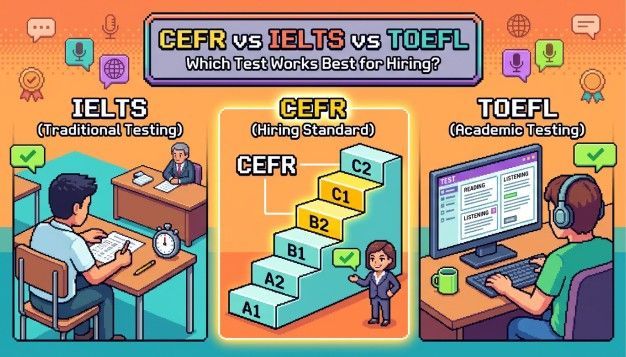
CEFR stands for the Common European Framework of Reference for Languages. It contains a six-level scale (A1–C2) developed to describe how well someone can use a language, in this case, it is English.
It was originally designed by the Council of Europe to harmonize language teaching across nations. CEFR now functions as a benchmark for both education and assessment.
The framework defines what learners can do at each level, from basic comprehension to fluent professional communication. This matters in hiring because it replaces vague phrases like “good English skills” on resumes with clearly articulated descriptors linked to real-time language performance.
A Changing Hiring Landscape
Twenty years ago, a recruiter might go by where someone studied or have a gut feeling about a candidate’s English. International roles today demand repeatable and rigorous assessments because communication errors carry real costs. Whether it is about misunderstandings in contracts, unclear instructions leading to rework, or frustrated clients, each one of them is a ticking time bomb with respect to how the company handles itself later.
CEFR-based English proficiency test frameworks help organizations cut through ambiguity and cut out aiming in the dark for hiring proficient candidates. It is not about the test-taking skill but about real language ability, measurable and comparable across candidates by their performance markers that these tests are designed to pick up on.
Language Measurement & Standardization
Ask any hiring manager why they care about English proficiency, and you’ll hear variations on the same theme, which is consistent performance in communication tasks. A CEFR-based English proficiency test aligns a candidate’s abilities along a globally recognized scale. They are designed to give
- Clarity for hiring teams: Everyone interprets a CEFR level in the same standardized manner.
- Fair comparisons: CEFR controls for bias better than subjective interview impressions that may be muddled with bias.
- Evidence-based results: Recruiters can justify choices with objective scores rather than intuition alone, and hence make it more accurate.
It is a dramatic shift from older approaches where “English required” meant different things to different interviewers.
CEFR Levels and What They Tell
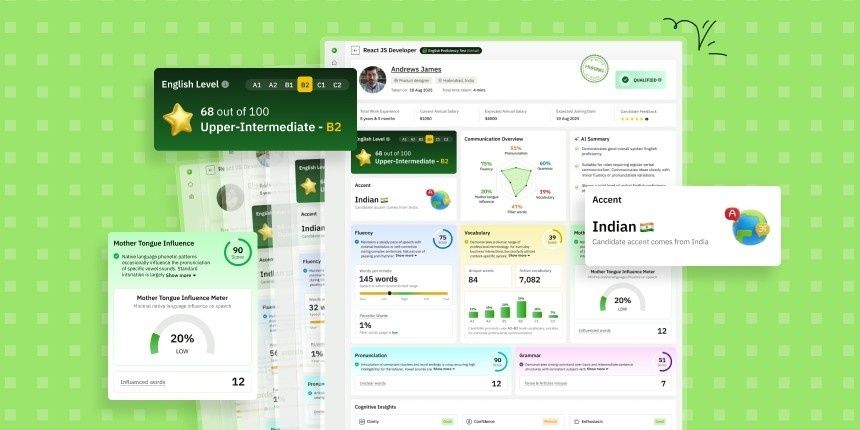
CEFR isn’t just a grade on a sheet of paper. Each level has descriptors that tie to the candidate’s level of capability in daily job activities. For example, a B2 candidate can understand complex work instructions and present ideas in meetings articulately, whilst C1/C2 candidates can operate comfortably in professional and academic contexts.
Recruiters usually align expectations of the role with their corresponding language demands with the help of levels such as below-
- B1: Those with B1 are best suited for internal communication and routine tasks.
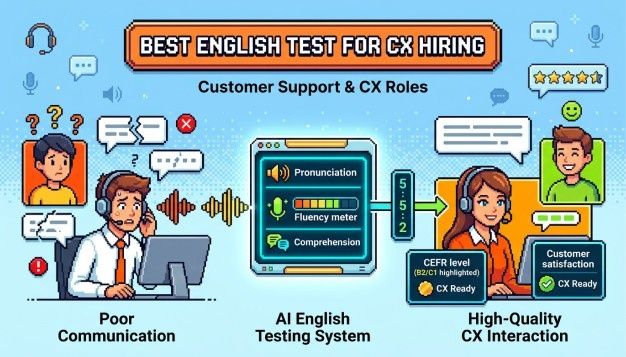
- B2: Candidates securing this level are more suitable for external customer interactions and detailed written reports.
- C1: This level is good for leadership roles with frequent public speaking or cross-border collaboration.
When language requirements are framed around CEFR by HR teams, they make it easier to match candidates to those roles.
Also Read: From Recruiter to Talent Strategist: HR Pro Skills for the AI Era
Research-Backed Reliability of CEFR-Aligned Tests
The dominance of CEFR in hiring didn’t just happen by accident. Studies in language assessment consistently confirm the validity and reliability of CEFR-based frameworks.
For instance, recent test development research found strong validity of selection criteria between CEFR-aligned tests and established benchmarks like TOEIC, making them more relevant and useful. It means CEFR levels predict actual performance on respected language measures.
Other academic efforts, like the UniversalCEFR dataset project, which is a large-scale multilingual and multidimensional dataset of texts annotated with CEFR (Common European Framework of Reference) levels in 13 languages, support the use of CEFR-labelled texts and assessments to improve fairness and consistency in proficiency evaluation.
These aren’t isolated papers; they reflect a broader scholarly consensus that CEFR levels correspond to meaningful, assessable differences in language ability.
How Employers Use CEFR in Practice
When companies adopt a CEFR-based English proficiency test strategy, their hiring processes gain a certain structure.
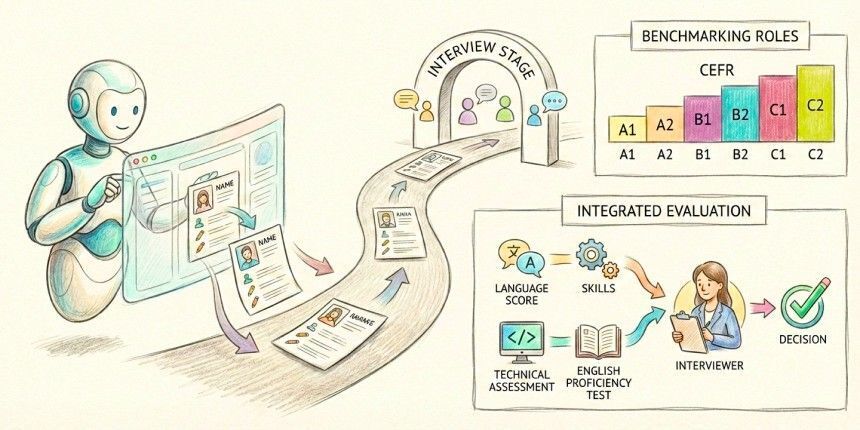
- Auto pre-screening candidates with CEFR thresholds before interviews using AI interviewers.
- Benchmarking roles by defining the minimum required proficiency that does not involve guesswork.
- Integrating language scores into broader skills evaluations, alongside technical or cognitive assessments that happen in parallel
Let us consider global tech companies or organizations that prioritize remote work. A B2 minimum for roles requiring regular client interaction is set by them. That’s because research proves that B2 and above correlate with fewer communication breakdowns in professional settings.
Also, CEFR adoption is not limited only to hiring but is also used in internal training, performance evaluation, and even succession planning.
The Role of AI in Scaling CEFR Proficiency Assessments
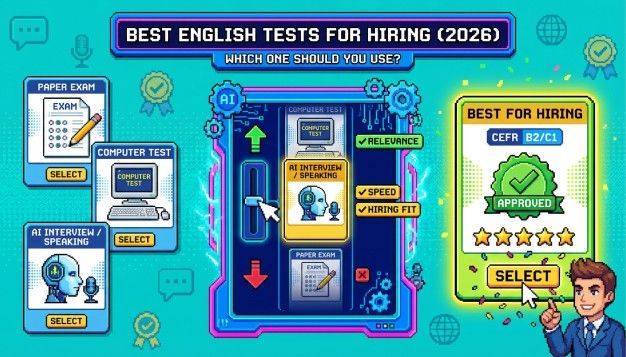
CEFR frameworks and AI hiring tools have a powerful overlap. Hyring’s AI English proficiency test embeds CEFR standards into automated evaluation workflows, which gives recruiters fast, objective results without tedious manual scoring.
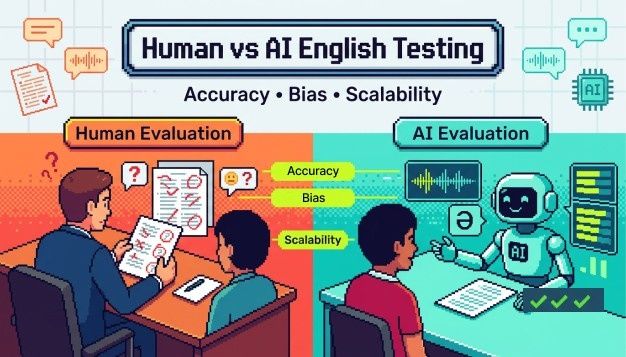
This matters because manual assessments are time-consuming and inconsistent. AI models trained on CEFR descriptors can assess reading, writing, listening, and speaking simultaneously in ways that align with human judgment and additionally do it at scale.
An AI-powered CEFR-aligned test reduces bottlenecks and brings fairness to large applicant pools. Employers get a CEFR level output (which can then be used to match with the role being hired for), and candidates receive meaningful feedback on their proficiency.
Common Misconceptions
CEFR is Meant Only for Europe
CEFR did originate in Europe, but its use in English testing has spread worldwide, including Asia, Africa, and the Americas. Most major English exams- from IELTS to Cambridge and EFSET- map to CEFR levels. Hence, this codswallop of an allegation is untrue.
CEFR Measures Only Grammar and Vocabulary
CEFR examines four skills - reading, writing, listening, and speaking. This is linked to real communication tasks. That’s why its descriptors are actionable for hiring teams.
Any English Test Will Suffice
Not all tests align with CEFR, and that inconsistency creates disconcertion in hiring decisions. When the tests align with CEFR, they assure reliability, clarity, and comparability across candidates, which is especially important in global talent markets.
Conclusion
CEFR-based English proficiency test frameworks are not some vague passing trend but are designed specifically to address certain pain points. They solve core hiring problems, which are ambiguity in language requirements, subjectivity in evaluations, and scalability across global teams.
Employers who adopt CEFR standards, especially through AI-integrated systems like Hyring’s own AI English proficiency test, get objective, actionable data that can be used to interpret someone’s language proficiency.
CEFR’s predictive value is backed by solid research, and global adoption continues to rise as organizations seek fairer, more efficient hiring. For job seekers, demonstrating a clear CEFR level on a resume or LinkedIn profile can be a career multiplier. Ultimately, CEFR empowers employers and candidates, and both benefit from its findings.
FAQ
1. What is CEFR English Proficiency Test?
The English proficiency test based on the Common European Framework of Reference for Languages (CEFR) evaluates the English proficiency level of a candidate on the Common European Framework of Reference for Languages (A1 to C2) scale.
2. Why Are English Proficiency Tests Based on CEFR Important In Recruitment?
They assist employers in making a rational comparison of candidates' language abilities based on a job description.
3. Can CEFR-based tests predict job performance?
Although no test is ever a guarantee of actual performance, the evidence shows a strong correlation between CEFR levels and effective communication at work. Hence, CEFR levels are more reliable than non-professional judgments.
4. In what way is the testing based on the CEFR used in Hyring?
Hyring has incorporated the standard of CEFR in its AI English proficiency test, which gives employers specific language skills required according to job requirements.
5. Which level of CEFR would you aim for to help you find employment?
For most global positions, a minimum of B2 is necessary, particularly if the position includes communication, working with global colleagues, or meeting with clients.