
In A Nutshell
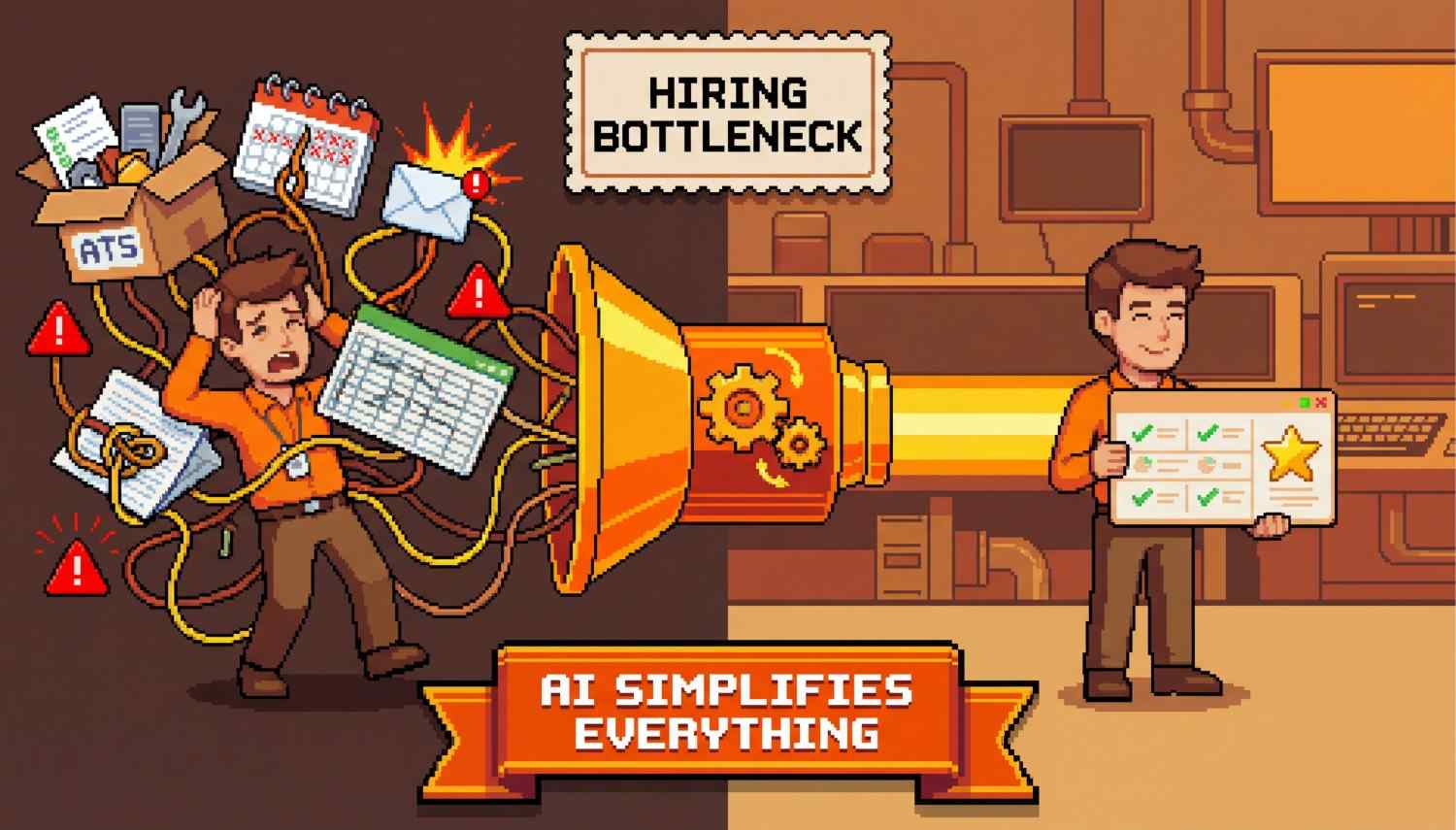
Using multiple tools for recruitment often slows you down with the extra weight, instead of the converse happening. Every login, manual export, or double-entry adds abrasive tedium to the entire workflow.
Replacing this clutter with a unified AI-driven system simplifies, debugs, and lets your team focus on what really matters - the human element.
Bloated Hiring Stacks: Deadweights
Many companies stack up tools over time. It's not as if overnight, you add a job-board plugin, then an assessment tool, a scheduling app, a video-interview platform, - already a mouthful, ain’t it, but wait, there’s more - a resume scraper, a spreadsheet tracker, a separate CRM, and maybe just another compliance audit tool to top it off. Lo and behold, before you know it, you are juggling eight or ten logins just to hire a single person. Sounds unsmart? Probably because it is.
The cost isn’t just the individual financial subscriptions to all these tools. It’s time- time wasted switching between dashboards, exporting CSVs, reconciling data, and copying notes from one system to another. It’s the tiresomeness. The frustration. It’s lost candidates slipping through or stacked up against a scheduling sheet that you don’t understand yourself. And those are just the usable parts.
You have scores of fragmented data waiting behind the scenes, hoping to be made sense of. One system has a candidate’s test score. Another one has their profile picture. Another has interview feedback notes and inferences. None of them makes sense in isolation. That means important context gets lost, and the time taken to process expands.
Studies show that tool overload reduces recruiter efficiency significantly. In one survey, recruiters with more than five platforms were twice as likely to report burnout and slowdown hiring cycles.
Why Multiple Tools Create Chaos
Here are some common grievances when you rely on many unique tools:
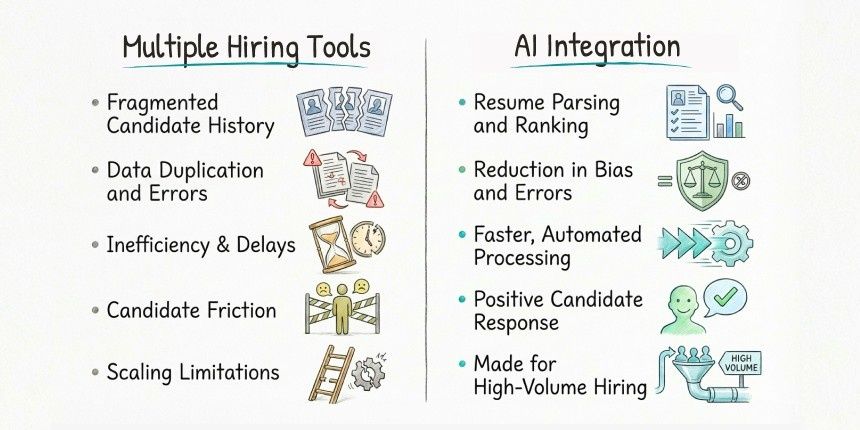
- Fragmented candidate history: You need to open multiple applications to garner a full picture. Resumes, test scores, interview notes, and background checks - all need to be weighed upon.
- Data duplication and errors: It is observed that manual data duplication and copy-pasting from one app to another is a dicey multi-step process. It will invariably lead to errors, incompatibilities, and ultimately data corruption and loss.
- Inefficiency and delays: Feedback loops elongate, and scheduling becomes incredibly slow. More time is wasted in app-switching rather than on what actually matters.
- Candidate friction: When feedback is multiple and disjoint, candidates do not get a proper review of their performance, and hence makes the company and recruiter look unprofessional.
- Scaling limitations: As volumes increase, all the above problems magnify a hundredfold. What used to work for 5-10 applicants will simply collapse during a large volume hiring spree.
How AI Offers a Better Path to Simplicity
Instead of stitching multiple tools together, one must consider AI hiring tools - you get a single AI recruitment platform that multitasks in the following areas:
- Resume parsing and ranking
- Interview scheduling and follow-ups
- Skills matching and ranking
- Candidate tracking and status updates
- Feedback collection and interpretation
- Visualization dashboards
All these under one roof- no hassles, no coordination mishaps, and definitely no confusing jumbles?
Centralizing all these workflows is key. AI eliminates the headache, reduces human error, and keeps all candidate data in one place. It saves time and mental bandwidth for recruiters and hiring managers alike. Hyring prides itself on having a first-in-class desktop app that goes one step further and includes a wide range of proctoring with AI and interviewing modes that are suitable for any kind of hiring problem.
Multiple studies show that consolidating hiring tools into a unified ATS or AI-powered system can dramatically shorten hiring cycles and improve efficiency. An advanced ATS implementation improved core recruiting operations such as screening, scheduling, candidate tracking, and reference checking.
What a Unified AI System Looks Like in Real Life
Imagine a scenario where a candidate applies. You instantly see their resume, skill-match scores, test results (if needed), and interview schedules — all in a single view post the initial stage of screening.
The agentic AI that replaced the potpourri of hiring tools on your desktop sends an automated interview invite. The candidate accepts and chooses to interview at a reasonable and convenient time. The system updates their status post-interview. You and the hiring manager both see the same timeline. They sync across dashboards and take notes in your meeting that can be a common ground.
Recruiters don’t spend hours moving data around. Managers don’t chase updates. Candidates get timely communication. Everyone stays aligned. Hiring flows instead of stalling. That’s the definitive hallmark of a well-designed AI hiring system.
When AI Isn’t the Answer (and What to Do Instead)
Let’s all concede that AI isn’t magic. It isn’t right for every scenario. If your hiring volume is low and your processes are simple, you might as well be fine with a small toolset or even spreadsheets - whatever works for you.
But, stacking one complex system over the other in turn, over inconsistent internal practices that just don’t make cohesive sense, won’t solve problems on its own.
You need clear hiring guidelines, well-defined roles, and alignment. When you scale - that’s when the real cost of tool overload shows. The human cost, the bad hire cost, and the cost of inefficiencies that magnify throughout the pipeline. In those cases, moving to an AI-driven unified solution really is its own reward.
Conclusion
Having many top-of-the-line hiring tools seems smart at first, but as soon as you start hiring frequently, the errors eventually add up. They’ll end up slowing you down and costing you more to run the hiring process.
AI-driven hiring tools bring an integrated simplicity to the process that stitches together screening, scheduling, tracking, feedback, and analysis into one workflow. They reduce many human-induced errors. Communication is then streamlined. They give you back time- time to focus on people that matter and form (or will form) the crux of your organisation.
If hiring feels messy, a congested stack of hiring tools could be the problem- not talent.
FAQs
1. Does one platform really replace all hiring tools?
Yes and no. A good AI hiring system can cover the core workflow- resume screening, scheduling, tracking, and feedback. You might still use niche tools (for very specific assessments or branding), but it takes a load off the core work.
2. Will switching to AI mean learning a new system once again?
Maybe at the beginning, sure, but the learning curve is usually small. Once set up, working in a unified system saves far more time than it takes to master it.
3. What about concerns regarding data security and compliance?
A unified AI hiring system simplifies compliance. Instead of tracking candidate data across multiple apps and spreadsheets, you manage permissions, audit logs, and data storage in one place. This automatically improves security and accountability.
4. Does this approach work for small companies, too?
If you hire occasionally, a full AI integration may be an unnecessary investment. It works best when you hire frequently or in volume. For smaller teams, a simple tool, ATS, or even a spreadsheet may still suffice.
5. Can a unified system replace human judgment?
The goal is to simplify workflow and surface insights. Decisions about culture fit, leadership potential, and team dynamics still need human judgment to assess. AI hiring tools help you to simplify and select the apt candidate for you within a smooth workflow; who the apt candidate is is defined by you, the human.