




The appointment letter is one of the most important documents in the process of recruitment. Additionally, the letter offers confirmation of employment with the company issuing the same.
It has details about the job role, specifies that there is a salary and other emoluments, and explains organizational rules and policies, thereby providing transparency right from the beginning.
A succinctly written appointment letter may also be used to create a bond of trust between the employer and employee that can cover any deficit.
In this guide, you will find all you need to create a professional appointment letter with relative ease:
- Generic layout of an appointment letter
- What an appointment letter contains
- Some practical tips that can be followed to write a letter of appointment with assurance and professionalism.
In addition to being aided by expert advice, an individual can also access free templates. The individual concerned may be an HR manager or simply a small or new entrepreneur writing his or her very first letter. This resource promises to make it all seamless, professional, and legal.
What is an Appointment Letter?
An appointment letter is a statement by the employer that they have selected a qualified candidate for a specific position in the company.
It is basically a statement that certifies that the hiring of a particular job was genuine and includes the key elements of T&Cs, such as the duties that the candidate is expected to fulfill. An employment offer letter, appointment letter, and joining letter are entirely different from one another.
The letter consists of information that is sent by the employer, who lets the candidates know that they accept their candidature and are proceeding with the hiring process.
It helps to spell out clear expectations, and it may, among others, relate to the title of a job, duties to be performed, wages, benefits, working hours, leave, and a probation term.
Assuming that the purpose is clear, we will look at how this translates on paper.
Standard Appointment Letter Format
A well-written appointment letter is essential for making job offers and helping new team members get started. But to write this letter correctly, you need a standard format.
Especially if you are an HR professional, writing an employee appointment letter properly can impact your organization’s branding and ensure a smoother onboarding process.
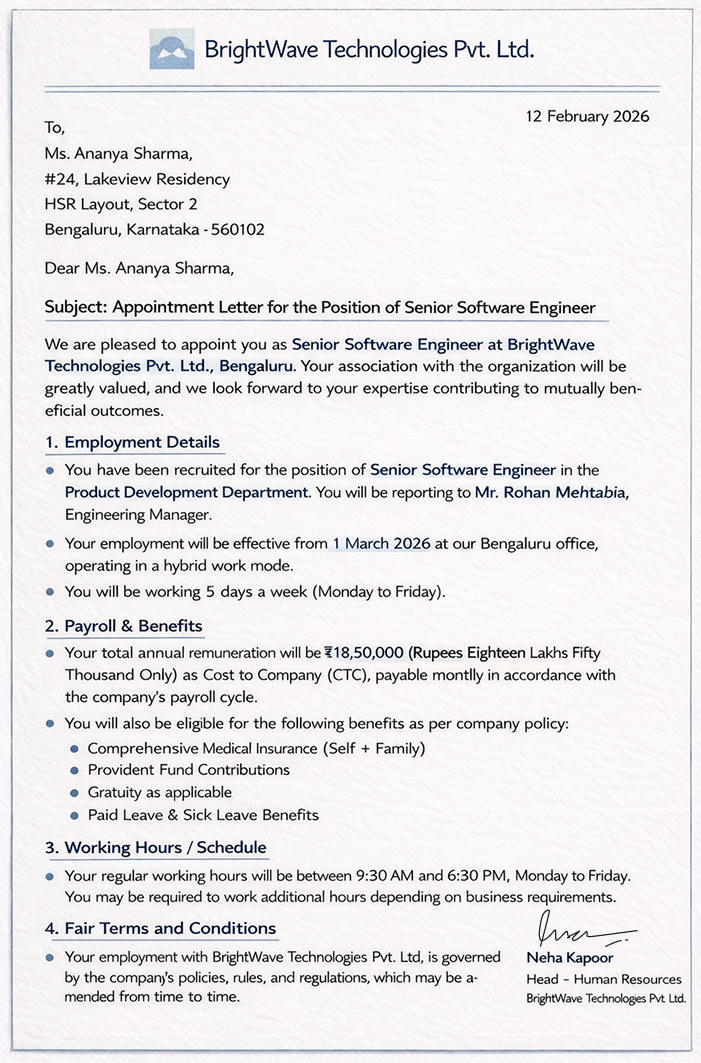
Sample of Appointment Letter
[Company Letterhead]
[Date]
[Candidate’s Name],
[City, State, Zip Code]
Dear (Candidate’s Name),
Subject: Appointment Letter For The Position Of (Job Title).
We solicit you to join us as (Job Title) at our (Company Name)(Address). Your association with the organization will be greatly valued, and we would like to see your qualities produce mutually beneficial outcomes.
1. Employment Details
You have been recruited for the vacancy in the post of [Job Title] in the [Department Name] department. You will be reporting to [Reporting Manager Name/Designation]. The employment will be effective on [Start Date] at our [Address/City] office (and/or) [Home]. You will be working [No. of Days] in a week, in [hybrid/WFH/fulltime] mode.
2. Payroll & Benefits
Your total annual remuneration will be [Amount Figures and Words] (CTC), which will be paid in line with the company’s payment cycle monthly. Along with this, you will be qualified for such benefits as:
- [Medical Insurance]
- Retirement Benefits [Provident Fund if opted for]
- Performance Bonus/Incentives
- Others as per policy
3. Working Hours/Schedule
Your regular hours of work will be between [Start Time] and [End Time] on [Days of the Week, e.g., Monday to Friday] (or) You will be expected to work __ hours every week. You may, however, be asked to work extra hours based on business demands.
4. Fair Terms and Conditions
Your work in the company is governed by the rules and regulations, which may be updated at any time. You are also expected to uphold the highest standards of integrity, confidentiality, and professionalism whilst in employment with us.
Your employment is on a Probation/Contract/Permanent basis. This probation will last [X months], and then your work will be analyzed, and evaluated for regularization.
We once again welcome you to [Company’s Name], and are thrilled to have you on board. Please duly sign a copy of this letter, as an acknowledgement of its acceptance.
Yours sincerely,
<Signature>
[Authorized Signatory Name]
[Designation]
[Company’s Name]
What to Definitely Include in a Professional Appointment Letter
A standard appointment letter format requires providing all necessary information when the employment is awarded. This is a legal requirement so that both the interests of the employer and the employee are considered. To keep in mind, the elements of the letter are as follows:
- Employee Personal Details - New employees’ details include their full name, address, contact information, and job title.
- Department/Area of Expertise - The department inside the organization where the individual will work
- Hierarchy - Employees will report to their respective department head.
- Terms & Conditions - Any particular conditions of employment, such as confidentiality agreements, non-compete clauses, and policies (like leave and attendance policies), should be included.
- Compensation - Explanation of salary, bonuses, and other monetary/ancillary benefits in detail.
- Start Date - The date that the employment is scheduled to commence.
- Duration of Employment - The contract’s termination date or duration must be mentioned wherever relevant.
- Working Hours - The anticipated working hours, whether part-time, work-from-home, or full-time status.
- Probation Period - If there is a probationary period, its length and conditions should be specified before regularization.
- Benefits - Information about health insurance, wellness programs, retirement plans, vacation days, and other employee perks and advantages
- Job Description - A thorough description of the duties and responsibilities of the role.
- Conditions - Any additional conditions or requirements, such as learning and development (L&D), academic skill (AS) certifications, travel requirements, or equipment provided, are specified.
Once you know what to include in an appointment letter for a job, it is the first step. To make the process easier, below are the ready-to-use templates for quick customization and use.
How to Write an Appointment Letter?
When composing an appointment letter, it is essential to use a formal letterhead and address the candidate by their name. Then, officially bequeath to them the position, with duties, date of commencement, working hours, salary and such essential conditions. Ensure clarity, fullness, and a professional tone throughout, and finally close with acceptance formalities and a timeline to respond to the same.
- Letterhead and header details - Create an official letterhead and place the full name of the candidate, contact details and the date of issuance at the top to provide some formality and traceability.
- Professional greeting - To create the appropriate tone and tenor, it is essential to address the candidate using their official name with a formal salutation (e.g., Dear Aditi Krishnan).
- Opening statement - Open by formally nominating the candidate for the position, and specifying the precise designation to eliminate any ambiguity or vagueness.
- Role and responsibilities - Give a brief overview of the position and primary (and secondary) duties to set expectations at the very beginning of his or her employment period.
- Start date - Indicate the date of commencement as agreed upon during the interviews or provide negotiations with reference to any previous agreement.
- Work schedule - Indicate the weekly working hours or daily hours, and specify whether the position is full-time or part-time to define the availability expectations clearly, such that there is no misunderstanding later on.
- Compensation and components - Add the actual salary and other mandatory requirements, such as pension, gratuity, and insurance, to have a complete picture of pay and benefits.
- Additional terms and policies - Include any pertinent terms (e.g., dress code) at the bottom to roll up prerequisites or must-haves.
- Acceptance and deadline - In the end, pointing out whether a signature is necessary and specifying a deadline to accept or respond to formalise the process is essential so that the process is time-bound.
Quick, Actionable Writing Tips
- Make sure to use a business-friendly tone
- Sections such as compensation, benefits, and reporting should be clearly mentioned.
- Write language that is simple and plain, jargon-free and understandable.
- Legal accuracy is essential throughout, as this document would be admissible in court in any subsequent dispute.
By following these guidelines, one can create a letter that is both informative and professional, setting the stage for a positive and productive working relationship with the new employee.
Checklist for HR Teams
Before issuing an appointment letter, HR teams should verify that all formalities are complete. These are some of the things one must keep in mind.
- Offer letter accepted
- Background verification completed
- Salary approved
- Reporting manager assigned
- Company policies attached
- NDA signed (if applicable)
- Compliance reviewed
The key purpose of maintaining said checklist is to help in minimizing errors and delays.
Explanation of Key Clauses in an Appointment Letter
Every clause in an appointment letter serves a key specific purpose. Understanding these clauses helps both parties avoid misunderstandings in the future.
Probation ClauseThis defines the initial assessment period during which performance and suitability are evaluated.
Compensation ClauseThis explains salary structure, benefits, and payment cycles to prevent pay-related disputes at a later date.
Confidentiality ClauseThis protects the data, intellectual property, and business information of the employer as is applicable and enforceable by laws such as the Patents Act of 1970 (and amendments thereto).
Termination ClauseThis outlines notice periods and exit conditions that may be imposed upon the employee during exigencies or may be applicable when the employee withdraws voluntarily from his employment.
Hierarchy/Chain of CommandThis clarifies who the employee is actually accountable to. Each clause should be written in clear language and should leave no room for multiple interpretations or subversions and manipulations.
Termination, Resignation, and Exit Provisions
An appointment letter must clearly explain how the employment may end, whether through resignation, termination, or mutual agreement.
This section should elucidate:
- Required notice period
- Conditions for immediate termination
- Salary in lieu of notice (if applicable)
- Full and Final (F&F) settlement process
- Return of company property
- Issuance of experience and relieving letters
Clear exit policies reduce conflicts and ensure a professional closure of employment.
Are The Appointment Letter and Offer Letter the Same?
An appointment letter and an offer letter are not the same. Here is a table to understand it more simply and better.
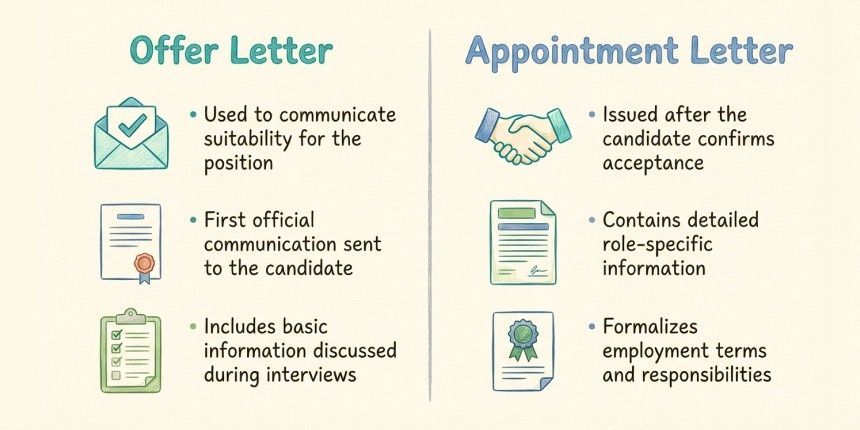
Both are important in their own ways. Especially when organizations with strong onboarding see up to an 82% higher retention rate, offer letters are as crucial as appointment letters.
Common Mistakes in Appointment Letters (and How to Avoid Them)
Despite our best intentions, appointment letters often contain avoidable errors. Some of the most common include:
- Vague job descriptions
- Incomplete salary breakdowns
- Missing terms of probation
- Unclear notice periods
- Absence of confidentiality clauses
- No governing law mentioned
To avoid these issues later, letters should be carefully reviewed and standardized before issuance.
Regular audits of appointment formats can also further help maintain consistency and keep them updated according to the market and regulations present.
Governing Law and Dispute Resolution
Every appointment letter should specify the governing law and jurisdiction that will apply in case of disputes.
This clause defines:
- Which country or state’s laws apply
- Which courts have authority
- Whether arbitration is applicable
Including this information reduces legal uncertainty and helps resolve conflicts more efficiently if they arise.
Digital Appointment Letters and e-Signatures
With the rise of remote work and digital HR systems, many organizations now issue appointment letters electronically. Digital appointment letters, when signed using legally valid e-signature platforms, carry the same legal value as physical documents under most jurisdictions.
Organizations should ensure:
- Secure document storage
- Proper access controls
- Compliance with digital signature laws
- Backup and retrieval systems
This approach improves efficiency while maintaining the legal integrity of the company simultaneously.
Digital Appointment Letters and e-Signatures
With the rise of remote work and digital HR systems, many organizations now issue appointment letters electronically. Digital appointment letters, when signed using legally valid e-signature platforms, carry the same legal value as physical documents under most jurisdictions.
Organizations should ensure:
- Secure document storage
- Proper access controls
- Compliance with digital signature laws
- Backup and retrieval systems
This approach improves efficiency while maintaining the legal integrity of the company simultaneously.
Appointment Letters for Remote and International Employees
For remote or cross-border employees, appointment letters require additional clarity.
They should mention:
- Work location and time zone
- Payment currency
- Tax obligations
- Data security requirements
- Equipment responsibility
- Work authorization status
These details help manage expectations and ensure compliance across regions.
Why Well-Drafted Appointment Letters Matter
A carefully written appointment letter sets the tone for the entire employment relationship. It reflects professionalism, builds trust, and establishes clear boundaries.
When employees understand their role, compensation, and obligations from the start, they are more likely to engage positively and perform effectively.
For organizations, strong appointment letters reduce legal risks, improve onboarding, and support long-term stability.
In essence, an appointment letter is not just a document—it is the foundation of the employer-employee relationship.
Conclusion
By using the correct format on an appointment letter, not only do you conform to the organizational policies, but you also shape the expectations of your new employee accordingly. We have gone through what is typically the generic, everyday letter of appointment format. We have also seen a direct comparison with the most commonly confused format which is the job offer letter - along with the letter of appointment. Other HR templates can help streamline all other steps of your hiring and onboarding process.
FAQs
1. What is the Purpose of an Appointment Letter?
Appointment letters formally confirm a candidate’s employment and outline the terms and conditions of the employment between two parties - the company and the job applicant.
2. What are the key components of the Appointment Letter?
The key components of a letter of appointment include job title, responsibilities, start date, remuneration, working hours, probation period, and terms such as non-compete clauses and other relevant important company policies.
3. How long does it take to get an Appointment Letter?
It takes typically a few days to two weeks to get after accepting a job offer post the L2 stage of the interview process.
4. What is a good company Appointment Letter format?
A good letter of appointment format is one that clearly outlines the job title, start date, salary, terms of employment, reporting structure, and other important company policies, in a precise and business-like professional tone.
5. How is a Letter of Appointment Different from an Offer Letter?
The letter of appointment confirms your employment, while the offer letter is submitted to you by the employer as the first communication, confirming their suitability for the role, post your interview.
6. When can I respond to HR after signing the letter of appointment once I've accepted the job?
Usually, one should typically sign it within a few days or within the timeline required by the employer as mentioned in their communication to the employee-designate when sending the letter to them.
7. How can I request an appointment letter from HR?
If you have received a job offer and have accepted the same, you can then politely email or speak to HR requesting your letter.
8. Are Company Appointment Letters Cancellable?
In some instances, a letter of appointment may be rescinded, like in cases of failed background checks where the candidate has provided inaccurate information or commits a breach of company policy.
9. What is meant by the probation period mentioned in employee Appointment Letters?
The probation period is a time duration of usually 2–6 months during which the employee’s performance and adaptability is evaluated before receiving confirmation as a permanent employee/ being regularized.