
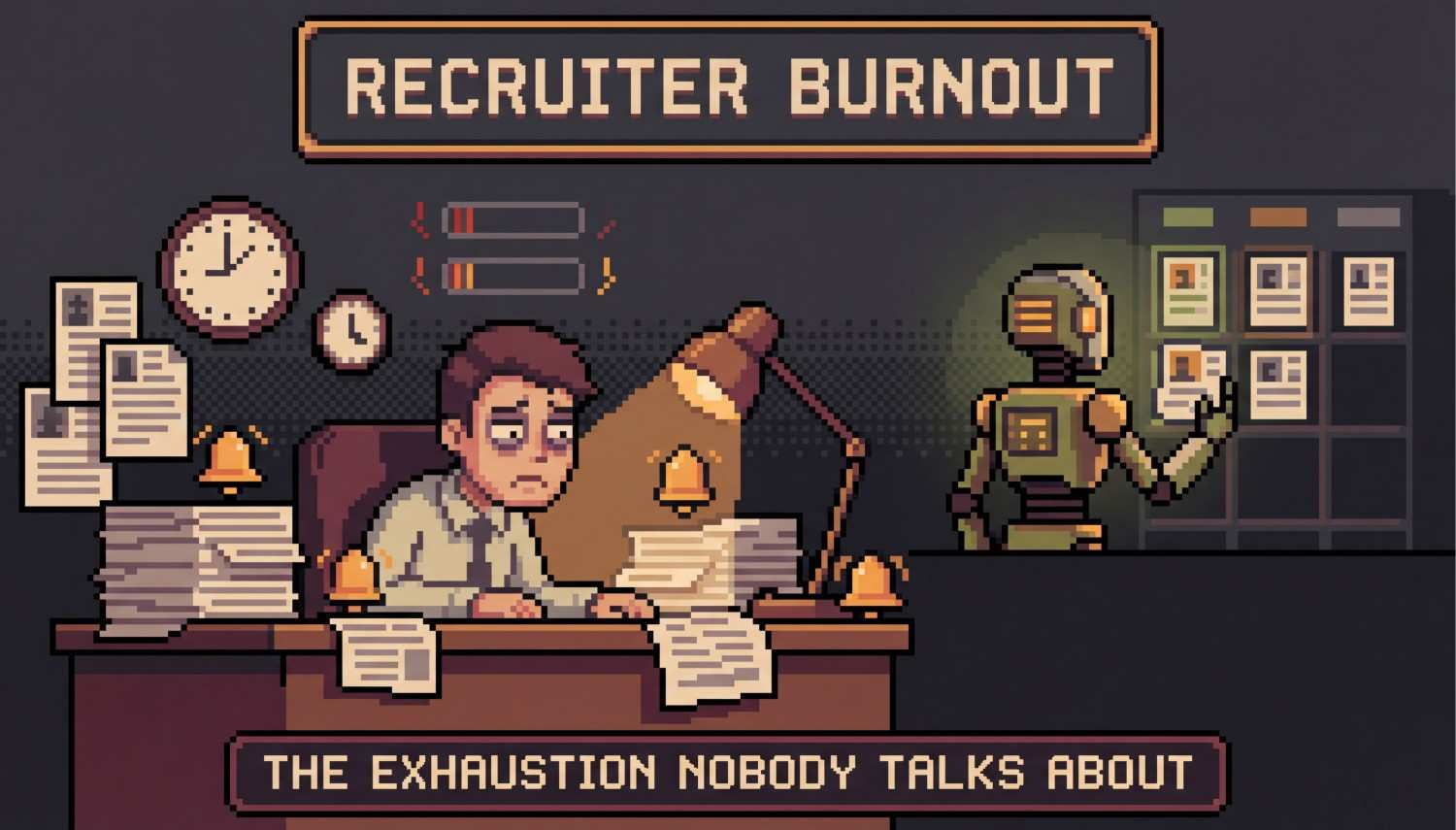
Recruiters are burning out, not because they don’t work hard, but because the job is too demanding and is offered too little support. Tight deadlines cause greater administrative overload. Constant availability and lack of boundaries make recruitment a mental and emotional grind.
Data shows that more than half of recruiters feel increased stress or recruiter burnout post-pandemic. The solution isn’t just more energy- it’s about smarter recruitment strategies, clearer boundaries, and better support.
A Burnout Problem That’s Real
Recruiter burnout is not an industry myth- definitely not in the recruitment industry, at least. In 2024, it was observed in a survey that 54% of recruiters said their job became more stressful compared to the previous year. This is backed by real data.
There was another recent systematic review for 2025 that concluded that stress and exhaustion among HR recruitment professionals are rising globally. This is alarmingly redefining burnout as a growing occupational hazard.
Recruiters in Serbia exhibited a strong correlation between high burnout levels, low engagement, and stronger intentions to quit.
The signs are everywhere. Recruitment is quietly becoming one of the most stressful jobs in HR with high turnover, burnout and mental strain and drain.

What Makes Recruiting So Stressful Right Now
Once upon a time, not so long ago, recruitment strategies were simply about matching people with the job roles that needed to be filled. Now, it’s become a high-pressure war on time, volume, expectations, and deliverables. We shall look at what mainly concerns them:
- Constant volume pressure- It’s often about candidates to pick through the talent pool, to fill multiple roles, while meeting deadlines that are often unrealistic.
- Administrative overload- Manual involvement becomes cumbersome with a myriad postings, spreadsheets, follow-up emails, scheduling and status tracking. Especially when coordination between multiple tools is required.
- 24/7 availability- Candidates these days expect fast responses. Hiring managers want instant updates. This blurs the boundaries between work and personal time. This isn’t ideal.
- Emotional labour- Empathy and energy wear out when there is constant rejection, ghosting, internal departmental pressure and high anxiety.
A recent piece about recruiter stress captured it well; they constantly juggle “open roles, candidate drop-offs, resource gaps and endless follow-ups.
It’s not about it being just another job when it becomes a daily firefight. CEOs and Founders need to realise that this is happening, and we need to look at a constructive way to solve this, and not dismiss concerns.
The Signs That It’s Not Just Workload
These are some of the common signs that the problem isn’t simply about volume:
- Lower engagement, feeling emotionally and mentally drained at the end of the day; something researchers connect with burnout, not just physical tiredness.
- The rising desire to quit- In one 2025 study, a substantial portion of HR professionals reported considering leaving the profession due to strangulating burnout.
- Drop in productivity- When mental fatigue, low morale and administrative burdens mount, mistakes can magnify, and other issues spiral - missed candidate follow-ups, or even mixed-up or delayed decisions.
When stress becomes constant and relief is rare, the natural progression from simple workload to occupational hazard is complete.
Why Tools and Process Alone Don’t Fix It
The solution to this recruiter burnout is not just the adoption of more technology. Some companies think dumping more tools onto the HR workflow will somehow make the recruiter’s life easy and that this burnout will simply vanish. More apps, widgets, dashboards and stacks are not going to help. Why do you ask? It’s because:
- More app-switching
- More clustered and fragmented data (that doesn’t make sense)
- More context loss and mounting errors
- More mental gymnastics
That overload adds a subtle, almost subliminal stress. Trust me, “helpful tools” can become just another source of friction, and this problem needs to be handled with alacrity.
The issue isn’t about hiring tools. It’s about fragmented tools without proper design that are meddling with recruitment strategies.
What Must Change for Recruiters to Stay Sane
If recruiting must scale but also stay humane, there needs to be a visible or tangible pivot:
- Processes need to be consolidated into unified workflows to reduce overhead and switching of contexts.
- Recruiter focus must be protected at any cost, while personal time is respected - clear demarcations avoid a toxic “always-on” culture.
- Policies must be human-centric, recognising that recruitment is emotionally taxing and that there have to be some breaks, flexibility and support for them.
- Besides speed or just metrics spread across a sheet, prioritize quality and candidate-recruiter dynamics over mere quantity.
- Physical and mental well-being is paramount. Realistic work schedules and clarity around expectations are necessary to support the candidate's and recruiter's well-being.
When done right, recruiting can become effortless and plain sailing and recruiter burnout, a thing of the past.
Conclusion
Recruiter burnout is real. It is not a sign of weakness. It is a signal that something is systemically wrong.
Instead of piling on more tools that rarely help ameliorate the situation, making the stackflow smarter is the more intelligent thing to do. To support people, respect their time and privacy and treat their well-being as important are the real metrics that matter.
If you care about hiring results, ask not just how many candidates you get, but who is doing the hiring. And how are they, perhaps, for a change?
FAQs
1. Is this only a post-pandemic trend?
This is not true. While the conditions that arose during the pandemic were certainly responsible for intensifying the stress, recruiter burnout remains high even today, 3 years post the final waves. Administrative overload and long working hours have been a part of the problem for years.
2. Won’t new recruiting tools reduce burnout?
There is no guarantee that stacking up the tools will proportionately reduce stress. It is only if they are integrated and implemented well that they can reach their intended potential as a carefully designed workflow that is meant to aid the recruiter. Not just more cluttered dashboards.
3. Is recruiter burnout just about too many roles?
Even recruiters with moderate workloads report stress when ultimately job demands, lack of autonomy, emotional labor, and poor support build up. So, not always!
4. Can small teams avoid this problem?
The weight of emotional load, lack of clear boundaries between the personal and the professional and poor workflow design can cause recruiter burnout irrespective of the team size.
5. What’s the immediate first step to reduce recruiter burnout?
Auditing work patterns will clarify where the targets of improvement should lie. Depending on the time taken to complete mundane, non-human tasks (like spreadsheeting, follow-ups, etc.), you should look for ways to streamline or completely eliminate those tasks which are time-consuming.