There is a common fear that AI is here to replace us. However, in the world of recruitment, the reality is quite the opposite. AI is here to simplify the human experience. AI proctoring doesn't replace the recruiter, it provides them with a digital superpower.
By diving into candidate performance with a level of minute observation that exceeds human comprehension, AI handles the data-heavy monitoring, much like how AI resume screening automates the initial stages of candidate evaluation. AI proctoring involves software backed by AI, which dives deeper into candidates' performance and activities with minute observations that looks beyond the screen into screen activities. The endpoint of the process is for human recruiters to look into the whole AI's input and consolidated data to arrive at a decision.
A Quick Look at Human Proctoring
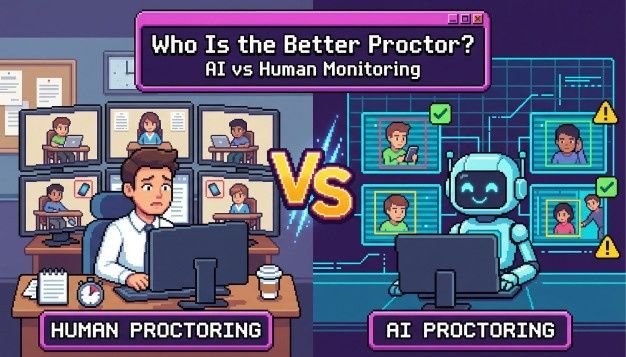
Human proctoring is the conventional method of exam supervision that most of us have experienced. A trained proctor monitors candidates either in person at a test center or remotely through a live video feed. They observe behavior, verify identity, and intervene if something seems off.
In a remote recruitment scenario, this involves a proctor logging in via webcam and screen-sharing software to observe the candidate in real time. It does work, and it does have its limitations. A single proctor can realistically monitor only one to five candidates at a time, and the quality of their attention inevitably dips over long sessions. While this model will work for recruitment teams conducting tests on a small number of candidates, it does have its limitations when you are talking about hundreds or thousands of candidates spread out across different time zones.
What AI Proctoring Actually Does
AI proctoring uses artificial intelligence, machine learning, and computer vision to monitor candidates automatically. But not to make hiring decisions. That distinction matters.
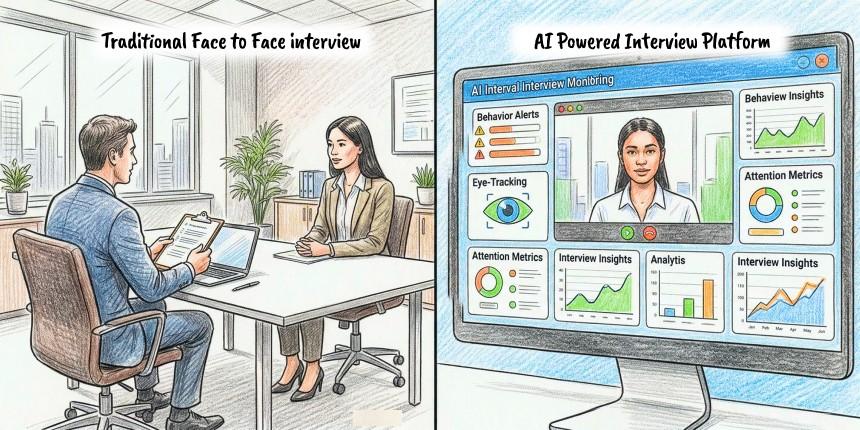
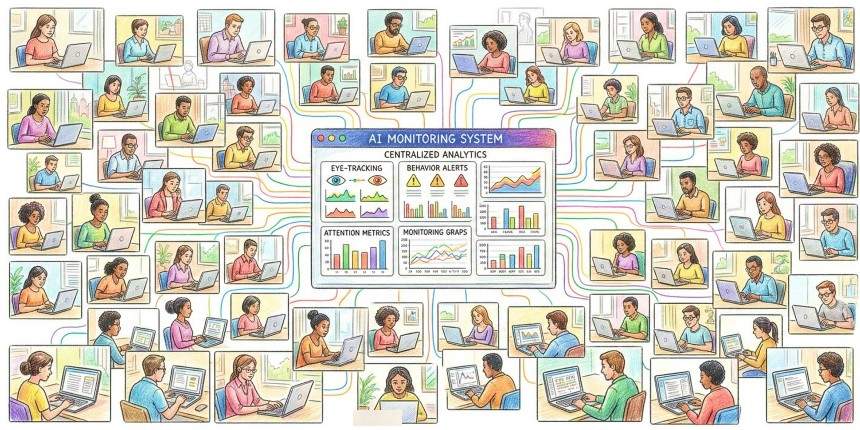
The software tracks a range of signals during an assessment, including facial movements, eye gaze patterns, audio anomalies, browser activity, and screen behavior. It processes all of this in real time to detect potential irregularities and flag them for the recruiter to review.
Most AI proctoring platforms operate in one of these modes: fully automated monitoring, live AI-assisted proctoring where flags are raised for a human reviewer in real time, or AI proctoring assistance, with human recruiters staying behind the wheels, for added layer of proctoring and ensuring to watch beyond what the eye sees with on-screen activities log.
The result is that recruiters receive a consolidated, data-backed summary of each candidate's session instead of sitting through hours of raw footage. The AI does the heavy lifting of observation. The recruiter does the thinking.
Why the Shift Is Happening and the Data Behind It
This isn't a speculative trend. The move toward AI-based proctoring is driven by measurable demand and a growing threat.
According to Gartner, candidate quality is being threatened by the rise of candidate fraud and the increasing use of generative AI in the hiring process. This has created an AI arms race, where Gartner predicts that up to 25% of candidate profiles could be fake by 2028. In this environment, AI proctoring is no longer just a luxury. It is an essential architect of trust.
By leveraging machine intelligence to provide real-time, objective supervision, organizations can ensure that every assessment remains fraud-free. This transition allows recruiters to shift their focus away from monitoring behavior and toward what Gartner calls the irreplaceable human touch, using their unique judgment and empathy to make the final hiring decisions.
For recruitment teams managing seasonal hiring surges or campus drives, that kind of scalability isn't a necessity born out of convenience. It's a direct response to a trust crisis that is only getting worse.
Where Human Proctoring and AI Proctoring Differ
The differences between these two approaches come down to a few core areas, each of which matters in a recruitment context.
A recruiter or proctor watching live feeds can cover a handful of sessions. AI proctoring can handle thousands of concurrent assessments without any drop in monitoring quality critical during large-scale hiring campaigns.
Consistency is equally important
Human proctors are subject to fatigue, distraction, and unconscious bias. One proctor might flag a candidate for glancing sideways and another might not. AI applies the same detection criteria to every single candidate, creating a level playing field that supports fair hiring.
Cost shifts significantly at scale
Human proctoring requires ongoing labor for hiring, training, and scheduling staff for every assessment window. AI proctoring involves a platform investment, but the per-assessment cost drops sharply as volume increases, making it far more sustainable for organizations with continuous hiring needs. This does not essentially remove the human recruiter from the picture, but makes their life easier.
Human reviewers for contextual judgment
A trained recruiter can interpret flagged behavior with nuance understanding. For instance, that a candidate in a noisy household might trigger audio alerts without any intent to cheat. This is precisely why the best AI proctoring setups are hybrid: AI monitors and flags, humans review and decide.
The Pros and Cons: a comparison
| Human Proctoring | AI Proctoring |
|---|
| Pros: | Pros: |
| Human Proctoring brings real-time interaction and the ability to resolve candidate issues on the spot. For small-batch, high-stakes assessments where personal oversight is non-negotiable, it has clear value. | AI Proctoring excels at scale, consistency, and cost efficiency. It uses multi-modal detection, combining facial recognition, gaze tracking, keystroke patterns, and audio monitoring, to catch a wide range of irregularities that a human eye might miss. It operates around the clock without scheduling constraints and delivers structured, reviewable reports to the hiring team. |
| Cons: | Cons: |
| However, it struggles with scale, introduces inconsistency across proctors, and adds significant cost and scheduling complexity, especially across time zones. | The trade-offs are real but shrinking. AI can occasionally flag innocent behavior like a candidate talking through a problem aloud or looking away briefly as suspicious. Organizations need to ensure compliance with data protection regulations like GDPR and local privacy laws, and communicate data usage policies clearly to candidates for data security purposes. |
The hybrid model:
AI monitoring paired with human review, effectively mitigates both concerns, and is quickly becoming the industry standard.
Why AI Proctoring Is the Smarter Choice for Recruitment
Recruitment operates under pressure that traditional proctoring was never designed to handle. Hiring teams deal with tight timelines, large applicant pools, multiple assessment rounds, and the constant need to make fair, defensible decisions. Asking recruiters to also sit through hours of proctoring footage is not a good use of their expertise.
AI proctoring changes that equation. It takes over the exhaustive work of monitoring the frame-by-frame observation, the pattern detection, the behavioral tracking and distills it into actionable insights.
The recruiter doesn't watch a four-hour session. They review a flagged summary and apply their judgment where it actually counts.
This isn't about removing humans from the process. It's about removing the parts of the process that don't need to be human.
When AI handles the monitoring, recruiters are free to focus on evaluating talent, reading between the lines of a candidate's responses, and making the nuanced calls that no algorithm should be making alone.
Modern AI proctoring platforms are also getting smarter. Deep learning models are reducing false positives, adapting to diverse testing environments, and handling edge cases far better than earlier versions. The technology is maturing in step with the demand.
For organizations that value assessment integrity, candidate fairness, and operational efficiency, AI proctoring isn't just a better tool. It's the enabler that lets recruiters do their best work.
Conclusion
The future of proctoring in recruitment isn’t about the choice between human and AI. It’s about giving the human more tools. While AI handles the heavy lifting of constant observation, recruiters are left to do what humans do best: interpret results and make informed hiring decisions.
The organizations that adopt this approach aren't replacing their hiring teams. They are empowering them. In a competitive talent market, that edge makes all the difference.
FAQs
1. Does AI proctoring replace human recruiters in the hiring process?
Not at all! AI proctoring is designed for the more data-intensive work of monitoring candidate assessments, similar to how AI phone screening automates early-stage evaluation, and not for replacing recruiters. They are there to provide recruiters with more information and make the final hiring decisions.
2. How does AI proctoring ensure fairness across candidates?
The AI proctoring works towards ensuring fairness among the candidates by applying the same criteria for all the candidates. In this way, the chances of human error and bias will be reduced, as different recruiters will be applying different criteria for different candidates.
3. Is AI proctoring appropriate for high-volume recruitment campaigns?
Yes. In fact, that’s one of the greatest benefits of AI proctoring. Thousands of candidate proctoring sessions can be conducted at once. For recruitment campaigns like those conducted on university campuses or for seasonal recruitment drives, AI proctoring would be highly appropriate.
4. Which is better: AI proctoring or human proctoring?
With the change of times, it is important to strike a balance and arrive at the best approach in terms of hiring and recruitment. AI offers scale and accuracy, and humans offer fairness and final decision-making. This is how a bulletproof and ethical hiring process is ensured.
5. What is hybrid proctoring, and why is it becoming the norm?
Hybrid proctoring utilizes the combination of AI proctoring and human proctoring. During the proctoring session, the AI system monitors the candidate’s activities. Once there is suspicion of malpractices, the AI system flags the issue. After this, the human proctor evaluates the situation before taking action.