
TL;DR
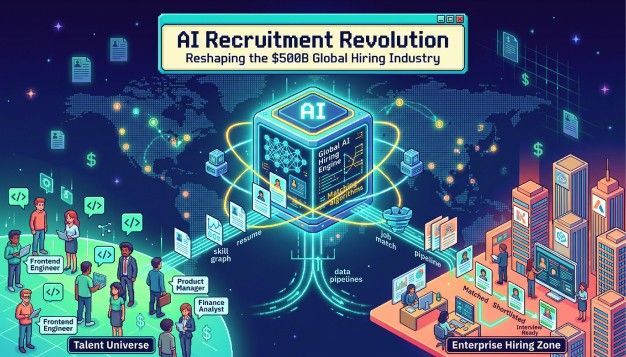
The recruitment industry globally contributes to around $500 billion worth of transactions. AI recruitment has changed everything that we know about it, with huge benefits like faster screening, sharper candidate insights, and fewer mis-hires that are costly.
Most companies are still in the adoption era, as this is still a transition that is in its nascent stages. The gap, though, is widening, contributing to a wide range in hiring outcomes between those who have moved on and those who haven’t.
The Scale of What's Shifting
One needs to recognise how the sands of recruitment are shifting globally when the annual value of transactions is crossing north of 500 billion. Functions of in-house talent, staffing firms, and the technology that is stacked on top of both, compound fast - recruitment is deciding where the greenbacks are being spent.
A report titled LinkedIn's 2024 Future of Recruiting has discovered that 62% of recruiting professionals don’t deny that they have saved nearly 4-5 hours of time per week using AI tools. If you apply that to HR teams of 50-60 people, think of all the hundreds of hours monthly that you will be saving? That time, usually used for application sorting and scheduling, can now be utilized to focus on getting culture-fit right for the company.
The global shift also runs deeper, and is not just about efficiency. AI recruitment platforms are replacing fragmented, manual workflows with efficient AI-powered tools that streamline the entire hiring pipeline - bringing about structural change, and not just menial tweaks to the workflow.
Where AI Is Actually Making a Difference
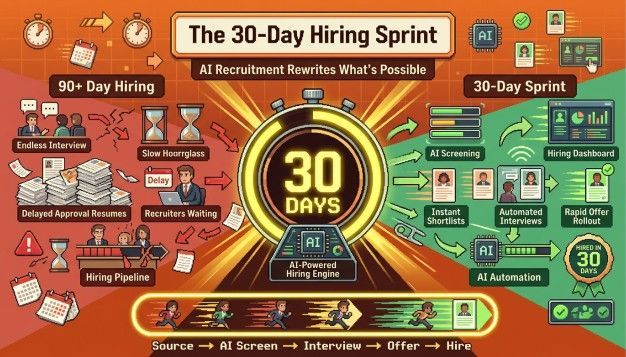
AI-assisted pipelines cut average time-to-fill a job role by 40-60%, depending on the role, its complexity, and volume. Speed is the obvious endgame and story for high-volume hiring, as average time-to-fill globally sits at 44 days, as per LinkedIn Talent Solutions. Speed, however, is the easier part.
The main problem that one can consider as harder to improve is insight quality. Legacy recruiting filters candidates through rudimentary methods like first impressions and keyword matching. A polished resume can gloss over a weak match. A plain Jane can ostracise a genuinely good match, too.
AI systems can look at both structured and unstructured data together, along with work history and the depth of one’s skills, as well as communication patterns, and how answers hold up to consistent questioning. A polished resume can hide a weak match. A plain one can bury a genuinely strong candidate. AI systems look at both structured and unstructured data together, work history, skill depth, communication patterns, and how answers hold up under consistent questioning.
High-volume hiring also rarely solves an integrity problem that plagues the industry today. One study found that 64.2% of American job seekers have admitted to lying on applications. That’s not simply a one-of-a-kind case, it's actually something traditional screening was never built to solve.
Resume Screening at Scale
A recruiter reviewing 400 applications for a single role is doing something that doesn't scale well by design. Standards drift, fatigue sets in, and the 350th application gets a fraction of the attention the first one did.
AI resume screening applies weighted criteria against a defined role profile on every single application, no drop-off, no fatigue. Employment gaps, credential mismatches, inflated seniority claims: patterns that register quickly when every application is measured against the same benchmark. Research from Harvard Business Review shows that structured, criteria-based evaluation significantly outperforms unstructured review in predicting actual job performance. The consistency matters as much as the speed.
Platforms like Hyring, recognized at the ET HR World Awards and listed on both G2 and Product Hunt for AI hiring innovation, connect resume screening directly to downstream assessment stages. Candidate data moves through the pipeline without manual re-entry or disconnected scoring. A small architectural detail that eliminates a surprisingly large source of error.
Interviewing Without the Inconsistency
Interviews are where hiring falls apart most quietly. Two interviewers. Different questions, different order, different follow-ups. The data they produce can't be meaningfully compared, so decisions made on that data aren't really decisions. They're impressions.
AI video interviewing changes that. Every candidate gets the same structured questions, the same consistent follow-ups. The system evaluates communication quality, answer clarity, confidence markers, and response coherence. Not just what someone says, but also how they say it, and whether that holds across the full interview.
That matters financially. SHRM estimates the average cost-per-hire at $4,700, with bad hires running to at least 30% of first-year salary. A significant portion of that loss starts in interview processes that produced no useful comparative data beyond gut feel.
Modern AI interview tools include proctoring, tab-switching detection, secondary device flags, and off-camera activity monitoring. The candidate being assessed is the candidate being hired. That sounds like a baseline. In practice, it closes a gap most companies didn't realize was open.
Predictive Hiring: From Gut Feel to Data
This is where AI recruitment gets genuinely interesting.
After structured screening and consistent interviewing, a platform holds a detailed data set on every candidate: skills, communication style, behavioral markers, and assessment scores. Cross-referenced against existing employee performance data, the system can model which candidate profiles correlate with long-term retention and performance in comparable roles.
McKinsey's research on talent management consistently finds that data-driven hiring organizations significantly outperform peers on revenue growth. Predictive hiring is that approach, made operational.
The mechanism is direct: identify characteristics of existing high performers, map incoming candidates against those characteristics, and surface the highest-probability matches before the final round. The forecast isn't perfect, no model is, but replacing pure instinct with a statistically grounded signal is a real upgrade. Especially for high-volume roles where hiring at scale, without that layer, produces consistently inconsistent outcomes.
What This Means for Recruiters
The idea that AI replaces us humans is a complete misunderstanding of what actually happens. AI only filters out the low-quality noise - the insights that aren’t, the signals that didn’t come through, and replaces all the high-volume work that is extremely time-consuming. What it creates is the energy to improve candidate relationships, recruiter judgments, and thereby, offer a strategy.
The idea that AI replaces recruiters misreads what's actually happening. What AI replaces is the low-signal, high-volume work that consumes most of a recruiter's day. What it creates is room for candidate relationships, stakeholder alignment, final-stage judgment, and offer strategy.
Gartner's 2024 research on AI in HR, as reported by SHRM, found that AI adoption is primarily accelerating process speed, not replacing human decision-making at the final stage. The hire is still made by a human, only they are informed by cleaner data, and more time for the parts of the process that actually requires the human-in-the-loop to intervene.
Undergoing training on AI-assisted platforms today will help in developing a different core skill set- data interpretation, system-wide configurations, and even behavioral assessment. This is how the system goes through change and the profession involves; it isn’t a threat, more like it’s a revolution.
The Competitive Edge Companies Are Already Claiming
Organizations deploying AI recruitment tools now aren't running experiments. They're compressing hiring timelines, reducing cost-per-hire, and improving hire quality, the metric that's hardest to move without changing the underlying process.
An IBM Institute for Business Value study estimates that 40% of the global workforce may need to reskill within three years due to AI-driven role changes. Demand for fast, accurate talent acquisition won't ease as that shift accelerates; it grows. Roles evolve faster, and the cost of misalignment climbs alongside them.
Hyring's CEO is a member of both the Forbes Technology Council and the Forbes Human Resources Council, a positioning that reflects where this conversation is actually happening: at the intersection of technology strategy and people operations. That, alongside the platform's recognition from ET HR World, G2, and Product Hunt, points to a growing base of teams that have already moved.
The companies that haven't will get there. The question is whether that happens before or after a few expensive mis-hires make the case for them.
Key Takeaways
- The global recruitment industry exceeds $500 billion. AI recruitment is restructuring how that pipeline works, from the first filter to the final offer.
- AI resume screening removes evaluation inconsistency at volume and catches credential gaps that slip past fatigued human reviewers.
- AI video interviewing produces comparable, objective candidate data, not just an impression formed in a 30-minute call.
- Predictive hiring maps candidate profiles against high-performer benchmarks, turning instinct into a statistically grounded forecast.
- Recruiters aren't being replaced. The role is shifting, from administrative throughput to high-judgment decision-making backed by real data.
Frequently Asked Questions
1. What is AI recruitment?
AI recruitment applies artificial intelligence, machine learning, natural language processing, and predictive analytics to the hiring process. It covers resume screening, structured interviewing, candidate scoring, and workforce forecasting, replacing manual, low-signal work with faster and more consistent evaluation.
2. How does AI recruitment improve hiring quality?
It enforces consistent, criteria-based evaluation at every stage. Variability from different interviewers, reviewer fatigue, and keyword-only filters are removed. Predictive models then surface candidates whose profile matches existing high performers, before the final round even happens.
3. Can AI in recruitment introduce bias?
Yes, if the training data reflects historical biases, the model can replicate them. Well-designed systems minimize demographic proxy variables and focus on role-relevant criteria. The key question when evaluating any platform: how was the scoring model trained, and what auditing mechanisms are in place?
4. What's the difference between an ATS and an AI recruitment platform?
An ATS organizes and stores candidate data. An AI recruitment platform evaluates it, scoring, ranking, and predicting based on structured analysis. Many organizations use both, with AI tools integrated on top of existing ATS infrastructure.
5. How do AI interview platforms handle candidate integrity?
Most leading platforms include real-time monitoring: tab-switching detection, secondary device flags, and off-camera activity alerts. These don't close every gap, but they raise the bar significantly for candidates trying to misrepresent their abilities during assessment.