
TL;DR
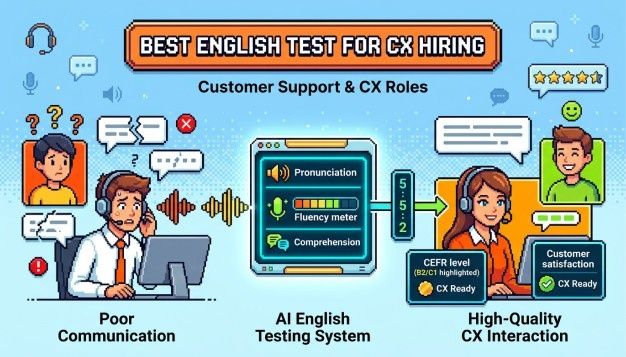
Customer support hiring lives and dies by communication. A strong English proficiency test gives recruiters a reliable, standardized way to assess how candidates actually speak, not just what their resume says. Hyring's EPT uses globally recognized CEFR benchmarks to score candidates on five skills: fluency, grammar, vocabulary, pronunciation, and mother tongue influence. Each one connects directly to CX job performance.

Why English Skills Make or Break a CX Role
Think about the last time you had a frustrating customer service call. Chances are, communication was at the root of it.
In customer support, how clearly an agent speaks is not a soft skill. It is the skill. One muddled explanation, one miscommunicated refund policy, one sentence that goes sideways under pressure. The customer is gone. So is their review score.
The problem is that traditional hiring does not catch this early enough. A candidate can nail a 10-minute phone screen and still struggle badly once they are live on the floor. Call recordings do not lie, but by then, onboarding costs have already been spent.
Customer satisfaction scores, first-contact resolution rates, and average handle time: all of these trace back to how well your agents communicate. Research from Zendesk's CX Trends Report consistently shows that communication quality is the top driver of customer satisfaction. Running an English communication skills test before a single interview is scheduled is one of the most cost-effective things a CX hiring team can do.
What Should an English Proficiency Test for Customer Support Actually Measure?
Here is where a lot of companies get this wrong.
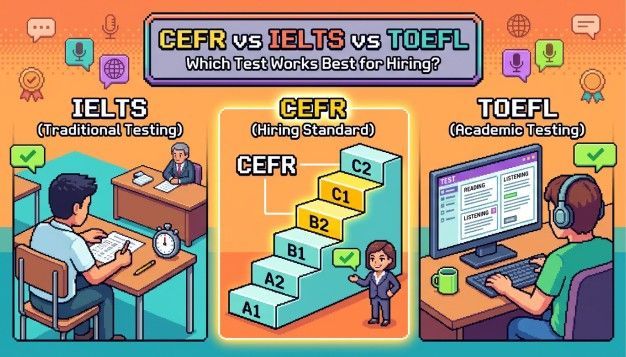
IELTS and TOEFL are designed for universities. They test reading comprehension, formal essay writing, and academic vocabulary. None of that tells you whether a candidate can explain a billing dispute to a frustrated customer without losing the thread.
A proper English screening test for CX hiring needs to capture spoken, real-time communication. Grammar under pressure. Vocabulary that fits a professional service environment. And the scores need to be consistent, the same rubric, applied the same way, to every candidate.
This matters more than it sounds. When you are hiring across multiple locations at volume, one recruiter's sense of "clear English" is not repeatable data. What reads as fluent to one evaluator might not register the same way to another. That inconsistency quietly shapes your shortlist in ways that are hard to audit and harder to defend.
How Hyring's EPT Works: Five Skills That Predict CX Performance
Hyring's English Proficiency Test scores candidates across five dimensions. Each one maps to a real failure point in customer-facing work.
- Fluency: Can the candidate speak naturally, without long gaps or losing momentum mid-sentence?
- Vocabulary: Do they reach for words that suit a professional context, not just casual everyday speech?
- Grammar: Are sentences accurate under natural conversational conditions, not in a controlled, multiple-choice format?
- Pronunciation: Is their speech easy to follow, or does the listener have to work hard to understand them?
- Mother Tongue Influence: How strongly does a candidate's first language shape their English delivery, and does it affect the listener's comprehension?
Each of these has a measurable downstream effect. Weak pronunciation increases average handle time. Customers ask for things to be repeated. Calls run long. Agents lose confidence. Vocabulary gaps show up when agents try to explain technical steps or policy language, and they cannot quite find the right words. Grammar errors in live chat and email quietly damage how professional a brand feels, even when the content itself is correct.
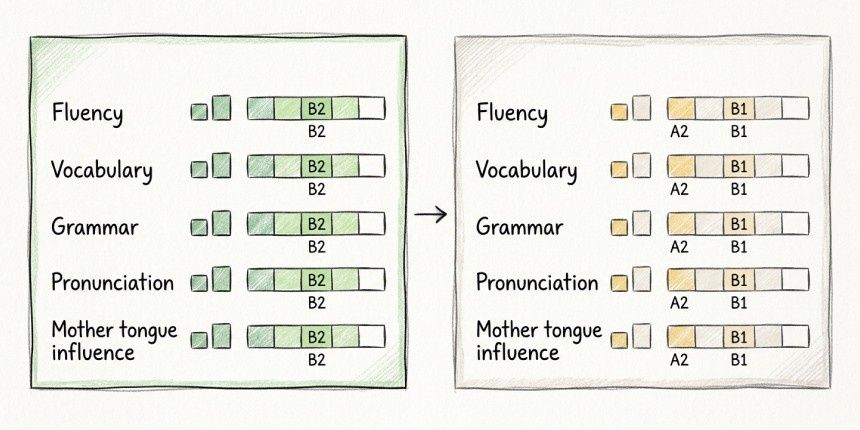
Every candidate gets the same test, the same scoring, and the same AI-driven evaluation. No recruiter fatigue. No variance between evaluators.
What Do CEFR Levels Mean for Your CX Hiring Bar?
Hyring's English proficiency assessment test maps results to the Common European Framework of Reference for Languages (CEFR), a globally recognized standard used across professional and academic contexts in over 40 countries.
For recruiters, this turns a vague impression into a benchmark you can act on.
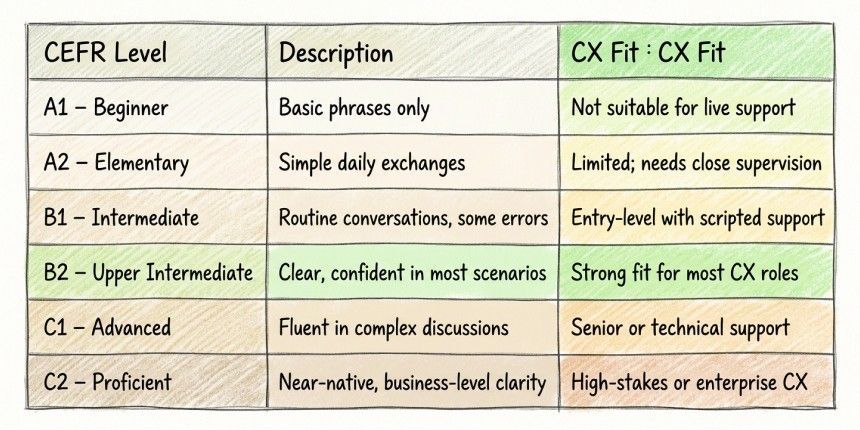
Most customer support roles sit at B2. Set that as your floor. Then filter the pipeline before a single live interview is booked.
This does something important beyond screening. When hiring pressure builds, especially in seasonal or high-volume recruitment cycles, benchmarks erode. Roles need to be filled fast. Standards slip. A hard CEFR threshold keeps the bar in place even when the pressure is on.
How Does AI Change English Assessment at Scale?
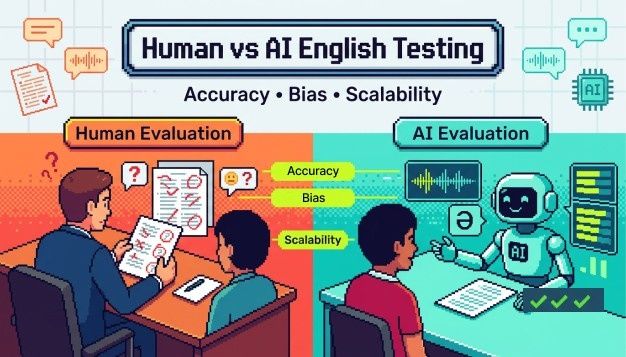
Manual language evaluation is slow. It is also inconsistent in ways that are hard to notice until the data adds up.
Two recruiters can listen to the same candidate and walk away with very different impressions. One reads a strong regional accent as "professional." Another finds it "hard to follow." Neither opinion is a reliable hiring signal. Both shape the shortlist anyway.
Hyring's English screening test runs inside the AI-driven screening workflow. In some hiring setups, the language assessment runs directly within an AI-led interview, so recruiters see how language holds up in a real conversational scenario, not in isolation from a scripted test. That is a meaningful difference. A candidate might score fine on a grammar quiz but completely lose coherence when responding to a scenario question under time pressure. That gap shows up in context.
Results come back in minutes. That makes language screening viable at high volume without creating a bottleneck before human interviews begin.
For global teams hiring across regions, consistency is the point. A candidate in Manila, Nairobi, or Medellín takes the same test, against the same rubric, with the same opportunity to demonstrate their workplace English skills. Geography stops standing in as a proxy for language quality.
Key Takeaways
- Communication is the job. In CX, English proficiency directly shapes handle time, CSAT scores, and first-contact resolution.
- Five dimensions, not one score. Fluency, vocabulary, grammar, pronunciation, and mother tongue influence each point to a different failure mode. A single pass/fail number misses where the gaps actually are.
- CEFR benchmarks give you a shared standard. B2 is the floor for most support roles. Locking that in before the pipeline opens protects the bar when hiring pressure rises.
- AI removes subjectivity and saves time. Automated scoring makes the English proficiency test scalable across geographies without trading accuracy for speed.
- Context reveals what isolated tests cannot. Language assessed inside a real interview scenario shows how candidates perform under pressure, which is what the job actually requires.
Frequently Asked Questions
1. What is the best English proficiency test for customer support hiring?
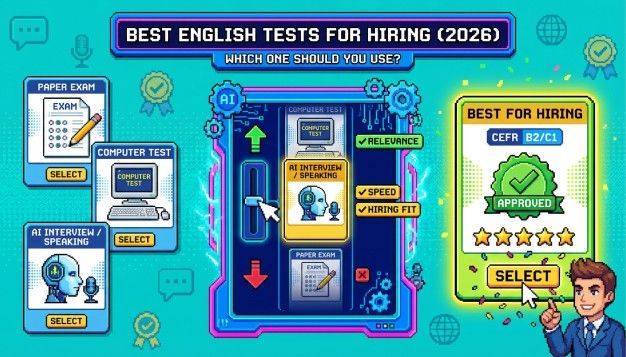
One designed for workplace communication, not academic English. Hyring's EPT assesses five spoken-language skills using AI scoring and maps results to CEFR levels, making it directly relevant to CX screening.
2. What CEFR level should customer support candidates reach?
B2 is the standard threshold for most customer-facing roles. Candidates at this level communicate clearly in typical support scenarios. Senior or technical support often requires C1.
3. How is Hyring's English proficiency assessment test different from IELTS or TOEFL?
IELTS and TOEFL measure academic English. Hyring's EPT evaluates workplace communication, including fluency, grammar, pronunciation, vocabulary, and mother tongue influence, in conversational conditions that reflect what the job actually demands.
4. Can this English screening test handle high-volume CX hiring?
Yes. AI-scored results come back in minutes, making it viable for large pipelines across multiple regions without adding recruiter hours to the process.
5. Does the assessment measure written or spoken English?
Hyring's EPT focuses on spoken English proficiency, which is the primary communication channel in most customer support and CX roles.