TL;DR
The Hiring workflow often overlooks English skills until a bad hire shows the problem. A good English test should help find the best way to check communication skills using CEFR levels and AI. Hyring’s EPT is better because it measures five important work skills automatically.
Why English Proficiency Testing Has Become a Hiring Priority
Think about how much we rely on communication every day, emails, meetings, and updates.
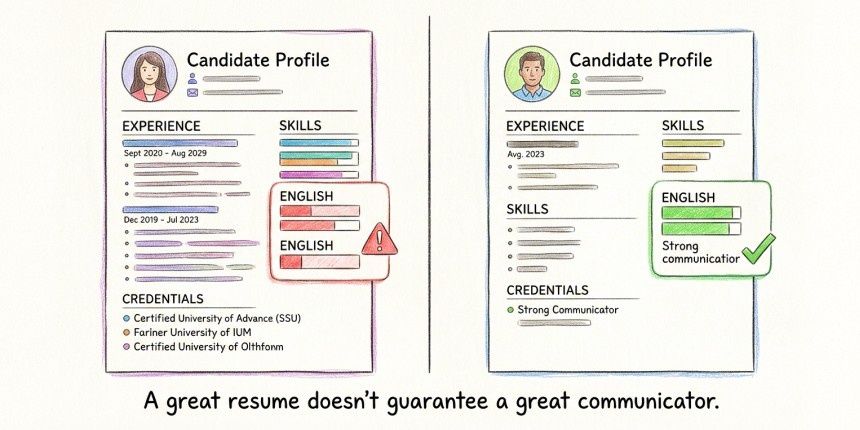
Good English skills are becoming a must for many jobs, not just a bonus. However, checking candidates' English skills is not always a priority. Over 95% of companies say they hire the wrong people each year, often due to communication issues.
A candidate might look good on paper but may not be right for a customer-facing role. This usually shows up only after a job offer is made, which is the worst time. Testing language skills early in hiring can prevent these problems.
The Problem with Traditional Language Tests in Recruitment
The truth about using IELTS and TOEFL for job interviews is that these tests were made for college entry, not hiring. Being able to read and write essays helps in school, but does not show how someone will act under stress or convince managers.
A high score does not mean a person can communicate well under pressure. Also, traditional tests take a long time to prepare for and get results, which is not good for high-volume recruitment.
Recruiters can have very different opinions after watching one video, based on things like the speaker's accent or voice.
What Makes an English Proficiency Test Actually Useful for Hiring
It is important to know that there are different types of language tests, and we should not ignore their differences.
For example, an English Proficiency test should check how well someone speaks, uses the right words, and pronounces clearly. Also, having a standard way to measure results is important for comparison.
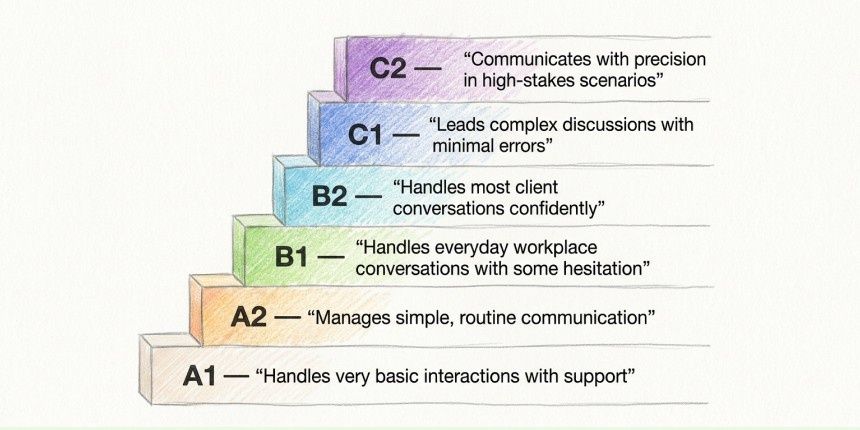
The CEFR system has six levels, from beginner (A1) to advanced (C2), and is known worldwide.
A language test should be part of the overall hiring process, not just a separate score. An AI-driven screening process can provide more information about a candidate's behavior and communication skills.
What English Proficiency Tests should you use for Hiring & Recruitment in 2026?
Hyring English Proficiency Test
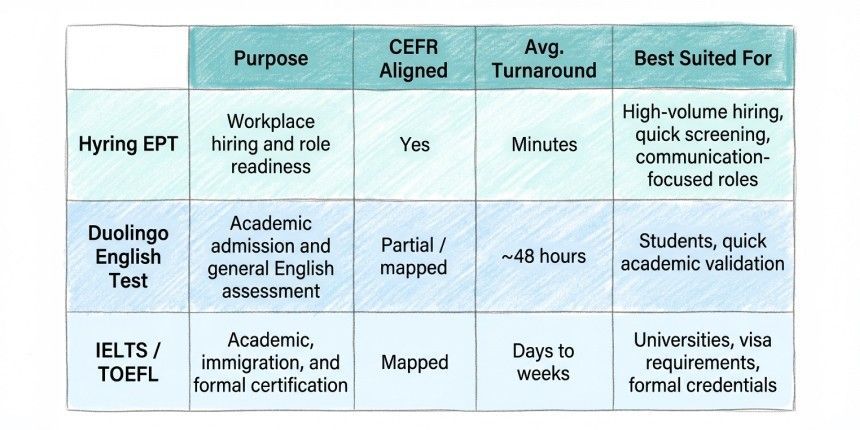
Hyring’s English Proficiency Test (EPT) is made for hiring, making it a unique addition to your hiring process. Instead of testing general English knowledge, it focuses on five areas that matter for work: fluency, vocabulary, grammar, pronunciation, and first language influence.
Understanding how a candidate’s first language affects their English is helpful, especially for jobs abroad. Many tests ignore this, but Hyring’s EPT does not. Scores from this test match CEFR levels, so results are easy to use.
A C1 score means someone can discuss complex topics well. A B1 score means they can handle everyday tasks but may struggle in tough situations. Scoring is done automatically through Hyring’s AI recruiting software, along with resume screening and video interviews.
Duolingo English Test
The Duolingo English Test was made as an easier option than the TOEFL.
It is so accessible that it is now also used for the hiring process as well. It evaluates and checks reading, writing, listening, and speaking skills quickly and cheaply.
However, it does not cover all job-related language skills. It measures basic skills but not tone, business terms, or speaking fluency.
It can be useful for jobs that focus more on writing. With IELTS / TOEFL, you might still need to take them for jobs or immigration. Some jobs require proof of English skills. But for other cases, their high cost and long wait can be a problem.
IELTS / TOEFL
There are scenarios where IELTS and TOEFL still make sense: regulated industries requiring formal certification, roles tied to immigration requirements, and academic or research institutions. In those contexts, the brand recognition and standardization carry real weight.
Outside of them, though, the cost, the turnaround, and the academic framing create friction that most modern recruiting pipelines aren't designed to absorb.
Key Takeaways
The cost of language problems in new hires is high but avoidable.
Many hiring processes find these issues too late. Basic language tests check general English skills.
Recruiters need to see if candidates can communicate well at work, pronounce words correctly, and use the right vocabulary. A CEFR scoring system helps make this clear for each applicant. AI tools like Hyring's English Proficiency Test automate this process, making it faster and fairer, especially for large hiring needs.
Frequently Asked Questions
1. What is the best English proficiency test for hiring in 2026?
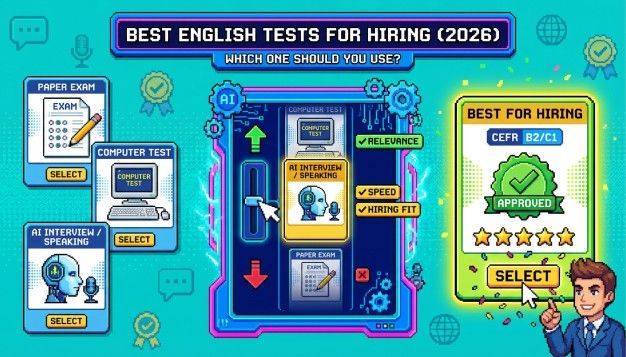
Tests like Hyring's EPT, which use AI, are better for finding candidates for specific jobs. They check professional communication skills and fit well into hiring processes.
2. What does CEFR mean in a hiring context?
CEFR is an internationally recognized proficiency scale from A1 (Beginner) to C2 (Proficient). When a test is CEFR-aligned, results mean the same thing regardless of who's reading them, which makes cross-team and cross-border hiring much more straightforward.
3. Can AI fairly assess English proficiency?
Yes. Human judges may see things differently, but AI uses the same rules to score candidates fairly, regardless of their accents.
4. How early in the hiring process should English testing happen?
As early as possible, especially for jobs needing good communication. This saves time by filtering out unqualified applicants early.
5. Does Hyring's EPT work for multilingual or global hiring teams?
Yes, it is made for that. It considers the influence of a candidate's native language, making it more relevant in the global job market than regular tests.