
TL;DR
The English proficiency level for sales teams isn't defined by words like 'fluent' or 'good enough.' The real question is simpler: can this rep run a sales conversation from start to finish, ask the right questions, handle pushback without freezing, and send a follow-up the buyer will actually read? For most customer-facing roles, you need an independent, job-ready level of English. For enterprise and global roles, that bar goes higher because the conversations are messier, longer, and carry real commercial weight.
Want to screen this early without adding more interviews? Hyring's English Proficiency Test scores workplace communication using CEFR standards and evaluates fluency, vocabulary, grammar, pronunciation, and mother tongue influence.
The Hidden Sales Tax of 'Okay English'

Sales doesn't give you many second chances when communication breaks down.
A rep can be sharp, motivated, and genuinely good at building rapport, and still leak deals consistently if they can't do three things reliably in English:
- Keep the conversation moving without awkward silences
- Explain value in plain terms without trailing off into vague filler
- Confirm next steps in a way that leaves no room for confusion
That gap costs more than people realise. Stalled deals. Longer cycles. Managers jumping into email threads to clean up messages that should never have gone out that way.
Here's the tricky part: most teams don't catch this as an English issue. They call it 'low confidence' or 'needs to improve communication.' Then they put the rep through product training, hoping it sticks. It rarely does, because the real problem was never product knowledge.
What 'Proficient Enough' Sounds Like on a Real Sales Call
Forget grammar-perfect English. Sales needs usable English, the kind that keeps momentum alive even when the conversation goes sideways.
Here's what you want to hear from a candidate who's genuinely ready for customer conversations:
1. They clarify quickly, without over-explaining
Buyer: 'We want something simple.' Rep: 'Simple for whom, your end users, your ops team, or whoever signs off on the budget?'
2. They summarise without rambling
'From what you've shared, the main priority is cutting down on handoffs. The bottleneck right now is approvals, currently taking three days. If we can bring that to the same day, you'd be open to a pilot next month. Is that a fair summary?'
3. They handle pushback without going silent
Buyer: 'We already work with a competitor.'Rep: 'Completely makes sense. What do you value most about them, and where does it still feel like a workaround?'
None of this requires an impressive vocabulary. It just requires control.
The English Proficiency Level for Sales Teams, Based on Selling Motion
This is the piece most hiring teams skip entirely, and it matters more than people think.
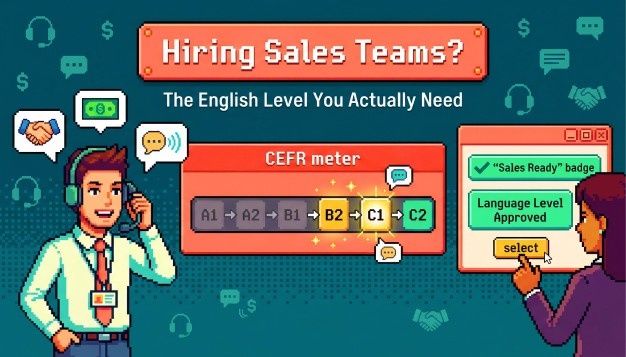
A scripted inbound SDR and a senior enterprise AE are doing completely different jobs. It follows that their English requirements are different too. Setting one universal 'good English' standard doesn't work when the actual tasks vary this much.
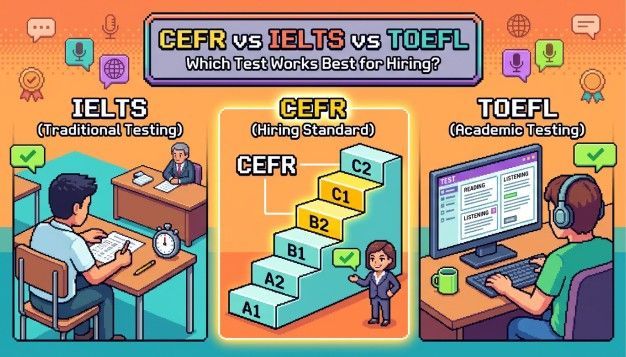
CEFR (Common European Framework of Reference) is a globally recognised scale for measuring language ability, running from A1 (beginner) to C2 (mastery). Hyring uses CEFR as the backbone of its assessments and publishes clear, plain-language descriptions for each level, which makes it a practical tool for setting a hiring bar without second-guessing yourself.
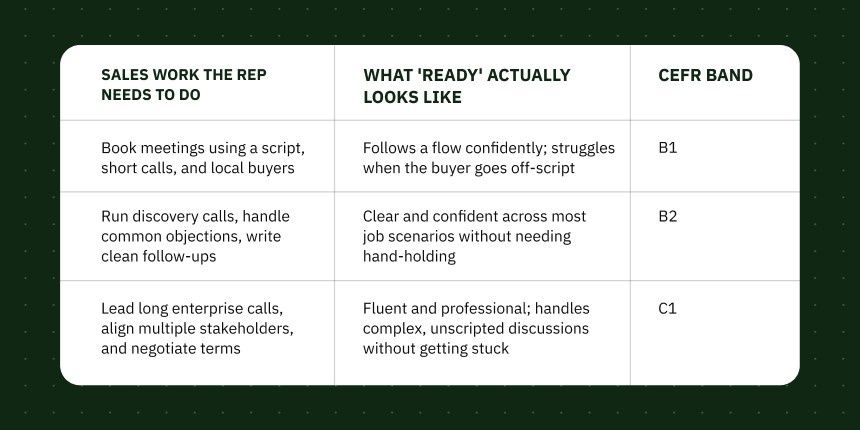
A simple rule of thumb: if the rep needs to improvise often, don't hire for script-level English. If the rep needs to negotiate and present to senior buyers, don't hire for 'can hold a casual chat.'
The Follow-Up Test: Where Most Candidates Slip
Sales hiring interviews are almost entirely focused on talking. But real sales includes a lot of writing, and writing is where 'sounds fine on a call' turns into 'this email can't go to a client.'
A strong rep's follow-up does five things:
- Restates the problem in the buyer's own words
- Captures what the buyer said matters most in their decision
- Lists next steps with clear owners and dates
- Stays short enough to actually get read
- Sounds like a human wrote it
A weak rep's follow-up sounds like this:
'Great speaking with you today. Really looking forward to the next steps. Please let me know if you have any questions.'
No one replies. Not because they're busy, but because there's nothing to reply to.
Hyring's English Proficiency Test evaluates this kind of workplace communication specifically, scoring across vocabulary, grammar, fluency, pronunciation, and mother tongue influence. That combination matters because a follow-up email is a test of all of those at once, not just grammar in isolation.
What to Assess (Without Turning Hiring Into an English Exam)
The goal isn't to run a language school admissions test. It's to assess English the way sales representatives actually use it.
The five signals that matter most
Hyring identifies five factors tied to workplace communication performance: fluency, vocabulary, mother tongue influence, grammar, and pronunciation. Here's how each one plays out in a sales context:
- Fluency (speed and flow under pressure): Listen for what happens when the buyer interrupts or takes the conversation in an unexpected direction. Do they recover quickly, or does the pace collapse into long pauses and filler words?
- Vocabulary (precision without jargon): Can they explain what the product does in plain language that a non-technical buyer would understand? Or do they reach for buzzwords when they're not sure what to say next?
- Pronunciation (numbers and next steps have to land clearly): If a buyer mishears 'fifteen percent' as 'fifty percent,' that's not a minor miscommunication; it's a deal risk. Clarity on figures, timelines, and terms is non-negotiable.
- Grammar (credibility in writing): Not perfection. Just enough control that emails and proposals don't undermine the rep's credibility before the buyer has even responded.
- Mother tongue influence (a coaching signal, not a red flag): This isn't about penalising accents. It's about understanding what coaching the rep might need to communicate more clearly in high-stakes moments.
Two practical checks you can run right now
Keep both job-like. Keep both short.
- Objection role-play (90 seconds): Give them one real objection from your pipeline. Ask them to respond, then throw one follow-up question. You'll see fluency, composure, and vocabulary under mild pressure, all at once.
- Follow-up recap (under 6 sentences, timed): 'You just ran a discovery call. Write the follow-up email. Keep it under 6 sentences.'
You'll learn more from these two tasks than from a 15-minute general conversation about their background.
How to Screen English Early, Fast, and Consistently
Language assessment that happens late in the process is expensive for everyone involved. The sales panel spends time evaluating candidates who should have been filtered earlier. Hiring managers end up making judgment calls on English 'vibes' instead of actual data.
A cleaner workflow looks like this:
- Set the bar based on the selling motion (scripted, discovery-led, or enterprise) before you post the role
- Screen early so the panel only meets candidates who can genuinely communicate on the job
- Use a consistent scoring method so there's no variation between interviewers or hiring rounds
Hyring's English Proficiency Test is built for this kind of early-stage screening. It's AI-powered, CEFR-aligned, and designed to assess workplace communication specifically, not general English ability. The verbal interview format takes around four minutes, which means it fits into a pre-screen without adding meaningful time to the process.
That kind of filter protects the sales panel so they can focus on what they're actually supposed to be evaluating: selling skill, pipeline thinking, and closing instinct, not trying to read between the lines of how someone phrases an answer.Recruiters have noticed a clear pattern with sales reps. Those who struggle most aren't lacking product knowledge; they're lacking communication skills.
Key Takeaways
- The English proficiency level for sales teams should be set based on the actual selling job, not a blanket 'fluent English preferred' requirement.
- Sales-ready English means clear questions, clean summaries, and composed objection handling, not accent-free speech or perfect grammar.
- Writing is just as important as speaking, so test follow-ups, not just conversation.
- Use a structured, consistent screen early in the process. Hyring's English Proficiency Test scores workplace communication across fluency, vocabulary, grammar, pronunciation, and mother tongue influence, benchmarked to CEFR.
Frequently Asked Questions
1. What English proficiency level should I hire for in sales?
It depends on the role. For most customer-facing positions, you need a rep who can run discovery, handle objections, and write clear follow-ups independently, without a manager cleaning up their communication. That typically maps to an independent, job-ready level rather than basic conversational ability. For enterprise roles with longer sales cycles and senior stakeholders, the bar is higher.
2. Should I prioritise accent when assessing candidates?
No. Focus on clarity, specifically, whether the buyer can understand key points, numbers, and next steps without asking for repetition. Accent alone is not a reliable indicator of communication effectiveness.
3. What's the fastest way to test English for sales hiring?
A short verbal role-play combined with a written follow-up task tells you most of what you need to know. If you want a standardized, consistent benchmark across candidates, a CEFR-aligned assessment that scores workplace communication factors, like Hyring's English Proficiency Test, gives you a score you can actually compare across candidates and hiring rounds.
4. What does Hyring's English Proficiency Test measure?
It evaluates workplace communication using AI, benchmarked against CEFR standards. The assessment scores candidates across five factors: fluency, vocabulary, mother tongue influence, grammar, and pronunciation, all of which are relevant to how a sales rep communicates with buyers on calls and in writing.