
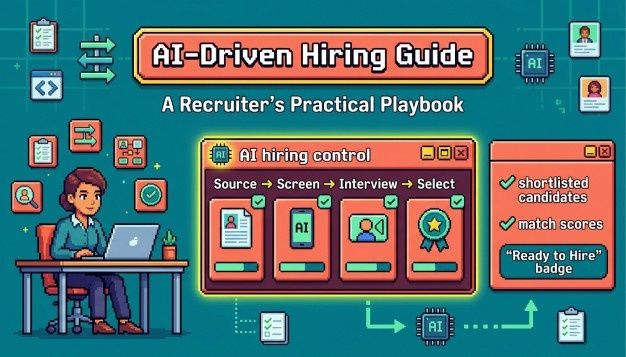
You post a job. Within days, you are buried in applications. Half of them are not even relevant. Your inbox is a mess. Hiring managers are asking for updates. The right candidate is waiting in the midst of the chaos as the candidates are chasing you for feedback.
This is what the recruitment process looks like for most teams – the need for speed without sacrificing quality.
According to sources, recruiters spend about 23 hours screening resumes for a single hire. That is a lot of time on just one part of the process.
That is exactly where AI is starting to make a difference. Not by taking over the process. But by taking the weight off the parts that slow you down the most.
So how does it actually work? And more importantly, how do you use it without losing what makes great hiring great?
What Does AI in Recruitment Actually Mean?
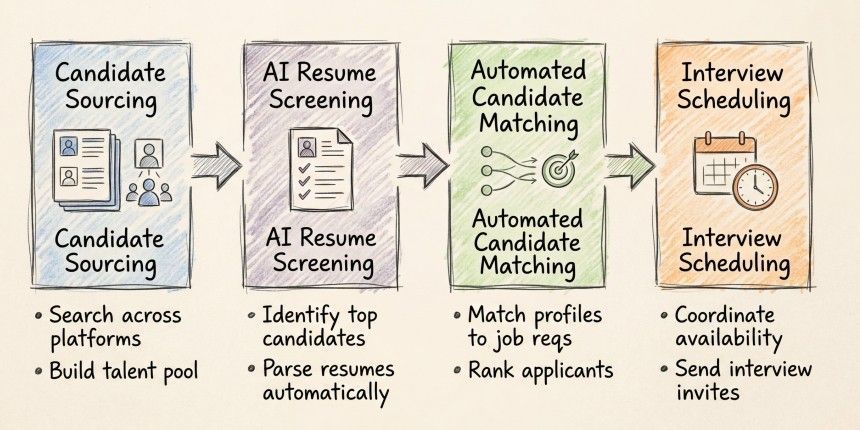
AI in hiring mostly works in the background. It takes care of the stuff that is time-consuming. Resume screening, candidate sourcing, scheduling interviews, and running initial assessments are handled by AI. These tasks are repetitive, and AI just does them faster.
Say you post a job and get 500 applications. AI resume screeners can scan all of them in minutes. It pulls out the candidates who match what you are looking for. You still make the call. But now you are working from a shortlist instead of a pile.
There are other uses, too. AI agents run around the clock. Tools that flag biased language in job descriptions. Platforms that look at data patterns to suggest which candidates might be the best fit.
None of this replaces your judgment. It just gives you a head start.
Why AI Works So Well for Recruitment
Hiring has a lot of moving parts. AI fits naturally into the process because so much of the early work is structured and repetitive. That is exactly where it performs best.
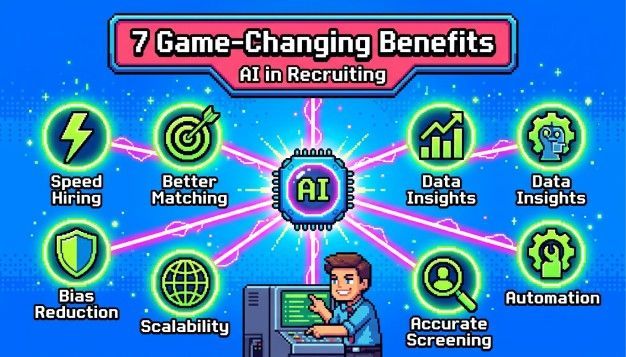
It saves time. Open roles cost money the longer they sit unfilled. The Society for Human Resource Management (SHRM) estimates that the average cost per hire is over $4,700. AI speeds up the early stages, so candidates move through your pipeline quicker, and those costs stay down.
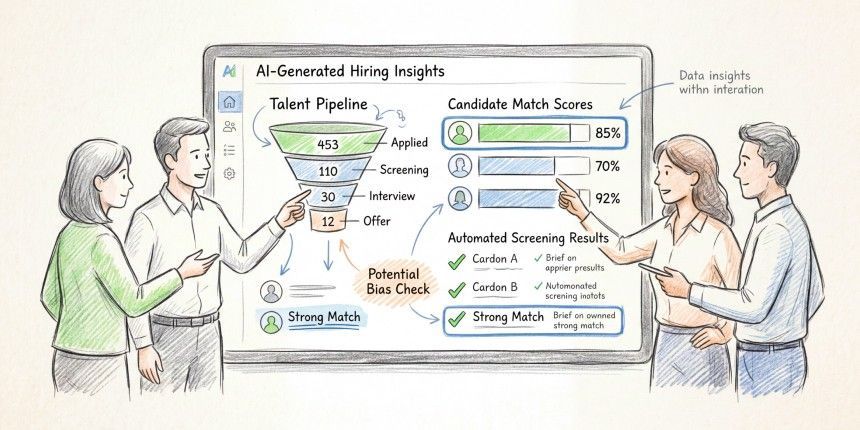
It brings consistency. We all have off days, and we all carry biases we do not always notice. AI applies the same criteria to every single application. That adds a layer of fairness and structure that helps teams make better decisions from the start.
It also gives you useful data. Which job boards bring in your best hires? Where do candidates drop off? AI tracks these things so you can make smarter decisions next time.
How AI Strengthens Every Stage of Hiring
In fact, AI is not just helpful in one area of the hiring process; it can add value throughout the whole process.
In the screening part, AI can help analyze resumes quickly and accurately, giving your organization a list of the most suitable candidates in just a few minutes instead of hours spent perusing every single resume.
The candidates do not have to wait any longer or be ignored; instead, their queries are addressed, and updates are provided to ensure that no candidate feels neglected in the process, as AI drives the interview process faster.
In the interview part, scheduling does not have to be a problem because AI can find a time that is suitable for everyone and send out confirmations automatically.
In fact, AI can also be helpful in the onboarding process by automating tasks, sending reminders, and helping the new employees adjust quickly to their new roles.
Each part of the hiring process is made faster, smoother, and better with the help of AI.
How to Get Started
You do not have to change everything at once. Small steps work.
Figure out where you are losing the most time. Is it screening, scheduling, or follow-ups? Start there.
Train your team. People need to know what the tool does and what it does not do. They also need to know how to read the results it gives them.
Keep people at the centre. AI should get candidates to the interview faster. But the interviews, the conversations, the final calls? Those should always be human.
Check in on how things are going. Are you seeing better candidates? Faster hires? If something is off, adjust.
Where Hyring Fits In
As AI becomes more common in hiring, platforms that blend technology with simplicity are standing out. Hyring is one of them.
Hyring focuses on helping companies connect with qualified talent without adding complexity. The AI recruitment platform is built to make hiring faster and more straightforward while keeping the process grounded in real human interaction.
If you are looking for a way to modernise your hiring method without overcomplicating things, it is worth exploring what platforms like Hyring can offer.
What Comes Next
AI in recruitment is not going away. It is becoming the norm. The tools are getting smarter. Some can now assess soft skills through video interview software. Others predict how long a new hire is likely to stay. The technology keeps growing, and the teams using it are seeing real results.
The organisations that get the most out of AI will be the ones that treat it as a partner. The goal is not to take people out of hiring. It is to give them better tools so they can do it well.
Final Thoughts
AI is changing how we recruit. But the basics have not changed.
You still need to understand the role. You still need to know what good looks like. AI just clears the path so you can do more of that. It handles the noise. You focus on the signal.
Stay curious. Stay open. And never forget that hiring is, at its core, about people.
Frequently Asked Questions
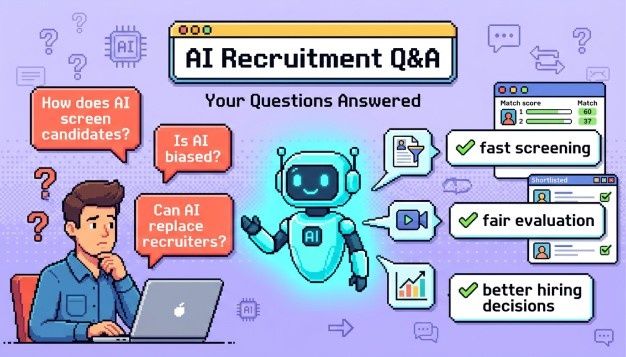
1. Will AI replace recruiters?
No. AI takes care of repetitive work like screening resumes and scheduling calls. The important stuff still needs a person. Evaluating culture fit, reading between the lines in a conversation, and making final hiring decisions. That is all human. AI makes recruiters faster. It does not make them obsolete.
2. How does AI improve the quality of hires?
AI screens candidates against specific criteria consistently. It does not get tired or distracted. It also analyses data from the recruiters about the specific skills and requirements for the particular role, leading to successful placements. Over time, this helps teams build stronger shortlists and make more informed decisions.
3. Is it expensive to use AI in hiring?
Not when you consider the return on investment. While some tools have a monthly fee, the savings usually far outweigh the cost. By reducing your $4,700 average cost-per-hire and cutting down those 23 hours of manual screening, AI pays for itself. It’s not just an expense. It’s a way to stop losing money on unfilled roles and inefficient workflows.
4. Do candidates like AI in hiring?
Candidates appreciate quicker responses and a smoother process. The best thing you can do is be upfront about how AI is used. Transparency builds trust and shows candidates that your company values their time and experience.
5. Where should we start with AI in recruitment?
Look at your biggest time drain. For most teams, that is resume screening or candidate communication. Pick one area. Find a simple tool that helps. Test it on a small scale. Learn from it. Then expand. You do not need to go all in on day one.