IBM Careers logo

IBM Careers

A 1911-founded American IT company running software, consulting and infrastructure businesses, with roughly 100,000 of its 264,300 employees based in India.

ibm.com

About the company

CFO

James J. Kavanaugh, Chief Financial Officer and Senior Vice President of Finance & Operations

Founded

June 16, 1911 as the Computing-Tabulating-Recording Company, renamed IBM in 1924

Employees

264,300 worldwide, about 100,000 in India

Industry

Information technology services and consulting

Revenue (FY25)

$67.54 billion, with $69.10 billion trailing twelve months as of July 2026

Market Cap

$193.40 billion as of July 2026

Listed on

NYSE: IBM

Headquarters

1 Orchard Road, Armonk, New York, USA. IBM India is headquartered in Bengaluru, Karnataka

IBM is an American multinational technology company legally named International Business Machines Corporation. It was founded on June 16, 1911 as the Computing-Tabulating-Recording Company and took the IBM name in 1924. The company is headquartered at 1 Orchard Road in Armonk, New York, trades on the NYSE under the ticker IBM, and is one of the 30 components of the Dow Jones Industrial Average. It operates in more than 175 countries and describes itself as the largest industrial research organisation in the world, with 12 research laboratories across six continents.

The business spans software, consulting and infrastructure. In the second quarter of 2026 IBM reported revenue of $17.2 billion, split across Software at $7.8 billion (up 5 percent, led by Hybrid Cloud and Red Hat at plus 11 percent), Consulting at $5.3 billion, Infrastructure at $3.8 billion and Financing at $0.2 billion. Full year 2025 revenue was $67.54 billion and trailing twelve month revenue stood at $69.10 billion in July 2026. Headcount is about 264,300. Arvind Krishna is Chairman, President and CEO, and James J. Kavanaugh is Chief Financial Officer.

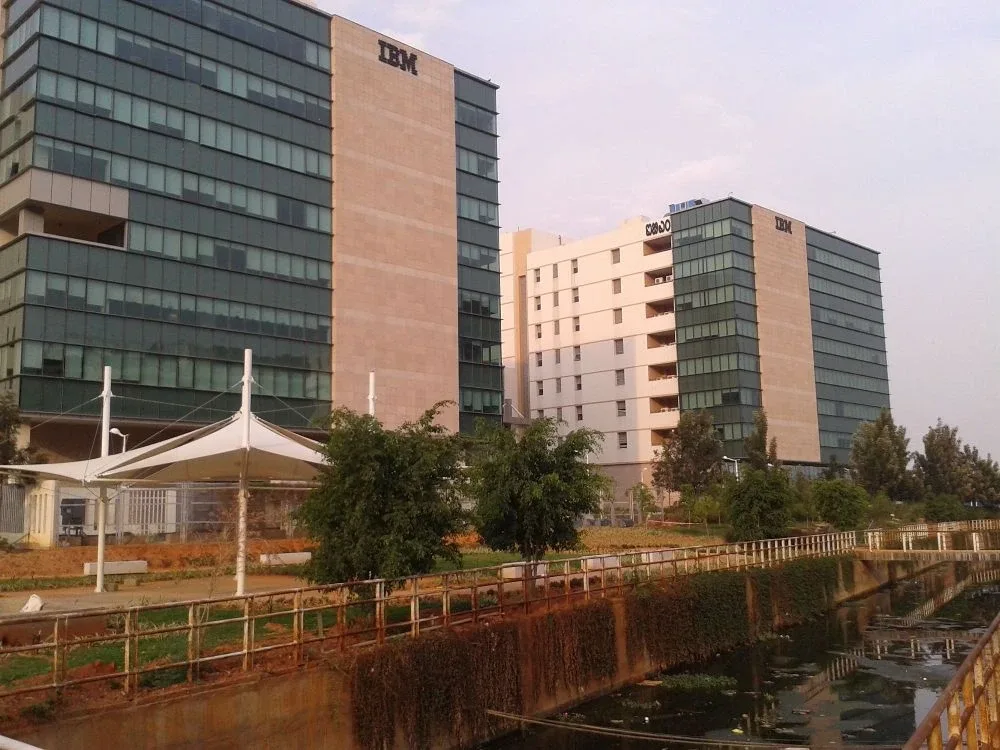
India is one of IBM's largest workforces. The local entity, IBM India Private Limited, carries CIN U72200KA1997PTC022382, is registered with the RoC in Bangalore and is headquartered in Bengaluru. IBM re-entered India in 1987 after an earlier stint from 1966 to 1976, and now employs roughly 100,000 people across Bengaluru, Pune, Hyderabad, Chennai, Kochi, Mumbai, Delhi, Gurgaon, Noida, Kolkata, Ahmedabad, Coimbatore, Mysuru, Bhubaneswar and Visakhapatnam. Sandip Patel is Managing Director for India and South Asia. Indian units include the India Software Labs, consulting delivery and systems development, and recent India investments centre on enterprise AI and infrastructure.

Key People

Arvind Krishna

Chairman, President and Chief Executive Officer

James J. Kavanaugh

Chief Financial Officer and Senior Vice President of Finance & Operations

Nickle LaMoreaux

Senior Vice President and Chief Human Resources Officer

Sandip Patel

Managing Director, IBM India and South Asia

Photos

IBM workplace 1

Interview process at IBM

(Based on 2,062 responses from candidates in India)

Interview experience

Favourable, 7 out of 10

Interview difficulty

Medium, 6 out of 10

Interview process length

About a week for most candidates

Overall experience

PoorExcellent
EasyDifficult

How long the process takes

About a day or two19%
About a week22%
About a month18%
More than one month20%

Prep for your IBM interview with AI

Practise real IBM questions with an AI interviewer and get instant feedback on your answers.

IBM Interview Questions & Answers

Q: What is shallow copy and deep copy?

A: A shallow copy duplicates the top level object but keeps pointing at the same nested objects, so changing a nested value shows up in both copies. A deep copy recursively duplicates everything, so the two objects are fully independent.

Answer by AI
  • Shallow copy copies field values as they are, which means references are shared and nested state stays linked.
  • Deep copy walks the whole object graph and rebuilds each nested object, so mutations don't leak between copies.
  • Mention the cost trade off: deep copies are safer but slower, and you need cycle handling for self referencing graphs.

Q: For runtime polymorphism, what else is necessary, other than the function to be virtual?

A: You also need to call the function through a base class pointer or reference. A virtual function invoked on an object directly is resolved at compile time, so the dynamic dispatch never happens.

Answer by AI
  • The call must go through a base class pointer or reference so the vtable lookup happens at runtime.
  • The derived class must override the function with a matching signature, otherwise it hides rather than overrides.
  • Add that the base class should have a virtual destructor when you delete derived objects through a base pointer.

Q: Explain the SOLID principles.

A: SOLID covers single responsibility, open closed, Liskov substitution, interface segregation and dependency inversion. Together they push you toward small focused classes that you extend rather than edit, and that depend on abstractions instead of concrete types.

Answer by AI
  • Name each letter and give a one line definition, then a concrete example from code you've written.
  • Show you understand the goal rather than the acronym: these rules exist to keep change local and testing cheap.
  • Be honest about trade offs. Over applying interface segregation can leave a codebase with more indirection than it needs.

Q: String compression: convert "abbcddeee" into "ab2cd2e3".

A: Walk the string once, count each run of identical characters, then append the character and, only when the count is above one, the count itself. That gives O(n) time and O(n) space for the output buffer.

Answer by AI
  • Use two pointers or a running counter over a single pass, then build the result in a string builder.
  • Skip the count when a run has length one, which is why the a and c in the example carry no digit.
  • Call out edge cases: empty string, single character, runs longer than nine, and whether the compressed form can end up longer than the input.

Prep for your IBM interview with AI

Practise real IBM questions with an AI interviewer and get instant feedback on your answers.

IBM Salaries in India (Updated 2026)

Software Engineer

Site average, all levels

₹10,54,767/yr (average)

179 salaries reported Salaries submitted

Senior Software Engineer

Site average, all levels

₹15,85,076/yr (average)

43 salaries reported Salaries submitted

Application Developer

Site average, all levels

₹9,04,352/yr (average)

132 salaries reported Salaries submitted

Data Engineer

Site average, all levels

₹12,05,888/yr (average)

42 salaries reported Salaries submitted

Senior Data Scientist

Site average, top of IBM India range

₹19,28,224/yr (average)

Risk Analyst

Site average, bottom of IBM India range

₹3,40,378/yr (average)

Know your worth at IBM

Compare your current pay against real IBM India bands and see which roles fit your experience.

Build a standout resume with AI

Match your resume to the IBM role you want and see exactly what's missing before you apply.

Benefits

Health insurance cover for employees
Free learning platforms and certifications
Chance to upskill and switch projects to match your skills
Roughly 15 to 25+ days of paid time off a year, depending on tenure and location
4 personal choice holidays on top of PTO
Flexible workplace options and work from home
Flexible timing reported by employees in India
Fixed pay component (employee reported perk in India)
401(k) match and automatic contributions paid every pay period (US plan)
Three medical plan options for active employees, with most paying the same or lower monthly premiums (US plan)
IBM sponsored Group Medicare Advantage retiree plan with a zero premium option (US)
20 weeks paid maternity leave for birth mothers and 12 paid weeks for fathers, partners and adoptive parents (US)
Up to $20,000 reimbursement for adoption or surrogacy expenses (US)

Latest News & Updates

July 22, 2026

IBM reports Q2 2026 revenue of $17.2 billion and trims full-year outlook

IBM posted second quarter revenue of $17.2 billion, up 1 percent, with Software at $7.8 billion and Infrastructure down 7 percent. The company now guides to 4 to 5 percent constant currency revenue growth for the full year.

#Earnings #Results #Guidance

View post

July 15, 2026

IBM launches new Power Systems and software for enterprises

IBM introduced Power Systems hardware and accompanying software aimed at enterprise risk, productivity and flexibility needs. The launch includes Power Autonomous Operations and the Power S1112 server.

#Infrastructure #ProductLaunch

View post

June 29, 2026

Gujarat government, IAIRO and IBM plan an Industrial AI Centre of Excellence

The Government of Gujarat, IAIRO and IBM announced plans for an industrial artificial intelligence centre of excellence in the state. It's one of several IBM India AI investments announced in 2026.

#India #AI #Partnership

View post

May 13, 2026

IBM and IndiaAI study says AI could add over $500 billion to India's economy by 2030

A joint IBM and IndiaAI study estimated artificial intelligence could contribute more than $500 billion to India's economy by 2030. The study covers adoption across Indian industry sectors.

#India #AI #Research

View post

March 4, 2026

IBM opens its first infrastructure innovation center in India

IBM launched its first India infrastructure innovation center to help enterprises build and scale AI workloads. The facility sits at IBM's Bengaluru systems development campus.

#India #AI #Bengaluru

View post

IBM FAQ

IBM is an American multinational technology company running three main businesses: software, consulting and infrastructure. In Q2 2026 it reported $17.2 billion in revenue, with Software at $7.8 billion, Consulting at $5.3 billion and Infrastructure at $3.8 billion. It operates in more than 175 countries.