Tesla Interview Process - Electrifying Advantage with Hyring AI Agents
The Tesla interview process absorbed roughly 5.9 million job applications in 2023 alone. With a workforce that swung from 140,473 employees at the end of 2023 to 125,665 by December 2024 after a 10%-plus global layoff, and then climbed back to an estimated 134,785 by end of 2025, the company is simultaneously shedding roles and creating new ones that did not exist eighteen months ago. Optimus, Robotaxi, full self-driving. Three product lines pulling from entirely different candidate pools, all funnelled through the same career portal.
This blueprint maps where Hyring's AI agents can absorb manual screening, phone interviews, and technical validation across that funnel, what each agent outputs for the hiring team, and which metrics keep the whole thing measurable.
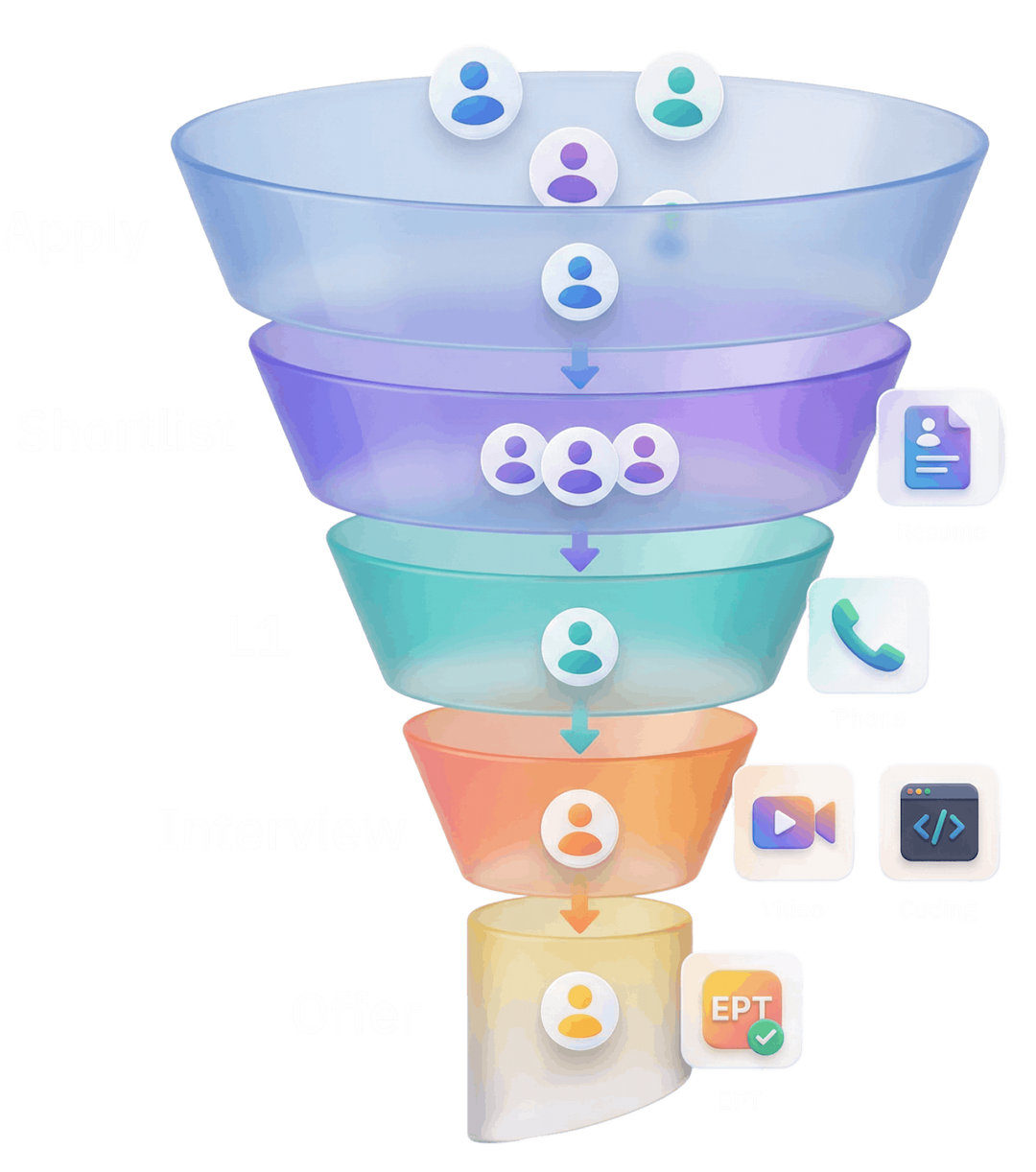
This article is a planning framework showing where AI can reduce manual effort across the funnel.
The Road Ahead
The headcount whiplash of Tesla tells you something important. They have to manage the hiring pipeline that expands and contracts in the same year. Most hiring teams manage one of those two situations. But not both.
The following has four parts and is combined into one operating model. First, the funnel map. Here, we track the multi-track pipeline of Tesla (manufacturing, software, AI/robotics). Second, the phased deployment. Here, we use pilot roles and weekly check points. Third, the KPI scoreboard. Here, we have ten metrics. Each of them will have a risk flag based on the company's position against Rivian, Lucid, Apple, and Google DeepMind for talent in the field of engineering. Fourth, the ROI module - uses Tesla's publicly reported volumes with all projections clearly marked as illustrative.
Where the hiring funnel of Tesla clogs up is not the final panel. That is the last part of the funnel. Where the funnel clogs up is the part where the 5.9 million applications need to be converted into 50,000 phone screens and 25,000 technical assessments. But the engineers who should be working on full self-driving (FSD) V13 are working on hiring funnels instead.
Current State
Tesla closed FY 2024 with approximately 125,665 employees as of December 31, 2024, per its annual 10-K filing. That number represented a net reduction of 14,808 from the 140,473 reported at the end of FY 2023, driven primarily by the April 2024 layoffs that cut over 10% of the global workforce (Reuters, April 2024).
The rebound was fast. By the end of 2025, headcount had recovered to approximately 134,785, a 7.26% increase year-over-year. The composition shifted though. Manufacturing and delivery roles that were cut in April 2024 were partially replaced by AI, robotics, and autonomy engineers through the second half of 2024 and into 2025. Tesla posted its first AI hardware engineer roles in India in February 2026, signalling geographic expansion for technical recruitment.
The application volume is staggering and almost absurd to think of. Tesla received 5.9 million job applications in 2023, up 64% from 3.6 million in 2022. Even after the layoff headlines, application interest remained high.
The Tesla hiring process runs 25 to 40 days from first contact to offer, per Glassdoor data based on 4,900+ candidate reviews. Stages include an initial recruiter phone screen (20 to 30 minutes), a HackerRank or Codility technical assessment for engineering roles, and three to five rounds of virtual or onsite panel interviews.
~125,665
5.9 million
25-40 days
Problems in the Tesla Interview process
When 5.9 million people apply and the average time to hire stretches to 40 days, the question stops being "how do we screen faster" and becomes "where exactly are we losing the candidates we actually want?"
Resume screening at this volume is a staffing problem disguised as a process problem
Five point nine million applications. If 15% are minimally qualified (a generous filter), that leaves 885,000 resumes requiring human review. At 4 minutes per resume, you are looking at 59,000 person-hours of screening labour per year. Phew!
No recruiter team scales to that without either massive seasonal hiring of contract screeners or aggressive automated keyword filtering that rejects qualified candidates alongside unqualified ones.
Engineering panels burn Optimus and FSD delivery hours on interviews
A senior autonomy engineer pulled into a campus interview sprint for 3 hours a day is 3 hours of unbilled work on a $10 billion Robotaxi program.
If 25,000 candidates reach technical panels annually and each interview averages 45 minutes with 1.5 panellists, that is 28,125 person-hours of engineering time absorbed. It does not appear on the recruiting budget. It appears on the vehicle delivery timeline.
Post-layoff offer acceptance is a brand problem that speed can fix
After the April 2024 layoffs hit global headlines, Tesla's employer brand took a measurable hit on sentiment trackers. Candidates with competing offers from Google, Apple, or Rivian have less patience for a 40-day cycle.
Compressing the Tesla interview process from six weeks to two is not just efficiency. For contested AI talent, it is the difference between a signed offer and a ghosted recruiter.
Remote technical assessments rely on interviewer attention that degrades by session five
As Tesla's global footprint expanded, remote and asynchronous/conversational interviews became standard for many roles. But proctoring a live coding session over video depends on the interviewer noticing tab switches, audio anomalies, or secondary speakers. By the fifth consecutive session, that attention is shot. The integrity gap widens with every additional interview, and it scales linearly with candidate volume.
Hyring AI Agents
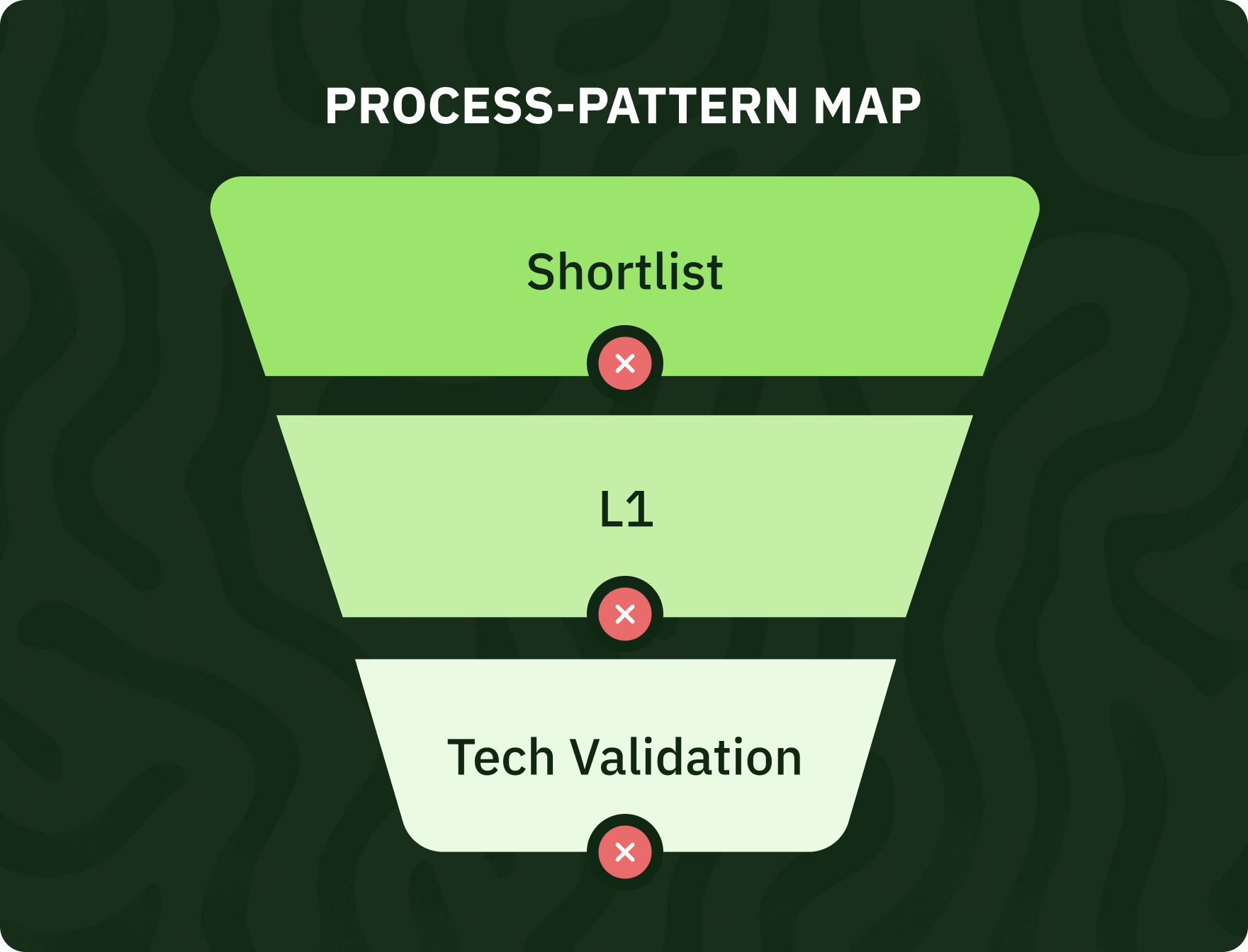
At 5.9 million applications per year, Tesla's funnel has a simple structural question - which stages need a human to think, and which stages need a human to repeat the same checklist thousands of times?
Hyring's agents sit at the repetition-heavy stages. Wherever the evaluation follows a fixed rubric with a scored output, the agent runs it. Contextual judgment, final-stage decisions, culture-fit reads: those stay with people. Every offer still requires human approval.
The AI Resume Screener
Instantly parse and rank resumes based on job-fit signals and technical requirements.
- Rapid high-volume parsing
- Objective skill ranking
- Bias-reduced shortlisting
The AI Phone Screener
Automated L1 verification calls to ensure basic qualifications and interest levels.
- 24/7 automated screening
- Consistent evaluation metrics
- Instant shortlist generation
The AI Coding Interviewer
Technical assessment with live coding environments and real-time logic evaluation.
- Real-time code analysis
- Plagiarism detection
- Automated logical scoring
English Proficiency Test
Standardized evaluation of communication skills, fluency, and professional vocabulary.
- Automated fluency scoring
- Grammar and clarity analysis
- CEFR aligned reporting
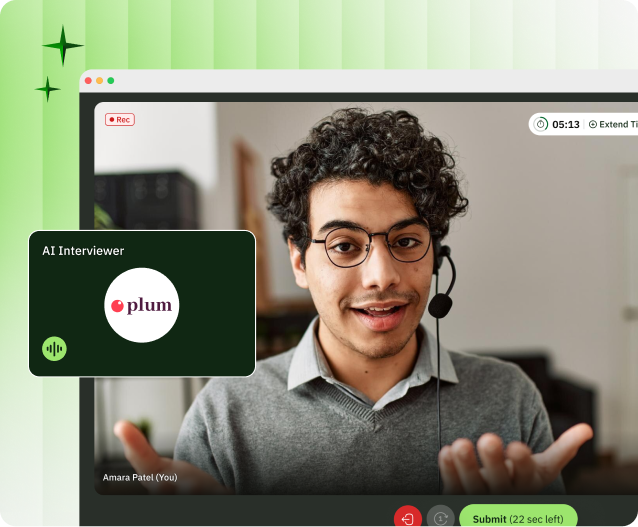
Funnel-to-agent
| HIRING STAGE | HYRING PRODUCT | WHAT IT DOES | OUTPUT (WHAT THE TEAM SEES) |
|---|---|---|---|
| SHORTLIST | AI Resume Screener | Parses inbound applications against role-specific criteria across Tesla's manufacturing, software, and AI/robotics tracks. | Scored shortlist with role-fit flags per track. |
| L1 SCREENING | AI Phone Screener | Conducts initial phone conversations to gauge candidate interest, availability, salary expectations, and basic qualification fit. | Call transcript + composite score + advance/hold tag. |
| STRUCTURED INTERVIEW | AI Video Interviewer | Runs async or scheduled video interviews with behavioural and competency questions calibrated to the role level. | Video recording + structured evaluation + integrity score. |
| TECH VALIDATION | AI Coding Interviewer | Administers live or timed coding challenges for software, firmware, and ML engineering candidates. | Code evaluation report with pass/fail and skill breakdown. |
| COMMUNICATION | English Proficiency Test | Benchmarks spoken English for roles requiring cross-site or client-facing communication. | CEFR-aligned level + fluency and accuracy scores. |
HYRING PRODUCT
AI Resume Screener
WHAT IT DOES
Parses inbound applications against role-specific criteria across Tesla's manufacturing, software, and AI/robotics tracks.
OUTPUT (WHAT THE TEAM SEES)
Scored shortlist with role-fit flags per track.
HYRING PRODUCT
AI Phone Screener
WHAT IT DOES
Conducts initial phone conversations to gauge candidate interest, availability, salary expectations, and basic qualification fit.
OUTPUT (WHAT THE TEAM SEES)
Call transcript + composite score + advance/hold tag.
HYRING PRODUCT
AI Video Interviewer
WHAT IT DOES
Runs async or scheduled video interviews with behavioural and competency questions calibrated to the role level.
OUTPUT (WHAT THE TEAM SEES)
Video recording + structured evaluation + integrity score.
HYRING PRODUCT
AI Coding Interviewer
WHAT IT DOES
Administers live or timed coding challenges for software, firmware, and ML engineering candidates.
OUTPUT (WHAT THE TEAM SEES)
Code evaluation report with pass/fail and skill breakdown.
HYRING PRODUCT
English Proficiency Test
WHAT IT DOES
Benchmarks spoken English for roles requiring cross-site or client-facing communication.
OUTPUT (WHAT THE TEAM SEES)
CEFR-aligned level + fluency and accuracy scores.
KPI Scoreboard - Tesla Hiring Model
Time to Screen
Definition: Calendar days between a completed application and the first screening decision (advance or reject).
Risk indicator: Tesla competes with Google DeepMind and Apple for the same AI candidates. If screening takes longer than 72 hours for autonomy roles, the top 5% of that applicant pool is already in a competing pipeline. Track this separately for AI/robotics versus manufacturing tracks.
Screening Throughput
Definition: Number of applications processed to a decision state per recruiter per week.
Risk indicator: If throughput doubles but the shortlist-to-phone-screen conversion drops, your screening criteria got looser, not your team faster. Audit a sample of 200 rejections before celebrating the number.
Interview Completion Rate
Definition: Percentage of candidates who receive a scheduled interview slot and actually finish the full session.
Risk indicator: Completion below 55% for remote technical rounds often traces back to assessment length. Tesla's coding challenges reportedly run 60 to 90 minutes; candidates with three other offers will abandon anything past 50 minutes.
Early Stage Drop-offs
Definition: The funnel step where candidates stop responding or formally withdraw.
Risk indicator: If the biggest drop happens between phone screen and technical assessment (not between application and phone screen), the delay between stages is the problem, not the assessment itself. Candidates sitting idle for 10 days after a phone screen assumes they were rejected.
Panel Hours per Hire
Definition: Total interviewer-hours consumed by human panels per accepted offer.
Risk indicator: If panel hours per hire drop and 90-day attrition rises simultaneously, the AI screening layer may be filtering out signals that only a live conversation catches. Compare attrition rates for AI-screened versus manually-screened cohorts quarterly.
Pass-through Rate
Definition: Percentage of candidates who clear one stage and enter the next.
Risk indicator: A 25-point pass-through variance between Gigafactory Austin and Gigafactory Shanghai for the same production role means the rubric needs site-level tuning. One threshold will not fit factories operating under different labour regulations and candidate pools.
Shortlist-to-Offer Ratio
Definition: How many shortlisted candidates it takes to produce one accepted offer.
Risk indicator: Improving from 12:1 to 6:1 is meaningful. Dropping below 3:1 means you are over-pruning and losing candidates who would have performed well. For AI/ML roles where the qualified pool is already thin, a ratio below 4:1 warrants a rubric review.
Integrity Flag Rate
Definition: Percentage of AI-administered interviews that trigger fraud, impersonation, or cheating alerts.
Risk indicator: Expect 4 to 6% as a baseline across remote technical rounds. A spike above 12% from a specific sourcing channel (a coding bootcamp, a particular university, a staffing partner) needs a manual audit before you blacklist the source. The flag rate is an indicator, not a verdict.
Time to First Touch
Definition: Hours between a candidate submitting an application and receiving any human or automated outreach.
Risk indicator: A fast auto-acknowledgement followed by 14 days of silence is worse than a consistent 3-day cadence. Candidates interpret silence as rejection. For software roles, Rivian and Lucid are sending personalised outreach within 48 hours.
SLA Adherence
Definition: Percentage of candidates who receive a status update within the committed timeframe at each stage.
Risk indicator: When SLA adherence drops below 80% during a Gigafactory hiring sprint, offer acceptance for that sprint falls within the same reporting period. Speed of communication and speed of evaluation are different metrics. Track both.
Model ROI for The Upscaling Scenario
Every number in this section is an illustrative prediction. The math uses Tesla's publicly reported headcount and application volumes as inputs, but internal cost structures at Tesla are not public.
Annual Operational Savings
$4.2M+
estimated savings across recruiter and engineering hours.
Reduction in Time-to-Hire
55%
faster from initial application to accepted offer.
Faster Technical Evaluation
50%
acceleration in evaluation throughput for engineering roles.
5-Year ROI Projection
~400%
with an estimated break-even point near month four of deployment.
Note: ROI figures below are an illustrative model of potential savings in this specific scenario. Actual results vary by internal workflow costs.
1. Hours recovered annually
The heaviest manual burden in the Tesla recruitment process sits across two stages: resume screening and L1 phone or video screens. Technical panels are the third.
- Resume screening: 885,000 minimally qualified applications (15% of 5.9M), 4 minutes average review, total 59,000 person-hours. AI resume screening reduces recruiter review to approximately 6,000 hours spent validating AI-generated shortlists.
- L1 phone and video screens: An estimated 80,000 candidates reaching phone screen stage, 25 minutes each, total 33,333 person-hours. AI phone and video agents completing 90% of these leave roughly 3,300 person-hours of human review.
- Technical panels: 25,000 candidates at 45 minutes with 1.5 panellists average, total 28,125 person-hours. AI coding and video screening reduces candidates reaching human panels by 50%, recovering approximately 14,000 person-hours of engineering time.
Total estimated hours recovered annually: ~97,000.
Hours by Stage (Manual vs. AI-Assisted)
Source: Hyring hiring model | Illustrative, based on 5.9M volume
2. Manual cost vs. target state with AI
With over 5.9 million annual applications, Tesla's recruitment efficiency isn't just about saving time - it's about identifying the top 1% of talent before they are hired by competitors like Apple or Google DeepMind.
| Metric | Current Manual Process | Target with Hyring AI Agents |
|---|---|---|
| L1 Screening Cost | ~$2.5M (recruiter hours at $30/hr loaded, US-weighted, coordinator time, telephony) | ~$310K (at ~$1 per AI-conducted screen, plus ~$80K in recruiter review hours) |
| Engineering Panel Load | Heavy: engineers run early technical screens across time zones, averaging 3 to 4 interviews per day during hiring sprints | Reduced: panels receive only candidates who cleared AI resume, phone, and coding gates; interview load drops to 1 to 2 per day with higher signal |
| Interview Scalability | Capped by interviewer calendars, timezone coordination across Fremont, Austin, Berlin, and Shanghai | Concurrent and async: candidates complete AI assessments within a defined window on their own schedule |
| Candidate Verification | Interviewer observation during live video, inconsistent across fatigue levels and experience | Automated monitoring of face presence, voice match, screen activity, gaze, and clipboard behaviour simultaneously |
| Funnel Completion Rate | ~20% of shortlisted candidates reach offer stage (estimated from Glassdoor data and benchmarks) | >60% projected, driven by shorter cycle times, self-scheduling, and faster status updates |
3. Where the $4.2M+ savings come from
The most expensive leak in the Tesla interview process is not recruiter salaries. It is the engineering delivery time consumed by interview panels for candidates who would not have passed a structured AI coding screen.
- L1 volume handled by AI agents: 80,000 phone screens at a loaded cost of $30/hr, 25 minutes each, costs roughly $2.5M manually. AI phone and video agents running 90% of these at ~$1 each bring the total to approximately $310K. Net recovery: ~$2.2M.
- Engineering hours returned to product delivery: 14,000 panel hours recovered at an average loaded cost of $75/hr for a Tesla engineer is approximately $1.05M of delivery capacity restored to Optimus, FSD, or Megapack programs.
- Scheduling and coordination overhead reduced: Cross-timezone coordination across four continents (Fremont, Austin, Berlin, Shanghai) consumes an estimated 18,000 coordinator hours per year. Self-scheduling through AI assessment links eliminates approximately 55% of that. Estimated recovery: ~$297K.
- Integrity-related re-evaluation costs avoided: Late-stage disqualifications from cheating detected after two completed rounds waste all prior evaluation time. Early automated proctoring saves an estimated $150K in wasted interview hours annually.
Total estimated annual savings: ~$4.2M (conservative, single-year, does not include lateral hiring or intern pipelines).
Where the Savings Come From
Source: Hyring hiring model | All figures are illustrative
4. Cumulative savings vs. cost
Break-even arrives near month four in this model - slightly earlier than expected in most use-case estimates. Tesla's hiring activity is not seasonal in the same way campus recruiting is (it runs year-round with spikes around Gigafactory ramp milestones), so savings accumulate steadily rather than in bursts.
Adding intern and lateral hiring to the same Hyring deployment compresses the payback further, since the marginal cost per additional AI-conducted interview is near zero.
Cumulative Savings vs Investment (12-month model)
Month
Source: Hyring hiring model | Illustrative
Tesla interview process implementation
Starting with 5.9 million applications on a new system in week one would produce garbage data and justified distrust from every hiring manager involved. Phased rollout builds the evidence base that earns internal buy-in. One track at a time.
Week 2
Run AI agents in shadow mode alongside existing manual screens
Activate AI Phone Screener and AI Video Interviewer for the pilot roles only. Run them in parallel with the existing Tesla hiring process for 72 hours. Compare score distributions, completion rates, and time-to-decision side by side on a daily dashboard. Any scoring discrepancy between AI and human evaluators gets flagged for rubric recalibration before you add more roles.
Week 3
Add coding and language assessments to the engineering track
Layer in AI Coding Interviewer for the ML Engineer pilot role. Add the English Proficiency Test for any cross-site role where spoken English is a first-year working requirement (common for Berlin or Shanghai hires collaborating with US-based teams). Begin monitoring integrity flag rates. Compare against whatever manual fraud detection exists today, even if that is just interviewer intuition.
Week 4
Review, recalibrate, and decide what scales
Did pass-through rates improve without panel satisfaction declining? Did candidate feedback hold steady? Did the time-to-offer compress measurably for the pilot roles? Adjust question banks, scoring weights, and flag sensitivity using the data from weeks two and three. Expand to additional requisitions only after two consecutive weekly reviews show stable SLAs across both tracks.
Frequently Asked Questions
How does this model handle Tesla's application volume of nearly 6 million per year?
Each candidate in a batch gets their link at the same time. Hyring uses AI agents that process thousands of phone and video sessions at the same time. It means that the 80,000 candidates in the phone screen stage are processed in days instead of weeks.
What does the first-round AI agent produce for the Tesla interview process?
A structured report containing competency scores, a response summary, areas flagged for deeper probing, and an advance or hold recommendation. A recruiter reviews this in about 90 seconds per candidate instead of spending 25 minutes on a live call.
How does the system detect cheating in remote interviews?
Six signals are monitored in parallel during AI video interviews - tab switches, secondary faces in frame, voice mismatch patterns, gaze direction anomalies, lip sync gaps, and clipboard paste activity. These feed a composite integrity score. No single flag triggers automatic rejection and the hiring team reviews which flags fired and decides accordingly.
Do AI-led interviews affect Tesla's candidate experience?
Candidates choose their own assessment window, skip the scheduling back-and-forth, and get status updates faster because scoring is immediate. Feedback from comparable deployments indicates satisfaction stays flat or improves, primarily because wait times shrink.
Can coding assessments be configured for different Tesla engineering roles?
The coding interview tool supports Python, C++, Java, JavaScript, SQL, and other environments with difficulty calibrated per role. An ML Engineer candidate for Autopilot and a firmware engineer for Battery Management see entirely different problem sets without needing separate platform instances.
Where do human panels fit in the Tesla interview process?
Panels engage at the final stage only. By that point, the candidate has cleared resume screening, phone or video assessment, coding validation, and (where applicable) the language check. Engineers use their panel time for problem-solving depth and team-fit evaluation rather than re-verifying qualifications the AI already scored.