How AI Agents Fit Inside The Adobe Hiring Process
The Adobe hiring process fills roughly 5,000 roles per year across engineering, design, data science, product, and go-to-market functions. Adobe closed FY2025 with 31,360 employees and $23.77 billion in revenue. About half that workforce sits outside the US, with R&D hubs in Noida and Bangalore processing thousands of specialized applications each cycle. Source: Adobe FY2025 Investor Relations.
This blueprint maps where Hyring's AI agents can absorb screening and evaluation workload inside the Adobe recruitment process, what each agent produces, and which KPIs keep the whole operation measurable.

This article is a hypothetical planning framework. It maps where AI agents could absorb repetitive screening work inside Adobe's hiring funnel.
The Plan
The company that creates the creative tools used by half the planet. And yet the hiring process for the engineers that create those tools has a four-round loop that includes a first round that is identical every single time. This is a structural flaw when Google, Meta, and Microsoft can kill a candidate in less than three weeks.
- A funnel map based on Adobe's lateral-heavy, multi-site hiring model across the US, India, and EMEA.
- A deployment plan for a two-job pilot with weekly checkpoints.
- A KPI scoreboard that includes risk indicators based on unique competitive pressures faced by Adobe.
- An ROI module that shows math behind the calculations and includes a disclaimer on all calculations.
The bottleneck in the hiring process for Adobe engineers is different from the high-volume hiring patterns seen by most IT services companies.
The volume per role is lower, the cost per mis-hire is much higher, and the interview process puts all the pressure on the technical interview loop rather than the funnel top. Three senior engineers spending 45 minutes each on a candidate that should have failed at L1 is a cost problem that grows exponentially for each open req.
Current State
Adobe closed fiscal year 2025 (ending November 28, 2025) with 31,360 employees, split 50/50 between US and international locations, per its 10K filing. Net addition from FY2024's 30,709 came to roughly 650 people. Modest growth, but the Adobe hiring process for these positions targets expensive, hard-to-fill profiles.
The FY 2025 revenue figure ended at 23.77 billion dollars. There was an 11% increase in revenue over the last fiscal year. This is all thanks to AI. Over 16 billion images were created by Adobe Firefly by mid-2025. The integration of Adobe Firefly, Sensei, and Gen AI in Creative Cloud, Document Cloud, and Experience Cloud requires new headcounts in machine learning, computer vision, and product engineering.
Adobe India is an R&D center and not a support center. The available job openings listed on careers.adobe.com include Computer Scientist, Senior ML Engineer, and Staff Data Scientist. Every one of these goes through the Adobe interview process. The process includes a Team Lead Screen, an assessment round, a technical deep dive, and a discussion with the reporting manager. That’s four.
The process is resource-intensive by design. Adobe’s Glassdoor rating is 4.1 out of 5.0 based on over 10,000 reviews. Which falls in the realm of it being ‘not bad’. The Glassdoor interview reviews from early 2026 reveal that Adobe’s hiring process is slow. There can be a week or more between interview rounds. When candidates describe a six-week hiring process for an Adobe job that could have been completed in three at Salesforce, the hiring process itself becomes a brand liability.
0
$23.77B
~5,000
Headcount Reporting (FY2025)
Employee Count Trajectory
Problems in the Adobe hiring process
The Adobe hiring process carries friction that costs more per candidate than most TA leaders realize. And the pain does not sit where you would expect.
ML talent goes to whoever moves fastest
Adobe needs the same ML researchers that Google DeepMind, Meta FAIR, and Microsoft Research want. The Adobe hiring process runs four rounds. Google's priority pipeline closes in 14 days for high-demand profiles. When a senior ML engineer holds four competing offers, speed wins. Period.
India R&D screening requires technical depth that keyword filters cannot provide
Adobe Noida and Bangalore fill roles like Computer Scientist and Staff Data Scientist. A resume keyword hit on "Python" and "TensorFlow" reveals nothing about systems-level research capacity.
Recruiters spend 10 to 15 minutes per resume scanning publication lists and project descriptions. At roughly 20,000 India applications per year, that is 3,300 to 5,000 person-hours of specialized manual work.
Candidates disappear when round gaps stretch past two weeks
The Adobe interview process runs three to six weeks end-to-end per Glassdoor reviews.
Salesforce, ServiceNow, and Figma move in half that time. Every extra silent week costs accepted offers. Candidates do not formally decline. They ghost. The data never shows what you lost.
Remote interview integrity degrades after the fourth session
Hybrid work expanded video-based rounds across the Adobe hiring process. Catching secondary audio, tab-switching, or identity swaps in a 45-minute technical call depends on interviewer attention. By session four, that attention fades, and assessment consistency drops with it.
Hyring AI Agents
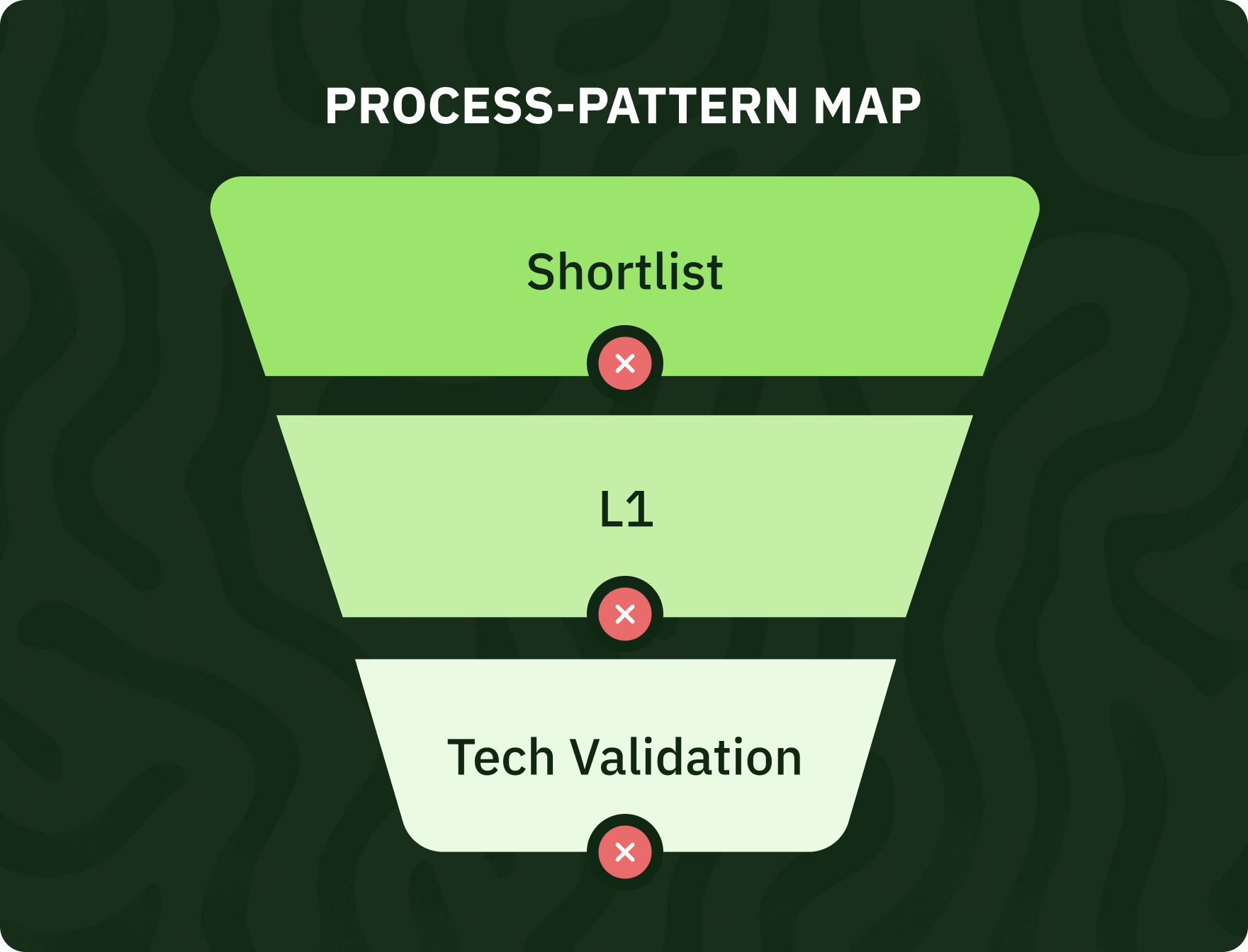
Look at the Adobe hiring process as a two-part system. The first two stages (resume screening, initial phone/video screen) follow a fixed rubric with scored output. Every time. Same criteria, different candidate.
The final two stages (deep technical loop, hiring manager fit) need a human making a contextual call. Hyring's agents cover the rubric-driven stages.
Think of it this way: if the evaluation form has a numeric score at the bottom, the agent can handle it. If it requires reading the room, a person handles it. Every final decision at Adobe goes through human sign-off regardless.
The AI Resume Screener
Instantly parse and rank resumes based on job-fit signals and technical requirements.
- Rapid high-volume parsing
- Objective skill ranking
- Bias-reduced shortlisting
The AI Phone Screener
Automated L1 verification calls to ensure basic qualifications and interest levels.
- 24/7 automated screening
- Consistent evaluation metrics
- Instant shortlist generation
The AI Coding Interviewer
Technical assessment with live coding environments and real-time logic evaluation.
- Real-time code analysis
- Plagiarism detection
- Automated logical scoring
English Proficiency Test
Standardized evaluation of communication skills, fluency, and professional vocabulary.
- Automated fluency scoring
- Grammar and clarity analysis
- CEFR aligned reporting
Funnel-to-agent
| HIRING STAGE | HYRING PRODUCT | WHAT IT DOES | OUTPUT (WHAT THE TEAM SEES) |
|---|---|---|---|
| Shortlist | AI Resume Screener | Scores resumes against Adobe role rubrics, weighing publication history and systems experience for R&D positions. | Ranked candidate list with role-fit confidence scores. |
| L1 screening | AI Phone Screener | Handles structured phone screens covering communication, motivation, and logistics without calendar coordination. | Conversation transcript, competency score, advance/hold flag. |
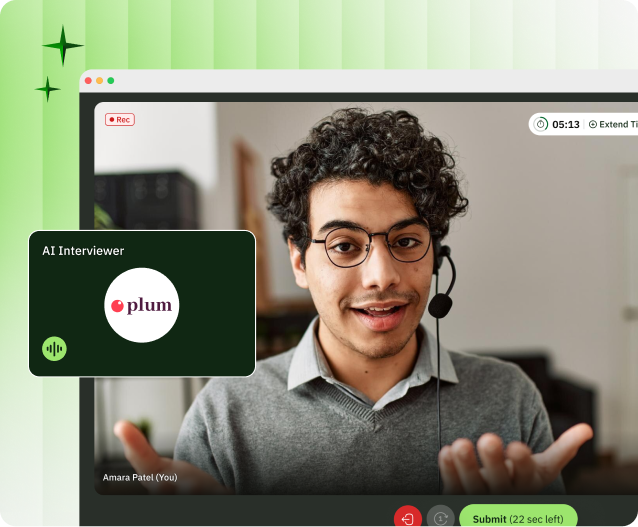
| Structured interview | AI Video Interviewer | Runs standardised video interviews with integrity monitoring across Adobe's global hiring locations. | Scored report with behavioural ratings and integrity flags. |
| Tech validation | AI Coding Interviewer | Administers coding problems calibrated to Adobe role levels (MTS, Senior, Staff, Principal). | Code evaluation with complexity analysis and performance benchmarks. |
| Communication | English Proficiency Test | Checks spoken English for client-facing or cross-geo Adobe roles. | CEFR-benchmarked proficiency score with skill-area breakdown. |
HYRING PRODUCT
AI Resume Screener
WHAT IT DOES
Scores resumes against Adobe role rubrics, weighing publication history and systems experience for R&D positions.
OUTPUT (WHAT THE TEAM SEES)
Ranked candidate list with role-fit confidence scores.
HYRING PRODUCT
AI Phone Screener
WHAT IT DOES
Handles structured phone screens covering communication, motivation, and logistics without calendar coordination.
OUTPUT (WHAT THE TEAM SEES)
Conversation transcript, competency score, advance/hold flag.
HYRING PRODUCT
AI Video Interviewer
WHAT IT DOES
Runs standardised video interviews with integrity monitoring across Adobe's global hiring locations.
OUTPUT (WHAT THE TEAM SEES)
Scored report with behavioural ratings and integrity flags.
HYRING PRODUCT
AI Coding Interviewer
WHAT IT DOES
Administers coding problems calibrated to Adobe role levels (MTS, Senior, Staff, Principal).
OUTPUT (WHAT THE TEAM SEES)
Code evaluation with complexity analysis and performance benchmarks.
HYRING PRODUCT
English Proficiency Test
WHAT IT DOES
Checks spoken English for client-facing or cross-geo Adobe roles.
OUTPUT (WHAT THE TEAM SEES)
CEFR-benchmarked proficiency score with skill-area breakdown.
KPI Scoreboard — Adobe Hiring Model
Time to Screen
Definition: Hours from application submission to first screening outcome on a given Adobe requisition.
Risk indicator: Adobe's biggest competitive threat is cycle speed against Google and Meta. If this drops below 36 hours but offer acceptance does not budge, the bottleneck lives downstream.
Screening Throughput
Definition: Completed first-pass screens per recruiter per week across open requisitions.
Risk indicator: Throughput spikes after AI deployment with a technical-round pass rate drop of five-plus points means the filter is too loose. Tighten it before engineering panels start complaining.
Interview Completion Rate
Definition: Share of candidates who receive an assessment link and finish all assigned rounds.
Risk indicator: Completion below 65% on India R&D roles specifically? Check if assessment length exceeds 40 minutes. Google India and Flipkart candidates will bail on a longer test.
Early Stage Drop-offs
Definition: The funnel step where candidates stop responding or pull out.
Risk indicator: Clustering at the scheduling stage signals broken calendar integration. Clustering at the assessment stage signals content or duration issues. Different fixes for each.
Panel Hours per Hire
Definition: Total human interviewer hours consumed per confirmed hire.
Risk indicator: Watch this alongside 90-day performance data. Panel hours dropping while early attrition rises in the same quarter means the AI filter is likely cutting soft-skill signals that interviewers would have caught during a longer loop.
Pass-through Rate
Definition: Percentage advancing from one funnel stage to the next.
Risk indicator: A 15-point variance between Noida and San Jose for the same role means the rubric needs location-calibrated thresholds, not one uniform cutoff.
Shortlist-to-Offer Ratio
Definition: How many shortlisted candidates produce one accepted offer.
Risk indicator: Going from 6:1 to 3:1 is progress. Going from 6:1 to 2:1 means the shortlist is too narrow and viable candidates are being pruned prematurely.
Integrity Flag Rate
Definition: Percentage of AI-conducted interviews triggering a fraud or identity alert.
Risk indicator: Baseline is 3 to 5%. A jump above 8% from a specific university or region needs manual audit of that cohort before drawing conclusions about source quality.
Time to First Touch
Definition: Gap between application completion and first outreach from Adobe's team.
Risk indicator: Fast first touch then two weeks of silence is worse than a consistently moderate pace. Pacing across the full cycle matters more than speed on message one.
SLA Adherence
Definition: Percentage of candidates getting a status update within the committed window.
Risk indicator: Below 80% during peak hiring and offer acceptance rates drop within the same cohort that week. Silence tells candidates Adobe is not serious.
Model ROI for Adobe: Mid-Volume, High-Cost Scenario
The figures in this section are projections, not actuals. They are built from Adobe's publicly reported headcount and revenue data, combined with industry-standard compensation benchmarks for recruiters and engineers. Your internal numbers will differ. Use this as a calculator template, not a forecast. At roughly 5,000 annual hires from an estimated 250,000 applications (50:1 ratio), the Adobe hiring process carries heavy per-candidate costs.
Annual savings potential
~$800K
approximately $800K across operational, panel, and coordination costs.
Time-to-hire reduction
55%
55% faster from assessment completion to technical panel stage.
Throughput acceleration
45%
45% increase in candidates evaluated per recruiter per week.
5-year ROI projection
280%
approximately 280% with break-even at month four.
Note: ROI figures below are an illustrative model of potential savings in this specific scenario. Actual results vary by internal workflow costs.
Recoverable hours by stage
Resume and application screening: an estimated 60,000 applications reach manual review after ATS filtering. At 10 minutes each, that is 10,000 person-hours. AI screening compresses this to roughly 1,500 hours of recruiter review on shortlists, recovering ~8,500 hours.
AI Phone and video screens: 15,000 candidates, 25 minutes each, totalling 6,250 person-hours. AI agents handling 85% leave ~900 hours of human review. Recovery: ~5,350 hours.
Technical panels: 8,000 candidates, 45 minutes, 1.5 panelists average, equalling 9,000 person-hours. AI coding screens reduce the volume reaching human panels by ~50%. Recovery: ~4,500 hours.
Total estimated recovery: ~18,350 hours annually.
Hours by Stage (Manual vs. AI-Assisted)
Source: Hyring hiring model | Illustrative, based on estimated Adobe volumes
Manual cost vs. target state
The bulk of recoverable cost in the Adobe hiring process hides in senior engineer calendars. By shifting technical validation into the AI layer, panel signal quality increases because humans meet only candidates who have already cleared a live coding benchmark.
| Metric | Current manual process | Target with Hyring AI agents |
|---|---|---|
| First-round screening spend | ~$156K (recruiter hours at $25/hr loaded, coordination, telephony) | ~$27K ($1/screen + ~$12K review hours) |
| Senior engineer time on interviews | Heavy: seniors run 3-4 interviews/day during peak sprints, pulled off product work | Reduced: panels see only AI-cleared candidates, 1-2/day with higher signal quality |
| Concurrent assessment capacity | Capped by calendars and timezone coordination across US/India/EMEA | Asynchronous: candidates complete assessments on their own schedule within a window |
| Identity and integrity checks | Manual observation during video calls, degrades with interviewer fatigue | Automated multi-signal monitoring: face, voice, gaze, tabs, clipboard, running continuously |
| Candidate survival to offer | ~30% of shortlisted reach offer (product company benchmark) | ~70% projected via compressed timelines and faster status communication |
Where the ~$800K sits
Most recoverable cost in the Adobe hiring process hides in senior engineer calendars.
Engineering panel hours returned to product work: 4,500 hours at $75/hr loaded. Roughly $338K of development capacity back on Firefly, Creative Cloud, and Experience Cloud.
L1 screening absorbed by AI: manual cost ~$156K. AI agents at ~$1/screen bring it to $27K. Net: ~$129K.
Scheduling overhead: ~4,000 coordinator hours/year. Self-scheduling eliminates ~55%. Recovery: ~$55K.
Integrity cost avoidance: late-stage disqualifications from fraud caught too late. Automating first-stage monitoring saves ~$40K in wasted evaluation time.
Direct savings subtotal: ~$562K. Secondary effects add an estimated ~$240K, bringing the total to ~$800K.
Where the savings come from
Source: Hyring hiring model | Illustrative
Cumulative savings vs. cost
The investment pays for itself by month four in this model. What accelerates the curve: every additional role added to the same Hyring deployment costs almost nothing extra per AI-conducted screen. Lateral hiring volume, campus drives, and seasonal spikes all ride the same infrastructure once it is running.
Cumulative Savings vs Investment (12-Month Model)
Month
Source: Hyring hiring model | Illustrative
Adobe hiring process implementation
Phased rollout is the only approach that keeps hiring managers on board. Dumping AI screening across 5,000 requisitions on day one guarantees pushback. Start small. Prove accuracy. Earn trust.
Week 2: Run AI agents alongside the current Adobe recruitment process
Activate AI Phone Screener and AI Video Interviewer for pilot roles only. Keep the existing manual process running in parallel for the first 72 hours. Compare score distributions, time-to-decision, and completion rates daily. Flag divergences between AI and human outcomes immediately for rubric calibration.
Week 3: Add coding and language assessments
Layer in AI Coding Interviewer for the engineering track. Add the English Proficiency Test for cross-geo roles. Start monitoring integrity flags from day one. Spikes above 8% from any specific source get flagged for manual review, not auto-rejection.
Week 4: Aggregate, calibrate, decide on expansion
Key questions - did pass-through rates hold without panel satisfaction declining? Did candidate NPS stay flat or improve? Did time-to-offer compress? Adjust question banks, scoring weights, and flag sensitivity based on two full weeks of data. Expand only after two stable review cycles.
Frequently Asked Questions
How does this Adobe hiring model handle multiple geographies?
Candidates in any timezone complete assessments on their own schedule within a defined window. Scoring rubrics are calibrated per location and role level, so applications from Noida and San Jose hit the right benchmarks without manual routing.
What does the first automated screen deliver inside the Adobe hiring process?
A competency breakdown, response summary, areas flagged for deeper probing, and an advance or hold recommendation. Recruiters review it in about 90 seconds instead of running a 25-minute call.
How does the system handle interview fraud?
Six signals run in parallel during video sessions: tab switches, secondary faces, voice mismatches, gaze anomalies, lip-sync gaps, clipboard activity. Combined into a composite integrity score. No single flag auto-rejects.
Will automated interviews hurt Adobe's employer brand?
Candidates pick their own assessment window, skip scheduling back-and-forth, and get faster status updates because scoring happens right after completion. Platform data from comparable deployments shows satisfaction holding steady or improving.
Can coding assessments be customized per Adobe role level?
Yes. Java, Python, C++, JavaScript, SQL, and other environments are supported. A Computer Scientist I test and a Principal Engineer test use entirely different problem sets without separate platform instances.
How do human panels fit into this Adobe interview process?
Panels come in at the end. By then, the candidate already passed resume screening, phone/video evaluation, coding, and language testing. Engineers use panel time for problem-solving depth and culture-fit evaluation, not baseline qualification checks.