Apple Hiring Process: Where Hyring's AI Agents Fit
The Apple hiring process now runs two parallel hiring motions inside India - a GCC engineering pipeline across Bengaluru, Hyderabad, and Chennai, and a retail engine staffing six physical stores from BKC to Borivali. Apple closed FY2025 with approximately 166,000 full-time employees globally. India's supplier ecosystem is projected to support over 600,000 jobs. Each new store opening pulls in 100+ retail hires. Each GCC wave posts hundreds of engineering, AI/ML, and manufacturing design roles at once.
This blueprint lays out where Hyring's AI agents absorb manual screening load across that Apple recruitment process, what outputs they generate, and which KPIs keep the model trackable.

This article is a planning framework showing where AI can reduce manual effort across the funnel.
The Roadmap
Apple runs hiring in India the way it launches products which are in a controlled, sequential, allergic-to-mess manner. But the volume underneath that control is growing faster than the process can absorb.
Six retail stores opened in under three years. A Hyderabad campus is now occupying 6.3 lakh square feet at WaveRock IT Park. A brand-new Chennai GCC is hiring CNC manufacturing design engineers and supply chain managers for its newest 2000 sq. ft. space along its upcoming IT corridors. Bengaluru's Embassy Zenith office is pulling in RF system integration and iPhone product design talent.
Four simultaneous hiring fronts, each with its own role taxonomy, each competing for local candidates against Google, Amazon, Samsung, and Microsoft's own India operations.
This roadmap covers the Apple hiring process operating at that combined scale. It contains a funnel map spanning both GCC engineering and retail store hiring, a deployment plan in weekly checkpoints, a KPI scoreboard carrying risk indicators built for Apple's dual-track funnel, and an ROI module showing where hours and dollars recover.
Where does the pressure concentrate? Not at the final loop interview. Apple's loop is 4 to 6 sessions with senior engineers and cross-functional managers — those are high-judgment conversations that need humans in the room.
The three stages before the loop carry the weight are resume screening, recruiter phone screens, and technical assessments. Same questions. Same rubric. Different candidates, thousands of them, timed to store launches and GCC ramp-ups.
Current State
Apple finished FY2025 (ending September 27, 2025) with approximately 166,000 full-time employees worldwide, a 1.2% increase from the 164,000 reported at the end of FY2024, per Macrotrends. The company sidestepped the mass layoffs that hit Google, Meta, and Amazon in 2023 and 2024, though it made selective cuts in some hardware and services teams.
India is where Apple's operational footprint is expanding fastest, though the numbers require careful separation.
Apple's supplier ecosystem in India (Foxconn, Tata Electronics, Pegatron) has generated over 250,000 manufacturing jobs under the PLI scheme, with total direct and indirect employment projected to cross 600,000 by March 2026, per Business Standard reporting on MeitY vendor data.
Those are assembly line positions, not Apple's own payroll. Apple's direct India headcount across GCC offices and retail stores is a separate, much smaller number, likely in the range of 5,000 to 8,000 employees (Apple does not break out country-level headcount publicly).
Three South Indian cities anchor the GCC engineering presence. Bengaluru houses hardware engineering, iPhone product design, and RF systems at Embassy Zenith. Hyderabad runs software, AI/ML data operations, and site reliability engineering from a campus that expanded to 6.3 lakh square feet in January 2026. Chennai is the newest on the block — manufacturing design engineering (CNC), operations, and supply chain.
Retail hiring adds a parallel track. Six Apple Stores operate across India — BKC (Mumbai), Saket (Delhi), Koregaon Park (Pune), Hebbal (Bengaluru), Noida, and Borivali (Mumbai). Each store carries roughly 100 to 150 positions spanning Genius, Business Pro, Creative, Operations Expert, and Technical Specialist roles. HR Katha reported that the four newest stores alone required 400+ hires.
0
600k+
0
Problems in the Apple Hiring Process
When you open six stores and three GCC campuses within two years, you do not have a talent shortage. You have a logistics bottleneck wearing a hiring badge.
Loop interviews borrow senior engineers from billable delivery
Apple's on-site or virtual loop runs 4 to 6 back-to-back interviews per candidate, 45 to 60 minutes each. For GCC roles in Bengaluru and Hyderabad, the interviewers are senior product design engineers, SREs, and ML leads pulling away from project work.
Four engineers off delivery for an afternoon to evaluate one candidate is real money, and it hits project timelines, not the recruitment budget. If 500 engineering candidates reach the loop stage across three cities in a quarter, that burns 2,500 to 3,000 senior engineer hours.
Retail rubrics stay constant but evaluation effort triples
Every Genius candidate answers the same behavioural and technical rubric. Customer empathy questions, troubleshooting scenarios, product knowledge checks - all are standardized. Going from two stores to six triples the evaluation volume while the rubric stays identical.
That makes it a textbook automation target. The human adds judgment only in grey-zone cases. For 80% of candidates, the rubric produces a clear pass or fail.
Two-month Apple interview process timelines lose GCC candidates to faster competitors
The Apple interview process for engineering roles can stretch 2 to 3 months. Google India's Bengaluru GCC often closes roles in 4 to 6 weeks. Samsung's R&D in Noida moves faster on hardware roles. A senior RF engineer with three offers is not waiting 8 weeks while Apple's recruiter coordinates loop schedules. Silent dropout. They just sign elsewhere.
Remote assessments lack a scalable integrity layer
For GCC technical assessments, Apple relies on interviewer judgment during video calls to spot irregularities. At 10 assessments a day, an interviewer catches tab-switching and secondary audio.
At 30 a day during a hiring sprint, things slip through. No standardised proctoring layer covers the India operations. That gap widens each time a new city joins the GCC map.
Hyring AI Agents
Apple's funnel has a clean split. Below the loop, everything runs on a rubric: resume fit scores, phone screen communication ratings, coding accuracy, language proficiency benchmarks. Above the loop, everything requires judgment whether culture fit, cross-functional collaboration or leadership potential. Hyring's five agents sit on the rubric side. A candidate reaching a human loop interviewer has already been screened, scored, and ranked, with a human reviewer confirming the shortlist before any loop invitation goes out.
The AI Resume Screener
Instantly parse and rank resumes based on job-fit signals and technical requirements.
- Rapid high-volume parsing
- Objective skill ranking
- Bias-reduced shortlisting
The AI Phone Screener
Automated L1 verification calls to ensure basic qualifications and interest levels.
- 24/7 automated screening
- Consistent evaluation metrics
- Instant shortlist generation
The AI Coding Interviewer
Technical assessment with live coding environments and real-time logic evaluation.
- Real-time code analysis
- Plagiarism detection
- Automated logical scoring
English Proficiency Test
Standardized evaluation of communication skills, fluency, and professional vocabulary.
- Automated fluency scoring
- Grammar and clarity analysis
- CEFR aligned reporting
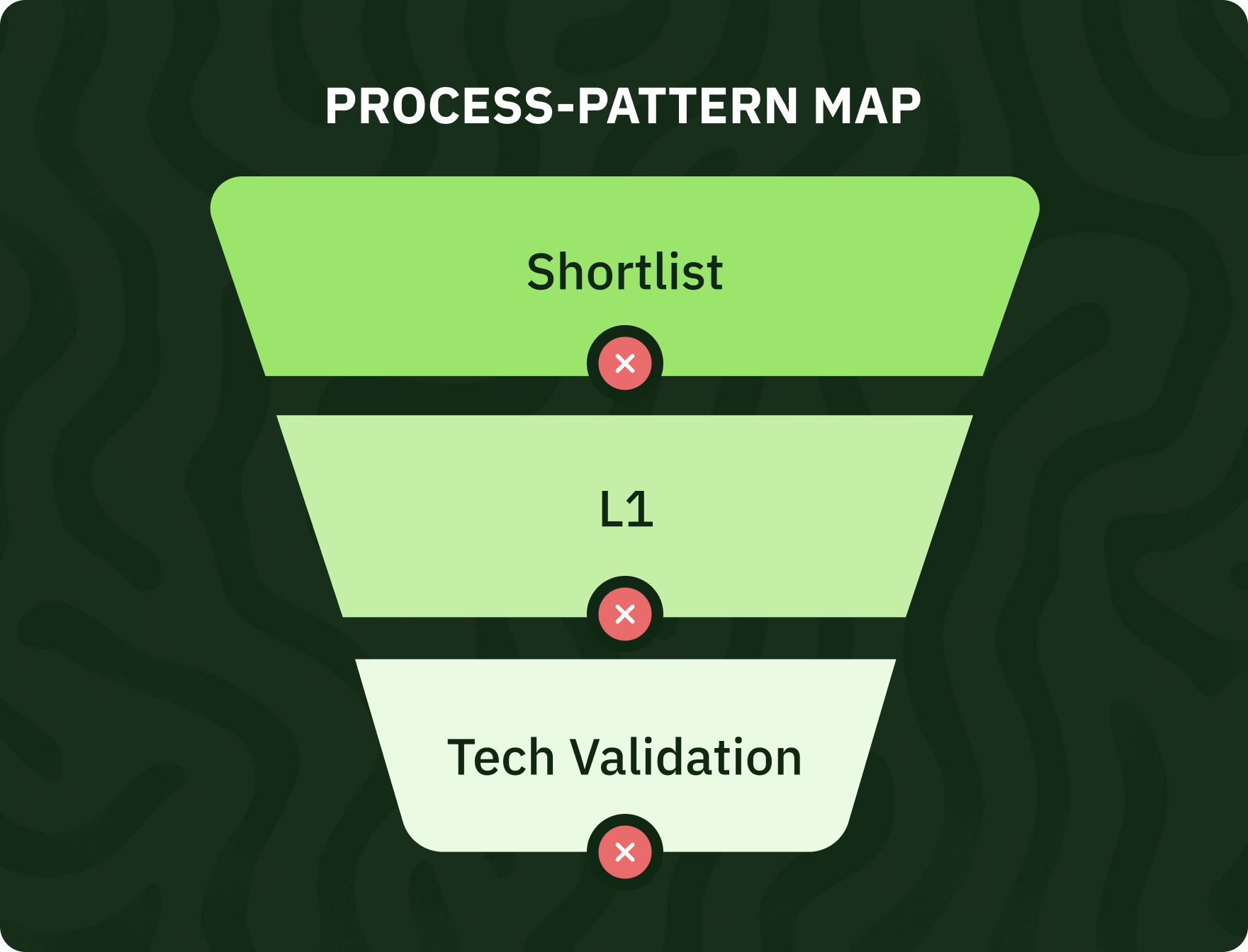
Funnel-to-agent
| HIRING STAGE | HYRING PRODUCT | WHAT IT DOES | OUTPUT (WHAT THE TEAM SEES) |
|---|---|---|---|
| SHORTLIST | AI resume screener | Parses GCC and retail resumes against role-specific criteria: RF experience for Bengaluru, CNC background for Chennai, Genius-track retail signals for store roles. | Scored shortlist with role-fit flags per candidate. |
| L1 SCREENING | AI phone screener | Handles initial phone conversations on motivation, availability, and baseline competency across both store and GCC tracks simultaneously. | Transcript, competency score, advance/hold recommendation. |
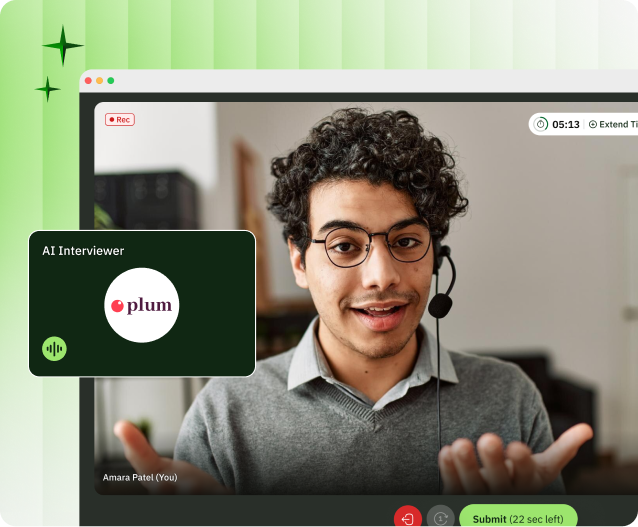
| STRUCTURED INTERVIEW | AI video interviewer | Runs video-based behavioural and situational interviews with six-signal proctoring and response scoring. | Structured evaluation report with integrity indicators. |
| TECH VALIDATION | AI coding interviewer | Executes live or async coding sessions for GCC software and hardware-adjacent roles in Python, Swift, C++, and SQL. | Code quality report, problem-solving score, complexity rating. |
| COMMUNICATION | English proficiency test | Benchmarks spoken English for client-facing GCC roles and cross-geography retail coordination positions. | CEFR-level score with skill-by-skill breakdown. |
HYRING PRODUCT
AI resume screener
WHAT IT DOES
Parses GCC and retail resumes against role-specific criteria: RF experience for Bengaluru, CNC background for Chennai, Genius-track retail signals for store roles.
OUTPUT (WHAT THE TEAM SEES)
Scored shortlist with role-fit flags per candidate.
HYRING PRODUCT
AI phone screener
WHAT IT DOES
Handles initial phone conversations on motivation, availability, and baseline competency across both store and GCC tracks simultaneously.
OUTPUT (WHAT THE TEAM SEES)
Transcript, competency score, advance/hold recommendation.
HYRING PRODUCT
AI video interviewer
WHAT IT DOES
Runs video-based behavioural and situational interviews with six-signal proctoring and response scoring.
OUTPUT (WHAT THE TEAM SEES)
Structured evaluation report with integrity indicators.
HYRING PRODUCT
AI coding interviewer
WHAT IT DOES
Executes live or async coding sessions for GCC software and hardware-adjacent roles in Python, Swift, C++, and SQL.
OUTPUT (WHAT THE TEAM SEES)
Code quality report, problem-solving score, complexity rating.
HYRING PRODUCT
English proficiency test
WHAT IT DOES
Benchmarks spoken English for client-facing GCC roles and cross-geography retail coordination positions.
OUTPUT (WHAT THE TEAM SEES)
CEFR-level score with skill-by-skill breakdown.
KPI Scoreboard — Apple Hiring Model
Time to Screen
Definition: Calendar days between application submission and the first scored evaluation for that candidate.
Risk indicator: If Bengaluru hardware roles screen in 3 days but Chennai manufacturing roles take 9, the bottleneck is city-specific resourcing, not the rubric. Fix the staffing before blaming the funnel.
Screening Throughput
Definition: Number of completed first-stage evaluations per recruiter per week across both retail and GCC tracks.
Risk indicator: Throughput spiking during a store launch while the GCC pipeline stalls means recruiters are being pulled to retail. Track by pipeline, not in aggregate.
Interview Completion Rate
Definition: Share of candidates who receive an assessment or interview link and finish the full evaluation without abandoning.
Risk indicator: Completion under 55% for GCC coding assessments likely points to test length exceeding 60 minutes or a confusing IDE setup, not candidate disinterest.
Early Stage Drop-offs
Definition: The funnel step where candidates stop responding or withdraw from the Apple hiring process.
Risk indicator: If retail candidates drop at the video interview stage but GCC candidates drop at phone screen, the causes are different. Retail candidates may find the video format unfamiliar; GCC candidates may be fielding faster counter-offers from Google or Amazon.
Panel Hours per Hire
Definition: Total hours consumed by human interviewers (loop panelists, hiring managers) for each accepted offer.
Risk indicator: If panel hours shrink and 90-day attrition rises, the AI screening may be filtering out candidates with weaker resumes but stronger on-the-job performance. Cross-check with hiring manager satisfaction scores before celebrating the efficiency gain.
Pass-through Rate
Definition: Percentage of candidates advancing between any two consecutive stages in the funnel.
Risk indicator: A pass-through variance of 15+ points between Chennai and Hyderabad for the same GCC role means the scoring rubric needs location-level calibration.
Shortlist-to-Offer Ratio
Definition: How many shortlisted candidates it takes to produce one accepted offer.
Risk indicator: Dropping from 6:1 to 3:1 is a win. Dropping from 6:1 to 2:1 means viable candidates are being screened out before they reach a human evaluator. Audit the AI filter thresholds.
Integrity Flag Rate
Definition: Percentage of AI-proctored interviews that trigger one or more fraud or anomaly alerts.
Risk indicator: A flag rate above 12% from a single recruitment source warrants a manual review of that channel's candidate quality, not automatic rejection of flagged candidates.
Time to First Touch
Definition: Hours between a candidate completing their application and receiving the first human or AI outreach.
Risk indicator: A fast first touch under 24 hours followed by 10 days of silence before the next step creates worse candidate perception than a steady 3-day cadence. Consistency beats speed-then-silence every time.
SLA Adherence
Definition: Percentage of candidates who receive a status update within the committed timeframe at each stage.
Risk indicator: When this metric dips below 80% during a concurrent store launch and GCC sprint, offer acceptance rates in both pipelines fall within the same fortnight. Slow updates signal disorganisation, and at Apple's brand level, that stings.
Model ROI for High-Volume Scenario
The math builds on Apple's publicly reported India hiring volumes in this illustrative projection, but internal cost structures vary across GCC and retail arms. Treat this as a starting framework and not something set in stone.
Annual Savings Potential
$2.6M+
across GCC and retail hiring in India.
Reduction in Time-to-Hire
55%
faster from application to accepted offer.
Faster Interview Process
45%
acceleration in scheduling and evaluation throughput.
5-Year ROI Projection
~340%
with break-even at month 6.
Note: ROI figures below are an illustrative model of potential savings in this specific scenario. Actual results vary by internal workflow costs.
Hours Recovered Annually
The recruiter phone screen eats the most hours, not the loop. Across retail and GCC pipelines combined, three pre-loop stages dominate manual effort.
- Resume screening: 25,000 applications, average review time 10 minutes per candidate, total 4,150 person-hours. AI resume screening reduces recruiter review to approximately 500 person-hours on AI-generated shortlists.
- L1 phone and video screens: 8,000 candidates reaching L1 after shortlisting, 25 minutes per candidate, total 3,300 person-hours. AI phone and video agents completing these screens leave roughly 400 person-hours for recruiter review.
- Technical assessments: 3,000 candidates reaching the tech stage, 40 minutes per candidate, 1.2 panelists average, total 2,400 person-hours. AI coding and video screening reduces the number reaching human panels by 50%, saving approximately 1,200 person-hours.
Total estimated hours recovered: ~8,950 annually.
Hours by Stage (Manual vs. AI-Assisted)
Source: Hyring Hiring Model (Illustrative)
Manual cost vs. target state with AI
At roughly a 3:1 shortlist-to-offer ratio across dual pipelines, every efficiency gain at the top of the funnel reduces cost and effort at every stage below it.
| Metric | Current manual process | Target with Hyring AI agents |
|---|---|---|
| L1 screening cost | ~$770K (recruiter hours at $14/hr loaded across retail and GCC screens, coordinator time, telephony) | ~$85K (at ~$1 per AI screen, plus ~$30K in recruiter review hours) |
| Engineering panel load | Heavy: GCC engineers run early technical screens across three cities, averaging 4 to 5 interviews per day during ramp sprints | Light: panels receive only candidates who cleared AI resume, phone, and coding gates. Load drops to 2 per day with higher relevance |
| Interview scalability | Capped by interviewer calendars, timezone coordination across Bengaluru/Hyderabad/Chennai, and store launch compression | Concurrent and asynchronous: candidates complete AI assessments on their own schedule within a defined window |
| Candidate verification | Interviewer observation during live video varies with fatigue and experience level | Automated proctoring monitors face presence, voice matching, screen activity, gaze direction, and clipboard behaviour simultaneously |
| Funnel completion rate | ~30% of candidates who enter shortlist stage reach the offer stage (estimated from industry benchmarks for premium tech hiring) | >65% projected, driven by reduced wait times, self-scheduling, and faster status communication |
Where the $2.6M+ Savings Come From
The biggest cost recovery is not in the recruitment team's budget. It sits in GCC engineering delivery capacity and candidate acquisition overhead.
- L1 Volume Handled by AI Agents: At 25,000 applications and a 25-minute average screen for those reaching L1, manual screening costs roughly $770K in loaded recruiter time. AI agents conducting 90% of screens at ~$1 each bring the cost to approximately $85K. Net recovery: ~$685K.
- Engineering Hours Returned to Client-Facing Delivery: GCC engineers in Bengaluru and Hyderabad carry loaded costs of $40 to $50/hr. Recovering 1,200 panel hours at a midpoint of $45/hr restores approximately $54K of delivery capacity per year.
- Scheduling and Coordination Overhead Cut: Store launch coordination (slot management, candidate communication, rescheduling loops, no-show follow-ups) and GCC interview logistics consume an estimated 3,500 coordinator hours annually across six stores and three cities. Self-scheduling through AI assessment links eliminates roughly 55% of this. Recovery: ~$98K.
- Integrity-Related Re-screening Costs Avoided: Manual fraud detection at the assessment stage catches problems late, after a candidate has passed two rounds. Late disqualifications waste all prior evaluation time. Automated proctoring in the AI video stage saves an estimated $45K in wasted evaluation time. Total estimated annual savings: ~$2.6M (conservative, includes secondary effects across retail hiring cycles and GCC ramp periods).
Where the Savings Come From
Source: Hyring Hiring Model (Illustrative) All figures are illustrative. Update inputs to match internal cost structures.
Cumulative Savings vs Cost
Break-even lands around month 6 in this model. Compressing that timeline is straightforward if lateral hiring volume and GCC contractor screening get added to the same Hyring deployment; marginal cost per additional AI session is close to zero. Apple's dual-track funnel — retail Genius screening on a fixed behavioural rubric, GCC engineering on a technical scoring rubric — is precisely the type of structured, high-volume work where AI agents outperform manual effort.
Cumulative Savings vs Investment (12-month model)
Month
Source: Hyring Hiring Model (Illustrative).
Apple Hiring Process Execution
Phasing matters more here than at most companies because Apple runs two fundamentally different hiring tracks under one brand. A retail Genius hire and a Hyderabad SRE hire share almost nothing except the Apple logo on the offer letter. Deploying AI agents across both without a phased rollout would create more confusion than it solves.
Week 2: run AI agents in parallel with the existing manual Apple hiring process
Activate AI Phone Screener and AI Video Interviewer for the two pilot roles only. Run them alongside the current manual process for 72 hours.
Compare score distributions, time-to-decision, and completion rates on a daily basis. Discrepancies between AI recommendations and human evaluator decisions get flagged for rubric calibration before any scaling happens.
Week 3: add coding and language assessments to the GCC track
Layer in AI Coding Interviewer for the Hyderabad software engineer pilot. Add the English Proficiency Test for any role requiring cross-geography communication in the first year. Start monitoring integrity flag rates from the AI Video Interviewer.
Compare those flags against whatever manual fraud signals the team currently tracks, even informal ones. Spikes from specific application sources need investigation, not automatic rejection.
Week 4: review, recalibrate, and decide on expansion
Did pass-through rates hold without panel satisfaction dropping? Did candidate NPS stay flat or improve? Did time-to-offer compress measurably for the pilot roles?
Adjust question banks, scoring weights, and flag sensitivity based on two weeks of parallel data. Expand to additional store roles and a second GCC city only after two consecutive review cycles show stable SLAs. Rushing expansion before calibration is locked invites exactly the kind of mess Apple's brand cannot afford.
Frequently Asked Questions
How does this Apple hiring model handle concurrent retail and GCC hiring sprints?
Each pipeline gets its own rubric configuration inside Hyring. A Genius candidate at Borivali and an ML engineer in Chennai receive entirely different assessment flows. AI agents run both tracks concurrently with no scheduling dependency between them, so a store launch does not slow down GCC screening or vice versa.
What does the first-round automated agent produce for the Apple hiring process?
A report containing a competency score breakdown, a summary of candidate responses, areas flagged for deeper probing in the next round, and an advance or hold recommendation. Recruiters review this in about 90 seconds instead of spending 25 minutes on a live phone call.
How does the system detect cheating during remote assessments?
The signals that are monitored simultaneously during AI video interviews are tab switches, secondary faces in frame, voice mismatch patterns, gaze anomalies, lip-sync gaps, and clipboard paste activity.
These produce a composite integrity score. No single flag triggers automatic rejection; the team reviews which signals fired and decides accordingly.
Do automated interviews hurt candidate experience at Apple's brand standard?
Candidates choose their own assessment window, skip scheduling back-and-forth, and receive faster status updates because scoring completes immediately. Platforms using this model report that candidate satisfaction holds steady or improves relative to traditional phone screens.
Can the coding validation be customised for different Apple GCC role profiles?
Yes. The AI Coding Interviewer supports Python, Swift, C++, JavaScript, SQL, and other environments with configurable difficulty. A Bengaluru RF firmware engineer and a Hyderabad full-stack developer see completely different assessment sets without needing separate platform instances.
Where do human interviewers fit in this Apple interview process?
They come in at the loop stage, after the candidate has already passed AI resume screening, phone/video evaluation, coding assessment, and language testing.
Loop panelists spend their time on problem-solving depth, design thinking, and culture fit rather than re-checking qualifications that have already been validated.