How AI agents fit into the Concentrix hiring process
The Concentrix hiring process is one of the busiest in the CX industry. The company has about 455,000 employees. BPO attrition runs at 25–30% per year. That means Concentrix needs to replace over 114,000 people every year before it adds a single growth hire.
This blueprint shows where Hyring's AI agents take on screening work across that funnel. It covers the outputs the agents give to hiring teams and the KPIs that keep the Concentrix recruitment process on track week to week. This is a planning framework. It shows where AI can reduce manual work. It does not claim any existing relationship between Concentrix and Hyring.

This article is a planning framework showing where AI can reduce manual effort across the funnel.
The Map
Attrition is the engine that runs the Concentrix hiring process.
Most companies hire to grow. Concentrix hires to stay even. With a 25–30% annual turnover, every single quarter has open roles to fill. Seasonal client ramps stack on top of that. So the hiring team is never between cycles. There is no slow season.
That shapes everything. The screening tools, the speed targets, and the number of people involved are all built around volume that never stops. One delayed stage does not just push back a few hires. It pushes back thousands.
This blueprint has four parts. First, it maps the current Concentrix recruitment process and where the work piles up. Second, it shows which Hyring agents fit into which stages and what each one produces. Third, it lays out ten KPIs that flag problems before they become delivery failures. Fourth, it shows the ROI math based on publicly reported hiring volumes.
The Concentrix interview process filters mostly on communication. That is different from a tech company, which filters on coding or system design. At Concentrix, most candidates fail early because of spoken English, listening accuracy, or response structure. Those are not judgment calls. They are rubric-based scores. That makes them a natural fit for AI screening.
Current State
Concentrix closed FY2025 (ending November 30, 2025) with about 455,000 employees. The headcount path has been steep: 290,000 in FY2021, 315,000 in FY2022, then a jump to 440,000 in FY2023 after the Webhelp merger closed in September of that year. It reached 450,000 at FY2024 year-end and 455,000 at FY2025 year-end. Net headcount change year over year looks small. Gross hiring volume underneath it does not.
FY2025 revenue came in at $9.83 billion across 70+ markets. Concentrix serves clients in tech, retail, banking, healthcare, and media. Many of those client accounts need voice support staff. That is where most of the hiring volume lives.
BPO attrition across the industry runs at 25–30% per year. Applied to 455,000 staff, that is 114,000 to 136,000 replacement hires needed annually. Add growth headcount and ramp hires for new client accounts, and the real number is closer to 140,000 to 160,000 hires per year.
The application funnel is wide. Concentrix operates hundreds of delivery centres, mostly in India, the Philippines, Colombia, and other high-volume BPO markets. For every role filled, the funnel processes eight to ten active applicants. At a conservative 140,000 hires, that is 1.1 to 1.4 million applications flowing into the system every year.
~455000
114000+
8-10:1
Concentrix Headcount (FY2021–FY2025)
Estimated Annual Hire Volume by Type
Problems in the Concentrix hiring process
Walk-in no-shows waste thousands of recruiter hours every month
Concentrix runs one of the biggest walk-in hiring operations in the BPO industry. Walk-in drives are common across India and the Philippines. No-show rates in BPO hiring run at 30–40%. That means for every ten candidates who confirm attendance, three to four simply do not show up.
At the volumes Concentrix manages, that translates to thousands of recruiter-hours blocked and wasted each month. The recruiter who sat waiting for a no-show cannot get that slot back. The vacancy does not fill itself. The problem compounds because no-shows are not tracked as a cost anywhere; they just disappear from the pipeline without leaving a record.
Trainer time is being used for early screening work
After the communication screen, operations trainers and team leads typically run the next interview stage. These are people Concentrix bills to client accounts. Pulling them into early-stage interviews has a real cost.
If a trainer conducts twelve interviews in a day during a ramp sprint, that is twelve hours of delivery capacity gone from a client account. It does not show up in the recruitment budget. It shows up in project margins, usually when the delivery manager raises it weeks later.
At Concentrix's scale, this pattern runs across dozens of delivery centres simultaneously. The total unbilled trainer time consumed by early screening rounds is significant.
Competing offers arrive before Concentrix moves to the next stage
BPO candidates do not apply to one company at a time. A candidate who clears a Concentrix communication screen on Monday is also in process at Teleperformance, Foundever, TaskUs, and iQor. If they do not receive an interview invite by Wednesday, they accept whichever offer arrives first.
The dropout does not get flagged properly. Candidates do not formally decline. They stop replying. Internal metrics show it as a no-show at the next stage, not as a lost offer. The real attrition between stages is higher than the numbers suggest.
Ghost candidates slip through at high screening volumes
Remote hiring created a specific problem for BPO hiring at scale: proxy candidates. A ghost candidate is someone who sends a more fluent friend or professional coach to take the video or phone screen on their behalf.
In a live session, an experienced screener can pick up on inconsistencies in speech patterns, mannerisms, or responses. But after the sixth or seventh session of a shift, attention drifts. Inconsistencies get missed. The ghost candidate clears screening, joins training, and the actual candidate's communication gap surfaces on the floor, after two or three weeks of onboarding costs have already been spent.
SLA gaps between stages damage candidate experience and acceptance rates
Concentrix's candidate pool skews young and mobile-first. These candidates check their phones constantly. When they apply and hear nothing for 48 to 72 hours, they assume they were rejected and move on.
Offer acceptance rates in BPO hiring are closely tied to how fast the process moves. A candidate who gets a same-day first touch and a same-week interview slot is far more likely to accept than one left waiting. At Concentrix's volume, even a 5% improvement in offer acceptance saves thousands of re-screening cycles per year.
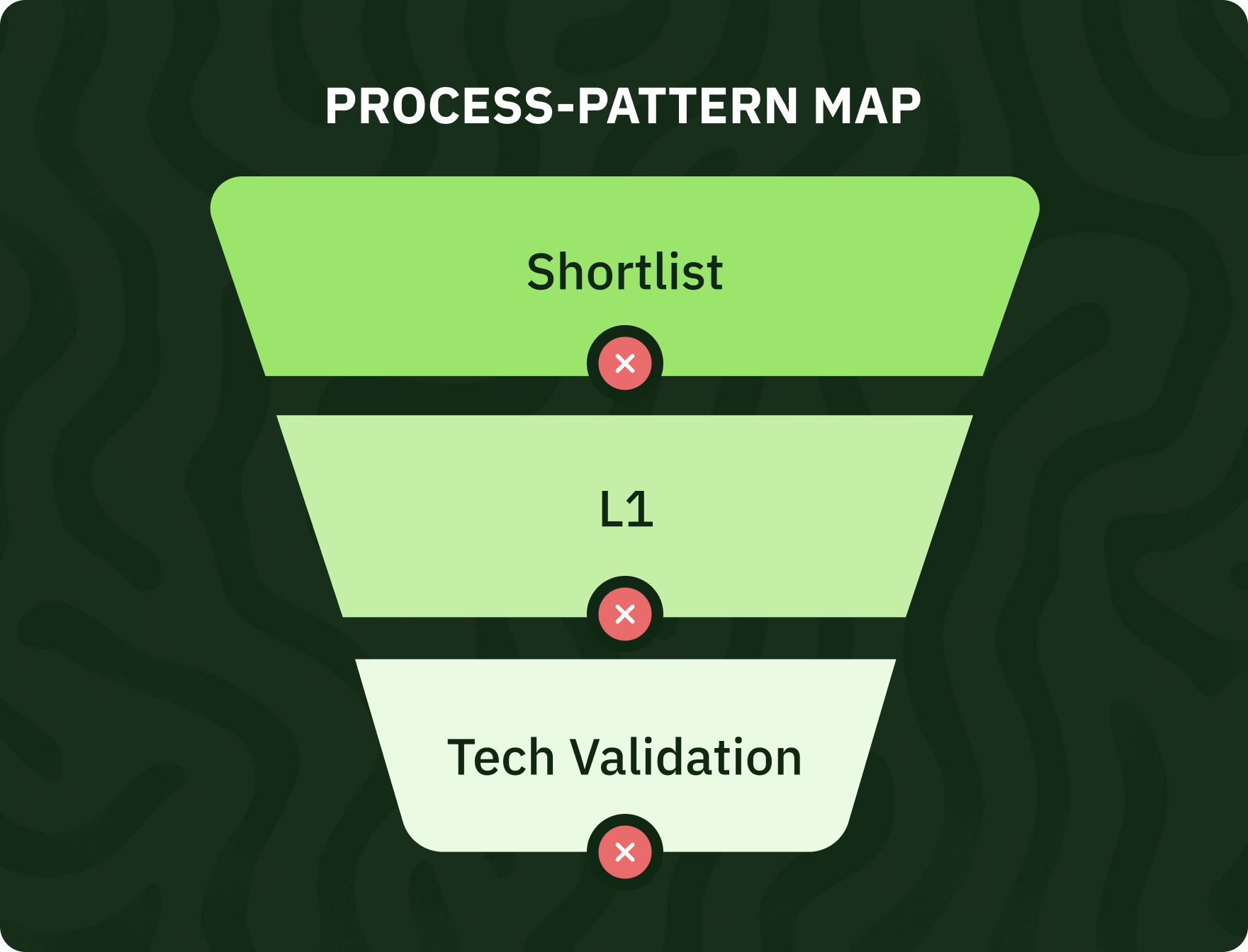
Hyring AI Agents
Most of the early stages in the Concentrix hiring process are repeatable. The questions are fixed. The scoring criteria are defined. The pass thresholds are set per client account. That pattern is what AI screening agents are built for.
The split is simple. If a stage follows a fixed rubric and produces a scored output, an AI agent handles it. If a stage needs a human to assess potential, read the room, or make a relationship-based call, a person handles it. Every offer still needs a hiring lead to confirm. That does not change.
The five Hyring agents cover the first four stages of the Concentrix recruitment process. Each one feeds a clean output into the next stage so that nothing gets lost between steps.
The AI Resume Screener
Instantly parse and rank resumes based on job-fit signals and technical requirements.
- Rapid high-volume parsing
- Objective skill ranking
- Bias-reduced shortlisting
The AI Phone Screener
Automated L1 verification calls to ensure basic qualifications and interest levels.
- 24/7 automated screening
- Consistent evaluation metrics
- Instant shortlist generation
The AI Coding Interviewer
Technical assessment with live coding environments and real-time logic evaluation.
- Real-time code analysis
- Plagiarism detection
- Automated logical scoring
English Proficiency Test
Standardized evaluation of communication skills, fluency, and professional vocabulary.
- Automated fluency scoring
- Grammar and clarity analysis
- CEFR aligned reporting
Funnel-to-agent
| HIRING STAGE | HYRING PRODUCT | WHAT IT DOES | OUTPUT (WHAT THE TEAM SEES) |
|---|---|---|---|
| Application review | AI Resume Screener | Scores incoming applications against the eligibility and communication role requirements for each client account track | Ranked candidate list with role-fit flags per account |
| Communication screen | AI Phone Screener | Runs concurrent spoken communication assessments across thousands of candidates, routes pass, hold, and reject outcomes to hiring leads | Call transcript + fluency score + routing decision |
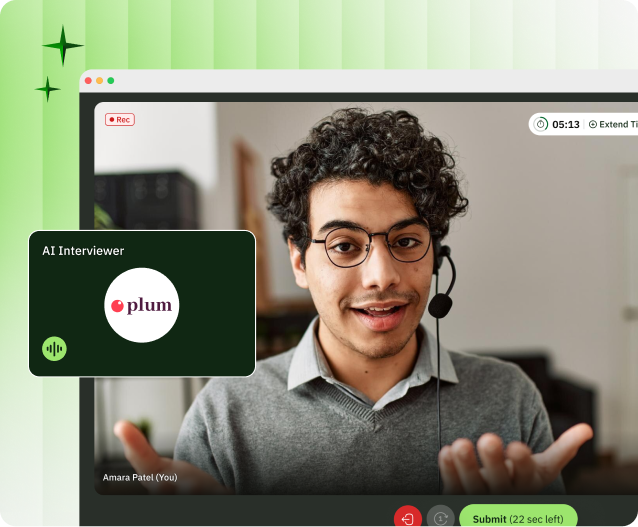
| Structured interview | AI Video Interviewer | Conducts structured video evaluations for process fit, response quality, and communication depth, without using trainer calendars | Video report + competency scores + integrity summary |
| Technical validation | AI Coding Interviewer | Runs first-round technical assessments for IT support, tech analyst, and back-office automation roles at Concentrix | Technical evaluation report + role-calibrated score |
| Language assessment | English Proficiency Test | Measures spoken fluency, comprehension, and professional register against the communication benchmark for each voice process account | CEFR-equivalent level + skill-dimension breakdown |
HYRING PRODUCT
AI Resume Screener
WHAT IT DOES
Scores incoming applications against the eligibility and communication role requirements for each client account track
OUTPUT (WHAT THE TEAM SEES)
Ranked candidate list with role-fit flags per account
HYRING PRODUCT
AI Phone Screener
WHAT IT DOES
Runs concurrent spoken communication assessments across thousands of candidates, routes pass, hold, and reject outcomes to hiring leads
OUTPUT (WHAT THE TEAM SEES)
Call transcript + fluency score + routing decision
HYRING PRODUCT
AI Video Interviewer
WHAT IT DOES
Conducts structured video evaluations for process fit, response quality, and communication depth, without using trainer calendars
OUTPUT (WHAT THE TEAM SEES)
Video report + competency scores + integrity summary
HYRING PRODUCT
AI Coding Interviewer
WHAT IT DOES
Runs first-round technical assessments for IT support, tech analyst, and back-office automation roles at Concentrix
OUTPUT (WHAT THE TEAM SEES)
Technical evaluation report + role-calibrated score
HYRING PRODUCT
English Proficiency Test
WHAT IT DOES
Measures spoken fluency, comprehension, and professional register against the communication benchmark for each voice process account
OUTPUT (WHAT THE TEAM SEES)
CEFR-equivalent level + skill-dimension breakdown
KPI Scoreboard for the Concentrix hiring process
Time to Screen
Definition: How long it takes from the moment a candidate applies to when the communication screen result is logged.
Risk indicator: Target is under 48 hours. If you cut this below 12 hours by removing rubric steps, expect a training dropout spike within six weeks. Faster is not always better if the filter gets weaker.
Screening Thoroughly
Definition: How many communication screens are completed per recruiter or AI agent per day?
Risk indicator: If throughput climbs but first-day-on-floor scores fall, the screen is passing candidates based on speed, not fit. Fix the fluency threshold before scaling.
Interview Completion Rate
Definition: The share of candidates who get an interview invite and finish the full assessment.
Risk indicator: Below 55% usually means the scheduling window is too wide. BPO candidates take the first offer that moves. A 7-day assessment window gives Teleperformance and Foundever four days to get there first.
Early Stage Drop-offs
Definition: Which stage in the funnel sees the highest candidate withdrawal rate?
Risk indicator: Heavy drop-off at self-scheduling, not at the assessment itself, usually means a broken or non-mobile-friendly booking link. In Concentrix's mobile-first candidate base, that alone can cut a cohort by 20–25% before a single question is answered.
Panel Hours per Hire
Definition: Total trainer and team lead hours used per confirmed hire across all interview stages.
Risk indicator: Watch this alongside 90-day retention. If panel hours drop but three-month attrition rises, something that trainers used to catch in person is no longer getting caught.
Pass-through Rate
Definition: The share of candidates who move from one stage to the next, measured per client account track.
Risk indicator: A big gap in pass-through rates between two city hiring clusters for the same role usually means local rubric drift. One standardised AI-scored baseline removes that variance before it becomes a sourcing quality issue.
Shortlist-to-Offer Ratio
Definition: How many shortlisted candidates are needed to produce one accepted offer?
Risk indicator: Moving from 10:1 to 5:1 is progress. Dropping below 3:1 means the filter is too loose. Offer declines and early attrition will correct it, but at a cost.
Integrity Flag Rate
Definition: The share of AI-conducted assessments that trigger a fraud or proxy alert.
Risk indicator: A 6–8% baseline is normal for large-scale BPO hiring in South Asia. Spikes above 12% from a specific city cluster need a manual audit of that source, not a blanket block.
Time to First Touch
Definition: How long it takes from when a candidate applies to when they get the first message from the Concentrix hiring team.
Risk indicator: BPO candidates apply to five or more companies in a single session. First touch within two hours is the standard Concentrix needs to hold against faster competitors. A 48-hour first touch is a slow start.
SLA Adherence
Definition: The share of candidates who get status updates within the agreed internal window.
Risk indicator: When SLA adherence slips in the Concentrix interview process, offer acceptance rates fall within the same week. Slow updates push candidates to whichever company replied faster.
Model ROI for High-Volume Scenario
Every number below is an illustrative projection. The math is based on publicly reported Concentrix hiring volumes and standard BPO industry benchmarks. Internal cost structures vary. Use this as a starting point, not a final number. Note: ROI figures below are an illustrative model of potential savings for this specific scenario. Actual results vary by internal workflow costs, recruiter compensation, existing technology stack, and process maturity.
Annual Savings Potential
$2.8M+
in operational and hiring costs.
Time-to-hire reduction
55%
faster from application to accepted offer.
Interview throughput gain
60%
more structured evaluations processed per week.
5-year ROI projection
~300%
with a 4-month payback period.
Note: ROI figures below are an illustrative model of potential savings in this specific scenario. Actual results vary by internal workflow costs.
Hours saved each year
The Concentrix hiring process has three stages that burn the most time. None of them require creative judgment. All three follow fixed rubrics. That is exactly where the hours are recovered.
Total estimated hours recovered per year: ~158,000.
- Communication screens: 500,000 candidates, 15 minutes each. That is 125,000 person-hours. AI phone and video agents handling 90% of those sessions brings the recruiter review load down to about 12,500 hours. Hours saved: 112,500.
- Structured interviews: About 75,000 candidates reach this stage. At 40 minutes per session with an average of 1.3 operations leads per interview, the total is 65,000 person-hours. AI video assessment handling 55% of this group saves about 35,750 hours. Hours saved: 35,750.
- Scheduling and coordination: An estimated 16,000 coordinator hours per year go to slot management, no-show follow-up, and rescheduling. Self-scheduling through AI assessment links cuts about 60% of this. Hours saved: 9,600.
Hours by Stage (Manual vs. AI-Assisted)
Source: Hyring hiring model | Illustrative, based on ~500K active screening volume
Manual process vs. AI-assisted state
To hire over 140,000 people annually, the current manual process involves millions of repetitive tasks. The table below maps how each stage costs today against the target state once Hyring's AI agents take over.
| METRIC | CURRENT MANUAL PROCESS | TARGET WITH HYRING AI AGENTS |
|---|---|---|
| Communication screen cost | ~$1.6M (screener time at $13/hr across ~500K candidates) | ~$500K (AI screens at ~$1 each for 450K candidates, plus ~$50K recruiter review time) |
| Trainer workload | Heavy: trainers run early structured interviews across dozens of delivery centres, averaging 12–15 sessions per ramp day | Light: trainers only see candidates who cleared the AI resume, phone, and communication gates. Daily session load drops to 4–5 |
| Scheduling dependency | Constrained by trainer calendars, delivery centre hours, and the compressed timeline of client ramp windows | Asynchronous: candidates complete their assessment in a defined window, on any device, with no back-and-forth scheduling |
| Identity verification | Inconsistent at high volume, screeners miss proxy patterns after six or seven consecutive video calls | Automated monitoring across face continuity, voice matching, gaze patterns, screen activity, and clipboard behaviour |
| Funnel completion rate | ~22% of active screened candidates reach the offer stage | ~65% projected, driven by faster scheduling, fewer wait gaps, and immediate status updates |
Where the $2.8M in savings comes from
The biggest savings are not inside the recruitment budget. They are in trainer time billed to client delivery and in the coordination overhead that no-shows create.
With secondary effects across multiple hiring cycles and lateral account ramp hiring added to the same deployment: ~$2.8M total recovery.
- Communication screening handled by AI: Manual cost at scale is about $1.6M loaded. AI agents at $1 per screen bring that to roughly $500K. Net recovery: $1.1M.
- Trainer hours returned to client delivery: At $18/hr, 35,750 panel hours freed from early interview stages represent about $643K of delivery capacity. After AI video session costs of ~$86K, net recovery: ~$557K.
- Scheduling overhead removed: Eliminating 60% of 16,000 annual coordination hours at $13/hr saves about $125K.
- Ghost candidate re-screening avoided: When fraud is caught late, all prior evaluation time is wasted. Early automated detection saves an estimated $90K per year in repeated screening costs.
Where the Savings Come From
Source: Hyring hiring model | Illustrative. Adjust inputs to match internal cost structures.
Cumulative savings vs. cost
Break-even in this model arrives at month four. The Concentrix hiring process runs all year with no cycle gaps, so savings build in every month from day one of deployment. Adding lateral hiring or seasonal ramp volume to the same deployment brings payback even faster, because the marginal cost per extra AI session is close to zero once configured.
Cumulative Savings vs Investment (12-Month Model)
Month
Source: Hyring hiring model | Illustrative.
Concentrix Hiring Process Implementation
Starting with everything at once is a mistake. Concentrix has hundreds of delivery centres, dozens of client accounts, and hiring pipelines running in parallel across multiple geographies. Turning on AI agents for all of that on day one gives no baseline to compare against. A phased rollout is faster in the long run. It creates comparison data. It lets teams calibrate before they scale.
Week 2: Run AI screeners alongside the existing manual process
Activate the AI Phone Screener and AI Video Interviewer for the pilot account only. Keep the existing manual process running in parallel for the first 72 hours.
Every day, compare three things: score distributions between AI-scored and human-scored cohorts, time-to-decision for each, and candidate completion rates. If the AI pass-through rate diverges from the manual pass-through rate by more than 10 percentage points, the rubric needs calibration before volume increases. This is normal. It is why you run the parallel process.
Do not skip this step and go straight to full AI replacement. The comparison data from these 72 hours is what gives the hiring panel confidence in the AI outputs before they stop cross-checking manually.
Week 3: Add language assessment and turn on integrity monitoring
Layer in the English Proficiency Test for all voice process candidates in the pilot. At the same time, activate integrity monitoring in the AI video sessions and start logging flag rates by geography and sourcing channel.
A flag rate of 8–12% is normal for high-volume BPO hiring in dense urban markets. Do not use that baseline to reject candidates wholesale. Use it to understand where the pattern is coming from. Flag spikes from a specific city cluster need a manual audit of that channel, not a blanket block.
This week is also when you check whether the assessment links work on mobile. In Concentrix's candidate base, most applicants will access the assessment on a phone. A link that breaks on mobile is a drop-off that looks like candidate disengagement but is actually a UX failure.
Week 4: Review the data and decide on expansion
Pull everything from the first three weeks. Look at four questions. Did pass-through rates improve? Did trainer satisfaction with the cohort hold steady or get better? Did no-show rates at the structured interview stage fall? Did time-to-first-touch stay within the SLA target? If two consecutive daily review windows show stable metrics, the pilot is ready to expand.
Expansion should be account by account, not a bulk rollout. Each account has its own communication benchmark. Treating them as interchangeable causes rubric drift at scale.
Frequently Asked Questions
How does this model handle the Concentrix hiring process across multiple client accounts at once?
Each client account runs as its own screening track. It has its own rubric, its own pass threshold, and its own communication benchmark. AI sessions for all tracks run at the same time. There is no calendar dependency. A 50,000-candidate intake across four active accounts in a single week does not need four times the recruiter headcount. Results route to account-specific queues automatically.
What does a recruiter actually get from the AI phone screener?
After each session, the recruiter gets a summary that shows spoken fluency scores, comprehension accuracy, response coherence, and a routing recommendation. The whole thing takes under two minutes to review. Borderline cases are flagged for a second look before any decision is made. Nothing is auto-rejected without a human seeing the flag.
How does the system catch ghost candidates in the Concentrix hiring process?
The AI video interviewer tracks face continuity throughout the session and checks whether the voice pattern stays consistent across different parts of the assessment. It also watches for specific behavioural signals that often differ between a prepared candidate and a proxy. No single flag triggers an auto-reject. The system gives the recruiter a composite score and a record of which signals fired, so the decision stays human.
Does this affect the candidate experience negatively?
Candidates choose their own assessment window. They do not need to schedule with a recruiter. Status updates arrive faster because scoring happens the moment the session ends. The two biggest pain points for BPO candidates are scheduling delays and silence after applying. Both drop significantly. Data from similar deployments shows candidate satisfaction holds steady or improves.
Can the English proficiency assessment be set differently for different Concentrix accounts?
Yes. Each account has its own communication benchmark. A chat support role for a retail client and a voice support role for a financial services client have different language requirements. The assessment threshold is set per account. The same platform handles both without needing separate instances.
Where do trainers fit into this process?
Trainers come in at the final stage only. By the time a candidate reaches them, the candidate has already cleared the resume screen, the communication screen, the structured video interview, and, where relevant, the language and technical assessments. Trainers use that final session to check for process fit and client-specific behavioural cues. They do not re-check basic communication skills that the earlier stages already scored.