A unique use case in fintech: FIS hiring process
Roughly 55,000 people work at FIS today. The FIS hiring process feeds three business segments (banking tech, capital markets, enterprise payments) that survived the Worldpay majority-stake sale to GTCR in 2024. Somewhere between 80,000 and 120,000 applications hit FIS's global offices every year, and most of that volume lands in India.
This blueprint maps where Hyring's AI agents slot into the recruitment funnel, what outputs they hand to hiring teams, and which KPIs stop the model from drifting.

This article is a planning framework showing where AI can reduce manual effort across the funnel.
The Map
Fifty trillion dollars. That is the annual transaction volume FIS settles through its payment rails and banking platforms. A recruitment function moving slower than those rails is a bottleneck nobody can afford. And yet here we are. The FIS hiring process has to keep pace with a business where a four-hour outage makes American Banker's front page.
Four pieces hold this framework together.
- One: a funnel map shaped around how FIS hires across banking tech, capital markets, and ops in the US and India.
- Two: a weekly deployment plan.
- Three: a KPI scoreboard with ten metrics and risk flags for fintech hiring.
- Four: an ROI module with visible math and a clear disclaimer.
The FIS recruitment process pushes its heaviest volume through Jacksonville and India (Pune, Chennai, Bangalore). Candidates wade through resume screening, aptitude tests, technical rounds, HR. Meanwhile, Fiserv, Wipro, and product startups are making competing offers.
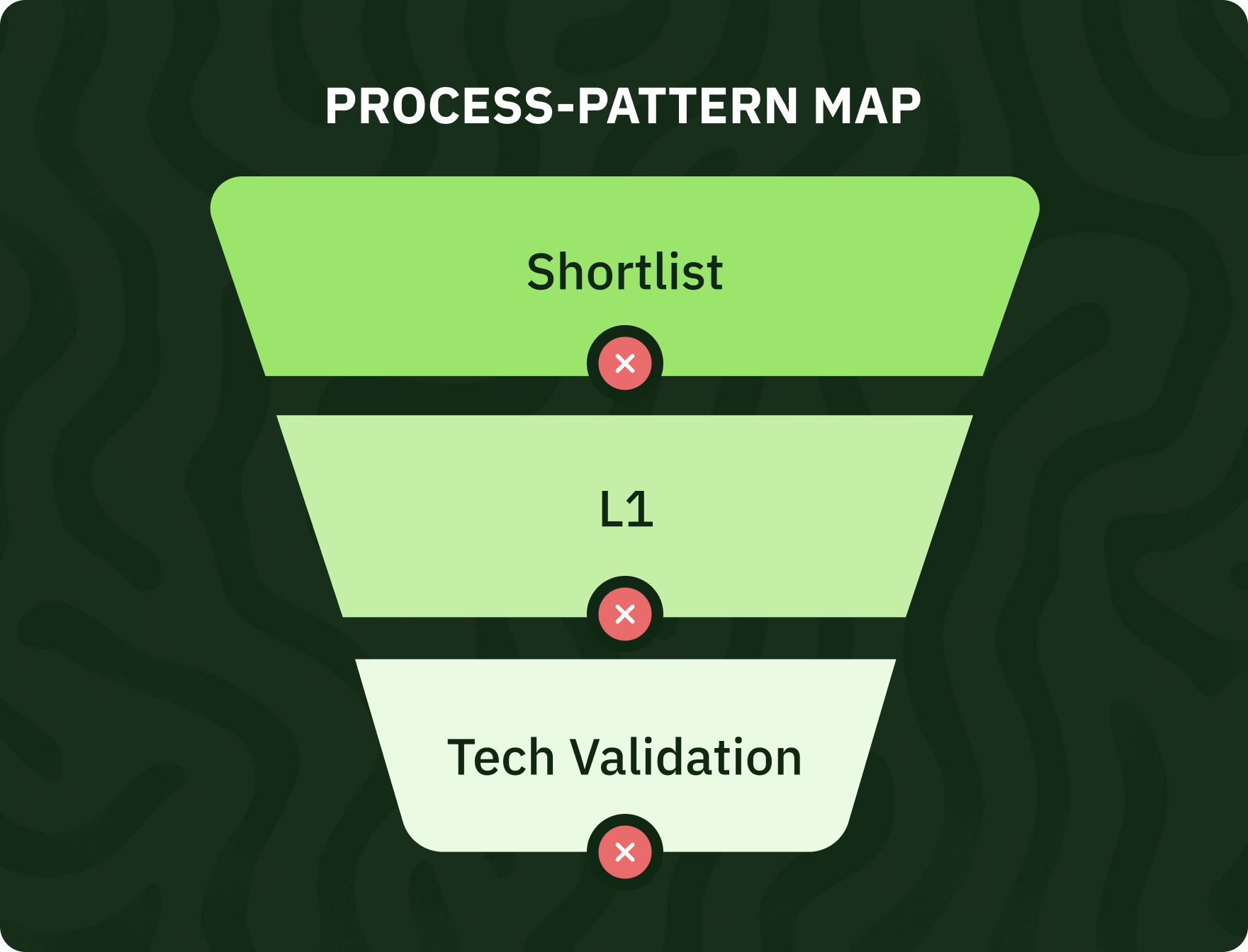
Friction? It stacks in the first three stages. Rubric-driven. Repetitive. Scored. Perfect for automation.
Current State
FIS closed 2024 with about 55,000 employees on the books, per its FY2024 10-K filed with the SEC. Before GTCR took Worldpay off FIS's hands, headcount sat north of 75,000. The split operationally separated the merchant payments workforce entirely but left banking and capital markets engineering untouched.
FY2024 revenue: approximately $10.1 billion from continuing ops. Banking Solutions, Capital Markets, Corporate. Three segments, three talent profiles. Banking wants Java devs and mainframe modernisation specialists. Capital Markets needs quant developers and risk-platform engineers.
Campus hires in India go through four rounds: online assessment, technical interview, managerial chat, HR sign-off. The FIS interview process for US lateral hires looks similar but adds system-design rounds for anyone above mid-level.
~55000
80000-120000
5000-6500+
FIS Headcount Trajectory (2021–2024)
Problems in the FIS hiring process
Fiserv, Global Payments, Jack Henry, every well-funded neobank on the block. They all want the same Java engineers, cloud architects, and risk-platform developers FIS needs. Two days of screening delay? That is enough for Stripe or Plaid to close the candidate.
40,000 campus candidates, two weeks, zero slack
Campus drives in Pune, Chennai, and Bangalore pull an estimated 30,000 to 50,000 applications per cycle. Aptitude test results land in 48 hours, but converting those scores into role-specific shortlists? Manual. About 7 minutes per candidate, 40,000 candidates, roughly 4,600 person-hours crammed into two weeks. The FIS hiring process stalls right there, and stalled candidates are gone.
Billable engineers stuck in interview rooms
When a senior Java developer spends four hours a day running campus interviews, that is four hours not billed to a banking client. FIS makes money by deploying engineers on platform modernisation and integration projects. Pull 8,000 candidates through technical panels at 40 minutes each, 1.5 panelists average, and you are looking at 8,000 person-hours of cost.
Buried in delivery margins. It is not a line item anyone in recruitment ever sees.
The 48-hour rule: break it and lose the candidate
Fintech candidates with cloud and API skills usually juggle two to four offers. The FIS interview process goes head-to-head with Fiserv's campus pipeline, which moves more quickly, and product companies that hand out offers within a week.
Once round spacing at FIS blows past 48 hours, candidates do not call to decline. They just ghost. The FIS interview process bleeds talent silently, and nobody tracks it because there is no formal rejection to count.
Proctoring quality drops after session five
An increasing share of FIS screening runs via video. Interviewers are supposed to catch tab switches, secondary speakers, and identity mismatches. After five consecutive sessions? Good luck with that. This is not a training fix. It is a stamina problem.
Hyring AI Agents
Three stages in the FIS hiring funnel follow the same rubric for every single candidate. Same questions, same scoring criteria, same pass/fail logic. Thousands of repetitions per cycle. Only the candidate changes.
That is precisely the work AI agents are built for. If the output has a score and a threshold, the agent handles it. If the work needs someone to read team chemistry or a hiring manager's gut feel about a candidate, a human does it. Every stage gate requires a person to sign off before the candidate advances. No exceptions. Built into the workflow, not tacked on after.
The AI Resume Screener
Instantly parse and rank resumes based on job-fit signals and technical requirements.
- Rapid high-volume parsing
- Objective skill ranking
- Bias-reduced shortlisting
The AI Phone Screener
Automated L1 verification calls to ensure basic qualifications and interest levels.
- 24/7 automated screening
- Consistent evaluation metrics
- Instant shortlist generation
The AI Coding Interviewer
Technical assessment with live coding environments and real-time logic evaluation.
- Real-time code analysis
- Plagiarism detection
- Automated logical scoring
English Proficiency Test
Standardized evaluation of communication skills, fluency, and professional vocabulary.
- Automated fluency scoring
- Grammar and clarity analysis
- CEFR aligned reporting
Funnel-to-agent
| HIRING STAGE | HYRING PRODUCT | WHAT IT DOES | OUTPUT (WHAT THE TEAM SEES) |
|---|---|---|---|
| Shortlist | AI Resume Screener | Matches profiles to FIS role specs: banking-tech stack experience, relevant certifications, seniority band. Filters out mismatches before a recruiter touches the file. | Scored shortlist with role-match indicators. |
| L1 Screening | AI Phone Screener | Runs structured phone conversations, checking for required skills, genuine role interest, and timezone/availability fit. | Transcript + composite score + advance/hold flag. |
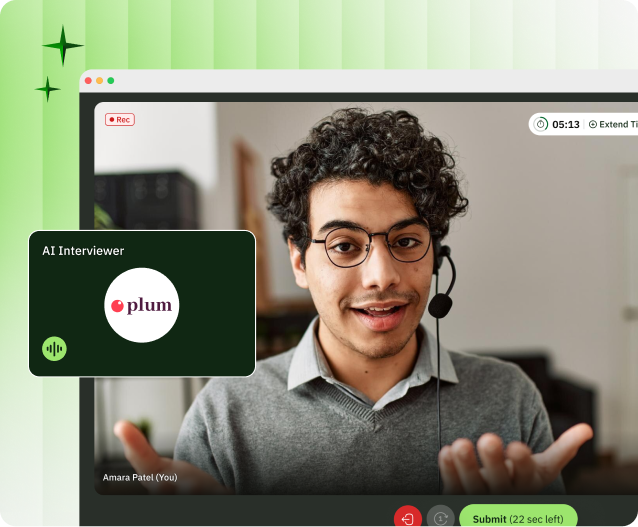
| Structured interview | AI Video Interviewer | Administers video-based interviews, records answers, scores against the role rubric, and flags behavioural signals. It offers both one-way and two-way interviews with conversational AI. | Overall scoring and integrity flags. |
| Tech validation | AI Coding Interviewer | Timed coding exercises calibrated to FIS platform stacks: Java, Python, SQL, cloud infrastructure. | Correctness, efficiency, and approach breakdown. |
| Communication | English Proficiency Test | Measures spoken English readiness for FIS client-facing or cross-geography assignments. | Proficiency level with four-dimension scores. |
HYRING PRODUCT
AI Resume Screener
WHAT IT DOES
Matches profiles to FIS role specs: banking-tech stack experience, relevant certifications, seniority band. Filters out mismatches before a recruiter touches the file.
OUTPUT (WHAT THE TEAM SEES)
Scored shortlist with role-match indicators.
HYRING PRODUCT
AI Phone Screener
WHAT IT DOES
Runs structured phone conversations, checking for required skills, genuine role interest, and timezone/availability fit.
OUTPUT (WHAT THE TEAM SEES)
Transcript + composite score + advance/hold flag.
HYRING PRODUCT
AI Video Interviewer
WHAT IT DOES
Administers video-based interviews, records answers, scores against the role rubric, and flags behavioural signals. It offers both one-way and two-way interviews with conversational AI.
OUTPUT (WHAT THE TEAM SEES)
Overall scoring and integrity flags.
HYRING PRODUCT
AI Coding Interviewer
WHAT IT DOES
Timed coding exercises calibrated to FIS platform stacks: Java, Python, SQL, cloud infrastructure.
OUTPUT (WHAT THE TEAM SEES)
Correctness, efficiency, and approach breakdown.
HYRING PRODUCT
English Proficiency Test
WHAT IT DOES
Measures spoken English readiness for FIS client-facing or cross-geography assignments.
OUTPUT (WHAT THE TEAM SEES)
Proficiency level with four-dimension scores.
KPI Scoreboard for the FIS hiring process
Time to Screen
Definition: Hours from application to first screening decision.
Risk indicator: Below 24 hours sounds great until next-stage rejection spikes. Speed beating accuracy. Pull Fiserv's campus conversion numbers before adjusting.
Screening Throughput
Definition: Completed first-round screens per recruiter per five days.
Risk indicator: Throughput up, advance rate down? The pass bar is too low. Fix before the next campus batch.
Interview Completion Rate
Definition: Percentage of invited candidates who finish every step.
Risk indicator: Below 55% for India campus hires? Usually, the assessment runs past 40 minutes, or the mobile access links break. Check logs first.
Early Stage Drop-offs
Definition: Where candidates stop showing up, as a share of stage entry.
Risk indicator: Drop-off at the coding test (not scheduling) means difficulty is pegged too high for freshers.
Panel Hours per Hire
Definition: Interviewer hours from first panel to signed offer, per confirmed hire.
Risk indicator: Cross-check with 90-day attrition. Panel hours dropping while early quitting rises means the AI filter is stripping soft-skill signals.
Pass-through Rate
Definition: Percentage advancing from one stage to the next, per boundary.
Risk indicator: 15-point gap between Pune and Bangalore for the same role? Rubric needs campus-level tuning.
Shortlist-to-Offer Ratio
Definition: Shortlisted candidates needed per accepted offer.
Risk indicator: 7:1 to 4:1 is progress. Down to 2:1 means you are cutting people who would have performed.
Integrity Flag Rate
Definition: Share of AI interviews triggering integrity alerts.
Risk indicator: 4% to 6% is normal. Above 12% from one campus needs a manual audit before drawing conclusions.
Time to First Touch
Definition: Hours from application to first outreach.
Risk indicator: Fast first touch, then five days of silence is worse than steady 48-hour intervals.
SLA Adherence
Definition: Candidates getting status updates inside the promised window.
Risk indicator: Below 80% during a sprint, and offer acceptance criteria the same week.
Model ROI for High-Volume Scenario
Every single number in this section is a projection. Illustrative. The math uses publicly reported FIS headcount and industry cost benchmarks for fintech hiring. FIS's real internal costs will be different. Use this as a starting framework and plug in your own numbers.
Annual Savings Potential
$2.4M+
in operational and hiring costs.
Time-to-hire reduction
55%
faster from application to accepted offer.
Interview throughput gain
45%
more structured evaluations processed per week.
5-year ROI projection
~340%
with a 6-month payback period.
Note: ROI figures below are an illustrative model of potential savings in this specific scenario. Actual results vary by internal workflow costs.
Where the hours go (and where they come back)
Resume screening eats the biggest chunk. 100,000 applications at 7 minutes each: 11,600 person-hours. AI screening compresses that to about 1,200 hours of recruiter review.
- Resume screening: 100,000 applications at 7 minutes each: 11,600 person-hours. AI screening compresses that to about 1,200 hours of recruiter review. Hours saved: 10,400.
- Phone and video screens: 25,000 candidates, 18 minutes each, 7,500 person-hours. AI agents drop recruiter review to about 900 hours. Hours saved: 6,600.
- Technical panels: 8,000 candidates, 40 minutes, 1.5 panellists. That is 8,000 person-hours. AI halves the volume reaching humans, recovering ~4,000 hours. Hours saved: 4,000.
Total recovered: about 22,000 person-hours annually.
Hours by Stage (Manual vs. AI-Assisted)
Source: Hyring hiring model | Illustrative, based on ~100K application volume
Cost side-by-side: manual vs. AI
To hire 6,000 people annually, the current manual process involves roughly 100,000 applications. The table below maps how each stage costs today against the target state once Hyring's AI agents take over.
| Metric | Current Manual | With Hyring AI Agents |
|---|---|---|
| L1 screening cost | ~$1.35M (recruiter time at $18/hr, scheduling platform, telephony overhead combined) | ~$135K (~$1/AI screen + $35K in recruiter review of edge cases) |
| Engineering panel load | 4 to 5 interviews per engineer per day during campus sprints | 2 per day after the AI gates filter the funnel. Higher signal per session. |
| Interview scalability | Capped by calendars and US-India timezone gaps | Concurrent and asynchronous. Candidates pick their own window. |
| Candidate verification | Relies on the interviewer's attention during live video. Falls apart after session five. | Automated monitoring: face, voice, gaze, screen activity, clipboard. All at once. |
| Funnel completion | About 22% of shortlisted candidates reach the offer stage (industry benchmark) | Projected above 60%, driven by shorter waits and faster status updates |
Where $2.4M actually comes from
The biggest savings at FIS hide in engineering delivery margins and time-to-fill drag. Not in the recruitment budget.
- L1 screening cost: The full manual operation runs about $1.35M loaded. AI agents at $1/screen bring it to ~$160K. Net: ~$1.19M.
- Panel hours back to billable work: 4,000 hours at $45/hr midpoint equals ~$180K in recovered delivery capacity.
- Scheduling overhead: ~6,000 coordinator hours, 55% eliminated through self-scheduling. Recovery: ~$110K.
- Integrity rework: Catching fraud early instead of after two rounds saves ~$80K annually.
Direct total: ~$1.56M. Secondary effects (faster fills, lower agency spend, reduced offer declines): ~$840K. Grand total: $2.4M. Secondary sits at about 54% of direct, which is tight but a CFO can live with it.
Annual Savings Breakdown
Source: Hyring hiring model | All figures illustrative. Adjust inputs to match your cost structures.
When it pays for itself
Month six. That is the break-even point in this model. Tack on US lateral hiring volume to the same Hyring deployment, and the payback compresses further.
The FIS hiring process is a good fit for this kind of model because those first three funnel stages are scored and rubric-driven. No creative judgment involved.
Cumulative Savings vs Investment (12-Month Model)
Month
Source: Hyring hiring model | Illustrative.
FIS Hiring Process Implementation
Phased rollout builds the comparison data that makes hiring managers trust the output. Here is the week-by-week.
Week 2: AI and manual run side by side
Week 3: Coding and language layers go live
Week 4: Read the data, adjust, decide
Frequently Asked Questions
How does this model handle FIS campus hiring volumes?
Assessment links go out to every candidate in the batch at once. Hyring's AI agents process thousands of phone and video sessions in parallel. A 40,000-candidate campus cycle clears L1 screening in days, not the three to four weeks a human team would need. Calendar bottlenecks vanish because there are no calendars involved.
What does the first-round AI agent hand to the FIS hiring process team?
A structured report with four parts: a role-fit score, a criterion-by-criterion response summary, specific flags for the human interviewer to dig into, and a recommendation to advance or hold. Takes about 90 seconds to review. Replaces a 20-minute phone call.
How does the system catch cheating in remote sessions?
Continuous monitoring throughout the FIS interview process: face matching against the registered photo, detection of extra voices or faces, gaze patterns suggesting off-screen reading, audio-lip sync gaps, and clipboard paste detection. All signals feed one composite integrity score. Nothing auto-rejects on a single flag.
Do candidates actually like AI-run interviews?
They pick their own time slot. No coordinator emails. Scoring runs immediately, so status updates come faster. Companies using this report have steady or improved satisfaction.
Can the coding tests match different FIS role profiles?
Yes. Difficulty, language environments, and problem types are configurable per role. A banking backend dev and a capital markets data pipeline engineer see completely different assessments from the same platform.
Where do human interviewers come in?
At the final gate. By then, the candidate has cleared the resume, phone, coding, and language screens. Panellists probe analytical reasoning and team fit. Not SQL syntax.