Fiserv Hiring Process: An AI-Agent Blueprint For Fintech-Scale Recruiting
Resume screening, first round phone interviews, and technical coding evaluation. We have put in place five AI agents which include the AI Resume Screener, AI Phone Screener, AI Video Interviewer, AI Coding Interviewer, and English Proficiency Test. Each of these is focused on one of the key stages. Projected outcome is we will recover over 34,000 recruiter and interviewer hours annually, see a direct savings of almost $1.64M, and in total see a return of investment which is nearly 13x that of platform cost. The Fiserv recruitment process does not require a full rebuild. What we need is for the repeatable parts to be automated so that human effort is put where it really counts.
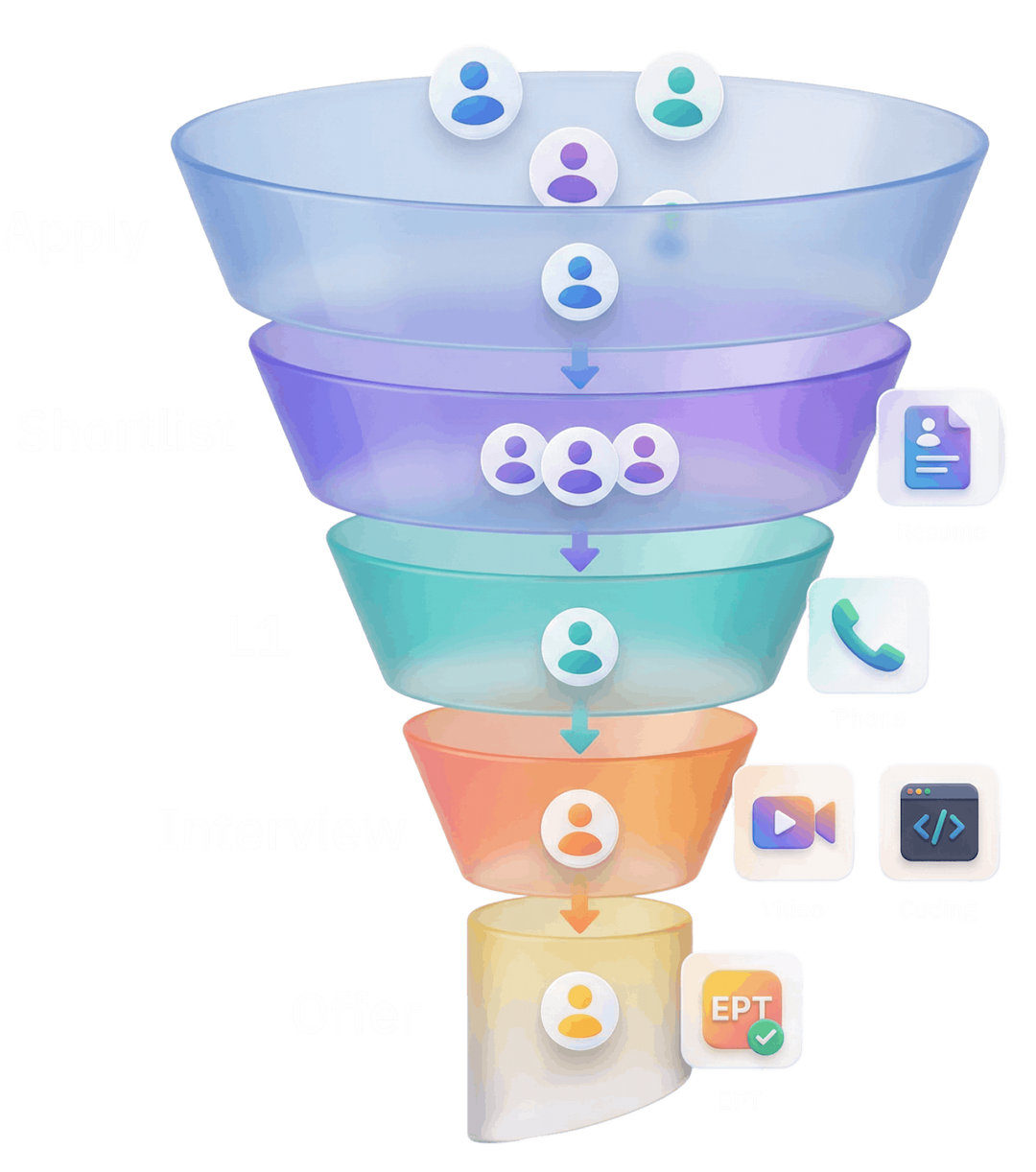
This article is a planning framework showing where AI can reduce manual effort across the funnel.
Why the Fiserv hiring process needs a different kind of map
Fintech is seeing a particular type of failure in large scale hiring which most general recruitment tools do not experience. Fiserv is in merchant acceptance, core banking tech, payments infrastructure, and digital money movement which we see in products like Clover for point of sale, Carat for omnichannel commerce, and bank grade core processing platforms.
That diversity includes we are looking for POS hardware support technicians, core banking software engineers, payments compliance analysts, and enterprise sales executives. Four very different candidate types, one process, and a recruitment team that is very much put together around the main role which in turn ignores the outlying ones.
This document maps what that problem looks like at Fiserv's hiring volume - roughly 40,000 employees globally as of FY2023 (Fiserv 2023 Annual Report, SEC filing), with a workforce that requires ongoing replacement and technical growth in areas like real-time payments and embedded finance.
It has four parts:
- A funnel map built around how Fiserv actually hires across engineering, operations, and client delivery today.
- A phased rollout plan that lets AI run alongside the current process before anything is switched off.
- A KPI scoreboard so people leaders can see, week by week, whether the AI‑augmented model is making hiring faster and more reliable.
- An ROI module that turns hours‑saved into an illustrative P&L story, with all the assumptions spelled out.
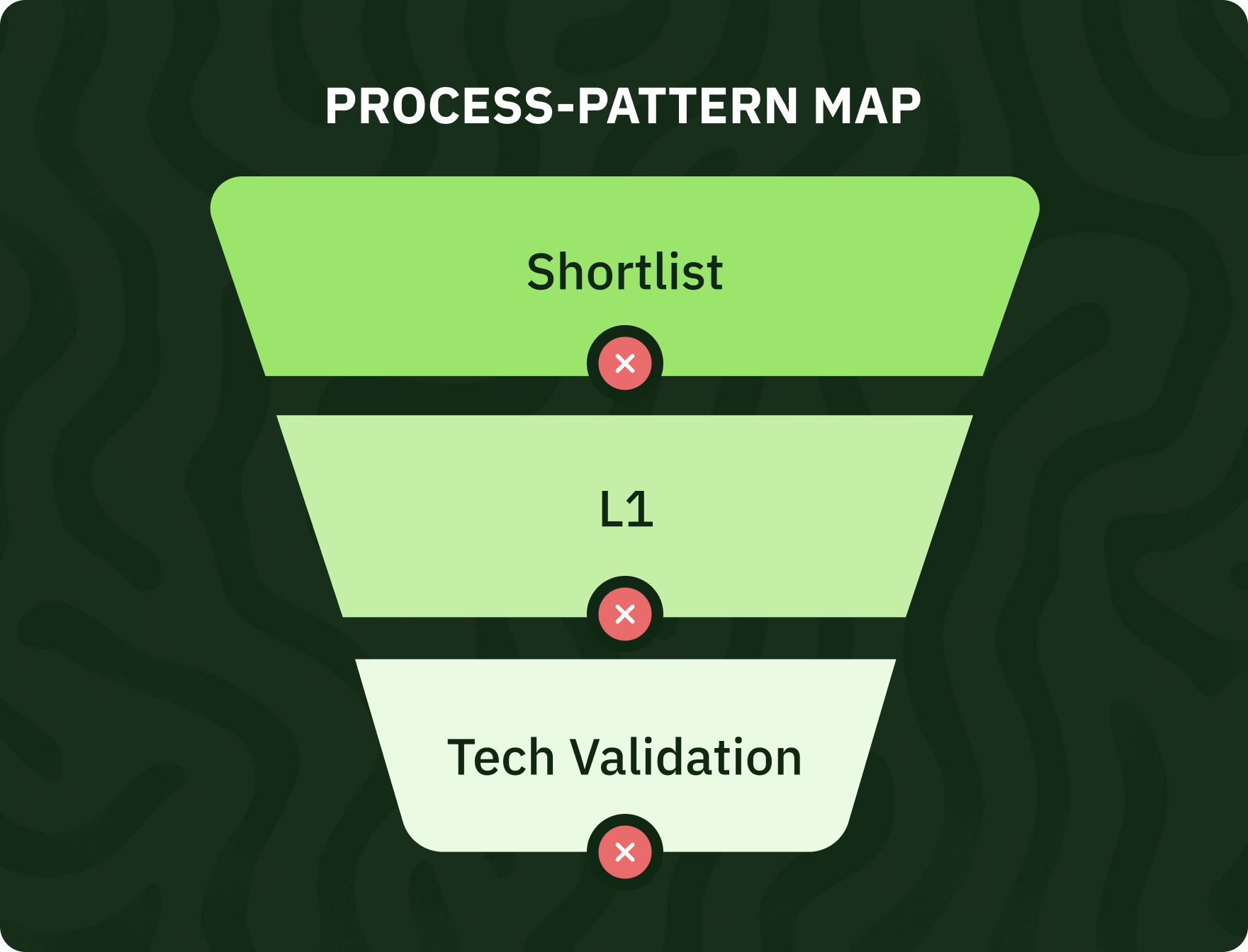
The bottleneck pattern at Fiserv is not arbitrary. The volume is greatest at the top of the process in resume screening. The depth of technical skills required slows the process in the middle with coding skills.
And the financial tech industry's inherent diligence requirements don't allow assessors to take any shortcuts with candidate verification. So it's the volume at the top and the diligence at the bottom that's most ripe for the AI agents working within their respective rubrics to make up the most time without compromising quality.
Current State
Fiserv's workforce has hovered near 40,000 employees, growing from approximately $17.7B in revenue in FY2022 to a reported $19.1B in FY2023. (Source: Fiserv FY2023 10-K via SEC EDGAR) That revenue trajectory, combined with ongoing investment in Clover and real-time payments, signals continued headcount demand. Based on standard fintech industry attrition benchmarks of 10-12% annually and disclosed hiring activity, Fiserv is estimated to bring on approximately 4,500 new employees per year, generating an application inflow of 200,000-250,000 candidates across all divisions.
~40,000
~4,500
200,000–250,000
Fiserv Employee Headcount Trend
Fiserv Revenue Trajectory
Four Pressure Points That Slow The Fiserv Hiring Process Down
Technical interviews leaning on a small expert pool
Communication and compliance checks too late in the funnel
Global scale without a unified rhythm
Hyring AI Agents
At 250,000 estimated applications, most of the work arriving at a recruiter's desk does not require a human judgment call at all. It requires pattern matching - does this resume meet the stated criteria? Does this candidate's spoken English reach the required level? Can this engineer pass a timed coding problem set? Those are rubric problems. And rubric problems at volume belong to AI agents, not people.
The five Hyring agents each take ownership of exactly one stage in this evaluation sequence where that logic applies. None of them make a hiring decision. They compress the candidate pool to the point where every human interaction in the funnel is high-information and irreplaceable.
The AI Resume Screener
Instantly parse and rank resumes based on job-fit signals and technical requirements.
- Rapid high-volume parsing
- Objective skill ranking
- Bias-reduced shortlisting
The AI Phone Screener
Automated L1 verification calls to ensure basic qualifications and interest levels.
- 24/7 automated screening
- Consistent evaluation metrics
- Instant shortlist generation
The AI Coding Interviewer
Technical assessment with live coding environments and real-time logic evaluation.
- Real-time code analysis
- Plagiarism detection
- Automated logical scoring
English Proficiency Test
Standardized evaluation of communication skills, fluency, and professional vocabulary.
- Automated fluency scoring
- Grammar and clarity analysis
- CEFR aligned reporting
Funnel-to-agent
| HIRING STAGE | HYRING PRODUCT | WHAT IT DOES | OUTPUT (WHAT THE TEAM SEES) |
|---|---|---|---|
| Resume screening | AI Resume Screener | Parses applications against role-specific criteria for Fiserv's 20+ job families (fintech engineering, POS support, compliance, payments ops) and ranks by fit without requiring manual reads | Ranked shortlist with a per-candidate fit score, ready for recruiter review |
| L1 phone screen | AI Phone Screener | Conducts asynchronous structured phone interviews across Fiserv's high-volume roles, runs concurrent sessions that do not depend on recruiter availability or time zone | Structured call summary with a screening decision and flagged follow-up areas for the human panel |
| L2 video interview | AI Video Interviewer | Runs pre-panel video assessments for non-technical roles including customer success, sales, and operations positions, covering role-fit and communication quality | Per-candidate video assessment with timestamped response scoring and a proceed/defer signal |
| Technical coding screen | AI Coding Interviewer | Administers configurable problem sets in languages relevant to Fiserv's engineering stack (Java, Python, C#, SQL, JavaScript) and grades solutions on correctness, efficiency, and code quality | Graded assessment report with a pass/flag/fail classification before any senior engineer time is committed |
| English proficiency | English Proficiency Test | Evaluates spoken clarity, reading comprehension, grammatical precision, and workplace vocabulary range for global operations candidates in Pune, Chennai, Lodz, and Belfast | Standardised proficiency score benchmarked against the role's communication requirement tier |
HYRING PRODUCT
AI Resume Screener
WHAT IT DOES
Parses applications against role-specific criteria for Fiserv's 20+ job families (fintech engineering, POS support, compliance, payments ops) and ranks by fit without requiring manual reads
OUTPUT (WHAT THE TEAM SEES)
Ranked shortlist with a per-candidate fit score, ready for recruiter review
HYRING PRODUCT
AI Phone Screener
WHAT IT DOES
Conducts asynchronous structured phone interviews across Fiserv's high-volume roles, runs concurrent sessions that do not depend on recruiter availability or time zone
OUTPUT (WHAT THE TEAM SEES)
Structured call summary with a screening decision and flagged follow-up areas for the human panel
HYRING PRODUCT
AI Video Interviewer
WHAT IT DOES
Runs pre-panel video assessments for non-technical roles including customer success, sales, and operations positions, covering role-fit and communication quality
OUTPUT (WHAT THE TEAM SEES)
Per-candidate video assessment with timestamped response scoring and a proceed/defer signal
HYRING PRODUCT
AI Coding Interviewer
WHAT IT DOES
Administers configurable problem sets in languages relevant to Fiserv's engineering stack (Java, Python, C#, SQL, JavaScript) and grades solutions on correctness, efficiency, and code quality
OUTPUT (WHAT THE TEAM SEES)
Graded assessment report with a pass/flag/fail classification before any senior engineer time is committed
HYRING PRODUCT
English Proficiency Test
WHAT IT DOES
Evaluates spoken clarity, reading comprehension, grammatical precision, and workplace vocabulary range for global operations candidates in Pune, Chennai, Lodz, and Belfast
OUTPUT (WHAT THE TEAM SEES)
Standardised proficiency score benchmarked against the role's communication requirement tier
KPI Scoreboard for the Fiserv hiring process
Time to Screen
Definition: Hours between application receipt and the first stage disposition decision (pass, hold, or decline)
Risk indicator: If this creeps above 48 hrs during peak intake cycles, Fiserv's pipeline is competing against faster-moving offers from Stripe, Block, and Adyen. Fintech candidates do not wait.
Screening Throughput
Definition: Number of applications processed through stage one per recruiter per week
Risk indicator: A drop below 200 during a high-volume intake period signals that the AI Resume Screener configuration needs recalibration for the active job family mix, not that headcount is too low.
L1 Conversion Rate
Definition: Percentage of screened candidates who advance from AI phone screen to L2 or panel stage
Risk indicator: A conversion rate above 40% likely means the screening rubric is too permissive, sending warm-but-unqualified candidates upward and burning panel time. Above 40% is a false economy.
Interview-to-Offer Ratio
Definition: Offers made as a proportion of candidates who reach the panel interview stage
Risk indicator: If this ratio widens to 1:7 or beyond, the upstream screening stages are not filtering tightly enough. The panel should see candidates that are likely to receive offers, not a broad sample.
Time to Hire
Definition: Calendar days from the date an application is received to the date an offer letter is signed
Risk indicator: Fiserv's engineering talent pool overlaps with Jack Henry and FIS, both of whom run faster funnels in certain role categories. A 52-day average in those segments is a direct attrition risk.
Candidate Drop-off Rate
Definition: Percentage of candidates who disengage or withdraw before completing the assigned assessment stage
Risk indicator: If drop-off spikes above 25% on the coding assessment specifically, the problem set is too long or the UX is broken. Candidates in Fiserv's target engineering tier have a short patience threshold for clunky tools.
Cost Per Qualified Screen
Definition: Recruiter cost allocated to each candidate who advances past the first stage gate
Risk indicator: A cost above $50 per qualified screen signals that too many unqualified applications are clearing the first gate and consuming L1 resources. Re-examine the job posting qualification criteria.
Diversity Pipeline Ratio
Definition: Proportion of candidates from underrepresented groups advancing through each stage at comparable rates
Risk indicator: If the AI Resume Screener's pass rate for a specific demographic segment differs by more than 5 percentage points from the overall pass rate, audit the rubric criteria immediately. Structured AI bias risk is real and regulatorily visible in financial services.
Technical Assessment Pass Rate
Definition: Percentage of candidates completing the AI Coding Interviewer who receive a pass classification
Risk indicator: A pass rate above 55% likely means the problem set difficulty is miscalibrated for Fiserv's seniority band, leading to inflated confidence in candidates who will underperform at panel. Recalibrate quarterly.
Offer Acceptance Rate
Definition: Percentage of extended offers that result in a signed acceptance
Risk indicator: Offer declines above 15% in Fiserv's payments and fintech engineering divisions typically trace back to extended time-to-hire rather than compensation gaps. Speed is the variable to fix first.
Model ROI for the Fiserv Hiring Process
Illustrative projection only. All figures are calculated from publicly reported data and industry benchmarks. They do not represent a contractual guarantee. This is a planning framework built on reasonable estimates.
Annual Savings Potential
~$2.28M
in operational and hiring costs at Fiserv, combining direct recruiter and interviewer time saved with secondary effects such as fewer reschedules and less context‑switching.
Time-to-Hire Reduction
~45–50%
modelled reduction in time‑to‑hire for roles that fully use Hyring agents, as resume screening, phone, and assessment stages move from sequential hand‑offs to parallel flows.
Interview Velocity
~40%
illustrative uplift in interview throughput, with AI‑handled L1 calls and assessments freeing recruiter and engineer hours for later‑stage conversations that actually influence hiring decisions.
5-Year ROI Projection
>500%
with payback well under 12 months, when Fiserv's $2.28M in yearly savings are stacked against a conservative envelope of platform and change‑management costs.
Note: ROI figures below are an illustrative model of potential savings in this specific scenario. Actual results vary by internal workflow costs.
Where the cost actually hides
The money in the Fiserv hiring process is not sitting in job board subscriptions or agency retainers. It is in labour time. Specifically, it is in recruiter hours spent triaging volume that was always going to resolve to the same outcome: decline. That is the math worth solving.
Direct savings by stage (annual projections):
| Stage | Applications / Candidates | Manual time per unit | Total manual hrs | AI time reduction | Hours recovered | Staff cost rate | Stage savings |
|---|---|---|---|---|---|---|---|
| Resume screening | 250,000 apps | 8 min | 33,333 hrs | 75% | 25,000 hrs | $45/hr | $1,125,000 |
| L1 phone screening | 12,500 candidates | 35 min | 7,292 hrs | 80% | 5,833 hrs | $45/hr | $262,500 |
| L2 video assessment | 3,750 candidates | 50 min | 3,125 hrs | 60% | 1,875 hrs | $75/hr | $140,625 |
| Technical coding screen | 1,125 candidates | 75 min | 1,406 hrs | 70% | 984 hrs | $95/hr | $93,516 |
| English proficiency screen | 938 candidates | 30 min | 469 hrs | 90% | 422 hrs | $45/hr | $18,994 |
| Total direct | 45,625 hrs | 34,114 hrs | $1,640,635 |
Secondary effects (capped at 40% of direct savings)
Three additional cost recoveries occur downstream but cannot be attributed cleanly to a single stage:
Compressing time-to-hire from roughly 52 days to a projected 28 days reduces temporary backfill and contract coverage costs across Fiserv's tech and operations divisions, estimated at $320,000 annually. A more structured screening rubric, consistently applied, lowers mis-hire exposure; the projected reduction in rehire costs and lost-productivity write-offs runs approximately $220,000 based on industry benchmarks for companies of comparable size. Faster pipeline velocity also reduces offer declines from candidates who accept competing offers during a drawn-out assessment cycle, estimated at $100,000 in avoided re-sourcing costs.
Secondary effects total: $640,000 (39% of direct, within the 50% cap)
| Category | Amount |
|---|---|
| Direct stage savings | $1,640,635 |
| Secondary effects | $640,000 |
| Gross projected savings | $2,280,635 |
| Estimated Hyring platform cost (Fiserv scale) | $175,000/yr |
| Net projected savings | $2,105,635 |
| ROI multiple | ~13x |
| Estimated break-even point | ~28 days post go-live |
Where the 2.28M savings come from
The largest chunk of money in the Fiserv hiring process also sits in labour time, not in tools or job boards. The direct stage‑by‑stage math in this model is simple: automating resume screening, first‑round phone screens, video assessments, coding tests, and English checks recovers around 34,114 hours out of 45,625 hours of manual work each year. At the loaded hourly rates Fiserv uses in this model, that comes to approximately 1,640,635 USD in direct savings across those five stages.
On top of that, three secondary effects add another 640,000 USD. Compressing time‑to‑hire from roughly 52 days to around 28 days cuts temporary backfill and contract coverage costs by an estimated 320,000 USD; fewer mis‑hires and rehires in critical fintech roles save around 220,000 USD in lost productivity and replacement spend; and reducing offer drop‑offs and re‑sourcing work recovers about 100,000 USD. Together, the direct and secondary effects add up to an illustrative 2,280,635 USD in annual savings for the Fiserv hiring process before Hyring's platform cost is applied.
Where the Savings Come From
Cumulative savings vs cost for the Fiserv model
On a 12‑month horizon, the same pattern compounds quickly. The model assumes cumulative savings ramping up with each month of hiring activity until they reach roughly 2.28M USD by the end of month 12, while platform and change‑management costs are capped at about 175,000 USD over the same period. That produces a break‑even point well inside the first quarter, with the net impact widening every month after that.
For Fiserv, that means the ROI story is not just a one‑off 2.28M line item; it is an ongoing gap between what the current hiring process costs and what an AI‑augmented version could cost at the same or better quality bar. Over five years, even with conservative assumptions, that gap translates into multi‑year returns comfortably above 500% on the initial investment in Hyring's agents for the Fiserv hiring process.
Cumulative Savings vs Investment (12-month model)
Month
Deployment Plan: Four Weeks To A Live Fiserv Hiring Process On Hyring
The most common rollout mistake for enterprise-level AI deployments is trying to run everything everywhere at once. A ~40,000-person company with 20+ active job families and a talent operation that spans many regions cannot validate a new screening layer intelligently if it's launched across all divisions at once. Start with a high-volume, well-defined role category. Prove it. Then expand.
Week 2: Pilot run on live intake for mid-level engineering roles
Week 3: Expand to operations, compliance, and customer success tracks
Week 4: Full-funnel go-live and KPI baseline
Frequently Asked Questions
Does the AI Resume Screener work across the different role types in the Fiserv recruitment process?
Yes. The screener operates on configurable job-family-specific criteria, which means a rubric for a Clover payment systems engineer is built and scored independently from one for a compliance analyst or an enterprise sales rep. The same tool, different configuration per track. There is no single rubric applied universally to a diverse applicant pool.
What does the AI Phone Screener actually produce at the end of an L1 call?
The output is a structured brief per candidate: a scored summary of how the candidate responded to each screening dimension, the overall screening tier (advance, hold, or decline), and a note on which areas the human panel should probe further. It is not a transcript dump. A recruiter should be able to act on the brief in under two minutes.
How does the AI Video Interviewer handle integrity? Can candidates cheat it?
The system runs passive monitoring throughout the session, capturing environmental signals that indicate whether the assessment environment is consistent. These include face detection continuity, audio channel consistency, and application-switching behaviour. Flagged sessions are routed to a human reviewer rather than auto-declined, because a flag is a signal worth investigating, not an automatic disqualification.
Can candidates in the Fiserv interview process complete assessments on their own schedule?
Completion on their own is the default for both phone and video assessments. A candidate receives a link, accesses it within a set validity window, and records or responds in their own time, without coordinating calendars with a recruiter. That design decision alone tends to reduce candidate drop-off rates meaningfully, particularly for candidates currently employed elsewhere.
How does the AI Coding Interviewer adapt to Fiserv's specific technology stack?
The problem set library covers the languages and paradigms most relevant to Fiserv's engineering environment. Administrators select the language scope and difficulty band at the requisition level. The grading engine evaluates solutions, edge case handling, time complexity, and code readability, not just whether the output compiles. A human engineer reviews any borderline scores before the candidate advances.
What does the English Proficiency Test actually measure?
Four dimensions: how clearly the candidate articulates under time pressure, whether grammatical structure holds up in extended spoken response, comprehension accuracy when processing audio instructions, and the range of professional vocabulary available to them in a workplace-communications context. The output is a standardised score mapped against Fiserv's defined proficiency tiers for each role grade.