Google Hiring Process: Improving ABC of Recruitment with Hyring AI Agents
Google processes roughly 3 million applications a year. Its offer rate hovers near 0.2%. That means 99.8% of applicants generate screening work that never converts.
The Google hiring process is one of the most resource-heavy funnels in tech, and most of that weight sits in stages that require pattern-matching, not judgment. This page maps Hyring's five AI agents onto Google's funnel (global operations and India-specific dynamics) and quantifies where automation trims hours without touching the decisions that need a human.
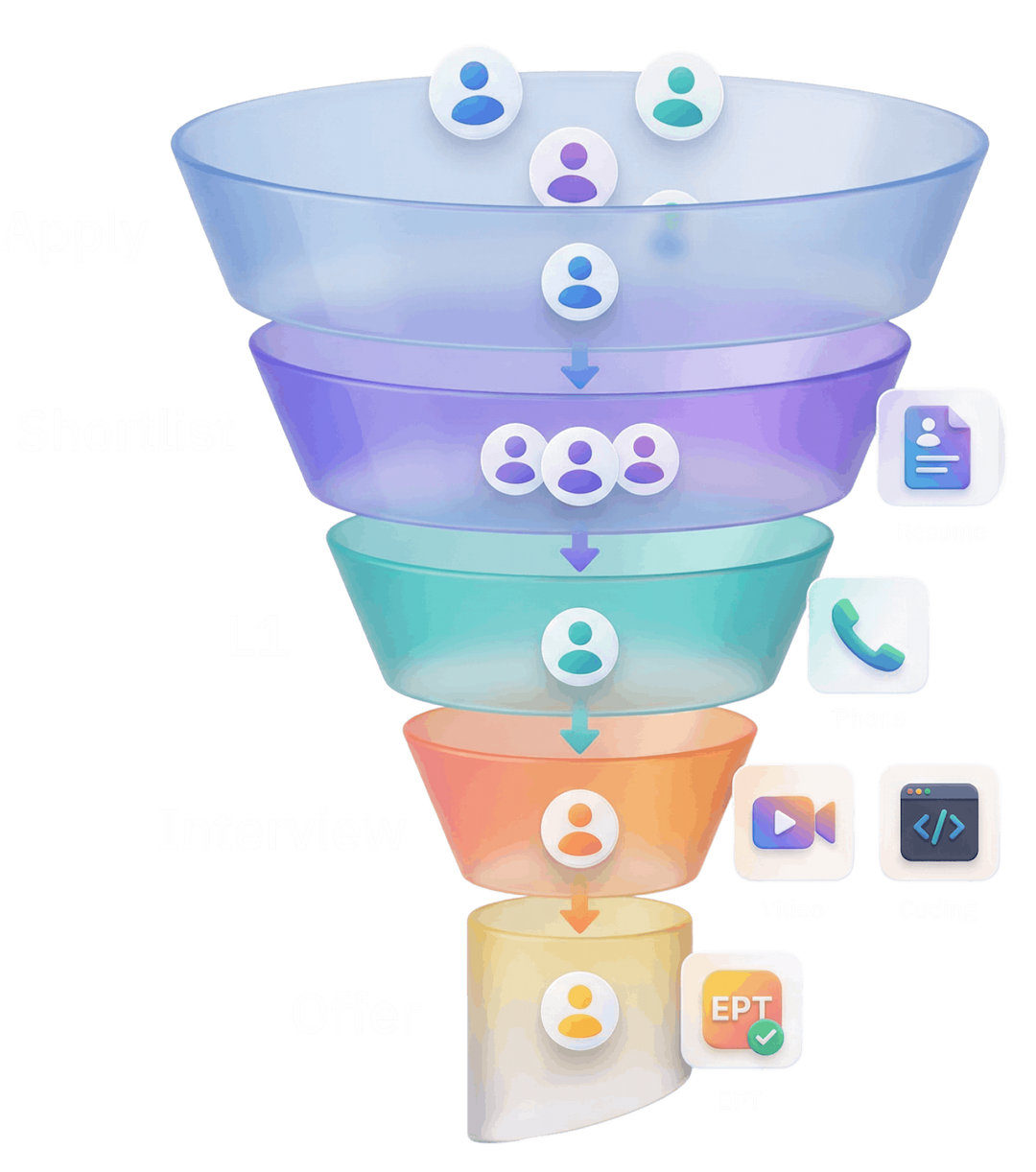
This article refers to a planning framework showing where AI can reduce manual effort across the funnel.
What This Blueprint Covers
Google does not have a hiring problem. It has a volume problem wearing a hiring costume. When 3 million people apply and fewer than 7,000 get offers, the real question is not "how do we find good candidates?" It is "how do we stop burning thousands of hours on the 2.99 million who will not get an offer?"
This page walks through four components. First, a funnel map that pins each of Hyring's AI agents to the specific stage where it replaces manual repetition in the Google recruitment process. Second, a phased rollout sized for Google's scale across both global and India operations. Third, a scoreboard of ten KPIs built for weekly tracking at this volume. Finally, an ROI module with transparent math showing where the cost recovery actually sits.
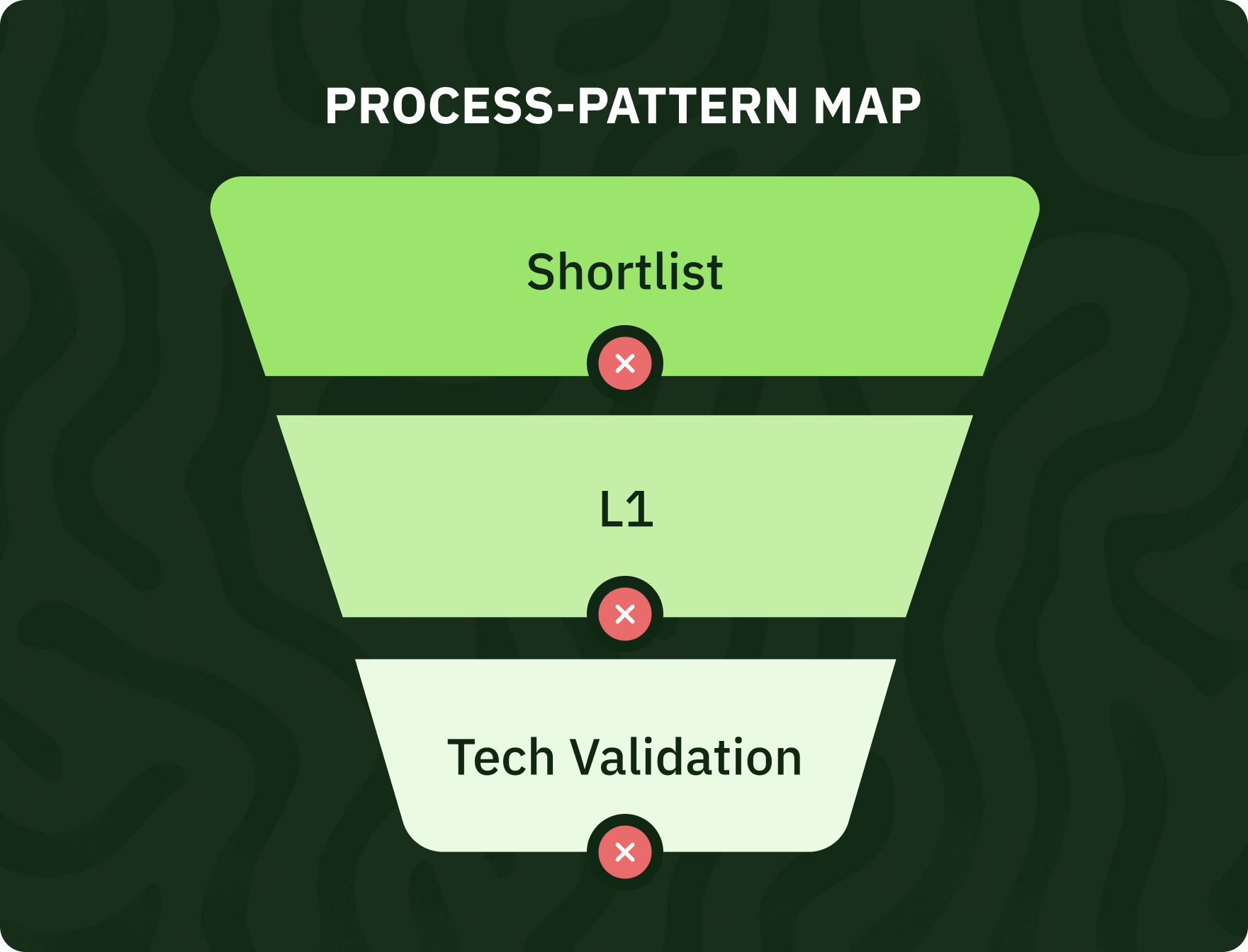
The bottleneck pattern at Google is front-loaded. Resume screening, initial phone conversations, and standardised coding assessments eat the most hours per hire. These three stages also have the highest ratio of repetitive decisions to total decisions. That is where agents belong.
Current State
Google's parent company Alphabet reported approximately 182,000 full-time employees at the end of 2024. Annual attrition in big tech runs 12-15%, meaning Google backfills somewhere around 20,000 to 25,000 roles per year before accounting for net new headcount. Stack that against 3 million inbound applications and you get a staggering application-to-hire ratio near 430:1 globally.
The Google interview process historically runs four to six rounds - resume screen, recruiter call, phone technical screen, onsite (now often virtual) interviews, hiring committee review, and team matching. Google's own hiring documentation has confirmed this multi-stage structure publicly.
~182,000+
~20,000–25,000
~3,000,000+
Google Headcount (End 2024)
Application and Hire Volumes
Four Pain Points That Scale Creates
Phone screen scheduling is a calendar war
Phone screens conducted by Google's recruiter-to-candidate process involve calendar coordination across multiple time zones (Mountain View, Bangalore, Zurich, London). Rescheduling a phone screen can delay a candidate two weeks further into the funnel.
In a peak campus recruitment season in India, scheduling bottlenecks result in a candidate being contacted for the first time 3 to 4 weeks after applying, with Amazon or Microsoft possibly having already extended an offer.
Coding assessments need standardisation, not more engineers
The coding interview at Google is notorious for being tough. The cost of conducting live coding rounds with a senior engineer as the interviewer is that the latter is not shipping code in that hour.
For L3-L5 (early to mid-level), the first coding screen is a repeatable process for data structures, algorithms, and time complexity analysis. The criteria for evaluation are well-defined, which makes it a good candidate for automation without compromising signal quality.
Attrition replaces the same roles on repeat
The attrition in MAANG companies (Big Tech), has steadily climbed since 2022. Google conducted significant layoffs in January 2023 (12,000 employees) and continued smaller reductions through 2024.
Backfill hiring for the same roles creates a loop — screen, interview, offer, onboard, lose, repeat. When the Google recruitment process re-runs identical evaluations for identical role profiles, the cost of not automating those evaluations compounds quarterly.
Hyring AI Agents
Google's funnel breaks cleanly into stages that demand human judgment and stages that demand consistent execution of a known rubric. The agents sit in the second category. A resume scored against a job description, a phone screen measured on five predefined criteria, a coding test graded against test cases and complexity benchmarks: these are mechanical. The hiring committee deliberation and final team-matching conversations are not. Those stay human, full stop.
The AI Resume Screener
Instantly parse and rank resumes based on job-fit signals and technical requirements.
- Rapid high-volume parsing
- Objective skill ranking
- Bias-reduced shortlisting
The AI Phone Screener
Automated L1 verification calls to ensure basic qualifications and interest levels.
- 24/7 automated screening
- Consistent evaluation metrics
- Instant shortlist generation
The AI Coding Interviewer
Technical assessment with live coding environments and real-time logic evaluation.
- Real-time code analysis
- Plagiarism detection
- Automated logical scoring
English Proficiency Test
Standardized evaluation of communication skills, fluency, and professional vocabulary.
- Automated fluency scoring
- Grammar and clarity analysis
- CEFR aligned reporting
Funnel-to-agent
| HIRING STAGE | HYRING PRODUCT | WHAT IT DOES | OUTPUT (WHAT THE TEAM SEES) |
|---|---|---|---|
| RESUME SCREENING | AI Resume Screener | Scores inbound applications against role-specific criteria (programming languages, system design experience, publication history) and flags top-percentile candidates for recruiter review. | Ranked shortlist with match-confidence scores per candidate. |
| PHONE SCREEN | AI Phone Screener | Conducts concurrent voice-based screens across time zones with no scheduling overhead; evaluates responses against structured criteria for communication, motivation, and baseline technical fit. | Pass/flag/reject classification with transcript and score breakdown. |
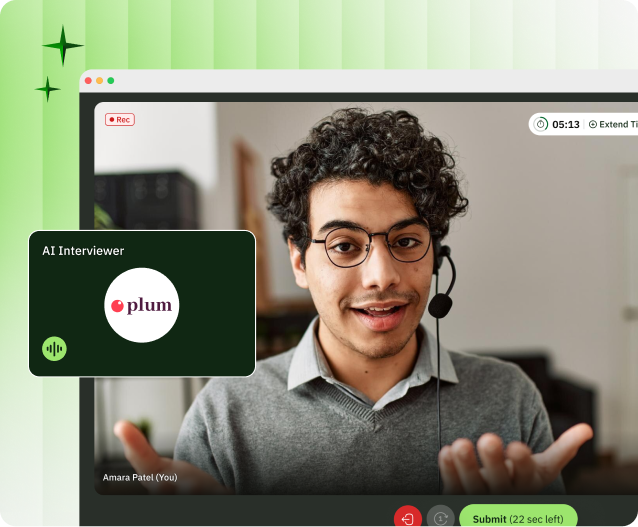
| VIDEO INTERVIEW | AI Video Interviewer | Runs asynchronous video interviews for behavioural and situational questions; captures response structure, depth of examples, and relevance to Google's leadership principles. | Timestamped interview recording with per-question scoring. |
| CODING ASSESSMENT | AI Coding Interviewer | Administers coding challenges calibrated to Google's L3–L5 bar (algorithms, data structures, system design basics); auto-grades against test cases, edge-case handling, and time complexity. | Code output, test-case pass rate, complexity score, plagiarism flag. |
| ENGLISH PROFICIENCY | English Proficiency Test | Assesses spoken English for candidates from non-English-medium institutions, particularly relevant for Google India campus hires from tier-2/tier-3 colleges. | Proficiency band (A1–C2) with sub-scores for fluency, comprehension. |
HYRING PRODUCT
AI Resume Screener
WHAT IT DOES
Scores inbound applications against role-specific criteria (programming languages, system design experience, publication history) and flags top-percentile candidates for recruiter review.
OUTPUT (WHAT THE TEAM SEES)
Ranked shortlist with match-confidence scores per candidate.
HYRING PRODUCT
AI Phone Screener
WHAT IT DOES
Conducts concurrent voice-based screens across time zones with no scheduling overhead; evaluates responses against structured criteria for communication, motivation, and baseline technical fit.
OUTPUT (WHAT THE TEAM SEES)
Pass/flag/reject classification with transcript and score breakdown.
HYRING PRODUCT
AI Video Interviewer
WHAT IT DOES
Runs asynchronous video interviews for behavioural and situational questions; captures response structure, depth of examples, and relevance to Google's leadership principles.
OUTPUT (WHAT THE TEAM SEES)
Timestamped interview recording with per-question scoring.
HYRING PRODUCT
AI Coding Interviewer
WHAT IT DOES
Administers coding challenges calibrated to Google's L3–L5 bar (algorithms, data structures, system design basics); auto-grades against test cases, edge-case handling, and time complexity.
OUTPUT (WHAT THE TEAM SEES)
Code output, test-case pass rate, complexity score, plagiarism flag.
HYRING PRODUCT
English Proficiency Test
WHAT IT DOES
Assesses spoken English for candidates from non-English-medium institutions, particularly relevant for Google India campus hires from tier-2/tier-3 colleges.
OUTPUT (WHAT THE TEAM SEES)
Proficiency band (A1–C2) with sub-scores for fluency, comprehension.
KPI Scoreboard — Google Hiring Model
Time to Screen
Definition: Hours elapsed between application submission and first automated screening decision.
Risk indicator: If this exceeds 24 hours during campus hiring season in India, Google loses candidates to Amazon and Flipkart, who move faster on day-of decisions.
Screening Throughput
Definition: Number of applications processed per day by AI Resume Screener across all open roles.
Risk indicator: A spike in throughput without a corresponding increase in phone-screen conversion likely means the screener's role-fit threshold needs recalibration for that job type.
Phone Screen Completion Rate
Definition: Percentage of candidates who complete the AI phone screen after invitation.
Risk indicator: Completion below 55% in India often traces to candidates receiving competing offers before Google's screen link arrives; track time-from-invite-to-completion separately.
Interview-to-Offer Ratio
Definition: Number of candidates who complete all interview stages divided by total offers extended.
Risk indicator: Google's historical ratio is roughly 4:1 at the final stage. If AI-screened cohorts push this above 6:1, the upstream filters are likely too permissive.
Coding Assessment Pass Rate
Definition: Percentage of candidates meeting the minimum threshold on AI-administered coding challenges.
Risk indicator: A pass rate above 70% suggests the difficulty calibration is below Google's L4 bar. Below 15% may indicate the test is filtering for competition-math ability rather than engineering judgment.
Candidate Drop-off Rate
Definition: Percentage of candidates who abandon the process between any two consecutive stages.
Risk indicator: Watch the gap between video interview invitation and video completion. If it exceeds 40%, the async format or time allowance may need adjustment for non-native English speakers.
Quality of Hire
Definition: 90-day performance review scores for hires who entered through the AI-augmented funnel vs. the legacy funnel.
Risk indicator: Compare across Google offices. If Bangalore hires score higher than Mountain View hires from the same pipeline, the AI agents may be correcting for bias in the legacy phone screen process.
Regional Consistency Score
Definition: Variance in pass rates for the same role across different Google offices (US, India, EMEA).
Risk indicator: More than a 12-point variance between Bangalore and Zurich for the same software engineer (SWE) role signals that regional evaluators are applying different standards; the AI layer should compress this gap.
Funnel Velocity
Definition: Median number of days from application to offer for candidates who complete all stages.
Risk indicator: Google's current median is reported around 6–8 weeks. A target of 4 weeks is aggressive but achievable if the first three stages run concurrently via AI agents.
Recruiter Escalation Rate
Definition: Percentage of AI-screened candidates flagged for manual recruiter review due to edge cases.
Risk indicator: A baseline of 8–12% is expected. Sustained rates above 20% indicate the agent's scoring model is uncertain on a common candidate profile that needs a rule update.
Model ROI for High-Volume Scenario
Illustrative projection only. All figures are calculated from publicly reported data and industry benchmarks. They do not represent a contractual guarantee. This is a planning framework built on reasonable estimates.
Annual Savings Potential
~$5.7M
in operational and hiring costs, based on 38,000 recruiter and engineer hours recovered at an illustrative blended $150/hour.
Time-to-Hire Reduction
~40%
faster from application to accepted offer in AI-augmented cohorts, by compressing the resume, phone, and coding stages.
Interview Velocity
~35%
higher scheduling and evaluation throughput when AI Phone Screener and AI Coding Interviewer run concurrent sessions instead of fully human-scheduled rounds.
5-Year ROI Projection
~250%
with a ~9-month payback period, assuming $5.7M in annualised savings against a conservative platform + change-management cost envelope of ~$2.3M/year over the first 12 months.
Note: ROI figures below are an illustrative model of potential savings in this specific scenario. Actual results vary by internal workflow costs.
Where The Hours And Dollars Go
From resume screening to phone screening and coding tests, it is estimated that Google's hiring process currently utilizes over 52,000 recruiter and engineer hours for evaluation with a set rubric.
By automating these three steps through Hyring's agents, it is projected that 38,000 hours will be recovered each year, representing an estimated cost savings of $5.7M in annual costs at a blended rate of $150/hour for Google's recruiters and engineers.
Hours by Stage (Manual vs. AI-Assisted)
Source: Hyring Hiring Model (Illustrative)
Where the $5.7M Actually Hides
The biggest chunk is not in the recruiting department budget. It is in engineering opportunity cost. Every hour a senior SWE spends running a coding screen for an L4 candidate is an hour not spent on production code.
At Google's scale, engineering time pulled into hiring rounds is a line item that finance teams rarely isolate but always feel. The second largest recovery comes from phone screen parallelisation: AI Phone Screener runs sessions without calendar dependency, eliminating the scheduling drag that stretches Google India's time-to-first-contact from days to weeks.
Cost by Stage (Manual vs. AI-Augmented)
Source: Hyring Hiring Model (Illustrative)
Deployment Plan: Eight-Week Rollout For The Google Hiring Process
Switching on five AI agents across 3 million annual applications on a Monday morning is a recipe for chaos. The rollout phases by stage, geography, and role family, starting narrow and expanding only after each phase hits its KPI targets.
Week 3: Add AI Phone Screener for the Same Cohort
Layer AI Phone Screener onto the candidates shortlisted from the Week 1-2 resume pilot. Run concurrent phone screens across IST and PST time zones.
Success gate: phone screen completion rate above 60%, recruiter escalation rate below 15%.
Week 4-5: Expand to Coding Assessment and English Proficiency
Activate AI Coding Interviewer for L3-L4 SWE candidates globally. Simultaneously deploy English Proficiency Test for Google India campus hires from non-English-medium institutions.
Success gate: coding pass rate between 20-40% (calibrated to Google's bar), English test completion above 75%.
Week 6: Introduce AI Video Interviewer for Behavioural Rounds
Deploy AI video interview software for behavioural/situational questions on L3-L5 non-engineering roles (sales, operations, program management) in one region (North America).
Success gate: candidate drop-off below 35%, video scoring alignment with human panel scores above 80%.
Week 7: Scale to All Active Global SWE Roles
Expand all five agents to cover active SWE requisitions across US, India, and EMEA. Monitor KPI scoreboard daily. Flag any metric drifting outside tolerance for immediate recalibration.
Week 8: Full Operational Review and Sign-Off
Run a full-funnel comparison: AI-augmented cohort vs. legacy cohort on all ten KPIs. Present results to Google's recruiting leadership. Decision point: proceed to full-scale deployment or adjust agent parameters before expanding to remaining job families.
Frequently Asked Questions
Does Hyring currently work with Google?
No. This page is a hypothetical use case that maps Hyring's AI agents onto Google's publicly documented hiring funnel. There is no commercial relationship between Hyring and Google or Alphabet Inc.
Would AI agents replace Google's hiring committee?
The hiring committee is a human deliberation stage and stays entirely outside the automation scope. Agents handle upstream screening and assessment while committee members receive structured data packages instead of raw interview notes, which actually makes their review faster.
How does the AI coding interviewer compare to Google's existing coding interviews?
It covers the same fundamentals (algorithms, data structures, complexity analysis) but runs without requiring a senior engineer to sit in the session.
The engineer's time returns to production work. Final-round coding interviews with a human evaluator remain for senior roles.
Can the AI phone screener handle Google India's accent diversity?
Hyring's phone screener is trained on multi-accent English datasets.
For Google India campus hires from tier-2 and tier-3 colleges, this matters because accent-based bias in manual phone screens is a documented friction point at scale.
What happens if the AI flags a candidate incorrectly?
Every agent includes a confidence threshold. Candidates near the decision boundary route to a human recruiter for manual review.
The recruiter escalation rate KPI tracks this, and the target is to keep it between 8-12%.
How long until the ROI projections materialise?
Based on the eight-week deployment plan, measurable time savings appear in Week 3 (phone screen stage).
Full cost recovery against Hyring's platform licensing typically falls within the first six months at Google's application volume.