HCL Hiring Process: AI Draft for Growth Using Hyring AI Agents
The HCL hiring process runs a workforce of 226,379 people across 60 countries, while hiring over 10,000 freshers every year. Q3 FY26 saw 2,852 new recruits alone. At this pace, any inefficiencies in the first three stages of the hiring funnel, even small, add up to thousands of recruiter hours wasted and millions of dollars in unseen costs.
This blueprint shows where Hyring's five AI Agents - AI Resume Screener, AI Phone Screener, AI Video Interviewer, AI Coding Interviewer, English Proficiency Test - are located in the HCL hiring process, what they deliver back to the hiring process, and which ten KPIs keep the entire model in check.
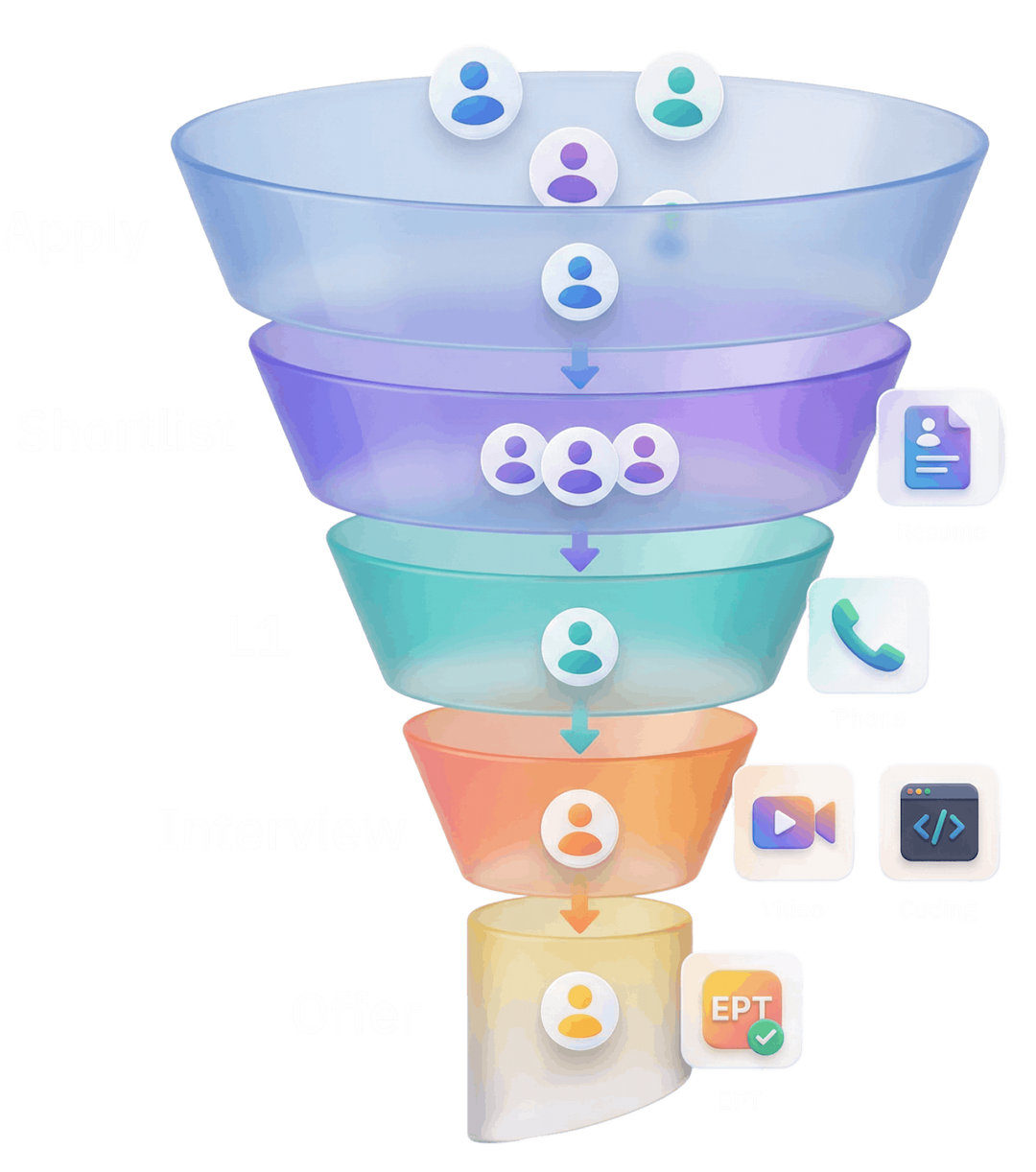
This article is a planning framework showing where AI could reduce manual effort across the funnel.
The Blueprint
Hiring models collect dust when nobody can identify which number moved last week. This one was built to avoid that problem.
- A funnel map shaped for the volume and rhythm of HCL's campus and lateral cycles.
- A deployment plan, staged week by week.
- A KPI scoreboard with risk flags attached to every metric.
- An ROI module with transparent math and an explicit disclaimer on projections.
HCLTech runs campus engagement across a large college network. According to GeeksforGeeks, freshers pass through four rounds- an English grammar and aptitude test, a voice and accent or group discussion round, a technical interview, and a final HR conversation. Those rounds compress into tight windows during campus seasons. The operational friction accumulates in the first three, where the work is repetitive and rubric-bound. That is where automation carries real weight.
Current State
HCLTech reported 226,379 employees at the end of December 2025, per its Q3 FY26 earnings release. Net headcount dipped by 261 that quarter, even while 2,852 freshers were added. That arithmetic tells a specific story: lateral exits and bench rationalisation are running alongside aggressive campus onboarding.
Trailing twelve-month voluntary attrition stood at 12.4%, down from 13.2% the prior year. Better than the 20%+ peaks of FY22-FY23. Still, 12.4% on a 226,000-person base equals roughly 28,000 departures per year. Replacement demand alone keeps recruitment running near capacity.
HCLTech brought on 12,141 freshers across FY24, per Business Standard. Management commentary through FY25 and FY26 earnings calls has flagged 10,000+ annual campus hires as the operating range, with quarterly numbers swinging based on deal ramp timing.
An 8:1 application-to-offer ratio (consistent with industry benchmarks for large Indian IT services firms) means a drive targeting 3,000 hires in a quarter pulls 24,000 to 36,000 applications into the recruiter team's queue within days.
0
0
0
What Breaks Inside The HCL Recruitment Process At Scale
A bottleneck at stage one does not stay at stage one. A two-day delay in shortlisting turns into a week-long gap before any candidate hears from a human. In that week, Infosys, TCS, Wipro, Accenture, and product companies are pulling from the same campus pool.
Repetitive L1 work eats recruiter capacity
HCL's fresher process starts with an English grammar test and a voice/GD round. The test is based on a fixed rubric - the questions are set, the marking is fixed, and the pass/fail threshold is constant across candidates.
At 10,000+ fresher hires and an application-to-hire ratio of 8:1, we're talking about an initial assessment requirement of 80,000 to 100,000 candidates per year. At 18 minutes per candidate per voice/GD round, we're talking about over 22,500+ person-hours of voice conversations with no change in the assessment framework whatsoever. Every hour is an hour of human effort that doesn't require human judgment.
Technical panellists pulled off billable delivery
The cost of HCLTech's engineering talent is variable by practice and geography. Industry benchmarks for mid-level delivery roles in Indian locations range from $30 to $55 per hour loaded.
A lead developer spends four hours a day interviewing during a hiring sprint. That's four hours of unbilled delivery time sitting on the project P&L, not the recruitment budget. Delivery managers don't see it until margin reviews bring it up.
Silence between rounds kills conversion
Campus hires receive two to four offers by final semester. The HCL interview process races on brand name as well as speed. A student who clears the aptitude test on Monday and waits until Thursday for a slot is being processed somewhere in between.
The loss is just a small blip on recruiter dashboards as the student simply stops responding.
Remote integrity checks degrade with volume
More of HCL's assessments are being done over video as a percentage of total assessments. To detect tab switches, secondary speakers, or identity changes, the interviewer needs to pay attention to all of the peripheral activity.
After interview number seven or eight, attention wavers, and bias enters the process. A gap in scaled remote hiring, without proctoring, is proportional to the volume of interviews going through the process.
Hyring AI Agents
Hyring's agents sit at the stages where manual repetition burns time without needing a judgment call. Binary rule: if the stage runs on a fixed rubric with a scored or pass/fail output, the agent handles it. If the decision needs creative thinking or relationship context, a person does. Final decision authority stays with humans. That is non-negotiable.
The AI Resume Screener
Instantly parse and rank resumes based on job-fit signals and technical requirements.
- Rapid high-volume parsing
- Objective skill ranking
- Bias-reduced shortlisting
The AI Phone Screener
Automated L1 verification calls to ensure basic qualifications and interest levels.
- 24/7 automated screening
- Consistent evaluation metrics
- Instant shortlist generation
The AI Coding Interviewer
Technical assessment with live coding environments and real-time logic evaluation.
- Real-time code analysis
- Plagiarism detection
- Automated logical scoring
English Proficiency Test
Standardized evaluation of communication skills, fluency, and professional vocabulary.
- Automated fluency scoring
- Grammar and clarity analysis
- CEFR aligned reporting
Funnel-to-agent
| HIRING STAGE | HYRING PRODUCT | WHAT IT DOES | OUTPUT (WHAT THE TEAM SEES) |
|---|---|---|---|
| SHORTLIST | AI Resume Screener | Scores resumes against role-fit indicators from the job description. | Ranked shortlist + job fit signals. |
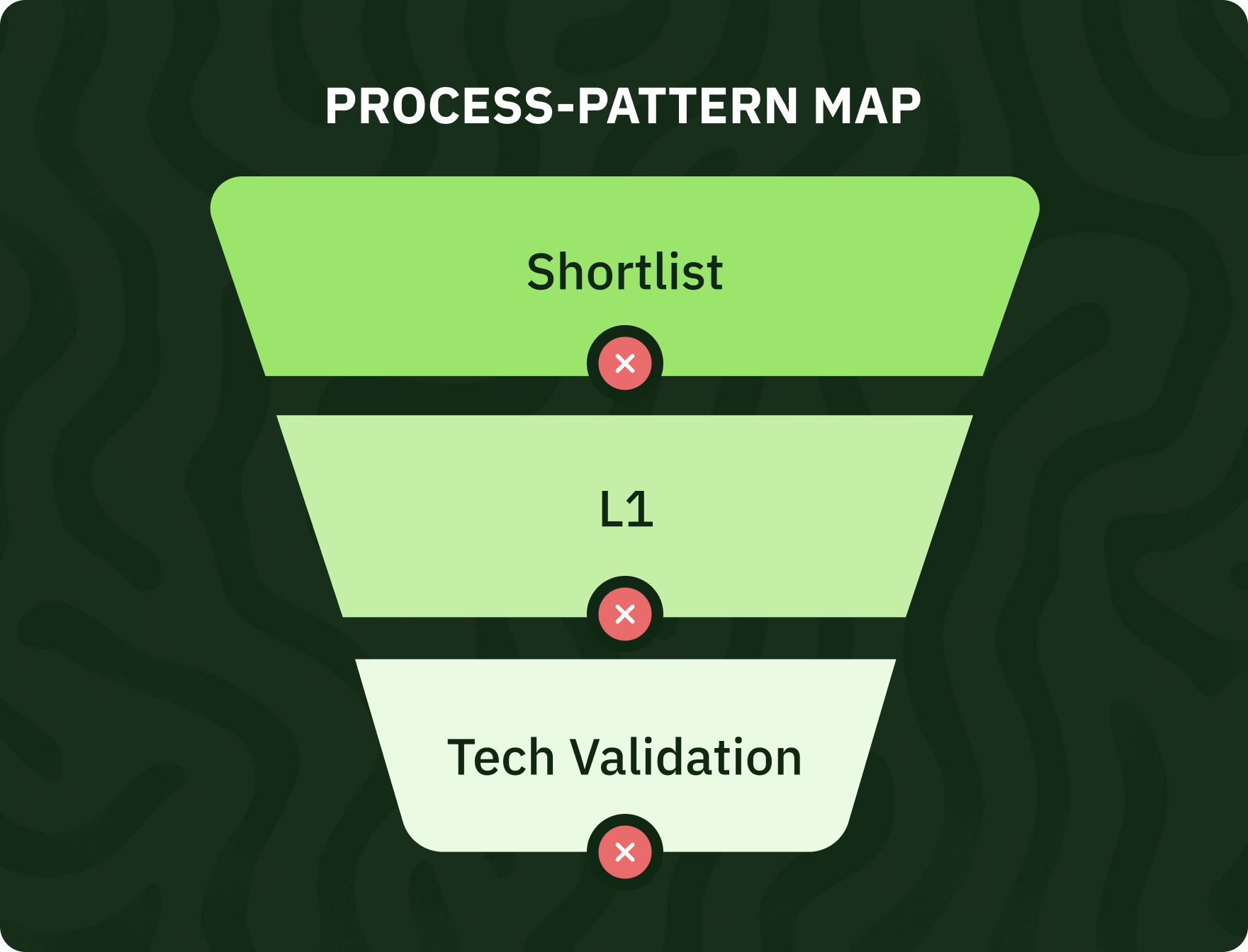
| L1 SCREENING | AI Phone Screener | Conducts first-round phone screens with scored outputs. | Call summary + score + shortlist. |
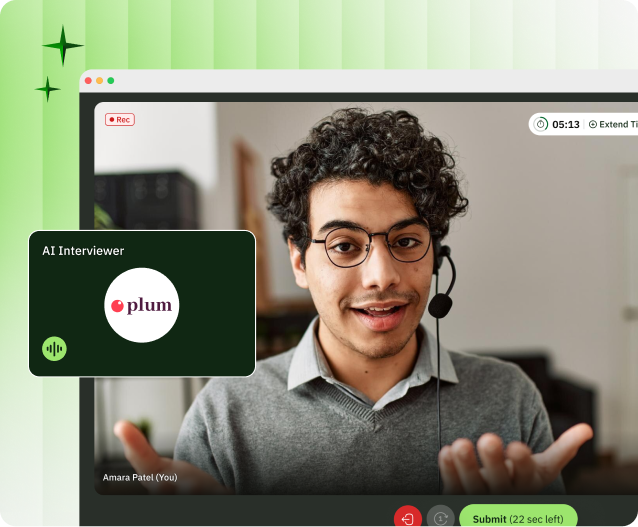
| STRUCTURED INTERVIEW | AI Video Interviewer | Runs structured video interviews and generates candidate reports. | Interview automation + structured scoring. |
| TECH VALIDATION | AI Coding Interviewer | Conducts live coding interviews for engineering roles. | Coding evaluation report. |
| COMMUNICATION | English Proficiency Test | Adds an English assessment where client-facing roles require it. | CEFR level + skill breakdown. |
HYRING PRODUCT
AI Resume Screener
WHAT IT DOES
Scores resumes against role-fit indicators from the job description.
OUTPUT (WHAT THE TEAM SEES)
Ranked shortlist + job fit signals.
HYRING PRODUCT
AI Phone Screener
WHAT IT DOES
Conducts first-round phone screens with scored outputs.
OUTPUT (WHAT THE TEAM SEES)
Call summary + score + shortlist.
HYRING PRODUCT
AI Video Interviewer
WHAT IT DOES
Runs structured video interviews and generates candidate reports.
OUTPUT (WHAT THE TEAM SEES)
Interview automation + structured scoring.
HYRING PRODUCT
AI Coding Interviewer
WHAT IT DOES
Conducts live coding interviews for engineering roles.
OUTPUT (WHAT THE TEAM SEES)
Coding evaluation report.
HYRING PRODUCT
English Proficiency Test
WHAT IT DOES
Adds an English assessment where client-facing roles require it.
OUTPUT (WHAT THE TEAM SEES)
CEFR level + skill breakdown.
KPI Scoreboard — HCL Hiring Model
Time to Screen
Definition: Elapsed time from application receipt to L1 decision.
Risk indicator: Compressing below 48 hours wins, but only if panel-stage rejection rates stay flat. A spike means the early filter swapped speed for accuracy.
Screening Throughput
Definition: Initial screens completed per recruiter per week.
Risk indicator: Throughput climbing while advance rates drop signals the intake net is too wide.
Interview Completion Rate
Definition: Percentage of invited candidates who finish the full assessment.
Risk indicator: Below 60% usually traces to unclear invite instructions, broken access links, or assessments exceeding 40 minutes.
Early Stage Drop-offs
Definition: The funnel step where candidates stop participating.
Risk indicator: Heavy drop-off at assessment (not scheduling) usually means the test feels disproportionate to the role level.
Panel Hours per Hire
Definition: Interviewer hours consumed per finalised hire.
Risk indicator: Track alongside 90-day retention. Panel hours dropping in tandem with retention means the AI filter is too aggressive on soft-skill signals.
Pass-through Rate
Definition: Percentage advancing stage to stage.
Risk indicator: A 15-point variance between two campuses hiring for the same role means rubrics need campus-level calibration.
Shortlist-to-Offer Ratio
Definition: Shortlisted candidates needed to produce one accepted offer.
Risk indicator: Moving from 8:1 to 4:1 is strong. Moving from 8:1 to 3:2 suggests viable candidates are being cut.
Integrity Flag Rate
Definition: Percentage of AI interviews triggering fraud alerts.
Risk indicator: 3-5% is the normal baseline. A jump to 10%+ from one campus warrants manual review before drawing conclusions about that candidate pool.
Time to First Touch
Definition: Lag between application and first outreach.
Risk indicator: A fast first touch followed by a week of silence creates worse perception than a steady moderate pace across all touch points.
SLA Adherence
Definition: Percentage of candidates receiving status updates within defined windows.
Risk indicator: Fast first-touch speed masking slow follow-up SLAs means the process feels responsive at the start and stalled afterward.
Model ROI for High-Volume Scenario
Every number below is an illustrative projection. The math starts from HCLTech's publicly reported hiring volumes, but internal cost structures vary. Treat this as a starting model, not a locked forecast.
Annual Savings Potential
~$1.8M
in operational and hiring costs.
Reduction in Time-to-Hire
~60%
faster from application to accepted offer.
Faster Interview Process
~48%
acceleration in scheduling and evaluation throughput.
5-Year ROI Projection
~310%
with a 7-month payback period.
Note: ROI figures below are an illustrative model of potential savings in this specific scenario. Actual results vary by internal workflow costs.
Where recruiter hours go today (and how to recover them)
Three stages eat the time: resume filtering, L1 voice/phone screens, and early technical panels.
Total estimated hours recovered annually: ~20,400.
Hours by Stage (Manual vs. AI-Assisted)
Source: Hyring Hiring Model (Illustrative).
Cost comparison: manual operation vs. AI-assisted
L1 screening cost drops from ~$720K in manual recruiter hours to ~$95K with AI-conducted screens. Engineering panel utilisation shifts from 4–5 interviews per day during peak sprints to 2 focused sessions as panels receive only candidates who cleared AI resume, phone, and coding gates. Funnel completion rate improves from ~30% to ~70% driven by reduced wait times, self-scheduling, and faster status updates.
| Metric | Manual process today | With Hyring AI agents |
|---|---|---|
| L1 screening cost | ~$720K (recruiter hours at $16/hr, coordinator time, telephony infrastructure) | ~$95K (~$1 per AI screen + ~$25K for recruiter review of reports) |
| Engineering panel utilisation | Heavy: 4-5 interviews per day during peak sprints, pulling engineers off delivery | Selective: panels receive only candidates who cleared AI resume, phone, and coding gates; 2 per day, higher relevance per session |
| Scalability constraint | Interviewer calendars, timezone coordination, physical/virtual room slots | Concurrent and asynchronous: candidates complete assessments on their schedule within a defined window |
| Verification method | Interviewer observation during live video, inconsistent across fatigue levels | Automated proctoring: face presence, voice matching, screen activity, gaze direction, clipboard behaviour monitored simultaneously |
| Funnel completion rate | ~30% of shortlisted candidates reach the offer stage (industry benchmark estimate) | ~70% projected from reduced wait times, self-scheduling, and faster status updates |
Where the ~$1.8M in annual savings originates
The largest recovery is not in the recruitment budget. It is in engineering delivery margins and candidate acquisition overhead.
Where the Savings Come From
Source: Hyring Hiring Model (Illustrative) All figures are illustrative
When does it pay for itself?
Platform investment is seen as savings accumulating per hiring cycle. Break-even in this model hits around month seven or sometimes even eight. That timeline compresses if lateral requisitions are layered onto the same Hyring deployment, because marginal cost per additional AI interview is near-zero once the platform is configured.
Why the HCL hiring model responds well to this kind of deployment: the first three funnel stages are high-volume, rubric-driven, and produce scored outputs. They do not require creative evaluation. They require consistency applied at speed.
Cumulative Savings vs Investment (12-Month Model)
Month
Source: Hyring Hiring Model (Illustrative)
HCL Hiring Process Plan (Week-By-Week)
Rolling this out across 100,000 applications on day one will break it. A staged approach protects live workflows, produces comparison data, and lets hiring panels build confidence in AI outputs before relying on them.
Week 2
Week 3
Week 4
Frequently Asked Questions
How does this model handle campus intake surges for HCL?
Every candidate in a batch gets their assessment link at once. Hyring's AI agents run thousands of sessions concurrently, so a 25,000-application drive clears the L1 stage in days rather than weeks.
What output does the first automated round produce in the HCL hiring process?
Every report has a competency score breakdown, response summary, flagged areas worth probing, and an advance-or-hold recommendation. Recruiters can review it in about 90 seconds.
How does the system detect interview fraud?
Six signals are monitored in parallel by the AI video interviewer — tab switches, secondary faces, voice mismatches, gaze anomalies, lip-sync gaps, and clipboard pastes. No single flag triggers rejection; the recruiter sees which signals fired and makes the call.
Do automated interviews hurt candidate experience?
Candidates choose their own assessment window, skip scheduling back-and-forth, and get faster status updates because scoring happens immediately. Feedback trends are positive in most deployments.
Can coding assessments be configured per role?
Yes. Java, Python, C++, JavaScript, SQL, and more, with configurable difficulty and problem types per role profile. A backend developer and a data engineer see completely different assessments.
Where do human technical panels fit?
At the final stage only. By that point candidates have cleared resume screening, phone or video assessment, coding validation, and language evaluation. Panellists focus on problem-solving depth and culture fit rather than re-checking eligibility.