IBM Hiring Process: Where Hyring's AI Agents Up The Game
IBM reported a global workforce of approximately 270,300 employees at the end of 2024, per its annual report filed with the SEC. The company expects to backfill thousands of roles annually while hiring for growth areas like hybrid cloud, AI, and consulting.
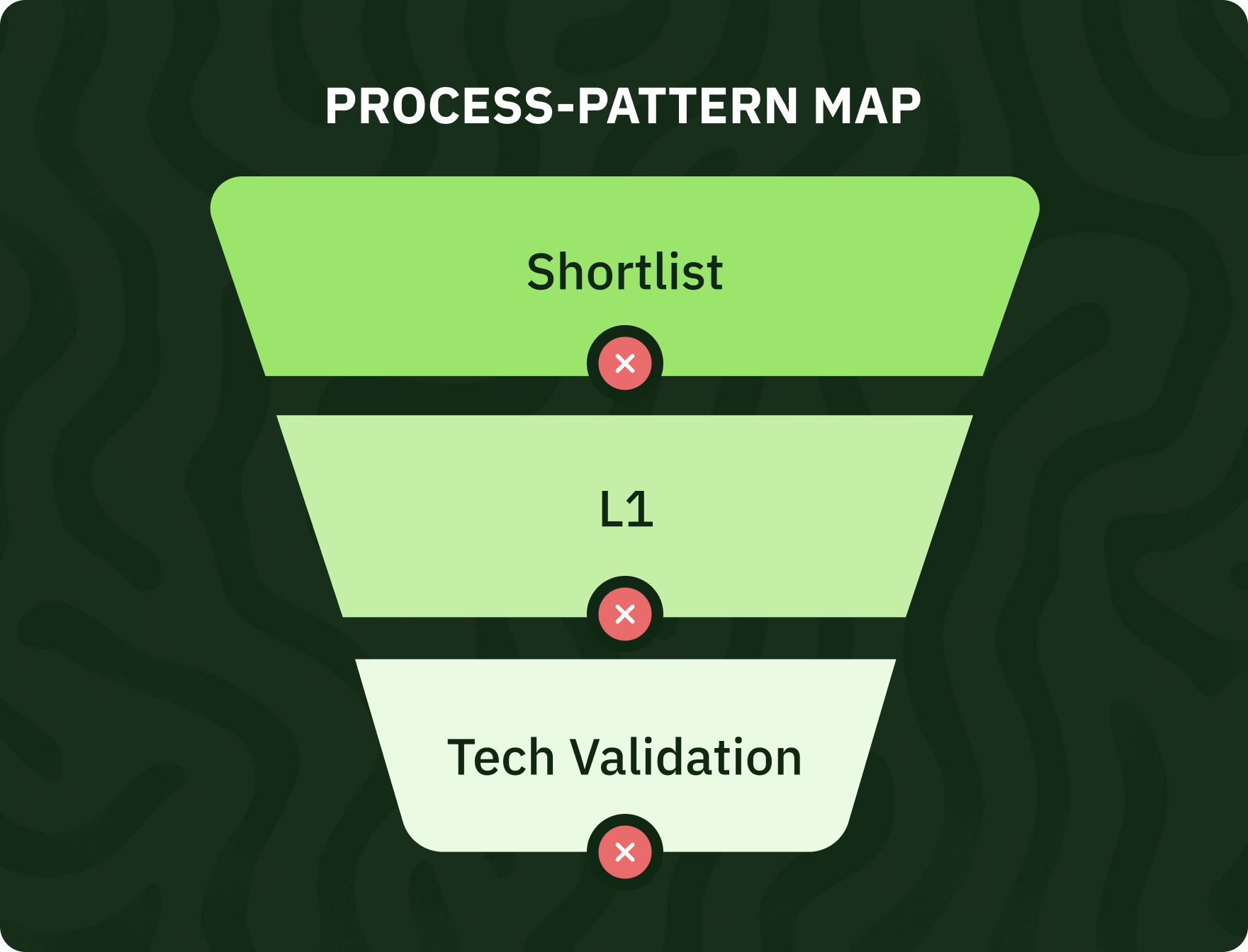
The IBM hiring process outlined here is a unique workflow structuring where Hyring's AI agents can absorb recruiter and panel workload, what outputs they generate, and which KPIs keep the operation measurable.

This article presents a planning framework showing where AI can reduce manual effort across the hiring funnel.
The Blueprint
A hiring model worth running needs a structure you can pressure-test, not a slide deck that stalls at phase two. What follows is built around IBM's publicly reported scale and hiring patterns.
- A funnel map for a high-volume hiring workflow.
- A deployment plan executable in phases.
- A KPI scoreboard containing risk indicators.
- An ROI module with adjustable inputs and a neutral disclaimer.
Current State
IBM's 2024 annual report, or 10-K filing with the SEC, indicated that the company's total headcount is approximately 270,300 people. The company's latest earnings calls and press commentary have highlighted the company's hiring in its consulting, hybrid cloud, and AI-focused business units. The company's management has indicated that it will continue to hire (to offset its 10-12% annual attrition rate, based on industry benchmarks for large technology service companies) while scaling talent in Red Hat, WatsonX, and consulting delivery.
IBM competes with the same talent pool of engineers and consultants that Accenture, Deloitte, Infosys, and Wipro compete with, all of whom have invested heavily in AI-assisted hiring over the past two years. If your competitor is able to interview 5,000 candidates overnight, then a three-week shortlisting process is a talent brain-drain.
IBM is likely to interview more than 150,000 to 200,000 candidates every year, based on the company's latest earnings calls and analyst estimates.
~270300
~27k-32k
~150k-200k
Pain Points of the IBM Recruitment Process
IBM's hiring model covers dozens of countries, hundreds of job families, and multiple business units, each with semi-autonomous talent acquisition processes. This creates unique friction points, especially when scaled.
L1 Phone Screens dominate recruiter time
IBM's recruiters, handling lateral moves into technical consulting roles, might spend 25-30 minutes per phone screen. At 50 screens per recruiter per month, that's 25 hours per recruiter, per month, dedicated to phone screens alone, before we even account for scheduling, rescheduling, and note-taking.
There are hundreds of recruiters in a TA team across multiple regions, so we're talking tens of thousands of hours per month.
Engineering panels pulled into early-stage filtering
For software engineering and architect-level roles, IBM's technical panel members (often billable consultants or product engineers) get pulled into first-round technical screens. Every hour a senior engineer spends interviewing a candidate who lacks baseline skills is an hour not spent on client delivery or product work.
Candidates experience gaps in high-competition roles
IBM competes directly with Google, Microsoft, Amazon, Accenture, and Deloitte for cloud architects, AI/ML engineers, and senior consultants.
Slow response times and long interview cycle times are common issues mentioned in Glassdoor reviews.
In a talent pool where the best candidates often have multiple offers within a two-week timeframe, IBM's four-week interview cycle is a risk for losing talent.
Hyring AI Agents
Hyring's AI agents each handle a defined stage of the funnel. The logic is the same for any enterprise at IBM's scale: compress the repeatable steps so that human decision-makers only engage where judgment is irreplaceable.
The AI Resume Screener
Instantly parse and rank resumes based on job-fit signals and technical requirements.
- Rapid high-volume parsing
- Objective skill ranking
- Bias-reduced shortlisting
The AI Phone Screener
Automated L1 verification calls to ensure basic qualifications and interest levels.
- 24/7 automated screening
- Consistent evaluation metrics
- Instant shortlist generation
The AI Coding Interviewer
Technical assessment with live coding environments and real-time logic evaluation.
- Real-time code analysis
- Plagiarism detection
- Automated logical scoring
English Proficiency Test
Standardized evaluation of communication skills, fluency, and professional vocabulary.
- Automated fluency scoring
- Grammar and clarity analysis
- CEFR aligned reporting
Funnel-to-agent
| HIRING STAGE | HYRING PRODUCT | WHAT IT DOES | OUTPUT (WHAT THE TEAM SEES) |
|---|---|---|---|
| SHORTLIST | AI resume screener | Scores and ranks resumes against role-fit signals from the job description. | Ranked shortlist with match-score breakdown. |
| L1 SCREENING | AI phone screener | Conducts first-round phone screens without calendar dependency; runs concurrent sessions. | Call summary, candidate score, recommended shortlist. |
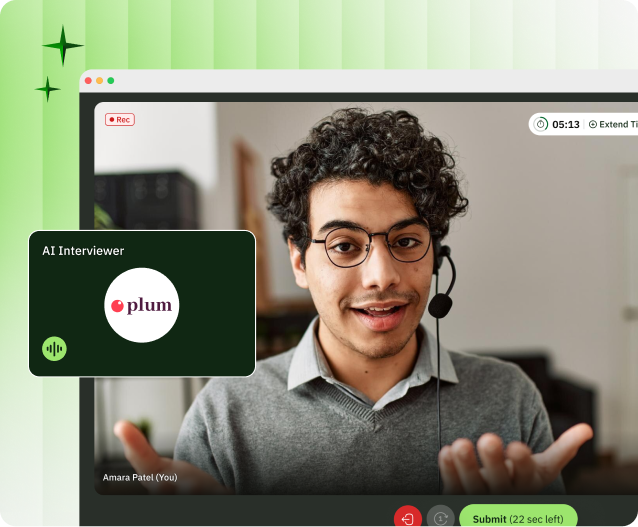
| STRUCTURED INTERVIEW | AI video interviewer | Runs structured video interviews with adaptive follow-up questions and proctoring. | Interview recording, structured score, integrity flags. |
| TECH VALIDATION | AI coding interviewer | Administers live or async coding interviews for engineering roles. | Code evaluation report with plagiarism and tab-switch detection. |
| COMMUNICATION | English proficiency test | Assesses spoken English for client-facing or international roles. | CEFR-benchmarked level with skill breakdown. |
HYRING PRODUCT
AI resume screener
WHAT IT DOES
Scores and ranks resumes against role-fit signals from the job description.
OUTPUT (WHAT THE TEAM SEES)
Ranked shortlist with match-score breakdown.
HYRING PRODUCT
AI phone screener
WHAT IT DOES
Conducts first-round phone screens without calendar dependency; runs concurrent sessions.
OUTPUT (WHAT THE TEAM SEES)
Call summary, candidate score, recommended shortlist.
HYRING PRODUCT
AI video interviewer
WHAT IT DOES
Runs structured video interviews with adaptive follow-up questions and proctoring.
OUTPUT (WHAT THE TEAM SEES)
Interview recording, structured score, integrity flags.
HYRING PRODUCT
AI coding interviewer
WHAT IT DOES
Administers live or async coding interviews for engineering roles.
OUTPUT (WHAT THE TEAM SEES)
Code evaluation report with plagiarism and tab-switch detection.
HYRING PRODUCT
English proficiency test
WHAT IT DOES
Assesses spoken English for client-facing or international roles.
OUTPUT (WHAT THE TEAM SEES)
CEFR-benchmarked level with skill breakdown.
KPI Scoreboard — IBM Hiring Model
Time to Screen
Definition: Hours elapsed from application received to L1 screening decision.
Risk indicator: Compressing this too aggressively can push poorly vetted candidates into panel rounds, inflating rejection rates downstream.
Screening Count
Definition: Number of completed screens per recruiter per week.
Risk indicator: A spike in throughput paired with a falling next-stage pass rate may signal that the screening criteria need tightening, not loosening.
Interview Completion Rate
Definition: Percentage of candidates who receive an AI interview invite and finish the full session.
Risk indicator: Completion dropping below 60% typically points to friction in the invite email, unclear instructions, or technical issues on the candidate side.
Early Stage Drop-offs
Definition: The exact funnel step where candidates exit before completing the process.
Risk indicator: High drop-off during scheduling or assessment stages often correlates with poor candidate UX or excessive wait times between steps.
Panel Hours per Hire
Definition: Total hours human interview panels spend per finalized hire.
Risk indicator: If panel hours fall sharply but offer-acceptance rates also decline, the AI screening layer may be filtering too aggressively and removing strong-but-unconventional candidates.
Pass-through Rate
Definition: Percentage of candidates advancing from one stage to the next.
Risk indicator: Large pass-through discrepancies between business units or geographies signal inconsistent calibration of scoring rubrics.
Shortlist-to-Offer Ratio
Definition: Number of shortlisted candidates needed to produce one accepted offer.
Risk indicator: A ratio improving too rapidly (e.g., from 8:1 to 2:1 in one quarter) deserves scrutiny — it could mean the top of the funnel is too narrow and viable candidates are being excluded.
Integrity Flag Rate
Definition: Percentage of AI video or coding sessions that trigger cheating or fraud alerts.
Risk indicator: Clustered spikes from a single geography, campus, or sourcing channel require manual review and possible recalibration of proctoring sensitivity.
Time to First Touch
Definition: Hours between a candidate submitting an application and receiving their first communication or assessment invite.
Risk indicator: An instant automated acknowledgment adds no value if the next human or AI touchpoint is still five days away. Measure the gap to the second touch as well.
SLA adherence
Definition: Percentage of candidates processed within the agreed internal turnaround window (e.g., 48-hour screen, 5-day interview cycle).
Risk indicator: Consistently missing SLAs on specific role types (e.g., niche AI/ML roles with low applicant volume) may indicate the workflow needs a separate track, not faster automation.
Model ROI for High-Volume Scenario
A practical IBM hiring process framework needs to reconcile efficiency claims with financial reality. Below is an illustrative ROI breakdown scaled for an estimated 30,000 annual hires (combining attrition backfill and growth).
Annual Savings Potential
$4.2M+
in operational and hiring costs.
Reduction in Time-to-Hire
68%
faster for roles where AI agents handle L1 and tech screening.
Faster Interview Process
58%
acceleration in scheduling and candidate evaluation cycles.
5-Year ROI Projection
~380%
with a 6-month payback period.
Note: ROI figures below are an illustrative model of potential savings in this specific scenario. Actual results vary by internal workflow costs.
Hours Saved Annually
At ~180,000 applications for ~30,000 hires, each requiring an average 20 minutes of human screening time, that is 60,000 hours of screening labor annually. Shifting 85% to AI agents recovers approximately 51,000 hours.
For technical roles (40% of hires), AI coding interviews handling 80% of volume recover a further ~7,200 engineering hours.
Combined recovery: ~58,200 hours annually.
Hours Saved by Hiring Stage
Combined recovery: ~58,200 hours annually
Source: Hyring Hiring Model
Current State Costing vs. Target State with AI
A practical IBM hiring process framework needs to reconcile efficiency claims with financial reality. Below is an illustrative ROI breakdown scaled for an estimated 30,000 annual hires (combining attrition backfill and growth).
| METRIC | CURRENT MANUAL PROCESS | TARGET WITH HYRING AI AGENTS |
|---|---|---|
| L1 Screening Cost | ~$3.0M (recruiter hours + scheduling overhead) | ~$300K (AI interviews at ~$1 per screen average) |
| Engineering Panel Load | High (engineers conduct early tech screens for 40% of roles) | Low (panels review only AI-shortlisted, pre-validated profiles) |
| Interview Scalability | Constrained by recruiter and panel calendar availability | Concurrent AI interviews with no scheduling dependency |
| Fake Candidate Detection | Manual verification, inconsistent across regions | AI proctoring: face, voice, screen, and tab-switch detection |
| Funnel Completion Rate | ~30-35% (estimated, based on slow process and scheduling friction) | >78% (instant self-scheduling, 24/7 availability) |
Where the $4.2M+ Savings Come From
The largest cost recovery sits outside the HR budget. Engineering and consulting teams absorb the heaviest hidden cost when senior practitioners spend billable hours on first-round screens.
- L1 Screening Elimination: The AI Phone Screener and AI Video Interviewer absorb the top-of-funnel volume in the IBM interview process. At 180,000 applications requiring even a 20-minute average screen, AI recovers roughly 51,000 operational hours. At a blended internal cost of $40/hour, that translates to ~$2.04M.
- Recovered Engineering Panel Hours: With AI pre-screening, the pass-through rate to human panels improves from roughly 5:1 to 2.5:1. Engineers and architects spend time only on candidates who have already cleared technical and communication baselines. Recovered panel hours (7,200) at an average loaded cost of $85/hour = ~$612K.
- Reduced Agency and Sourcing Redundancy: Standardizing top-of-funnel screening on an internal AI platform reduces reliance on external staffing agencies for volume sourcing. Estimated agency fee reduction: $500K-$800K annually for a company at IBM's scale.
- Integrity and Rework Savings: Catching fraudulent candidates (fake resumes, proxy interviews) before the panel stage eliminates wasted interview hours and onboarding costs for bad hires. Conservatively estimated at $200K-$300K annually.
Where the Savings Come From
Source: Hyring Hiring Model
Cumulative Savings vs Cost
Over a 12-month deployment, software investment is offset by reduced operational hours. Break-even in this 30,000-hire model occurs around month six, based on phased rollout and ramp-up assumptions.
Each stage of the IBM hiring process contributes incremental savings that compound quarter over quarter. Early wins come from L1 screening automation (months 1-3); panel hour recovery accelerates once AI coding interviews reach full volume (months 4-6); agency spend reductions materialize as the internal AI pipeline stabilizes (months 6-12).
Cumulative Savings vs Investment (12-month model)
Month
Source: Hyring Hiring Model
IBM Hiring Process Plan
Deploying AI agents across a workforce of 270,000+ spanning 170+ countries cannot happen in a single release. A phased rollout protects existing workflows and gives TA leaders real data before expanding.
Week 2
Activate the AI Phone Screener and AI Video Interviewer for the selected roles. Send bulk invites to the existing applicant backlog. Monitor completion rates, drop-off points, and candidate feedback daily.
Week 3
Layer in the AI Coding Interviewer for engineering tracks and the English Proficiency Test for client-facing and international delivery roles. Begin cross-referencing AI scores against historical panel decisions to calibrate accuracy.
Week 4
Review pass-through rates, integrity flag distributions, and SLA adherence across all active roles. Adjust question banks and scoring weights based on week 2-3 data. Expand to broader requisitions once metrics stabilize within agreed tolerances.
Frequently Asked Questions
How would this hiring model handle IBM's global application volume?
The AI Phone Screener and AI Video Interviewer run concurrent sessions across time zones with no calendar dependency. A candidate in Chennai and a candidate in Austin can both complete their L1 screen at 2 AM local time. Volume capacity is limited by platform throughput, not recruiter headcount.
What output does the first-round AI agent produce for the IBM hiring process?
Recruiters receive a structured summary per candidate: a numerical score, a shortlist recommendation (advance, hold, or reject), a call transcript or video recording, and any integrity flags. The workload shifts from hours of phone calls to minutes of report review.
How does the system flag cheating or proxy candidates?
The AI Video Interviewer tracks six concurrent signals — tab switching, multiple faces in frame, off-screen voice detection, eye-gaze anomalies, lip-sync mismatches, and copy-paste behavior. When any signal crosses a configurable threshold, the candidate's report gets an integrity flag with a reviewable timestamp.
Will candidates find the AI interview irksome compared to a human screen?
Candidate friction typically comes from scheduling delays, not the interview format. When candidates can complete their screen at any hour from any location, completion rates tend to rise. The AI interviewer also uses adaptive follow-up questions, so the conversation feels responsive rather than a static questionnaire.
Can the coding assessment be tailored to IBM's specific technology stack?
The AI Coding Interviewer supports multiple languages (Java, Python, Go, JavaScript, C++, and others) with configurable difficulty tiers. A Red Hat infrastructure role gets a Linux systems problem; a WatsonX ML engineer role gets a data pipeline task. Difficulty, time limits, and rubrics are all adjustable per role family.
Where do human panels fit once AI handles early rounds?
Panel members enter only after AI agents have filtered for technical baseline, communication readiness, and integrity. An engineering director reviewing senior cloud architect candidates sees only profiles that have cleared a coding screen, video interview, and (if applicable) English proficiency assessment.