Meta Hiring Process - Volume Recruiting With Hyring AI Agents
The Meta hiring process pushes roughly 78,865 employees through one of the most selective funnels in global tech. Every open requisition at Meta attracts hundreds of applicants, each facing six to seven interview rounds before a hiring committee even votes. Meta added 4,798 net employees in 2025 alone, and its Q4 2025 earnings release confirmed headcount growth of 6% year over year.
This blueprint maps where Hyring's AI agents can absorb manual screening load across Meta's recruitment funnel, what each agent produces for hiring committees, and which KPIs keep the whole model accountable.
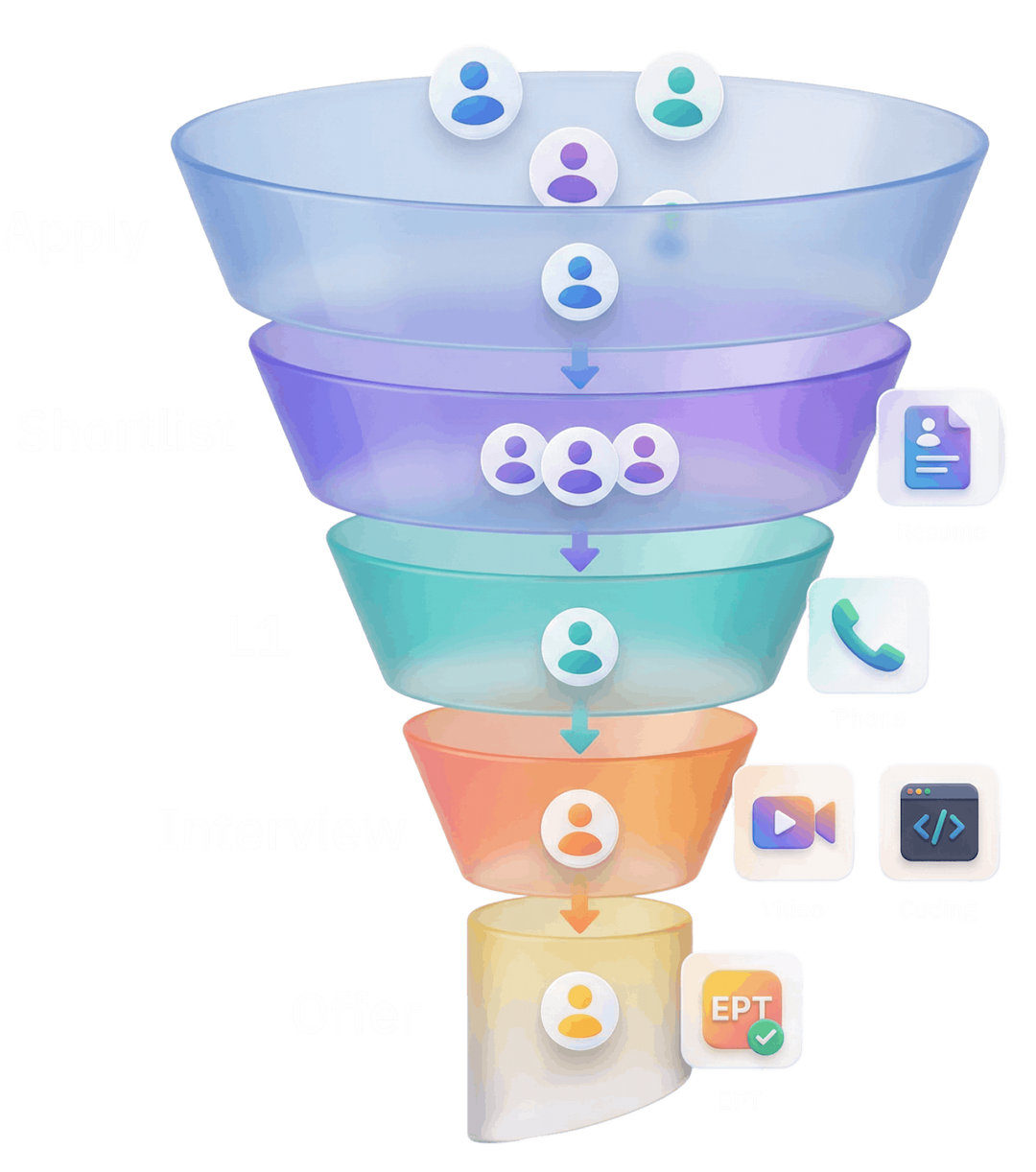
This article is a planning framework showing where AI can reduce manual effort across the funnel.
The Map
Meta's recruiting bar is famously high. That bar also takes an absurd amount of human time to maintain an employee scale of 78000+, and it still misses things. A recruiter screen that works at 50 open roles per quarter buckles at 200.
- A funnel blueprint that traces how candidates move through Meta's multi-round pipeline, from initial application to hiring committee sign-off.
- A phased deployment plan built around a 4-week pilot window, with weekly review gates for AI screening agents.
- A KPI scoreboard with ten metrics and a risk indicator attached to each one, calibrated for Meta's engineering-heavy recruitment patterns.
- An ROI module with transparent math, adjustable inputs, and an explicit disclaimer on every projection.
Where the friction is concentrated at Meta is different from the Indian IT services firms. It is not the top of the funnel. While Meta rejects at high rates, yes, the cost is incurred in the middle.
Phone screens by recruiters, phone screens by technologists, and the 4-round onsite process that burns 4+ hours of engineering time per candidate. Those three are where the manual repetition is most costly without the kind of decision-making nuance that only a hiring committee can provide.
Current State
Meta closed calendar year 2025 with 78,865 employees as of December 31, up 6% from 74,067 at the end of 2024. That net addition of 4,798 headcount came after two brutal years of cuts. The 2023 "Year of Efficiency" eliminated roughly 21,000 positions across two rounds of layoffs. FY2024 was the stabilisation period. FY2025 marked a return to active growth, driven almost entirely by AI infrastructure and engineering roles.
0
0
6.0%
Yearly Headcount Trend
Hiring Demand Composition
Problems In The Meta Hiring Process
While Meta's brand attracts enormous applicant volume, the bottleneck is not getting people in the door. It is what happens after they enter.
Recruiter phone screens scale linearly with applicant volume and nothing else
Every applicant who clears the resume review gets a 30-minute recruiter call. If Meta receives 100 applicants per open role (a conservative estimate for a company of this profile), that is 1.6 million applicants per year for 16,000 roles.
Even if 80% are filtered at the resume stage, the remaining 320,000 candidates each need a recruiter call. That is 160,000 person-hours at 30 mins a call roughly. There is no shortcut. No template. Just time.
Engineering interview panels compete directly with product shipping deadlines
At Google, Amazon, and Meta alike, the interviewers are the same engineers writing production code. Meta runs a calibrated interview system where interviewers are trained and rated, which is good for quality but terrible for availability.
A senior engineer doing two onsite interviews per week loses an entire day of coding time, plus preparation and debrief. When AI infrastructure projects are competing for the same senior talent pool that staff interview panels, something gives. Usually it is the candidate pipeline speed that matters.
The hiring committee bottleneck adds days that candidates spend interviewing elsewhere
Meta does not delegate hiring decisions to interviewers. A hiring committee reviews the packets and makes the decision. This introduces a quality control check, which improves the hiring decision but also introduces additional delay. If the hiring committee meets twice a week and reviews 15 packets each time, that's 30 hiring decisions per week per committee.
If we scale that across business units and geographies, the line still grows. The candidates interviewing at Apple, Google, and OpenAI simultaneously are not waiting patiently. The decline rate for offers will increase when the review cycles from the hiring committee exceed five business days from the last onsite interview.
Remote and global interviewing introduces integrity gaps that scale with volume
Meta hires globally, with active recruitment in the US, UK, India (Bangalore, Hyderabad), Singapore, and across EMEA. Remote interviews now make up a significant share of the pipeline.
Monitoring for secondary speakers, tab switching, or identity substitution across a 45-minute coding session depends on the interviewer noticing peripheral cues. By interview number four in a day, that vigilance drops off. Hard.
Hyring AI Agents
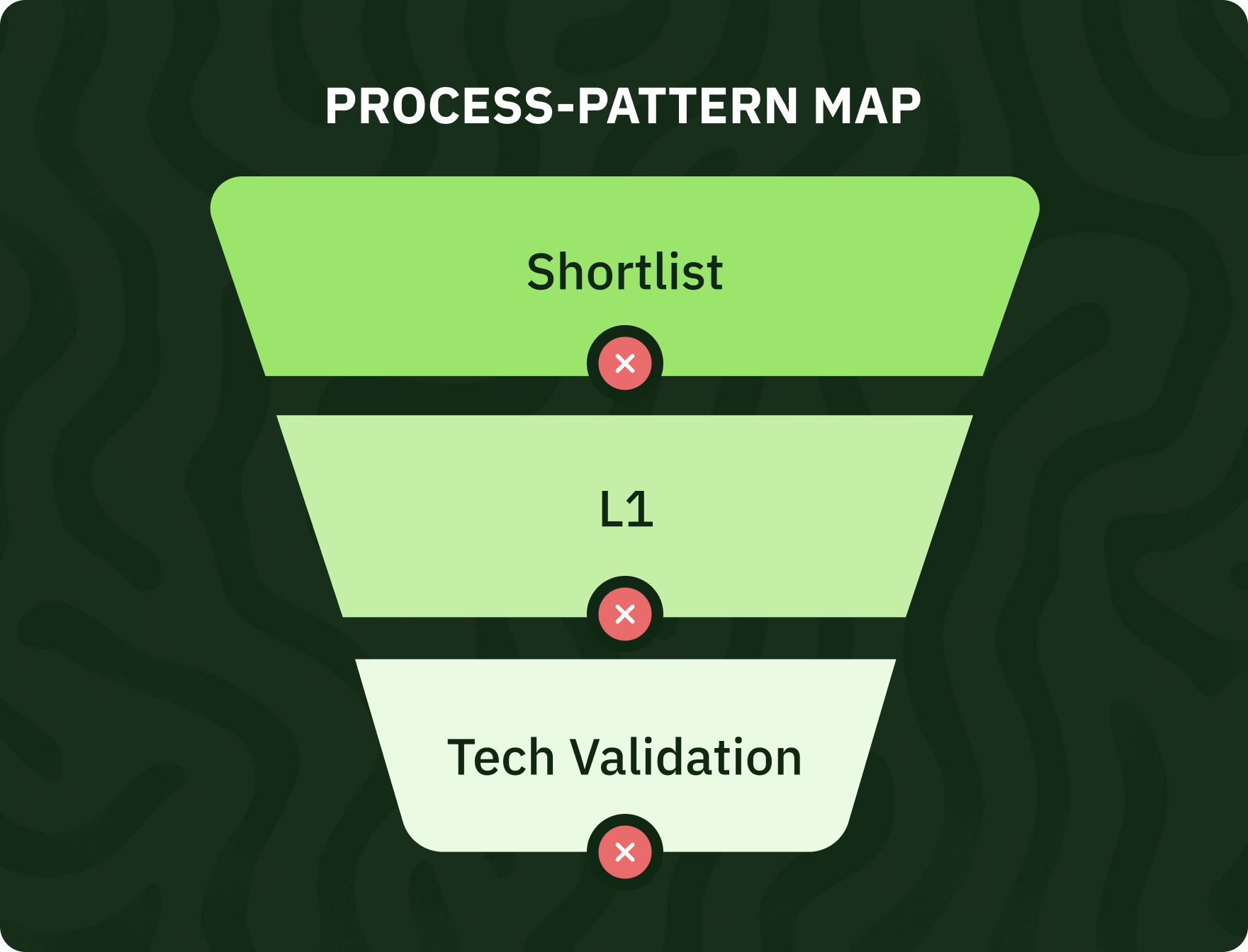
Meta's funnel is a specific shape: narrow at the top (high resume rejection rate), broad in the middle (many screening stages), and narrow again at the bottom (hiring committee). Hyring's five agents are designed for the broad middle, where volume is greatest and where three stages of our hiring process are most repetitive and rubric-scored.
If a task follows a rubric and results in a pass/fail or a number, an AI agent can perform that task. Contextual evaluations, culture fit, and hiring decisions are still human tasks.
The hiring committee still makes the final decision on every candidate.
The AI Resume Screener
Instantly parse and rank resumes based on job-fit signals and technical requirements.
- Rapid high-volume parsing
- Objective skill ranking
- Bias-reduced shortlisting
The AI Phone Screener
Automated L1 verification calls to ensure basic qualifications and interest levels.
- 24/7 automated screening
- Consistent evaluation metrics
- Instant shortlist generation
The AI Coding Interviewer
Technical assessment with live coding environments and real-time logic evaluation.
- Real-time code analysis
- Plagiarism detection
- Automated logical scoring
English Proficiency Test
Standardized evaluation of communication skills, fluency, and professional vocabulary.
- Automated fluency scoring
- Grammar and clarity analysis
- CEFR aligned reporting
Funnel-to-agent
| HIRING STAGE | HYRING PRODUCT | WHAT IT DOES | OUTPUT (WHAT THE TEAM SEES) |
|---|---|---|---|
| Shortlist | AI Resume Screener | Parses applications against role-specific criteria and scores each candidate on technical fit, experience match, and qualification alignment. | Ranked candidate list with fit-score breakdown. |
| L1 screening | AI Phone Screener | Conducts initial voice-based screens covering motivation, role understanding, and availability without recruiter scheduling overhead. | Conversation transcript + competency score + advance/hold flag. |
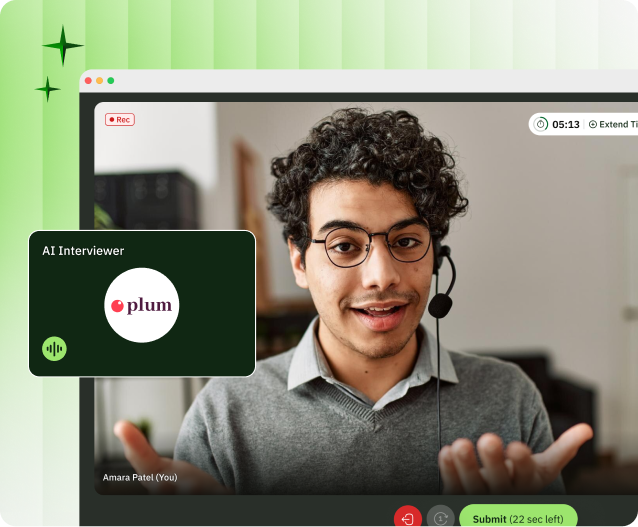
| Structured interview | AI Video Interviewer | Administers structured video interviews with standardised questions and produces scored evaluations per competency area. | Video recording + rubric-scored report + integrity indicators. |
| Tech validation | AI Coding Interviewer | Runs timed coding challenges in the candidate's preferred language, evaluating correctness, efficiency, and problem-solving approach. | Code submission + test results + difficulty-adjusted performance score. |
| Communication | English Proficiency Test | Measures spoken fluency, grammar accuracy, listening ability, and professional vocabulary against CEFR benchmarks. | Proficiency level + per-skill score breakdown. |
HYRING PRODUCT
AI Resume Screener
WHAT IT DOES
Parses applications against role-specific criteria and scores each candidate on technical fit, experience match, and qualification alignment.
OUTPUT (WHAT THE TEAM SEES)
Ranked candidate list with fit-score breakdown.
HYRING PRODUCT
AI Phone Screener
WHAT IT DOES
Conducts initial voice-based screens covering motivation, role understanding, and availability without recruiter scheduling overhead.
OUTPUT (WHAT THE TEAM SEES)
Conversation transcript + competency score + advance/hold flag.
HYRING PRODUCT
AI Video Interviewer
WHAT IT DOES
Administers structured video interviews with standardised questions and produces scored evaluations per competency area.
OUTPUT (WHAT THE TEAM SEES)
Video recording + rubric-scored report + integrity indicators.
HYRING PRODUCT
AI Coding Interviewer
WHAT IT DOES
Runs timed coding challenges in the candidate's preferred language, evaluating correctness, efficiency, and problem-solving approach.
OUTPUT (WHAT THE TEAM SEES)
Code submission + test results + difficulty-adjusted performance score.
HYRING PRODUCT
English Proficiency Test
WHAT IT DOES
Measures spoken fluency, grammar accuracy, listening ability, and professional vocabulary against CEFR benchmarks.
OUTPUT (WHAT THE TEAM SEES)
Proficiency level + per-skill score breakdown.
KPI Scoreboard — Meta Hiring Model
Time to Screen
Definition: Calendar days between a candidate's application submission and the first human or AI screening decision.
Risk indicator: Compressing this aggressively works until onsite rejection rates spike. If rejections after the onsite loop increase by more than 5 percentage points while screen time drops, the initial filter is passing people who should not advance.
Screening Throughput
Definition: Number of completed first-round screens per recruiter (or AI agent) per week.
Risk indicator: When throughput doubles but hiring committee approval rates stay flat, the funnel is moving faster without getting more selective. Compare throughput gains against offer-acceptance rates before celebrating.
Interview Completion Rate
Definition: Share of candidates who receive a scheduled interview slot and actually complete all assigned rounds.
Risk indicator: A completion rate under 65% at Meta likely points to scheduling friction, timezone mismatches on global roles, or assessment windows that conflict with competing interview timelines at Google and Amazon.
Early Stage Drop-offs
Definition: The funnel step where candidates exit without completing the process.
Risk indicator: If candidates are dropping after the technical phone screen but before the onsite invite, the gap between those two stages may be too long. At Meta's scale, a 3-day scheduling gap between rounds loses candidates to faster-moving competitors like OpenAI or Anthropic.
Panel Hours per Hire
Definition: Total engineering interviewer hours consumed for each candidate who receives an offer.
Risk indicator: Watch this alongside 90-day retention. If panel hours decrease and new-hire attrition in the first quarter also increases, the condensed evaluation may be filtering out signals that human interviewers would have caught during a longer loop.
Pass-through Rate
Definition: Percentage of candidates who clear one stage and enter the next.
Risk indicator: If the pass-through rate from AI coding interviews differs by more than 15 points between two offices recruiting for the same role, the rubric may need location-level tuning rather than one global threshold.
Shortlist-to-Offer Ratio
Definition: How many shortlisted candidates it takes to generate one accepted offer.
Risk indicator: Dropping from 6:1 to 3:1 is progress. Dropping further to 2:1 usually means the shortlist is too narrow and viable candidates are being excluded before they reach a hiring committee.
Integrity Flag Rate
Definition: Percentage of AI-administered interviews that trigger fraud or identity verification alerts.
Risk indicator: A steady 3-4% baseline is normal across remote technical screens. A sudden jump above 8% from a specific geography or referral source needs manual audit before any systemic conclusion is drawn.
Time to First Touch
Definition: Hours between a candidate submitting their application and receiving the first personalised response from Meta's recruiting team.
Risk indicator: Speed on the first response means nothing if the second contact comes a week later. Consistent pacing across touchpoints matters more than a fast first reply followed by silence.
SLA Adherence
Definition: Percentage of candidates who receive a status update within the SLA window defined by the recruiting ops team.
Risk indicator: When SLA adherence dips below 80%, expect offer declines to increase within the same two-week window. Candidates at this level have options and they use them quickly.
Model ROI for a high-volume scenario
Every figure in this section is an illustrative projection. The calculations use publicly reported Meta headcount data and industry-standard cost benchmarks for US-based technical recruiters and software engineers. Internal cost structures at Meta will differ. Treat this as a starting framework, not a guarantee.
Annual savings potential
$4.2M
approximately $4.2M across operational, panel, and re-acquisition costs.
Time-to-hire reduction
55%
55% faster from assessment completion to accepted offer.
Interview throughput
45%
45% acceleration in scheduling and evaluation cycles.
5-year ROI projection
400%
approximately 400% with break-even at month four.
Note: ROI figures below are an illustrative model of potential savings in this specific scenario. Actual results vary by internal workflow costs.
Hours recovered each year
The bulk of recoverable hours sit in three places: recruiter phone screens, technical phone screens, and early onsite rounds where AI coding and video agents can pre-filter before humans invest time.
Recruiter phone screens: 320,000 candidates at 30 minutes each = 160,000 person-hours. AI phone screening handles 85% of initial screens, leaving approximately 24,000 person-hours of recruiter review on flagged cases and edge candidates.
Technical phone screens: an estimated 80,000 candidates reach this stage at 45 minutes each = 60,000 person-hours. AI coding agents absorb 75% of this, reducing human technical screen hours to approximately 15,000.
Early onsite panel reduction: with stronger pre-screening, the number of candidates reaching the full 4-round onsite drops by an estimated 40%, recovering approximately 28,000 engineering interviewer hours.
Total estimated hours recovered annually: ~189,000.
Hours by Stage (Manual vs. AI-Assisted)
Source: Hyring hiring model | Illustrative, based on estimated Meta hiring volumes
Manual cost vs. target state with AI
The financial case for Meta's high-volume engineering recruitment is not simply about reducing recruiter headcount. It is about reclaiming thousands of production hours from senior engineers and engineering managers who currently conduct five to six interview rounds per hire. At Meta's scale, compressing the time-to-hire by 55% doesn't just save recruiting costs—it accelerates product shipping cycles and reduces the massive opportunity cost of unfilled engineering seats in critical AI infrastructure teams.
| Metric | Current manual process | Target with Hyring AI agents |
|---|---|---|
| Recruiter screening cost | ~$7.2M (320K candidates at 30 min, $45/hr loaded) | ~$1.4M ($1 per AI screen + ~$1.1M recruiter review on flagged candidates) |
| Engineering panel load | Heavy: senior engineers conduct 2-4 onsites/week during peak hiring, losing full days of product work | Lighter: candidates pre-filtered through AI coding and video, onsite load reduced by 40%, engineers average 1-2 onsites/week |
| Interview scalability | Constrained by interviewer calendars, timezone coordination, and hiring committee meeting cadence | Concurrent: candidates complete AI assessments on their own schedule within a 72-hour window |
| Candidate verification | Dependent on interviewer observation during live video, inconsistent after multiple back-to-back sessions | Automated monitoring tracks face presence, voice match, gaze direction, screen activity, and clipboard behaviour simultaneously |
| Funnel completion rate | Estimated ~30% of candidates who begin the interview process receive an offer (industry benchmark for FAANG) | Projected ~55%, driven by faster scheduling, reduced drop-off, and quicker status communication |
Where the $4.2M in annual savings originate
The biggest cost at Meta is not in the recruiting department's budget line. It is in engineering productivity lost to interview panels and in candidate acquisition overhead that compounds across thousands of open roles.
- Recruiter screen volume absorbed by AI: 320,000 candidates at $1 per AI-conducted screen versus 30-minute recruiter calls at $45/hr. Net recovery: approximately $5.4M saved on recruiter time, offset by ~$320K in AI screen costs and ~$1.1M in residual recruiter review. Net: ~$4.0M. Conservatively adjusted to ~$2.8M after accounting for process overlap.
- Engineering hours returned to product work: Approximately 28,000 panel hours recovered at an average loaded cost of $85/hr. That is roughly $2.4M in engineering capacity restored to product shipping. Conservatively adjusted to ~$1.0M (not all hours convert directly to billed or productive output).
- Scheduling and coordination overhead reduced: Interview coordination across timezones, no-show follow-ups, and rescheduling loops consume an estimated 8,000 to 10,000 coordinator hours annually at Meta's scale. Self-scheduling through AI assessment links eliminates approximately 55% of this. Estimated recovery: ~$200K.
- Integrity-related re-evaluation costs avoided: Manual detection of interview fraud catches problems late, after multiple rounds of evaluation have already been invested. Automated proctoring flags issues in real time during the first AI-administered round, saving wasted downstream evaluation. Estimated recovery: ~$200K.
Total estimated annual savings: ~$4.2M (conservative, includes adjustment factors).
Where the savings come from
Source: Hyring hiring model | All figures are illustrative. Update inputs to match your internal cost structures.
Cumulative savings vs. cost
The savings accumulate across each quarterly hiring push. In this model, break-even lands around month four. Adding lateral and backfill hiring to the same Hyring deployment compresses this further since the per-interview cost for AI sessions stays near zero at the margin.
Cumulative Savings vs Investment (12-Month Model)
Month
Source: Hyring hiring model | Illustrative. Adjust inputs to match your volumes and cost structure.
Meta hiring process implementation
Trying to automate all 16,000+ annual hires on launch day is a recipe for broken workflows and zero trust from hiring managers. A phased rollout builds evidence, gives interview panels time to compare AI outputs against their own decisions, and catches calibration issues while the blast radius is small.
Week 2: Run AI agents in shadow mode alongside existing recruiter workflows
Invite the AI Phone Screener and AI Video Interviewer for the two pilot roles. Run them in parallel with the current manual process for 72 hours. Every candidate gets both an AI screen and a human screen.
Compare score distributions, advance/hold agreement rates, and time-to-decision daily. Disagreements between AI recommendations and human decisions get reviewed in real time to calibrate the rubric before expanding volume.
Week 3: Add coding and language assessments to the pilot
Activate the AI Coding Interviewer for the engineering track. Add the English Proficiency Test for the Technical Program Manager (TPM) role where cross-functional communication across Meta's global offices is a first-year requirement.
Begin monitoring integrity flag rates. Note any spikes from specific referral channels or geographies. These flags are data points, not automatic rejections.
Week 4: Review, recalibrate, and scope the next phase
Did AI-screened candidates advance through the onsite loop at comparable rates to manually-screened candidates? Did candidate completion rates hold steady or improve? Did time-to-first-touch compress? Adjust question banks, scoring weights, and flag sensitivity based on four weeks of parallel data. Increase to additional requisitions only after two consecutive review cycles show stable results against the ten KPIs listed above.
Frequently Asked Questions
How does the Meta hiring process handle high applicant volume with AI screening?
Candidates receive their AI assessment links simultaneously, so thousands of phone and video sessions run in parallel without recruiter calendar constraints. A pipeline that would take weeks to clear through manual screens can complete initial evaluation in days.
What does the first automated screening round produce for Meta's recruiting team?
A structured report containing competency scores, a response summary, areas flagged for deeper evaluation, and an advance or hold recommendation. Recruiters review this report in about 90 seconds rather than conducting a 30-minute phone call.
How does the system detect cheating during remote interviews?
The video interview software tracks all these six indicators at once - tab switching, secondary face detection, voice mismatch, gaze anomalies, lip-sync discrepancies, and clipboard activity. A composite integrity score is generated. No single flag triggers automatic disqualification.
Does AI screening hurt the candidate experience?
Candidates choose their own assessment window, skip the scheduling back-and-forth, and receive faster status updates because scoring is immediate. Feedback from similar deployments shows candidate satisfaction holding steady or improving versus manual-only processes.
Can the coding assessment be customised for different Meta role levels?
Yes. The AI Coding Interviewer supports C++, JavaScript, SQL, Java and other environments with adjustable difficulty. An E3 new-grad software engineer and an E5 senior systems engineer see completely different problem sets without separate platform configurations.
Where do human interviewers fit in this Meta hiring model?
Human panels focus on the final onsite rounds - system design depth, behavioural signals, and team-fit evaluation. By that point, candidates have already passed resume screening, phone/video assessment, and coding validation. Engineers spend their interview time on judgment calls, not re-checking baseline qualifications.