NTT Data Hiring Process: Blueprint for AI-driven Volume
NTT Data is looking to hire 5,000 people in India in 2026, on top of a 40,000-person presence in India, with attrition creating a parallel need for replacements. The hiring process for NTT Data involves written aptitude tests, group discussions, technical panels, and HR closes, which gets bottlenecked at the top end of this process every campus season.
This is a blueprint that maps Hyring's five AI agents onto this process, identifies where manual hours get wasted, and projects where things will be when the repetitive parts of this process stop being manual. It is a planning document, not a claim of any relationship.

This article is a planning framework showing where AI can reduce manual effort across the funnel.
The Roadmap
A real-life operational problem: NTT Data has a machine for service delivery with 200,000 people worldwide, significant investments in AI infrastructure projects for its clients, and still, its hiring funnel itself handles tens of thousands of fresher applicants with manually scheduled aptitude tests and back-to-back GDs.
There are four components on this page, and they are connected. The first is a stage-by-stage mapping of the Hyring tools with the NTT Data hiring process, which is based on the actual process funnel sequence.
The second is a phased rollout, which should be alongside existing processes, not replace them in a day or two. The third is a 10-metric dashboard with risk metrics, specifically for the NTT Data campus recruitment scenario. And the fourth is ROI calculations, which are based on publicly audited hiring numbers.
Where does the friction actually exist? Not in the offer, nor in the HR closure. It's in the shortlisting for the written test and the GD, because these are two stages in the NTT Data hiring process, which are conducted in bursts, leading to a 10-day delay and the shortlisted candidates already passing the Wipro process. That's where the operational need for automation comes from, not philosophy but just pure mathematics.
Current State
Global headcount reached approximately 200,000 by end of FY25, with India accounting for roughly 40,000 of those roles across delivery, consulting, and support functions. In February 2026, NTT Data announced plans to add 5,000 India positions by end of year, citing growth in manufacturing clients and public sector IT contracts.
Attrition rate in the IT service industry is between 12 to 15%. This means NTT Data replaces 4,800 to 6,000 employees in India before the company even thinks about increasing the headcount. Freshers are the bulk of the hiring, which is done through campus drives to hire engineering graduates, typically from tier 1 and tier 2 colleges, in cities like Chennai, Pune, Hyderabad, and Bengaluru.
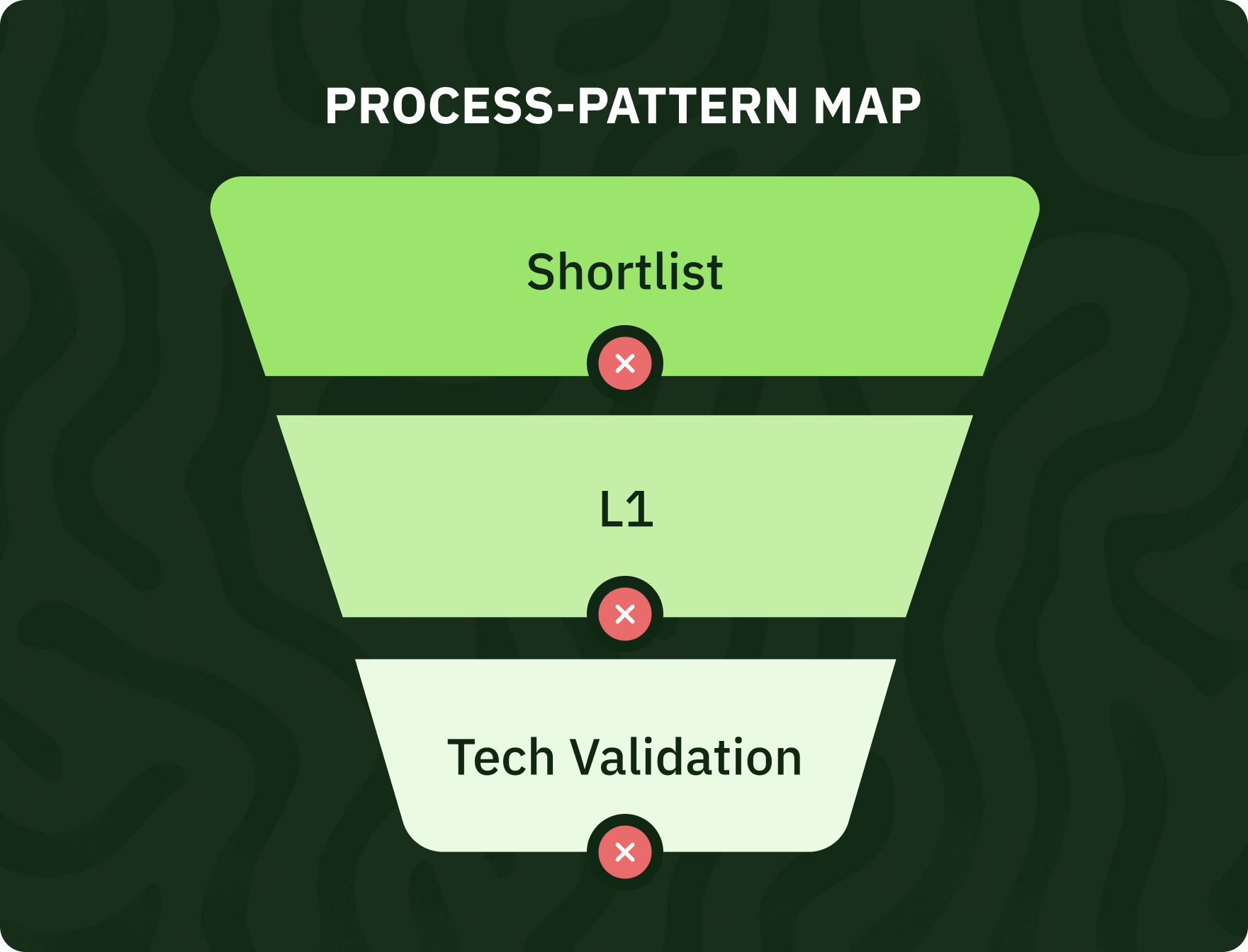
NTT Data's selection process involves four stages- AMCAT-style written tests that include aptitudes, verbal, and a small coding section, group discussions that assess the candidate's communication and reasoning skills, the technical round, and finally, the HR round.
At a conservative estimate of 40,000 applications for 5,000 positions, the selection ratio is as high as 8:1, which narrows down quickly in just the third round.
~200,000
5,000+
8:1+
Problems In The NTT Data Hiring Process
One drive consists of 40,000 applications, and you have only ten days to shortlist. Two slow days at the written-test filter and the GD queue starts piling with names who are simultaneously through Infosys's round two. That is the structural problem, and it repeats every cycle.
GD slot management burns coordination bandwidth
10,000 candidates advance past the written test. Grouping them into GD batches, sending slot invitations, handling reschedules, chasing no-shows: this runs to about 12 minutes of coordinator time per candidate, totalling 2,000 person-hours.
Chennai drives see no-show rates near 30% in practice, meaning a third of those coordination hours produce absolutely nothing.
Technical panels pull engineers off delivery work
5,000 candidates reach the technical interview. At 30 minutes each, with 1.5 interviewers per session on average, NTT Data absorbs 3,750 person-hours of engineering time per cycle.
These are billable engineers, not dedicated HR staff. The cost does not appear in the recruitment budget. It comes up later, in delivery margins and project velocity, and by then nobody connects it back to a campus drive from three months ago.
Lateral and fresher pipelines run in parallel without clean separation
NTT Data runs lateral hiring alongside campus intake. When both pipelines use the same assessment steps, coordination increases.
Roles are posted simultaneously, evaluation criteria overlapping, recruiters context-switching between fresher GD groups and lateral technical calls happens. Estimated 15% overhead added to total process hours and a big mess is created.
Offer-to-join dropout goes untracked across the funnel
Campus candidates typically hold two to four offers by final semester. A GD cleared on Monday with no technical invite by Thursday is not a rejection - it is a candidate who accepted somewhere else and stopped responding.
The NTT Data hiring process does not track this as a dropout because there is no formal decline. The number shows an open pipeline. Actual yield shrinks silently.
Hyring AI Agents
Every stage in the NTT Data hiring process where the decision follows a fixed rubric and outputs a score is a candidate for agent handling. The aptitude shortlist: entirely rule-based. The GD communication check: a rubric with defined criteria.
The coding validation is a pass/fail with measurable signals. Hyring agents run those. Human panels pick up where context and judgment enter the picture.
The AI Resume Screener
Instantly parse and rank resumes based on job-fit signals and technical requirements.
- Rapid high-volume parsing
- Objective skill ranking
- Bias-reduced shortlisting
The AI Phone Screener
Automated L1 verification calls to ensure basic qualifications and interest levels.
- 24/7 automated screening
- Consistent evaluation metrics
- Instant shortlist generation
The AI Coding Interviewer
Technical assessment with live coding environments and real-time logic evaluation.
- Real-time code analysis
- Plagiarism detection
- Automated logical scoring
English Proficiency Test
Standardized evaluation of communication skills, fluency, and professional vocabulary.
- Automated fluency scoring
- Grammar and clarity analysis
- CEFR aligned reporting

Funnel-to-agent
| HIRING STAGE | HYRING PRODUCT | WHAT IT DOES | OUTPUT (WHAT THE TEAM SEES) |
|---|---|---|---|
| WRITTEN SHORTLIST | AI Resume Screener | Parses resumes against NTT Data role specs post-aptitude, surfaces gaps and strengths in seconds. | Ranked list with role-fit score, eligibility flags. |
| GD COMMUNICATION GATE | AI Phone Screener | Runs structured voice assessments covering clarity, topic handling, and response coherence. | Fluency grade, key-phrase coverage, advance or hold. |
| STRUCTURED TECH PROBE | AI Video Interviewer | Delivers defined question sets via video with live session monitoring, removes interviewer fatigue from early rounds. | Per-question scoring, session integrity log, competency breakdown. |
| CODING VALIDATION | AI Coding Interviewer | Runs live code challenges calibrated per role track, records logic path not just final output. | Performance metrics, error classification, time-efficiency rank. |
| CLIENT-FACING LANGUAGE CHECK | English Proficiency Test | Assesses spoken clarity, listening retention, and business vocabulary depth against global client standards. | CEFR band, four-skill breakdown, placement recommendation. |
HYRING PRODUCT
AI Resume Screener
WHAT IT DOES
Parses resumes against NTT Data role specs post-aptitude, surfaces gaps and strengths in seconds.
OUTPUT (WHAT THE TEAM SEES)
Ranked list with role-fit score, eligibility flags.
HYRING PRODUCT
AI Phone Screener
WHAT IT DOES
Runs structured voice assessments covering clarity, topic handling, and response coherence.
OUTPUT (WHAT THE TEAM SEES)
Fluency grade, key-phrase coverage, advance or hold.
HYRING PRODUCT
AI Video Interviewer
WHAT IT DOES
Delivers defined question sets via video with live session monitoring, removes interviewer fatigue from early rounds.
OUTPUT (WHAT THE TEAM SEES)
Per-question scoring, session integrity log, competency breakdown.
HYRING PRODUCT
AI Coding Interviewer
WHAT IT DOES
Runs live code challenges calibrated per role track, records logic path not just final output.
OUTPUT (WHAT THE TEAM SEES)
Performance metrics, error classification, time-efficiency rank.
HYRING PRODUCT
English Proficiency Test
WHAT IT DOES
Assesses spoken clarity, listening retention, and business vocabulary depth against global client standards.
OUTPUT (WHAT THE TEAM SEES)
CEFR band, four-skill breakdown, placement recommendation.
KPI Scoreboard — NTT Data Hiring Model
Time to Screen
Definition: Calendar days between application submission and shortlist decision notification.
Risk indicator: Compressing below 36 hours sounds good until GD advance rates drop three weeks later, which often means the filter cut too hard on borderline scores. Check score-threshold calibration, not just speed.
Screening Throughput
Definition: Number of written-test applications reviewed and decided per recruiter per week.
Risk indicator: Throughput climbing while the GD completion rate falls is a sign the shortlist criteria are too permissive. Candidates who should not advance are clogging the next stage.
Interview Completion Rate
Definition: Percentage of candidates who receive a GD or technical invite and complete the full assessment.
Risk indicator: Below 65% almost always traces to one of three causes: unclear instructions, slot times conflicting with other drives, or an assessment that runs 15 minutes longer than candidates expected. Check all three before adjusting criteria.
Early Stage Drop-offs
Definition: The specific funnel stage at which candidate exits peak in a given cycle.
Risk indicator: High written-stage abandonment at NTT Data drives in Chennai suggests the aptitude test format feels mismatched to the candidate's preparation level. It is not a signal to lower the bar; it is a signal to improve communication about test format in advance.
Panel Hours per Hire
Definition: Total interviewer time logged per confirmed joined hire, across all stages where humans participate.
Risk indicator: If panel hours per hire drop sharply after AI introduction and 90-day retention also drops, the AI gate is filtering out candidates with soft-skill strengths that rubrics do not capture. Worth auditing a sample of rejected profiles.
Pass-through Rate
Definition: Proportion of candidates advancing from one funnel stage to the next.
Risk indicator: A 20-percentage-point gap in pass-through rates between two campuses recruiting for the same role profile means one campus's pool is being evaluated against a threshold calibrated for a different context. Uniform thresholds across diverse campuses break the measurement.
Shortlist-to-Offer Ratio
Definition: Number of shortlisted candidates required to produce one accepted offer.
Risk indicator: Moving from 9:1 to 6:1 indicates a tighter shortlist producing better qualified candidates. Moving from 9:1 to 3:1 is a red flag: you are likely pruning the funnel too hard and losing candidates who would have performed.
Integrity Flag Rate
Definition: Percentage of AI-assessed sessions triggering a behavioural anomaly alert during the session.
Risk indicator: A 6-7% baseline is typical. A spike to 15% from a specific college cluster in one cycle usually points to a shared preparation resource being used, not wholesale misconduct. Investigate before drawing college-level conclusions.
Time to First Touch
Definition: Hours elapsed between written-test completion and first recruiter outreach to the candidate.
Risk indicator: A very fast first ping followed by a 5-day silence before the next communication produces worse candidate satisfaction than a steady 48-hour cadence throughout. Timing of follow-ups after touch-one matters as much as touch-one itself.
SLA Adherence
Definition: Percentage of candidates receiving status updates within the committed timeframe at each funnel stage.
Risk indicator: When SLA adherence dips below 80% in the NTT Data hiring process, offer acceptance rates in that cohort typically fall within the same week. Faster-moving competitors are not necessarily offering more; they are just communicating more reliably.
Model ROI for the NTT Data Hiring Process
Every figure in this section is an illustrative projection. The inputs draw from publicly reported NTT Data hiring volumes and standard IT services cost benchmarks, but internal cost structures vary. Use this as a starting framework and swap in your own numbers. Note: ROI figures below are an illustrative model of potential savings. Actual results vary by workflow costs, recruiter compensation, existing tech stack, and process maturity.
Annual Savings Potential
$2.8M+
in operational and hiring costs.
Time-to-Hire Reduction
58%
faster from application to accepted offer.
Interview Velocity
48%
faster scheduling and evaluation throughput.
5-Year ROI
~4x
with a 4-month payback period.
Note: ROI figures below are an illustrative model of potential savings in this specific scenario. Actual results vary by internal workflow costs.
Where the Hours Go
Shortlist and GD together account for 70% of manual time in the NTT Data recruitment process. That is where this model concentrates its savings.
- Resume and aptitude correlation: 40,000 candidates at 7 minutes each equals 4,667 person-hours. With AI shortlisting, recruiter review of AI-generated outputs runs to approximately 467 person-hours.
- GD coordination and invitations: 10,000 candidates at 18 minutes each (scheduling, reminders, no-show follow-ups) equals 3,000 person-hours. AI-managed slot assignment and async phone assessment drops that to roughly 300 person-hours of oversight.
- Technical panels: 5,000 candidates at 30 minutes each with 1.5 panelists averages 3,750 person-hours. AI coding and video screening reduces the number reaching human panels by 50%, saving approximately 1,875 person-hours.
- Lateral pipeline overlap: 2,000 lateral candidates at 10 minutes of duplicate coordination each adds 333 person-hours. AI handling cuts this to 33.
Total estimated hours recovered annually: 10,928.
Hours by Stage (Manual vs. AI-Assisted)
Source: Hyring hiring model | Illustrative, based on 40k application volume and verified NTT Data India hiring data.
Manual Cost vs. Projected AI State
To process 40,000 applications for 5,000 India positions, the NTT Data hiring process absorbs approximately $1.75M in written shortlist costs alone, with engineering panels running heavy during campus sprints and funnel completion sitting at around 52%. The table below maps each cost driver against its AI-assisted equivalent.
| Area | Current Manual Process | Target with Hyring |
|---|---|---|
| Written shortlist cost | ~$1.75M (recruiter hours at $15/hr loaded) | ~$175K (AI screens at $1 each plus oversight) |
| Engineering panel load | Heavy: developers pulled 2-3 hours daily during peak campus sprints | Light: panels receive only candidates cleared by resume, GD, and coding gates |
| Scheduling scalability | Calendar-bound, limited by recruiter and interviewer availability | Async: candidates complete assessments within a self-selected window |
| Identity and integrity verification | Interviewer observation during live sessions, degrades across long days | Automated monitoring across multiple session signals simultaneously |
| Funnel completion rate | ~52% of shortlisted candidates reach the offer stage | >70% projected, driven by faster decision cadence and fewer delay-driven dropouts |
Where the $2.8M Comes From
The biggest savings in the NTT Data hiring model do not sit in the HR budget. They sit in engineering delivery capacity that leaks into campus seasons without anyone tracking it as a cost.
Total direct savings: ~$1.83M. Secondary effects (velocity gains, dropout reduction, faster offer cycles): ~$970K. Total: ~$2.8M. Secondary effects are 53% of direct savings, capped conservatively as noted.
- L1 and GD volume handled by agents: At 40,000 registrations and a $15/hr loaded recruiter rate, written shortlist alone runs to $1.75M. AI agents conducting 90% of that work at $1 per screen, plus $175K in oversight hours, brings the figure to about $210K. Net recovery: ~$1.54M.
- Engineering hours back to client work: NTT Data's mid-level India engineers carry an internal loaded cost typically in the $30-40/hr range. Recovering 1,875 panel hours at $35/hr midpoint is approximately $66K of delivery capacity returned per hiring cycle.
- Scheduling and coordination overhead eliminated: GD slot management, candidate communication, and no-show follow-ups consume an estimated 3,000+ coordinator hours per India campus season. AI-managed scheduling cuts roughly 60% of that. Estimated recovery: ~$108K.
- Lateral pipeline duplication removed: 333 hours of duplicate coordination at $12/hr coordinator cost is approximately $40K per year.
- Integrity-related re-screening avoidance: Manual proctoring misses fraud too late, after a candidate has cleared two stages. Automated session monitoring at the first AI interview stage prevents an estimated $80K in wasted evaluation cycles annually.
Annual Hiring Cost Savings Breakdown
Source: Hyring hiring model | All figures are illustrative. Adjust to match internal cost structures.
Cumulative Savings vs. Investment
At this scale, break-even lands around month four. Lateral hiring volume added to the same deployment compresses that further, since the marginal cost of an additional AI interview after setup is effectively zero.
Cumulative Savings vs Investment (12-Month Model)
Month
Source: Hyring hiring model | Illustrative. Adjust inputs to match your volumes and cost structure.
NTT Data Hiring Process Implementation
Throwing the full 40,000-application intake at an AI deployment on week one is not a plan. The first two weeks are worth more as a calibration and trust-building exercise than as a scale exercise.
Week 2: Parallel run on a controlled batch
Week 3: Layer in video and coding, watch flag baselines
Week 4: Full campus wave for pilot roles
Week 5: Lateral track integration
Week 6: Scale decision
Frequently Asked Questions
How does this model handle volume spikes in the NTT Data hiring process?
Hyring agents process concurrent sessions with no calendar constraint, so 40,000 written-test completions can queue into AI screening within hours rather than being stacked against a recruiter schedule. Status updates go out the same day assessments complete.
What does the first AI agent actually produce for the NTT Data recruitment process?
A ranked profile list with scores broken down by the criteria your team defined, plus a note on which areas look thin and would benefit from deeper questioning at the next stage. A recruiter working through those outputs spends about 60 seconds per candidate rather than conducting a 20-minute screen.
How does the video agent detect session irregularities?
It monitors several concurrent signals during the session - whether the candidate's face remains consistently present, whether a secondary voice appears, whether screen activity shows unusual pattern, and whether gaze direction tracks naturally for a self-recorded response. A composite risk score is generated. No single flag auto-rejects anyone; the output guides review.
Does async assessment put candidates off?
The NTT Data interview process already involves written tests completed without a human present. Extending that model to an AI video assessment, where the candidate picks their own window and gets a result within hours, typically lands better with campus applicants than waiting five days for a scheduled call. Completion rates on platforms using this approach run above 70%.
Can coding assessments be configured differently per NTT Data role track?
Yes. Developer tracks get algorithm and data-structure problems calibrated to the role's seniority level. Analyst tracks get SQL and data manipulation tasks. The configurations run in parallel under a single deployment without requiring separate platform instances.
Where do human technical panels actually fit?
After a candidate has cleared AI resume screener, AI phone screener, and AI coding interviewer gates, the engineers who conduct technical panels are working with someone who has already demonstrated baseline competency. The conversation moves to architectural thinking, real-world problem framing, and culture signal, none of which a rubric captures well. That is exactly where panel time should be spent.