How AI Agents Could Reshape The NVIDIA Hiring Process
The hiring process at NVIDIA clears more than two million applications annually, estimated based on publicly reported spikes in applications. This is for a company of about 32,000 employees. Jensen Huang's leadership of NVIDIA is based on a "small team, extraordinary output" philosophy. This means, of course, that NVIDIA's hiring function can't solve the problem of too many applications by hiring more people. It needs to automate or risk losing the best AI researchers to Google, Meta, or Apple while NVIDIA's hiring folks are reading their applications.
This blueprint maps where Hyring's AI agents can take over manual workload across the NVIDIA recruitment process, what each agent produces, and which KPIs keep the model honest.

This article is a planning framework showing where AI can reduce manual effort across the funnel.
The Blueprint
Jensen Huang told a Stanford crowd in 2024 that he wouldn't start NVIDIA again if he knew what it took. This bluntness from the CEO of the world's most valuable semiconductor company should shape how we think about NVIDIA's hiring process.
If the leads for each step in the funnel can't rattle off the numbers that have changed in the last week, then it's just a slide deck.
This page provides four components: a funnel map tailored to NVIDIA's volume and mix of roles, a week-by-week rollout plan that tries hard not to deploy everything at once, a scoreboard for key performance indicators with risk thresholds for each metric (because a metric without a risk threshold is just decoration), and an ROI section with visible math and a disclaimer that claims everything is illustrative.
The NVIDIA interview process mines talent pools for GPU architecture, CUDA platform engineers, AI research scientists, hardware designers, and corporate functions.
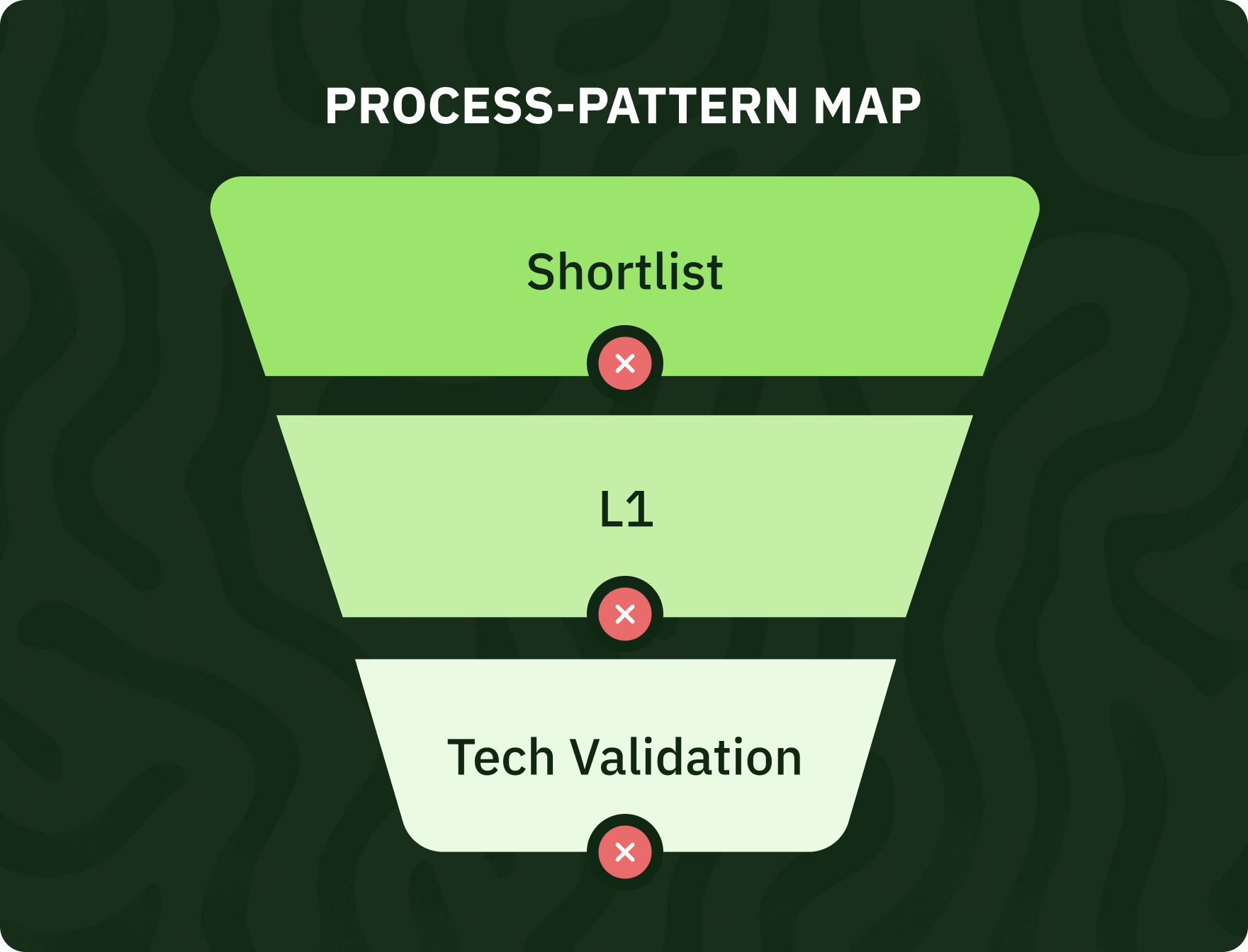
Friction concentrates in the same three stages that cripple every high-growth tech firm - resume filtering, first-round phone evaluation, and coding interviews. All three follow repeatable rubrics with scored outputs. That makes them candidates for AI agents, not human judgment calls.
Current State
NVIDIA closed fiscal year 2025 (ending January 26, 2025) with approximately 32,000 employees, per its FY25 annual report. Revenue hit $130.5 billion for the year, a 114% jump over FY24. Headcount grew by roughly 3,000 in the same period. Revenue doubled; the workforce grew 10%. That gap is deliberate.
Jensen Huang has described his preference for keeping teams small enough that everyone is "within two handshakes of every problem." The NVIDIA hiring process reflects this: the company rejects over 99% of applicants.
NVIDIA saw application volumes surge to multiples of prior years. A Wall Street Journal report noted the company received seven times as many internship applications in early 2024 compared to the year before, and total inbound applications are estimated at well over two million annually.
For roughly 3,000 to 4,000 net new roles, that is 500 to 700 applications per position. No recruiting team sized for a 32,000-person company can manually process that without tripling in size or automating the front of the funnel. The NVIDIA recruitment process compounds this further with its global footprint: candidates apply from 30+ countries, and timezone coordination alone consumes thousands of scheduler hours.
~32,000
~2M+ (est.)
$130.5B
Problems in the NVIDIA hiring process
When two million people apply and you hire fewer than 4,000, the filtering must be ruthless. But the experience of being filtered must not be. NVIDIA's employer brand took decades to build. A single viral Glassdoor review about a ghosted candidate spreads faster than a press release about a new Blackwell chip.
First-round phone calls cost 15,000+ hours and the questions never change
An estimated 70,000 candidates per year enter phone screening. Each call runs 15 to 20 minutes. They are about the same cycle- confirm interest, check communication, verify role alignment. Identical questions every time. That is 15,000 to 23,000 hours of recruiter time on a task with a fixed rubric.
Every engineering panel hour is an hour not spent on Blackwell or CUDA
If there are 15,000 candidates who make it to the technical panels, and the interview lasts for 1 hour with an average of 1.5 interviewers on the panel, that makes up 22,500 person-hours, which blows through the product delivery timeline, not the budget of the HR department. Nobody in the recruiting group sees it because of NVIDIA's loaded engineering cost.
Competing offers from AMD, Google, and Meta close faster
The top talent in AI has three to four offers on the table. If NVIDIA takes six weeks to interview and hire, and a competitor takes only three weeks to hire the same candidate, then the candidate will sign with someone else. Speed is what makes the difference between hiring a principal machine learning engineer and losing them to a Google L7.
Remote proctoring collapses after interview four
Detecting code-sharing during coding interviews depends on visual cues that fade by the fifth interview. The NVIDIA interview process has no scalable integrity layer for remote assessments.
Hyring AI Agents
NVIDIA generates the most waste in funnel stages where recruiters or engineers repeat identical evaluation criteria hundreds of times per quarter. The NVIDIA interview process at its current volume cannot sustain this manually. Scoring resumes against minimum requirements. Running the same phone screen script. Administering standardized coding tests. Each produces binary or scored outputs from fixed criteria, and Hyring's agents handle exactly those stages.
Anything requiring judgment on team chemistry or creative problem-solving stays with people. Every final hiring decision requires human approval, no exceptions.
The AI Resume Screener
Instantly parse and rank resumes based on job-fit signals and technical requirements.
- Rapid high-volume parsing
- Objective skill ranking
- Bias-reduced shortlisting
The AI Phone Screener
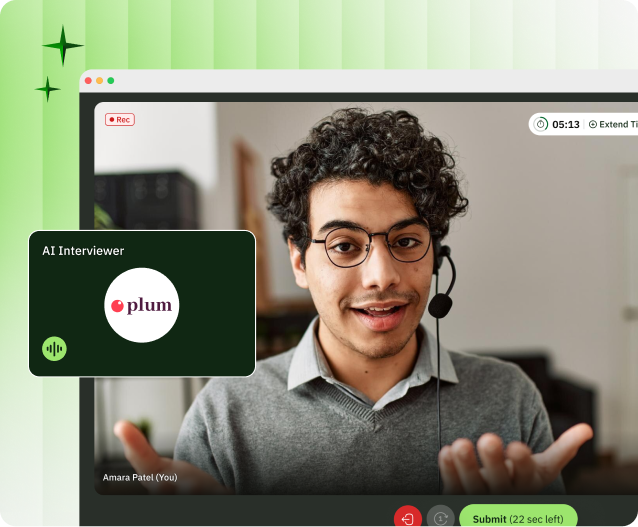
Automated L1 verification calls to ensure basic qualifications and interest levels.
- 24/7 automated screening
- Consistent evaluation metrics
- Instant shortlist generation
The AI Coding Interviewer
Technical assessment with live coding environments and real-time logic evaluation.
- Real-time code analysis
- Plagiarism detection
- Automated logical scoring
English Proficiency Test
Standardized evaluation of communication skills, fluency, and professional vocabulary.
- Automated fluency scoring
- Grammar and clarity analysis
- CEFR aligned reporting
Funnel-to-agent
| HIRING STAGE | HYRING PRODUCT | WHAT IT DOES | OUTPUT (WHAT THE TEAM SEES) |
|---|---|---|---|
| SHORTLIST | AI Resume Screener | Filters millions of applications against NVIDIA's role-specific qualification matrices, ranking candidates by technical fit. | Scored candidate list with match indicators per requisition. |
| L1 SCREENING | AI Phone Screener | Conducts voice-based screening calls covering motivation, role comprehension, availability, and communication baseline. | Transcript + composite score + advance/hold tag. |
| STRUCTURED INTERVIEW | AI Video Interviewer | Administers structured video interviews with behavioral scoring and concurrent integrity monitoring. | Evaluation report with behavioral scores and fraud flags. |
| TECH VALIDATION | AI Coding Interviewer | Runs timed coding challenges calibrated to NVIDIA role families: GPU kernels, ML pipelines, systems firmware. | Code quality report + approach analysis per candidate. |
| COMMUNICATION | English Proficiency Test | Measures spoken English readiness for cross-geography roles. | Proficiency band + skill-by-skill breakdown. |
HYRING PRODUCT
AI Resume Screener
WHAT IT DOES
Filters millions of applications against NVIDIA's role-specific qualification matrices, ranking candidates by technical fit.
OUTPUT (WHAT THE TEAM SEES)
Scored candidate list with match indicators per requisition.
HYRING PRODUCT
AI Phone Screener
WHAT IT DOES
Conducts voice-based screening calls covering motivation, role comprehension, availability, and communication baseline.
OUTPUT (WHAT THE TEAM SEES)
Transcript + composite score + advance/hold tag.
HYRING PRODUCT
AI Video Interviewer
WHAT IT DOES
Administers structured video interviews with behavioral scoring and concurrent integrity monitoring.
OUTPUT (WHAT THE TEAM SEES)
Evaluation report with behavioral scores and fraud flags.
HYRING PRODUCT
AI Coding Interviewer
WHAT IT DOES
Runs timed coding challenges calibrated to NVIDIA role families: GPU kernels, ML pipelines, systems firmware.
OUTPUT (WHAT THE TEAM SEES)
Code quality report + approach analysis per candidate.
HYRING PRODUCT
English Proficiency Test
WHAT IT DOES
Measures spoken English readiness for cross-geography roles.
OUTPUT (WHAT THE TEAM SEES)
Proficiency band + skill-by-skill breakdown.
KPI Scoreboard — NVIDIA Hiring Model
Time to Screen
Definition: Calendar days from application submission to first screening outcome.
Risk indicator: Compressing below 24 hours looks impressive until panel-stage rejections spike. Cross-check against NVIDIA's CUDA and ML role rejection rates before celebrating.
Screening Throughput
Definition: Candidates cleared through initial screening per recruiter per week.
Risk indicator: Rising throughput with falling next-stage conversion means the bar dropped quietly. One must compare this to eventual offer-quality scores.
Interview Completion Rate
Definition: Share of invited candidates who finish all scheduled rounds.
Risk indicator: Below 55% usually traces to assessment length exceeding 50 minutes or unclear prerequisites. Audit coding challenge length if this dips.
Early Stage Drop-offs
Definition: The funnel step where candidates stop participating.
Risk indicator: Drop-off at the coding stage (not scheduling) suggests miscalibration in difficulty levels. Junior hardware roles should not get high-level GPU questions.
Panel Hours per Hire
Definition: Engineering interviewer hours consumed per confirmed hire.
Risk indicator: Track alongside 90-day retention. If both drop, the AI filter may be pruning candidates whose soft-skill strengths panels would have caught.
Pass-through Rate
Definition: Percentage of candidates moving from one stage to the next.
Risk indicator: A 15-point variance between two similar NVIDIA roles signals rubric miscalibration. Fix before scaling.
Shortlist-to-Offer Ratio
Definition: Shortlisted candidates needed per accepted offer.
Risk indicator: Moving from 12:1 to 6:1 is progress. From 12:1 to 2:1 means viable candidates are getting cut too early. Audit the filter.
Integrity Flag Rate
Definition: Share of AI interviews generating fraud or anomaly alerts.
Risk indicator: Baseline around 3-4% is typical. Above 8% from a single source warrants manual review of flagged sessions before drawing conclusions.
Time to First Touch
Definition: Hours between application receipt and first outreach.
Risk indicator: Fast first contact followed by a week of silence creates worse sentiment than moderate consistency. NVIDIA's brand sets high expectations at every touchpoint.
SLA Adherence
Definition: Share of candidates receiving status updates within the promised window.
Risk indicator: A 5% SLA slip at NVIDIA's volume means losing 50+ qualified candidates per quarter to faster competitors. Monitor weekly with offer acceptance rates.
Model ROI for High-Volume Scenario
Every number here is an illustrative projection. The arithmetic uses publicly reported NVIDIA data and reasonable cost assumptions, but internal structures will differ. This is a starting framework, not something set in stone. Note: ROI figures below are an illustrative model of potential savings for this specific scenario. Actual results vary by internal workflow costs, recruiter compensation, existing technology stack, and process maturity.
Annual Savings Potential
$3.5M+
in operational and hiring costs.
Reduction in Time-to-Hire
55%
faster for roles where AI agents handle L1 and tech screening.
5-Year ROI Projection
~410%
with a 4-month payback period.
Note: ROI figures below are an illustrative model of potential savings in this specific scenario. Actual results vary by internal workflow costs.
Where the Hours Go Today
Resume screening is the largest block in the NVIDIA hiring process. With 600K resumes at 6 minutes each, that is 60,000 person-hours annually. AI screening reduces this to ~6,000 hours of recruiter review.
Phone screens for 70,000 candidates at 18 minutes average total 21,000 person-hours. AI agents handling 90% leave ~2,100 hours.
Technical panels for 15,000 candidates at 1 hour with 1.5 panelists total 22,500 person-hours. AI pre-screening cuts this by 50%, recovering ~11,250 hours. Total hours recovered annually: ~84,000.
Hours by Stage (Manual vs. AI-Assisted)
Source: Hyring Hiring Model | Illustrative, based on 2M+ application volume
Manual Cost vs. Target State with AI
To hire fewer than 4,000 people annually, NVIDIA processes over two million inbound applications. In the current state, resume screening, engineering panel hours, and global scheduling overhead consume millions of dollars in loaded recruiter and engineer time. The table below maps what each stage costs today against the target state once Hyring's AI agents take over the repeatable evaluation work.
| METRIC | CURRENT MANUAL PROCESS | TARGET WITH HYRING AI AGENTS |
|---|---|---|
| Resume screening cost | ~$2.7M (60K hrs at $45/hr loaded) | ~$270K (6,000 hrs review + ~$1/AI screen) |
| Engineering panel load | 22,500 hrs pulling senior engineers from GPU product work | Panels see only AI-cleared candidates; load drops 50% |
| Interview scalability | Capped by calendars and timezones across 30+ countries | Asynchronous: candidates complete AI assessments on their own schedule |
| Candidate verification | Live interviewer observation, quality degrades with fatigue | Automated concurrent checks on face, voice, screen, gaze, clipboard |
| Funnel completion rate | ~20% shortlist-to-offer (estimated) | >60% projected via reduced waits and faster communication |
Where the $3.5M Comes From
The biggest cost recovery does not happen in recruiting. It happens in engineering opportunity costs. A senior CUDA architect spending four panel hours weekly during a hiring sprint is four hours of Blackwell work that did not happen. At $200+/hr fully loaded, the math stacks fast.
Direct savings: ~$3.19M. With secondary effects (reduced reneging, faster backfill, lower agency spend): ~$3.5M. Secondary effects ($310K) = 12% of direct savings. A CFO reviewing the NVIDIA hiring process should find these numbers conservative.
- Resume screening handled by AI: 600K qualified resumes at 6 min each costs ~$2.7M manually. AI processing 90% at ~$1/screen brings total to ~$870K. Net recovery: ~$1.83M.
- Engineering hours returned: 11,250 panel hours at $95/hr midpoint = ~$1.07M of capacity restored to product work.
- Scheduling overhead cut: 8,000 coordinator hours globally, AI self-scheduling removes ~55%. Recovery: ~$198K.
- Integrity re-evaluation avoided: Early fraud detection saves ~$90K annually.
Where the Savings Come From
Source: Hyring Hiring Model | All figures illustrative
Cumulative Savings vs Cost
Investment recovers by month four itself! Adding lateral hiring to the same deployment pushes payback earlier, because marginal cost per AI interview approaches zero.
Cumulative Savings vs Investment (12-Month Model)
Month
Source: Hyring Hiring Model | Illustrative
Nvidia Hiring Process Implementation
Switching AI screening on for two million-plus applications without a controlled phase-in produces outputs nobody trusts. The purpose of phased deployment is evidence. Hiring managers need side-by-side results before handing over a funnel stage.
Week 2: Shadow mode alongside current recruiters
Week 3: Add coding and language assessments
Week 4: Review, calibrate, expand
Frequently Asked Questions
How does the NVIDIA hiring process handle two million-plus applications through this model?
Assessment links deploy to entire candidate batches at once. Hyring's AI agents run thousands of sessions in parallel, clearing a quarterly intake through L1 in days rather than weeks. The bottleneck shifts from recruiter availability to shortlist review speed.
What does the automated first-round agent produce for the NVIDIA hiring process?
A structured report with a role-fit score, plain-language response summary, flagged areas for human follow-up, and an advance or hold recommendation. Reviewing one report takes about 90 seconds versus a 20-minute call.
How does the system detect interview fraud?
The AI video interviewer monitors multiple signals continuously: face departure from frame, audio patterns suggesting a second speaker, gaze indicating off-screen reading, lip-audio sync mismatches, and clipboard activity. A composite score aggregates everything. No single flag triggers automatic rejection.
Do automated interviews hurt the candidate experience?
Candidates choose their own assessment window and receive scores the same day. Platforms using this model report candidate satisfaction that matches or exceeds traditional phone screens.
Can coding assessments be tailored for NVIDIA's different engineering roles?
Completely. Difficulty, language environment, and problem domain configure per role. A GPU kernel engineer sees CUDA optimization problems. A firmware engineer sees embedded scenarios. Same platform, different assessments.
Where do human technical panels fit?
The final stage is when they come in. By then, candidates have cleared resume, phone, coding, and language gates. Panelists assess systems thinking and collaborative instincts, not technical baselines already validated by the NVIDIA hiring process automation layer.