Wipro Hiring Process - AI Hiring Use Case with Hyring
Wipro reported a workforce of approximately 234,054 employees as of March 31, 2024, according to its Q4 FY24 earnings release. The company added a net negative headcount in several recent quarters due to ongoing attrition pressures, even while actively hiring laterals and freshers to fill open seats.
The Wipro hiring process detailed here is an unconventional workflow mapping where Hyring's AI agents can absorb recruiter load across screening, interviews, and technical aspects — what each agent produces and which KPIs keep the model in check.

This article presents a planning framework showing where AI can reduce manual effort across the hiring funnel.
The Blueprint
A hiring model effectively works when you can run it on a Monday, measure it on the following Friday, and adjust it before the next cycle starts. What follows is a set of connected components built for that kind of rhythm.
- A funnel map for a high-attrition, backfill-heavy hiring workflow.
- A deployment plan broken into timely phases.
- A KPI scoreboard with risk indicators.
- An ROI module with adjustable inputs and a neutral disclaimer.
Current State
Wipro's Q4 FY24 results reported a total headcount of 234,054 as of March 31, 2024. That number has fluctuated quarter to quarter. In FY24, the company reported voluntary attrition of 14.2% on a trailing twelve-month basis, per its earnings disclosures.
Media reports from late FY24 noted Wipro planned to onboard roughly 10,000 to 12,000 freshers across FY25, while also running parallel lateral hiring pipelines for project-specific demand.
One thing separates Wipro's recruitment challenge from companies that mostly hire freshers in bulk: backfill volume. When attrition runs at 14% on a base of 234,000 employees, that translates to roughly 32,000 to 33,000 exits per year.
Many of those seats need replacing within weeks, not quarters or else work will start to take a hit. The Wipro recruitment process therefore operates under constant replenishment pressure, where speed matters as much as screening accuracy.
~234054
14.2%
~32k-33k
Pain Points of the Wipro Recruitment Process
Backfill hiring at Wipro's scale creates a specific set of bottlenecks that differ from the challenges companies face when most of their intake is campus-driven.
Lateral candidates expect faster responses
Unlike freshers who accept batch processing timelines, experienced professionals interviewing at Wipro are typically also speaking with Infosys, TCS, HCLTech, and mid-size product companies.
A two-week gap between application and first interview pushes drop-off rates higher, and Wipro loses candidates to competitors who move quicker. Glassdoor reviews of the Wipro hiring process frequently cite slow response times as a friction point.
Screening quality varies across business units
Wipro operates across multiple industry verticals: BFSI, healthcare, energy, manufacturing, retail. Each vertical has its own hiring managers, its own technical bar, and its own definition of "good enough."
Without a standardized first screen, the same candidate might pass in one business unit and fail in another. Consistency becomes harder to enforce at volume.
Panel bandwidth gets consumed by unqualified profiles
When L1 screening is inconsistent, senior engineers and delivery leads end up interviewing candidates who should have been filtered earlier. Every wasted panel slot has a direct dollar cost, because those engineers are billing to client projects at $80 to $150 per hour depending on geography and seniority.
Hyring AI Agents
Hyring's AI agents plug into specific funnel stages. The pattern is the same for any enterprise dealing with high-volume, time-pressured hiring: compress the repeatable steps with software, and reserve human judgment for decisions that actually require it.
The AI Resume Screener
Instantly parse and rank resumes based on job-fit signals and technical requirements.
- Rapid high-volume parsing
- Objective skill ranking
- Bias-reduced shortlisting
The AI Phone Screener
Automated L1 verification calls to ensure basic qualifications and interest levels.
- 24/7 automated screening
- Consistent evaluation metrics
- Instant shortlist generation
The AI Coding Interviewer
Technical assessment with live coding environments and real-time logic evaluation.
- Real-time code analysis
- Plagiarism detection
- Automated logical scoring
English Proficiency Test
Standardized evaluation of communication skills, fluency, and professional vocabulary.
- Automated fluency scoring
- Grammar and clarity analysis
- CEFR aligned reporting
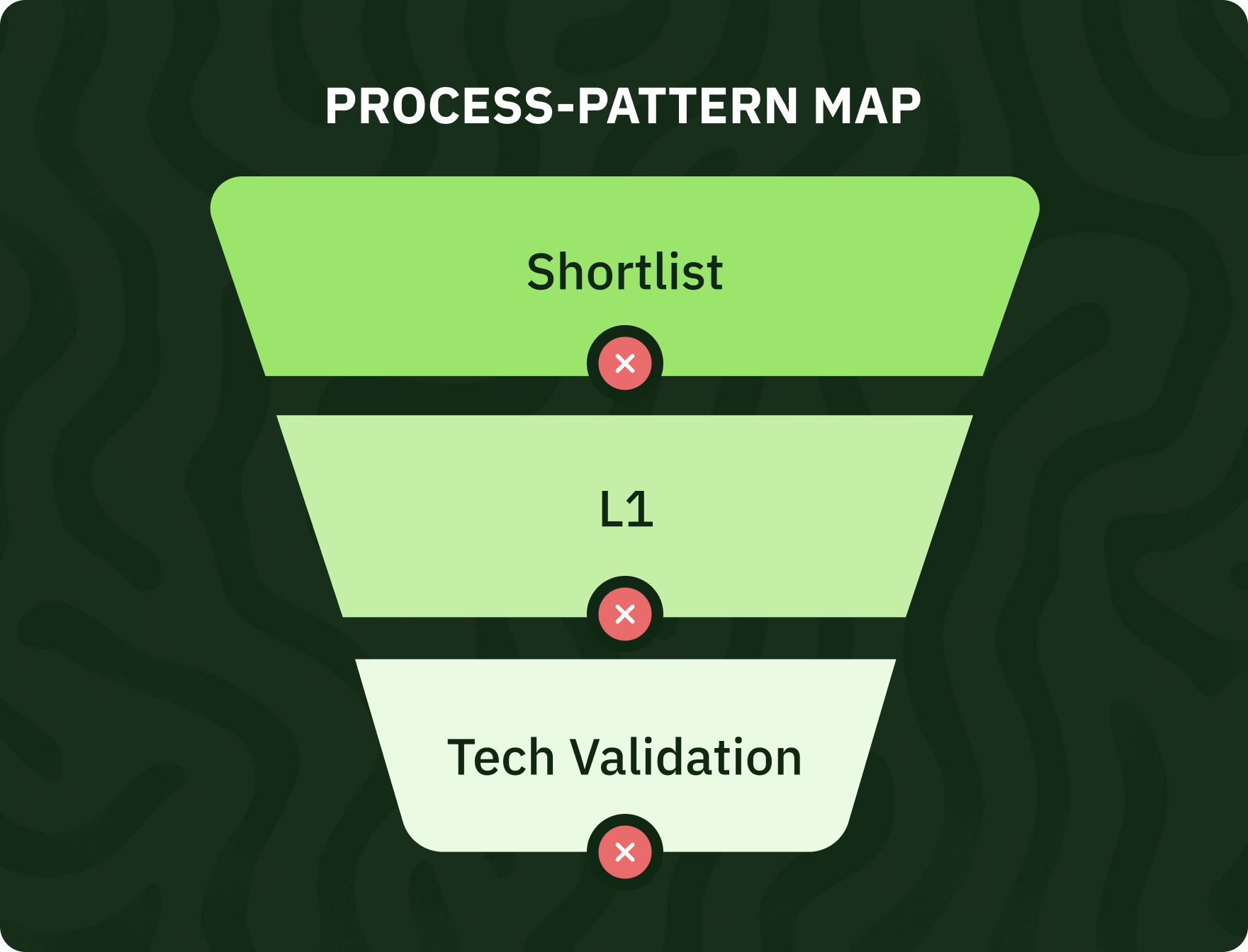
Funnel-to-agent
| HIRING STAGE | HYRING PRODUCT | WHAT IT DOES | OUTPUT (WHAT THE TEAM SEES) |
|---|---|---|---|
| SHORTLIST | AI resume screener | Filters resumes against role-fit criteria and ranks applicants by match strength. | Ranked shortlist with fit signals per candidate. |
| L1 SCREENING | AI phone screener | Conducts first-round phone screens without recruiter calendar dependency. Runs concurrent sessions. | Call summary, candidate score, recommended shortlist. |
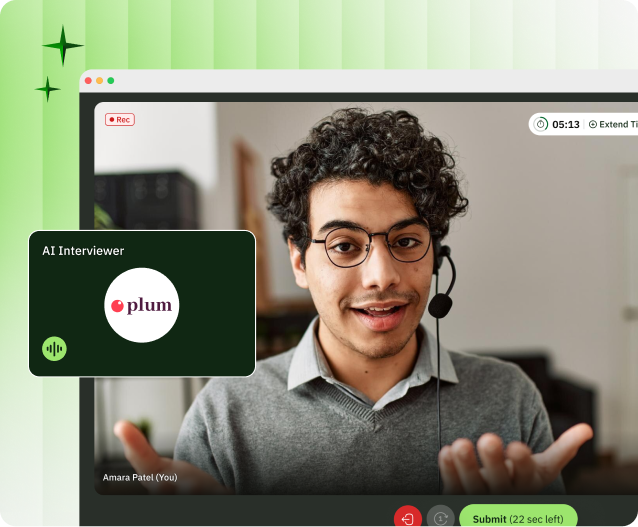
| STRUCTURED INTERVIEW | AI video interviewer | Runs structured video interviews with adaptive follow-up questions and proctoring. | Interview report with structured scoring and integrity flags. |
| TECH VALIDATION | AI coding interviewer | Administers live or async coding assessments matched to role requirements. | Code evaluation report with language-specific scoring. |
| COMMUNICATION CHECK | English proficiency test | Assesses spoken English proficiency against CEFR benchmarks. | Proficiency level and skill-area breakdown. |
HYRING PRODUCT
AI resume screener
WHAT IT DOES
Filters resumes against role-fit criteria and ranks applicants by match strength.
OUTPUT (WHAT THE TEAM SEES)
Ranked shortlist with fit signals per candidate.
HYRING PRODUCT
AI phone screener
WHAT IT DOES
Conducts first-round phone screens without recruiter calendar dependency. Runs concurrent sessions.
OUTPUT (WHAT THE TEAM SEES)
Call summary, candidate score, recommended shortlist.
HYRING PRODUCT
AI video interviewer
WHAT IT DOES
Runs structured video interviews with adaptive follow-up questions and proctoring.
OUTPUT (WHAT THE TEAM SEES)
Interview report with structured scoring and integrity flags.
HYRING PRODUCT
AI coding interviewer
WHAT IT DOES
Administers live or async coding assessments matched to role requirements.
OUTPUT (WHAT THE TEAM SEES)
Code evaluation report with language-specific scoring.
HYRING PRODUCT
English proficiency test
WHAT IT DOES
Assesses spoken English proficiency against CEFR benchmarks.
OUTPUT (WHAT THE TEAM SEES)
Proficiency level and skill-area breakdown.
KPI Scoreboard — Wipro Hiring Model
Time to Screen
Definition: Calendar time from application received to L1 decision completed.
Risk indicator: Reducing this number is only useful if downstream rejection rates stay flat. Watch for a spike in L2 panel rejections after accelerating L1.
Screening Count
Definition: Number of completed first screens per recruiter per week.
Risk indicator: A recruiter processing 80 screens a week who advances only 5% may be casting too wide. Track advancement rate alongside throughput.
Interview Completion Rate
Definition: Percentage of candidates who receive an AI interview invite and finish the full session.
Risk indicator: Completion dropping below 60% usually signals a UX or instruction clarity problem in the invite flow, not candidate disinterest.
Early Stage Drop-offs
Definition: Which specific funnel step causes candidates to exit before reaching a human interviewer.
Risk indicator: If drop-offs cluster at scheduling or assessment launch, the friction is logistical. If they cluster mid-interview, the content or length may need adjustment.
Panel Hours per Hire
Definition: Total hours spent by human interviewers (engineering leads, delivery managers) per confirmed hire.
Risk indicator: Falling panel hours paired with falling offer-acceptance rates can mean AI screening thresholds are set too aggressively, filtering out good candidates before panels see them.
Pass-through Rate
Definition: Percentage of candidates advancing from one funnel stage to the next.
Risk indicator: Wide variance in pass-through rates across Wipro's different verticals (BFSI vs. healthcare) could indicate scoring rubrics need vertical-specific calibration.
Shortlist-to-Offer Ratio
Definition: How many shortlisted candidates are needed to produce one accepted offer.
Risk indicator: A ratio that looks perfect (close to 1:1) may mean the screener is being too conservative and excluding viable candidates at the top.
Integrity Flag Rate
Definition: Percentage of AI video or coding sessions that trigger cheating or malpractice alerts.
Risk indicator: A sudden cluster of flags from a specific sourcing channel or geography requires immediate manual audit before any candidate decisions are finalised.
Time to First Touch
Definition: Hours between a candidate submitting an application and receiving their first response or assessment invitation.
Risk indicator: An instant automated acknowledgement means nothing if the next step (actual screening) takes another ten days. Measure the gap between first touch and first substantive interaction.
SLA adherence
Definition: Percentage of requisitions where each funnel stage is completed within the agreed timeframe.
Risk indicator: Consistently missing SLAs on specific role types (cloud architects, SAP consultants) could mean those roles need different sourcing or screening configurations, not just faster processing.
Model ROI for High-Volume Scenario
The Wipro hiring process involves both fresher onboarding and continuous lateral backfill. Below is an illustrative ROI model scaled for a combined annual hiring volume of approximately 40,000 (roughly 11,000 freshers plus an estimated 28,000 to 30,000 lateral and replacement hires, derived from attrition-based exit estimates and reported fresher targets).
Annual Savings Potential
$4.1M+
in recruiter hours, panel time, and agency fees.
Reduction in Time-to-Hire
68%
faster for roles where AI handles L1 and tech screening.
Faster Interview Process
58%
acceleration in scheduling-to-evaluation cycle.
5-Year ROI Projection
~380%
with a 6-month payback period.
Note: ROI figures below are an illustrative model of potential savings in this specific scenario. Actual results vary by internal workflow costs.
Hours Saved Annually
When 40,000 hires require an average of 45 minutes of L1 screening each (blending the shorter fresher screens with longer lateral screens), total manual screening time reaches approximately 30,000 hours per year.
Routing initial screens through Hyring's AI phone and video agents recovers an estimated 25,000 to 27,000 of those hours, assuming an 85% automation rate on first-round screens.
Math logic: 40,000 hires x 0.75 hrs average L1 time = 30,000 hrs. At 85% AI coverage = ~25,500 hrs recovered.
Hours Saved by Category
Source: Hyring hiring model (illustrative)
Current State Costing vs. Target State with AI
Processing 40,000 hires means working through an estimated 350,000 to 400,000 applications annually (based on a roughly 10:1 application-to-hire ratio for a mix of lateral and fresher roles).
In the current state of the Wipro interview process, recruiter-led L1 screens and early technical panels account for the largest time cost.
| Metric | Current Manual Process | Target with Hyring AI Agents |
|---|---|---|
| L1 Screening Cost | ~$3.2M (recruiter salaries, scheduling overhead, internal hours) | ~$350K (AI interview cost at ~$1 per screen on average) |
| Engineering Panel Load | High: delivery leads conduct early tech screens alongside billable project work | Low: panels only review AI-shortlisted, score-validated profiles |
| Interview Scalability | Capped by recruiter and panel calendar availability | Concurrent sessions with no scheduling dependency |
| Fake Candidate Detection | Manual verification, reference checks | AI proctoring: face, voice, screen, and tab-switch monitoring |
| Funnel Completion Rate | ~30–35% (estimated, based on industry benchmarks for IT services lateral hiring) | >75% (24/7 self-scheduling removes timezone and calendar friction) |
Where the $4.1M+ Savings Come From
The largest cost recovery sits outside the HR budget, inside engineering and delivery teams.
L1 screening displacement accounts for roughly $2.85M. If 350,000 applications each require even a 20-minute initial triage (resume screening plus a short call), that is over 116,000 hours of recruiter time. At an average fully loaded cost of $25/hr for Indian recruitment staff, the number climbs fast. AI phone and video agents absorb the bulk of that volume.
Recovered panel hours add another $850K. When candidates reaching L2 technical rounds are already pre-validated on core skills, the pass-through ratio improves from an estimated 5:1 to roughly 2.3:1. Engineers spend fewer hours interviewing candidates who lack basic qualifications.
Reduced agency dependency contributes approximately $400K. Standardising top-of-funnel screening internally means fewer roles need to be farmed out to external staffing vendors who charge 8% to 15% of annual CTC.
Where the Savings Come From
Source: Hyring hiring model. All figures are illustrative.
Cumulative Savings vs Cost
On a 12-month timeline, investment in AI screening software is offset by recruiter and panel hour reductions beginning in month two or three. Break-even for a 40,000-hire model occurs around month six in this projection.
Savings compound as more requisitions route through the AI agents. By month twelve, cumulative net savings in this model reach approximately $260K after subtracting estimated platform costs.
Cumulative Savings vs Investment (12-month model)
Month
Source: Hyring hiring model (Illustrative)
Wipro Hiring Process Plan
Rolling out enterprise hiring software across thousands of open requisitions at once is a reliable way to break existing workflows. A phased approach protects what already works while testing what could work better.
Week 2
Week 3
Week 4
Frequently Asked Questions
How does this model handle Wipro's mix of lateral and fresher hiring?
Lateral and fresher pipelines have different screening needs. Freshers typically go through standardised aptitude and communication checks, while lateral candidates need role-specific technical validation. The AI agents accommodate both by letting recruiters configure separate rubrics per role type.
A fresher pipeline might weight the English Proficiency Test and a general video interview more heavily, while a lateral pipeline for, say, a DevOps engineer would route through the AI Coding Interviewer with Docker and Kubernetes scenarios loaded into the test environment.
What happens when the system flags a candidate for suspicious behaviour?
The AI Video Interviewer tracks multiple integrity signals during a session: tab switches, off-screen audio, gaze patterns that suggest reading from a second display, and face-matching inconsistencies. When flags trigger, the candidate's session is marked for manual review. No candidate is auto-rejected on flags alone. A recruiter or hiring manager sees the flagged moments timestamped in the session report and decides whether to advance, re-interview, or reject.
Does switching to AI screening change how candidates experience the Wipro interview process?
Most candidates notice two differences - speed and flexibility. Instead of waiting five to ten days for a recruiter to schedule a phone screen, they receive an assessment link within hours of applying. They complete the initial interview on their own schedule, from any location.
Feedback from companies using similar AI-first screening models suggests completion rates climb when scheduling friction disappears, because candidates who are actively job-hunting do not want to wait.
Can the coding assessments be tailored for different technical stacks?
The AI Coding Interviewer supports multiple languages and frameworks. If a Wipro business unit needs to validate Python data engineering skills for one role and React front-end skills for another, each requisition gets its own test configuration.
Difficulty levels, time limits, and evaluation criteria are set per role. The test environment replicates a working IDE, so candidates write and run actual code rather than answering multiple-choice questions about syntax.
How do human panels fit into a workflow that automates the first two rounds?
Human panels see only candidates who have cleared AI screening and scored above the configured threshold. For a typical lateral hire, this means a delivery lead or architect conducts one focused technical deep-dive instead of three or four exploratory conversations.
The AI-generated reports (scores, transcripts, integrity flags, code evaluation) give the panellist context before the interview starts, so the conversation can skip basics and focus on problem-solving approach, system design thinking, or domain knowledge.
What does the English assessment actually measure?
Spoken fluency, listening comprehension, pronunciation clarity, and grammar. Results are benchmarked against CEFR levels (A1 through C2). For roles where a Wipro employee will be on daily client calls with a US or European stakeholder, the test provides a measurable communication readiness score rather than relying on a subjective impression from a 15-minute phone call.