
TL;DR
Recruiters today must choose between the academic-focused Duolingo English Test (DET) and specialized corporate tools like Hyring’s English Proficiency Test (EPT). While the DET provides a reliable baseline for general language knowledge, an AI-powered EPT within a hiring platform like Hyring offers deeper insights into role-specific communication, behavioral cues, and candidate integrity.
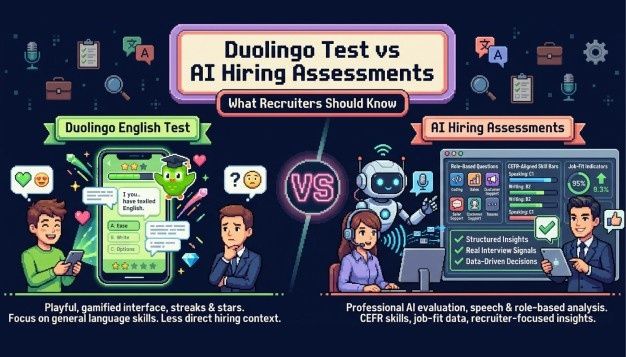
The DET is a certification for the student, whilst AI hiring assessments are a diagnostic tool for the recruiter. For high-volume, global hiring, the integration and specific data provided by AI-led assessments offer a significantly higher ROI and a more secure vetting process. This blog explains the key differences between DET and EPT and how the latter is far superior.
The 2026 Shift in Global Talent Vetting
I have spent the better part of the last decade watching the recruitment landscape evolve, but nothing has quite compared to the shift we are seeing in 2026. The world is no longer just “remote-friendly,” but now it has shifted to becoming the “global default.” When I talk to talent acquisition leads at major tech firms, the conversation has moved away from just simple grammar checks or resume scans to more advanced filters that enable only the best candidates to secure positions that require that level of proficiency.
We are now in an era where communication is the most critical skill in the tech skill stack. Recent data suggests that nearly 70% of workplace conflicts in global teams stem from a lack of nuance in communication rather than technical failure.
This environment is precisely why the choice between the Duolingo English Test vs AI Hiring Assessments is such a high-stakes game. In the past, having a certificate was enough to assess a candidate’s capability.
Today one needs to know if a candidate can handle a high-pressure client de-escalation or explain a complex code architecture without losing the human touch. While a general test can tell me if someone knows the words, a modern AI English proficiency test will reveal if they know how to use them in the heat of a real business scenario.
Duolingo English Test: The Academic Powerhouse
Here, I humbly concede that there is no denying that the Duolingo English Test changed the game. It broke the monopoly of center-based prosaic testing by offering an affordable, $59 assessment that candidates could take from the comfort of their bedrooms. It uses an intuitive adaptive model where the difficulty of the succeeding question is determined by the candidate’s previous answer.
As someone familiar with recruiting for my own firm, I find it to be an excellent top-of-the-funnel filter. If a candidate hasn't invested the hour to get a DET score, they might not be serious about the role offered to them. That was the basic equivalence assumed.
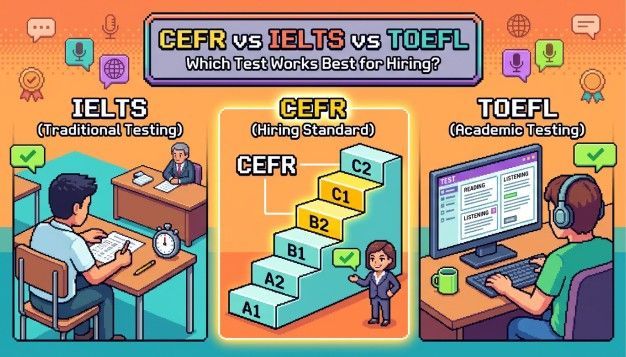
The DET is fundamentally an academic tool. It was built to help universities decide if a student can get through a lecture on 18th-century literature. Its subscores- literacy, conversation, comprehension, and production- are broad sweeps.
A score of 120 is usually considered to be impressive on a resume, it doesn't give me the specific data I need to know if that person will thrive in a fast-paced B2B sales environment. This is where the limitations of academic testing become apparent and where a specialized AI English proficiency test becomes necessary.
Also Read: How HR Builds an Entire Talent Pipeline Without Waiting for Applicants
The "Context Gap" in Standardized Testing
The biggest hurdle I face when relying on standardized tests is what I call the Context Gap. A candidate can be a brilliant test-taker but a poor communicator. I’ve seen candidates with near-perfect scores struggle to even articulate a single original thought when asked to solve a single problem that is asked as part of their job-fit assessments.
Standardized tests measure linguistic competence, but businesses need effectiveness in communication. The existence of a significant difference between general language proficiency and the specific language required for professional domains is seen by research in applied linguistics.
When I use an AI English proficiency test, I am closing that gap. These assessments aren't just checking if you know where the comma goes but are analyzing the way you structure an argument and the clarity with which you present an idea.
This is the primary reason why many firms are moving away from external certifications and moving toward internal, platform-based assessments like those found on Hyring.
Why a Specialized AI English Proficiency Test Outperforms General Exams
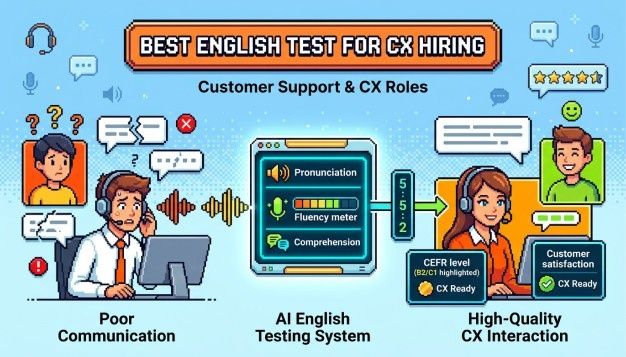
When we look deep into the mechanics of a specialized AI English proficiency test, we see features that a plain academic test simply isn't designed to provide. Modern AI models can now analyze prosody - the rhythm, stress, and intonation of speech - to determine how natural a candidate sounds. This is vital for front-end roles where the communication vibe is as important as the content itself.
On a platform like Hyring, the English Proficiency Test is often integrated directly into an AI-led interview. This means the candidate is being scored on their language skills while they are actually answering questions about their experience or technical skills. It provides a holistic view of the candidate that a standalone test can never hope to match.
These AI tools can measure things like "WPM" (Words Per Minute) and filler-word density, as well as Mother Tongue Influence (MTI) additionally. If a candidate uses "um" or "like" every three words or so, the AI English proficiency test will flag it as a lack of confidence or fluency, even if their grammar is technically perfect.
This level of granular data is as golden as it is insightful for a recruiter trying to distinguish between prolifically "proficient" and plainly "professional."
Security and Fraud Detection
I’ve never seen a bigger threat to hiring integrity than the rise of generative AI tools used by candidates to commit fraud. This may include real-time speech-to-text to read answers off a screen or even use AI voice morphing to mask one’s identity! These may be the in-thing these days, generally speaking.
While the DET has a rigorous human-and-AI review process, it still suffers from being a premeditated event that a candidate can prepare for, in isolation, anytime they want.
A robust AI English proficiency test that is built into a live platform like Hyring offers a multi-layered security shield. The proctoring used in Level 2 interview stages uses computer vision to track eye movements, and detects if there are multiple people in the room, and flags when a candidate switches browser tabs even!
This makes the entire package of English Proficiency and the AI Interviewer a powerful combination. Studies on remote assessment security show that integrated AI proctoring can detect over 90% of unauthorized assistance attempts. This level of security is essential for maintaining the value of your hiring funnel.
Workflow Integration and the Bottom Line
Managing external test scores from an operational standpoint is a personal headache for Human Resources. I’ve spent countless hours waiting for candidates to email me their PDFs or trying to verify a score on a third-party portal. When you use an EPT that is native to your hiring platform, that friction disappears.
The score is part of the candidate profile. You can sort, filter, and compare candidates instantly and simultaneously. According to Glass Door, it is what allows high-growth companies to reduce their time-to-hire by nearly 50%. By using an AI EPT as part of the initial screening, you aren't just checking a box, but also gathering the data that informs the final hiring decision.
The ROI isn't just in time saved, either but it’s more importantly in the quality of hire. An EPT that measures business readiness ensures that the person you hire can actually do the job on day one. You aren't wasting three months on a hire who has the score but lacks the actual skill.
Summary: Making the Strategic Choice
So, where does that leave us? In the debate of Duolingo English Test vs AI Hiring Assessments, the obvious choice depends on your goal. If you are a recruiter building a high-performance team in 2026 - you need a specialized AI-powered English Proficiency Test that leads the recruitment process, like the one Hyring has developed specifically tailored to the needs of the industry.
Standardized tests are a snapshot of the past, and AI assessments are a precursor to a definitive future that is driven by that intuitive intelligence. I believe that the best approach is to stop viewing language as a separate subject and start viewing it as a core component of professional performance that affects work in more ways than one. Using an AI hiring platform like Hyring allows you to do exactly that, providing a seamless, secure, and data-rich environment for vetting global talent.
Frequently Asked Questions
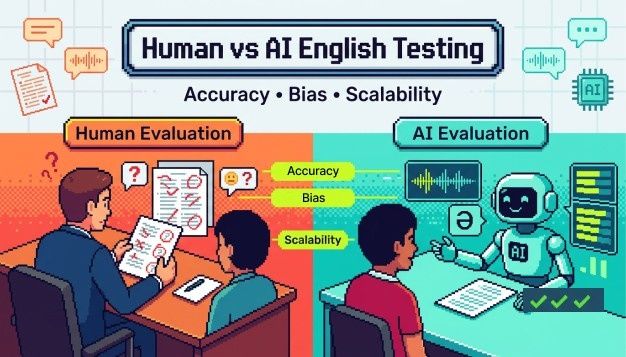
1. Is an AI English proficiency test more accurate than a human interviewer
Research suggests that AI can be more consistent than humans because it doesn't suffer from fatigue or unconscious bias.
An AI English proficiency test applies the same rigorous metrics to every candidate, ensuring a level playing field.
2. Can candidates use ChatGPT to pass an AI English proficiency test?
Advanced platforms like Hyring have that built-in detection for AI-generated content. They monitor the organic nature of the speech rhythm and flag any responses that appear too monotonous, robotic, or perfectly structured to be spontaneous.
3. Why would I use Hyring EPT instead of just asking for a DET score?
Hyring provides context that is specific to the role. An AI English proficiency test on the platform evaluates the candidate's communication in the context of the job they are actually applying for, rather than asking general academic questions.
4. How does an AI English proficiency test handle different accents?
Modern AI models are trained on diverse global datasets, making them highly effective at distinguishing between unclear pronunciations and say, a regional accent variation. This ensures that global talent is evaluated fairly based on clarity, not dialect.
5. How long does it take for a recruiter to get results from an AI English proficiency test?
Unlike traditional exams that may take 48 hours to certify, results from an AI English proficiency test are available instantly or within minutes of the candidate finishing the session which is conducive to faster, better hiring.