
Overview
Everything virtual has become a ritual in the AI era. Classes, courses, assessments, interviews, and even remote jobs have become a part and parcel of our advanced routine. However, as we move towards online, the integrity and trust of virtual assessments are at stake. How do you trust what's happening on the other side of the screen? That's exactly where AI proctoring comes in. In this guide, we'll break down what AI proctoring is, how it works, why it matters, and much more.
The Shift to Remote Assessments
The way we evaluate talent has changed over time. The processes of candidates walking in and out of companies have changed into candidates applying from their palm-sized phones and uploading their resumes in minutes. Remote work, distributed teams, and virtual hiring pipelines are now the standard. Organizations have altered their methods and now run thousands of online assessments every month, from coding tests to video interviews.
But with this shift comes a fundamental question: how reliable are the results? When a candidate is sitting at home, there is the risk of dishonesty. The applicants now have better access to a browser tab open to ChatGPT, or someone else can take up the test entirely. Traditional honor codes and manual reviews can't keep up at scale.
That's where AI proctoring steps in, bringing accountability back into the picture with remote assessments.
What Is Online Proctoring?
Online proctoring is the practice of supervising a candidate remotely using technology, which is the digital equivalent of an invigilator. It generally falls into these models:
Live proctoring: This has a human recruiter in the loop, watching the candidate in real time over video. It's effective but expensive and hard to scale across time zones, as the availability of the candidates and the recruiter/invigilator should align.
Record-and-review proctoring: The session most likely includes pre-recorded interview inputs, and the candidates drop their responses in. The entire session is captured on video for a human to review later. It's more scalable but introduces delays and still requires manual effort.
AI-based automated proctoring: It uses artificial intelligence to monitor video, audio, and browser activity in real time, flagging suspicious behavior in a report format with no human involvement but is intended for humans to refer to later. This is the most scalable model and the focus of this guide.
What Does AI Proctoring Actually Monitor?
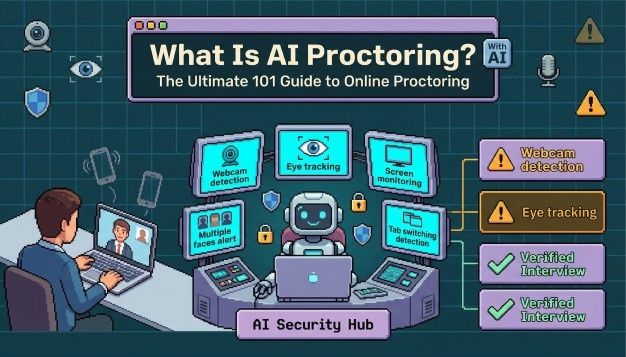
AI proctoring goes beyond passive recording. Using computer vision, audio analysis, and behavioral pattern recognition, it actively covers the following:
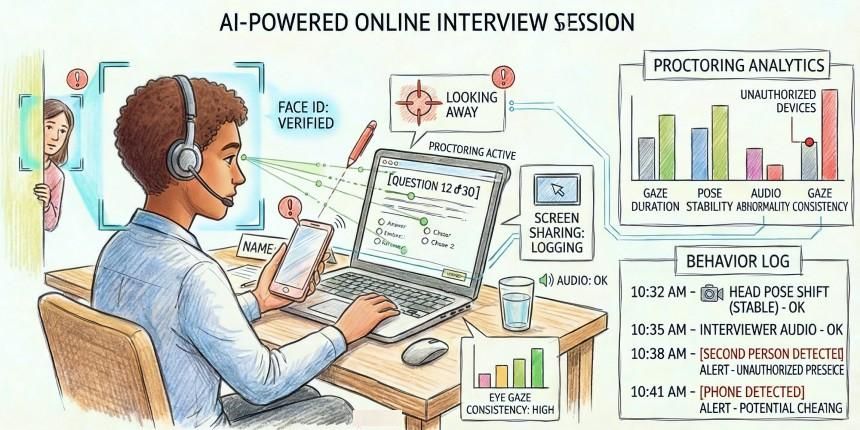
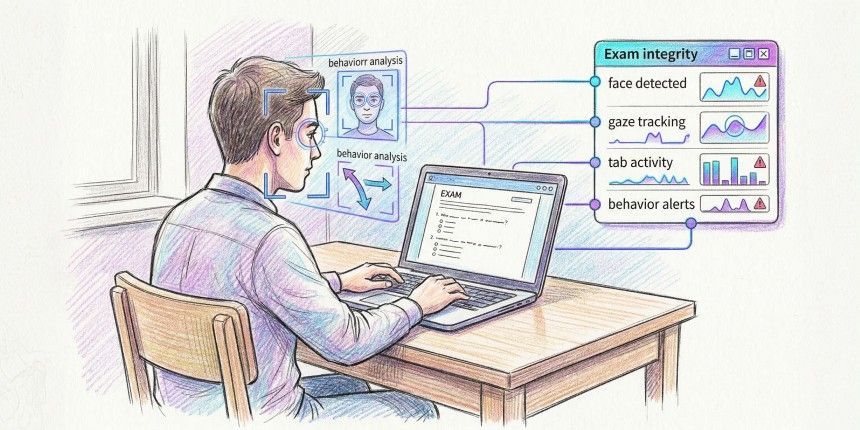
- Eye-gaze and head-movement tracking: It detects when a candidate is consistently looking off-screen, suggesting notes, a second device, or outside help.
- Multiple person detection: It flags anyone else visible in the candidate's frame, ensuring there is no external help for candidates.
- Audio anomaly detection: Picking up background voices, whispered dictation, or suspicious sounds around the vicinity.
- Browser and application monitoring: It detects tab switches, copy-paste attempts, and screen-sharing. Hyring's AI proctoring identifies any unauthorized applications and even extensions.
- The key difference: AI-based proctoring doesn't just record. It looks beyond the screens. It flags, scores, and generates an integrity report by the time the candidate finishes.
Why Is AI Proctoring Essential?
Scalability:
A company running hundreds of assessments weekly cannot staff a human proctor for each one. AI handles thousands of sessions simultaneously.
Consistency:
Human proctors get tired and may apply rules inconsistently. AI applies identical detection criteria to every session.
Speed:
Instant integrity results mean hiring teams are not waiting for hours of video to be reviewed manually. In a tight talent market, that speed matters. The recruiter gets an AI-generated report of the session without having to manually attend the interview or review video sessions.
Candidate experience:
Many candidates find a stranger watching them on camera, and this might seem intrusive. AI proctoring runs quietly in the background, which makes it present but not disruptive.
Cost efficiency:
By reducing manual oversight, the cost per assessment drops significantly. This frees recruiters from time-consuming monitoring, allowing them to focus on high-priority hiring tasks.
Global flexibility:
The scheduling trouble is out of the picture, and the assessment can be taken at the candidate's convenience. In fact, it also works great across time zones.
Key Benefits at a Glance
- Cheat-proof assessments: Multi-layered detection across video, audio, and browser activity makes it extremely difficult to game the system.
- Unbiased monitoring: Every flag is data-driven. No subjective human judgment, which means the process is fair and consistent for all candidates.
- Effortless scalability: Proctor 10 or 10,000 candidates with no change in quality, which is especially valuable during high-volume hiring drives.
- Faster hiring cycles: No bottleneck waiting for proctors. Integrity reports are ready the moment the assessment ends.
- Actionable reports: Detailed, timestamped flags with confidence scores and visual evidence give hiring teams the context to make informed decisions.
How Does AI Proctoring Work?
The technology is sophisticated, but the candidate experience is designed to be simple:
- Pre-test setup: The candidate grants webcam and mic access for AI to run checks throughout the session.
- Environment check: A brief check to ensure no unauthorized materials, extra screens, or other people are present.
- Live monitoring: Once the test begins, AI continuously analyzes the video and audio feed, tracking eye movement, facial presence, background sounds, and browser activity in real time.
- Browser monitors: The candidate's activities are monitored throughout the assessment. Tab switches, usage of AI extensions, and screen-sharing attempts are automatically detected and logged.
- Integrity report: The moment the test ends, a comprehensive report is generated with a trust score, a timeline of flagged events, and supporting evidence for each flag.
How Hyring Uses AI Proctoring
At Hyring, the AI proctoring is embedded directly into the assessment process. It is not an afterthought. The candidate does not need to install another proctoring app or suffer through a clunky setup process. The monitoring is done smoothly within the Hyring platform, regardless of the coding assessment or interview.
At Hyring, the AI monitors all the key activities from face verification, gaze tracking, tab switching, and video/audio anomalies, all without a clunky experience. Integrity reporting is included with the skill assessment report, providing the hiring manager with a complete and trusted view of all the candidates in one place.
For teams running high-volume technical hiring, this means scaling assessments confidently without sacrificing data trust or candidate experience.
Conclusion
AI proctoring is the new standard for secure remote exams. Not only is it secure, but it is also cost-effective and unbiased, ensuring a level playing field for all candidates based on merit.
Frequently Asked Questions
1. Is AI proctoring safe and secure for candidates?
Yes. AI-based online proctoring is designed to ensure the integrity of remote exams without compromising candidates' personal information. AI-based proctoring monitors video, audio, and browser activities in real-time and identifies suspicious activities. Most platforms, including Hyring, ensure secure and safe data practices for candidates.
2. Can AI proctoring identify if ChatGPT and other AI tools are being used during an exam?
Yes. AI-based proctoring monitors multiple activities, such as switching tabs, copy-pasting, and application usage, during an exam. These are common practices for using other AI tools during an exam. Although there is a possibility of bypassing these monitoring mechanisms, it is extremely difficult for candidates to use other AI tools during an exam.
3. Does AI proctoring work on any device?
Yes. Most AI-based proctoring platforms are browser-based and work on any device with a functioning webcam and microphone. Hyring's AI-based proctoring is directly embedded in its platform and doesn't require any additional software installation.
4. What happens if AI proctoring raises false alarms against the candidate?
The AI proctoring tool provides detailed integrity reports, along with timestamped evidence, for every flag raised against the candidate. This allows the hiring team to make a more informed decision based on the context in which the flag was raised, rather than just depending on the results. This way, even if there is a flag, the candidate is not disqualified.
5. What is the difference between AI proctoring and using a human proctor?
A human proctor can monitor a few candidates at any given time. It is also not possible for a human proctor to monitor the screen activities of the candidate. Thousands of sessions can be monitored at the same time using AI proctoring, and the same criteria are applied to all the candidates. It is also more cost-effective and less intrusive for the candidate.