Intel Careers logo

Intel Careers

US semiconductor maker designing and manufacturing CPUs, GPUs and foundry silicon, with a large chip design workforce in Bengaluru and Hyderabad

intel.com

About the company

Founded

July 18, 1968, in Mountain View, California

Headquarters

Santa Clara, California, United States

Industry

Semiconductors

Employees

85,100 (2025)

Revenue (FY25)

$52.85 billion

Market Cap

$515.77 billion

Listed on

NASDAQ: INTC

CEO

Lip-Bu Tan

Website

intel.com

Intel Corporation is an American semiconductor company headquartered in Santa Clara, California. It was incorporated on July 18, 1968 by Gordon Moore and Robert Noyce, and it designs, manufactures and sells CPUs, chipsets, graphics processors, network controllers and related computing products. Intel trades on Nasdaq under the ticker INTC and reported revenue of $52.85 billion for fiscal 2025, with a market capitalisation of about $515.77 billion.

The company reports through three main segments: Client Computing Group, Data Center and AI, and Intel Foundry. It employed 85,100 people at the end of 2025 and runs design, assembly and test sites across the United States, Ireland, Israel, Malaysia, Costa Rica, India, China and other countries. In July 2026 Intel committed 5 billion euros of capital to expand manufacturing at its Leixlip campus in Ireland, and it has been reshaping its foundry organisation under CEO Lip-Bu Tan.

In India, the business is registered as Intel Technology India Private Limited, incorporated in 1997 with its registered office on Outer Ring Road, Devarabeesanahalli, Bengaluru. Besides the Bengaluru campus, Intel opened a 300,000 square foot design and engineering centre in Hyderabad in December 2019 with capacity for roughly 1,500 people. Every one of its 58 currently open India roles is posted in Bengaluru.
Key People

Lip-Bu Tan

Chief Executive Officer

Dr. Craig H. Barratt

Independent Chair of the Board

David (Dave) Zinsner

Executive Vice President and Chief Financial Officer

Gokul V Subramaniam

President, Intel India and Vice President, Client Computing Group

Photos

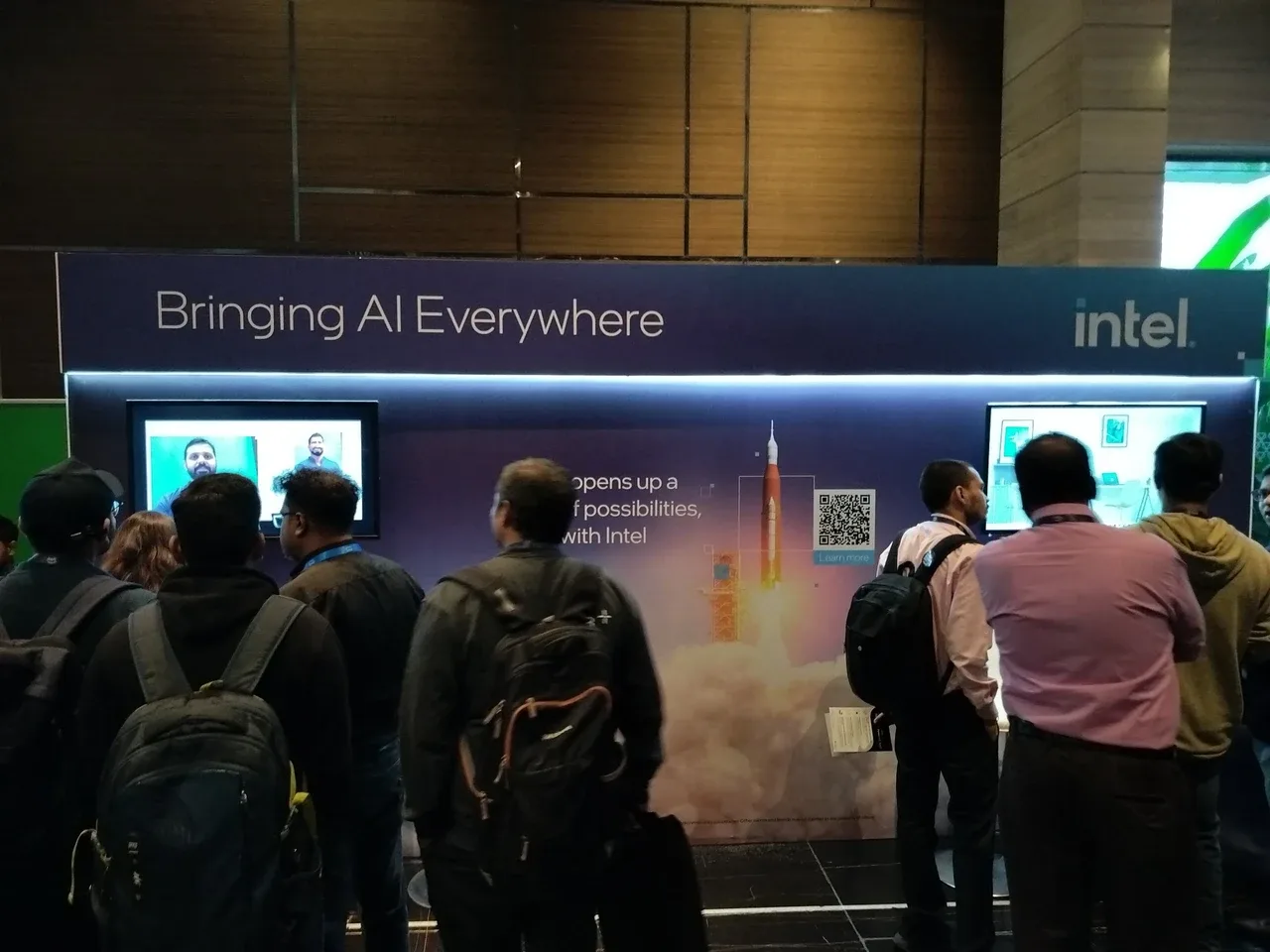
Intel workplace 1

Interview process at Intel

(Based on 174 interview reports from Intel candidates in India)

Interview experience

9 out of 10

Interview difficulty

Difficult, 7 out of 10

Interview process length

About a week to about a month

Overall experience

PoorExcellent
EasyDifficult

How long the process takes

About a day or two18%
About a week25%
About a month25%
More than one month13%

Prep for your Intel interview with AI

Practise real Intel style questions on systems, C++ and computer architecture, and get instant feedback on your answers.

Intel Interview Questions & Answers

Q: What is a template in C++, and why do we need to use templates?

A: A template lets you write a function or class once and have the compiler generate a version of it for each type you use it with. You need them so one implementation can serve many types without copy-pasted code or runtime type checks.

Answer by AI
  • Define it first: templates are compile time parameterised code, so the compiler stamps out a concrete version per type.
  • Give the motivation: without them you'd duplicate the same sort or container for int, float and custom types, or fall back to void pointers and lose type safety.
  • Add depth if the interviewer digs: mention function versus class templates, template specialisation, and that instantiation happens at compile time so there's no runtime cost.

Q: What is a virtual function and why is it needed?

A: A virtual function is a member function the derived class can override, with the call resolved at runtime through the vtable rather than at compile time. It's needed so code holding a base class pointer can call the right derived behaviour.

Answer by AI
  • Start with the mechanism: the compiler adds a vtable pointer to the object, and the call jumps through that table at runtime.
  • Explain the purpose: runtime polymorphism, so a renderer can hold base class pointers and each concrete type does its own work.
  • Close with the classic follow-up: a base class with virtual functions should have a virtual destructor, otherwise deleting through a base pointer leaks the derived part.

Q: How do you set the last 2 bits in a number?

A: OR the number with 3, since 3 is binary 11. So the answer is n = n | 3, which forces bits 0 and 1 to 1 and leaves every other bit untouched.

Answer by AI
  • State the mask: the last two bits are 0b11, which is decimal 3.
  • Show the operation: n |= 3 sets those bits, because OR with 1 always yields 1 and OR with 0 preserves the original bit.
  • Show you know the family: n &= ~3 clears them, n ^= 3 flips them, and (n >> k) & 1 tests bit k.

Q: What is the difference between a class and a struct?

A: In C++ the only language level difference is default access: struct members and base classes are public by default, class members are private by default. Everything else, including constructors, inheritance and virtual functions, works the same.

Answer by AI
  • Lead with the real answer: default member and inheritance access, public for struct and private for class.
  • Correct the common myth: structs in C++ can have methods, constructors and virtual functions, unlike C structs.
  • Add the convention point: teams usually use struct for plain data holders and class when there's invariants to protect.

Prep for your Intel interview with AI

Practise real Intel style questions on systems, C++ and computer architecture, and get instant feedback on your answers.

Intel Salaries in India (Updated 2026)

Software Engineer (all grades)

Median total compensation

₹43,00,000/yr

Software Engineer, Grade 3 (entry level)

Total compensation

₹19,60,000/yr

Software Engineer, Grade 6

Total compensation

₹34,10,000/yr

Software Engineer, Grade 7

Total compensation

₹48,70,000/yr

Software Engineer

Reported average

₹15,59,861/yr

32 salaries reported Salaries submitted

Firmware Engineer

Reported average

₹18,23,331/yr

10 salaries reported Salaries submitted

Know your worth at Intel

Compare what silicon design, firmware and software roles actually pay before you name a number.

Build a standout resume with AI

Match your resume to the Intel role you want and see what's missing before you apply.

Benefits

20 annual leaves plus 7 sick leaves reported by India employees
Flexible work hours with hybrid and work-from-home options
Health insurance cover
Free company transport in India
Wi-Fi bill reimbursement
Internal mobility support and in-house tool training
401(k) retirement plan (US programme)
Employee stock purchase plan (US programme)
Dental and vision insurance (US programme)
Paid holidays and vacation (US programme)
Education, training and certification reimbursement, including the Tuition Assistance Program
Quarterly Profit Bonus and Annual Performance Bonus
Up to 12 weeks of paid leave to bond with a new child (US programme)

Latest News & Updates

July 21, 2026

Intel and Fortinet partner on Security Processor 6

Intel and Fortinet announced a strategic collaboration to build the Fortinet Security Processor 6 (SP6), pairing Fortinet's security silicon expertise with Intel's design and manufacturing. The two companies said the work also strengthens supply chain resilience.

#Partnership #Semiconductors #Cybersecurity

View post

July 16, 2026

Intel and Google Cloud expand AI collaboration

Intel expanded its partnership with Google Cloud to run Gemini Enterprise and scalable cloud infrastructure across its own operations. The rollout covers engineering, supply chain and corporate teams, including silicon development workloads.

#AI #Cloud #Partnership

View post

July 13, 2026

Intel commits 5 billion euros to expand manufacturing in Europe

Intel announced a 5 billion euro capital investment at its Leixlip campus in Ireland to add advanced semiconductor capacity. The expansion supports production of Intel Xeon 6 processors and adds high-tech jobs in Europe.

#Investment #Manufacturing #Semiconductors

View post

June 18, 2026

Seok-Hee Lee named Executive Vice President of Intel Foundry

Intel appointed Seok-Hee Lee to lead advanced packaging, system integration and back-end manufacturing, reporting to CEO Lip-Bu Tan. The move sets up advanced packaging as its own business unit inside Intel Foundry.

#Leadership #Foundry #Hiring

View post

February 20, 2026

Intel India president outlines AI plans for education and small business

At the India AI Impact Summit, Intel India president Gokul V Subramaniam described plans to bring AI to Indian classrooms and small businesses using on-device computing rather than costly cloud setups. He also pointed to Intel's work with Tejas Networks on direct-to-mobile content delivery.

#India #AI #Education

View post

Intel FAQ

Intel is an American semiconductor company that designs, manufactures and sells CPUs, chipsets, graphics processors, network controllers and related computing products. It reports through three main segments: Client Computing Group, Data Center and AI, and Intel Foundry.