Amazon Hiring Process: Model AI Blueprint For Scale
The Amazon hiring process absorbs over two million applications a year across warehouse operations, corporate functions, and technology roles. With a reported global workforce of approximately 1.55 million as of Amazon's 2024 annual report, and seasonal hiring surges that add 250,000+ temporary workers in Q4 alone, the recruitment machine runs at a scale few companies match.
This blueprint maps where Hyring's AI agents can take over manual screening work across that funnel, what outputs they hand back to recruiters, and which KPIs keep the model consistently true.

This article is a planning framework showing where AI can reduce manual effort across the funnel.
The Blueprint
A hiring model earns trust when someone on the team can point to a metric that changed this week. If nobody can, the model is a slide deck with no use.
This blueprint targets the Amazon recruitment process at seven-figure application volumes. Four components hold it together: A funnel map shaped for high-volume, multi-format hiring workflows spanning warehouse, corporate, and engineering tracks. A phased deployment plan built for staged trust-building. A KPI scoreboard with risk flags on each metric and an ROI module with adjustable inputs and a disclaimer on every projection.
Amazon runs continuous hiring loops across 1,500+ facilities worldwide. Fulfillment centre associates go through virtual job tryouts and online assessments. Software development engineers face loop interviews with four to six panellists. Between those extremes sit operations managers, solutions architects, and support agents, each with different rubrics.
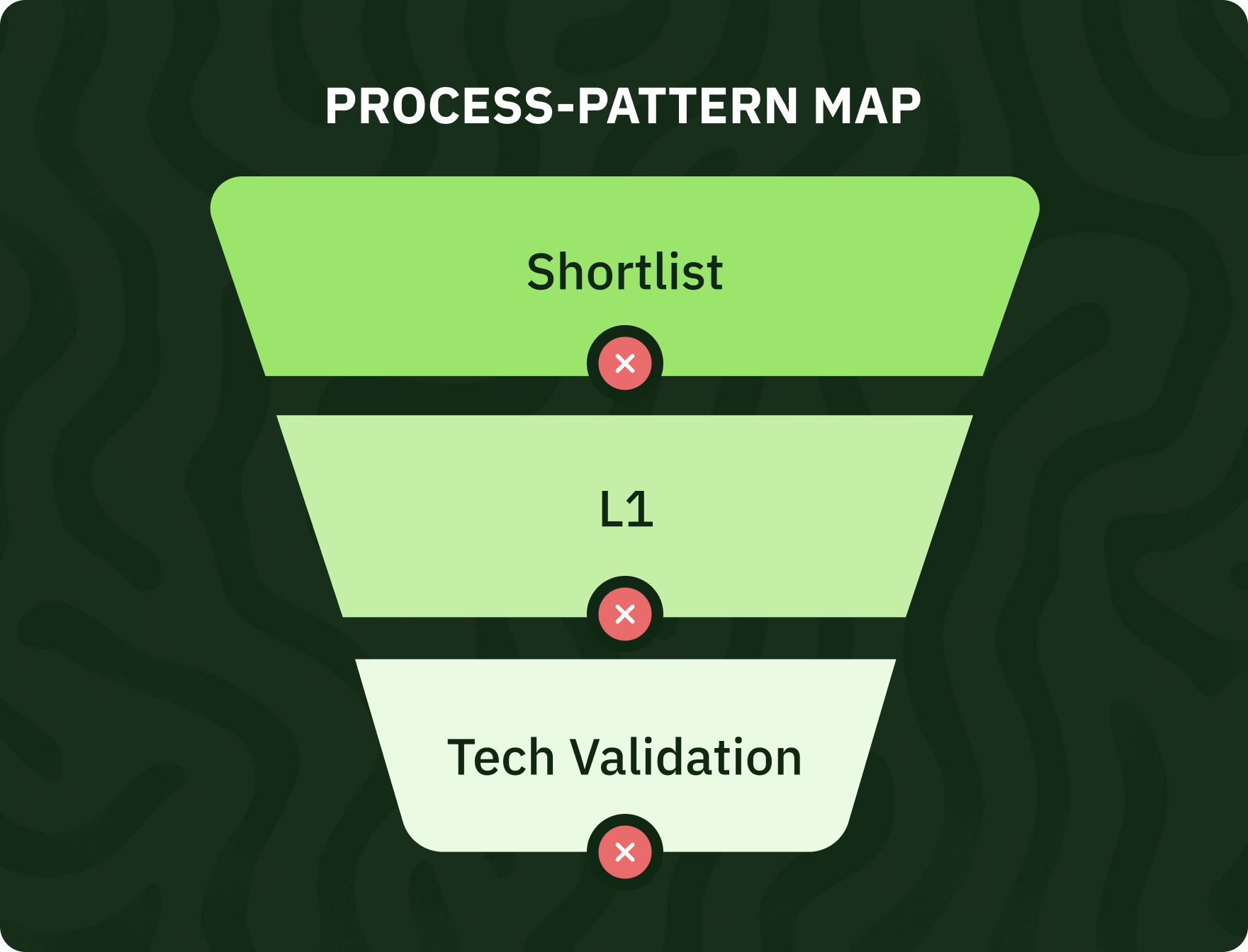
The friction concentrates in the first three funnel stages, where volume outpaces recruiter capacity without requiring complex human judgment.
Current State
Amazon closed 2024 with a global workforce of approximately 1.55 million, per its annual filing with the SEC. That figure dipped from the 2021 peak of 1.6 million following the post-pandemic workforce correction, but hiring momentum resumed in 2024 as AWS growth and same-day delivery expansion created new headcount demand.
Seasonal hiring tells the sharper story. Amazon brought on over 250,000 temporary workers for the 2024 holiday season (per its September 2024 press release), a figure consistent with prior years. These hires move through application, virtual assessment, and onboarding in compressed windows, sometimes under 72 hours from apply to start date.
Warehouse attrition remains Amazon's most publicly scrutinised workforce challenge. Reporting from the New York Times and internal data referenced in Senate testimony placed annualised turnover in US fulfillment centres at roughly 100% during peak years (2021 to 2023).
HR Management reports in 2024 suggested improvement through wage increases and career mobility programmes, though the rate remains substantially above industry averages for logistics (which typically range from 30% to 50% according to Bureau of Labor Statistics data).
On the technology side, Amazon hires an estimated 30,000 to 50,000 software engineers, data scientists, and technical programme managers annually, based on job posting volumes tracked by Revelio Labs and LinkedIn Talent Insights reports through 2024. Each of those hires typically passes through six to eight interview touchpoints.
The application-to-offer math: Amazon's careers page listed over 40,000 open roles at any given point in 2024. Conservative estimates put total annual applications above two million. For warehouse roles, the ratio sits at roughly 5:1 (applications per hire). For SDE roles, it exceeds 20:1.
~1.55M
250k+
2M+
Where the Amazon Recruitment Process Loses Time
At Amazon's volumes, a delay in one stage does not stay ensconced. A two-day backup in screening warehouse applicants during peak season cascades into missed start dates, which cascade into unfilled shifts during the highest-revenue weeks of the year. The Amazon interview process for tech roles faces a different version of the same problem - panel bottlenecks that push offers past the window where candidates accept.
L1 phone screens for corporate and operations roles burn recruiter hours on identical questions
Phone screens are required for corporate positions such as operations managers, programme managers, and account executives at Amazon. The screens are based on the Leadership Principles framework and last between 25 to 30 minutes. The recruiter asks the behavioral questions hundreds of times during the screening cycle.
The estimated number of hires is 80,000 annually at the corporation level. With an application-to-hire ratio of 6:1, this equates to about 480,000 applications that need at least a first-touch screen for the portion that passes the resume screening.
Bar raiser panels lose engineering hours to candidates who should have been filtered earlier
Amazon's bar raiser process is well-documented - a cross-team interviewer joins every SDE loop to protect hiring quality. The tradeoff is cost. A bar raiser interview loop consumes five to six engineers for a full day.
When the top of the funnel lets through candidates who lack baseline coding ability, every wasted loop burns 30+ engineer-hours at loaded rates between $75 and $120/hour (based on Levels.fyi compensation data for mid-to-senior SDE roles at Amazon).
Candidate drop-off between rounds accelerates in tech hiring
SDE candidates at Amazon routinely hold competing offers from Google, Microsoft, Meta, and well-funded startups. Teamblind surveys and Glassdoor reviews consistently report that Amazon's loop scheduling can take two to four weeks from phone screen to final.
In that window, competing offers arrive and expire. The candidate ghosts. However Amazon's recruiter dashboard records it as a passive withdrawal, but the root cause is pace, not interest.
Remote proctoring gaps in scaled assessments
Amazon's virtual assessment for warehouse roles and online coding assessments for tech roles both rely on browser-based testing. Identity verification at this scale depends on the candidate's self-reported information and basic webcam checks.
Systematic fraud detection across hundreds of thousands of concurrent sessions requires automated signals that a human proctor cannot sustain past the third hour of a monitoring shift.
Hyring AI Agents
Hyring's agents sit at the funnel stages where manual repetition consumes time without requiring original human judgment. The line is straightforward: if the task runs a repeatable rubric with a scored or binary output, the agent handles it. Anything else stays with a human. Final hiring decisions remain human-owned at every stage. Non-negotiable.
The AI Resume Screener
Instantly parse and rank resumes based on job-fit signals and technical requirements.
- Rapid high-volume parsing
- Objective skill ranking
- Bias-reduced shortlisting
The AI Phone Screener
Automated L1 verification calls to ensure basic qualifications and interest levels.
- 24/7 automated screening
- Consistent evaluation metrics
- Instant shortlist generation
The AI Coding Interviewer
Technical assessment with live coding environments and real-time logic evaluation.
- Real-time code analysis
- Plagiarism detection
- Automated logical scoring
English Proficiency Test
Standardized evaluation of communication skills, fluency, and professional vocabulary.
- Automated fluency scoring
- Grammar and clarity analysis
- CEFR aligned reporting
Funnel-to-agent
| HIRING STAGE | HYRING PRODUCT | WHAT IT DOES | OUTPUT (WHAT THE TEAM SEES) |
|---|---|---|---|
| SHORTLIST | AI resume screener | Filters applications against role-fit signals from the job description. | Ranked shortlist with fit scores. |
| L1 SCREENING | AI phone screener | Conducts first-round phone screens using configured question sets. | Call summary, score, shortlist recommendation. |
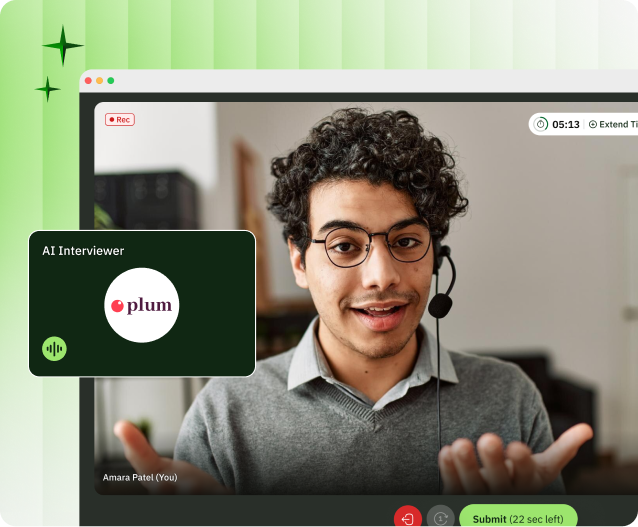
| STRUCTURED INTERVIEW | AI video interviewer | Runs structured video interviews and generates candidate reports. | Recorded session, structured scoring, behavioural signals. |
| TECH VALIDATION | AI coding interviewer | Administers coding interviews for engineering roles. | Code evaluation report with problem-solving breakdown. |
| COMMUNICATION CHECK | English proficiency test | Tests spoken English where client-facing roles require it. | CEFR-benchmarked level and skill breakdown. |
HYRING PRODUCT
AI resume screener
WHAT IT DOES
Filters applications against role-fit signals from the job description.
OUTPUT (WHAT THE TEAM SEES)
Ranked shortlist with fit scores.
HYRING PRODUCT
AI phone screener
WHAT IT DOES
Conducts first-round phone screens using configured question sets.
OUTPUT (WHAT THE TEAM SEES)
Call summary, score, shortlist recommendation.
HYRING PRODUCT
AI video interviewer
WHAT IT DOES
Runs structured video interviews and generates candidate reports.
OUTPUT (WHAT THE TEAM SEES)
Recorded session, structured scoring, behavioural signals.
HYRING PRODUCT
AI coding interviewer
WHAT IT DOES
Administers coding interviews for engineering roles.
OUTPUT (WHAT THE TEAM SEES)
Code evaluation report with problem-solving breakdown.
HYRING PRODUCT
English proficiency test
WHAT IT DOES
Tests spoken English where client-facing roles require it.
OUTPUT (WHAT THE TEAM SEES)
CEFR-benchmarked level and skill breakdown.
KPI Scoreboard — Amazon Hiring Model
Time to Screen
Definition: Hours from application receipt to L1 decision.
Risk indicator: Compressing below 24 hours for warehouse roles is strong, but watch whether assessment completion rates drop. Speed means nothing if candidates abandon a rushed, confusing intake flow.
Screening Throughput
Definition: Volume of screens completed per recruiter per week.
Risk indicator: If throughput climbs but pass-through to the next stage falls, the filter is too loose. Tighten rubric calibration before pushing more volume through.
Interview Completion Rate
Definition: Share of invited candidates who finish the full assessment.
Risk indicator: Below 55% for warehouse virtual tryouts usually traces to broken mobile links, unclear instructions, or assessment length exceeding 20 minutes on a phone screen (which is cumbersome and tiring).
Early Stage Drop-offs
Definition: The funnel step where candidates stop reacting.
Risk indicator: Drop-off spiking at the scheduling stage (rather than during the assessment itself) usually means the time gap between invite and slot is too wide. Candidates moved on.
Panel Hours per Hire
Definition: Total interviewer hours consumed per finalised offer.
Risk indicator: Cross-check against a 3 month retention period. If panel hours fall and new-hire attrition rises within the same quarter, the AI filter may be screening out soft-skill signals that loop interviewers would have caught.
Pass-through Rate
Definition: Share of candidates advancing from one stage to the next.
Risk indicator: A 20-point variance between two fulfilment centre regions hiring for the same role means the rubric needs regional calibration, not a blanket threshold.
Shortlist-to-Offer Ratio
Definition: How many shortlisted candidates produce one accepted offer?
Risk indicator: Improving from 10:1 to 5:1 is strong. Improving from 10:1 to 2:1 likely means viable candidates are being pruned too aggressively.
Integrity Flag Rate
Definition: Share of AI interviews that trigger fraud or cheating alerts.
Risk indicator: A 3% to 5% baseline is normal. A sudden jump above 12% from a single geography or assessment type warrants manual review before drawing conclusions.
Time to First Touch
Definition: Lag between application submission and first candidate outreach.
Risk indicator: A fast first touch followed by silence for five days creates worse candidate perception than a steady three-day rhythm across all touchpoints.
SLA adherence
Definition: Share of candidates receiving status updates within X days.
Risk indicator: Track this per hiring track. Warehouse SLAs and SDE SLAs should have different benchmarks; applying one standard to both distorts reporting.
Model ROI for High-Volume Scenario
Every number below is an illustrative projection. The math uses publicly reported Amazon hiring volumes, but internal cost structures at Amazon will differ. Treat this as a starting framework.
Annual Savings Potential
$4.1M+
in operational and hiring costs.
Reduction in Time-to-Hire
58%
faster from application to accepted offer.
Faster Interview Process
48%
acceleration in scheduling and evaluation throughput.
5-Year ROI Projection
~380%
with a 5-month payback period.
Note: ROI figures below are an illustrative model of potential savings in this specific scenario. Actual results vary by internal workflow costs.
Hours Saved Annually
Three stages absorb the bulk of manual effort in the Amazon hiring process pipeline.
- Resume screening: 1,000,000 applications routed to recruiter review, 6 minutes average per resume, total 100,000 person-hours. With AI resume screening, recruiter time drops to approximately 10,000 hours spent reviewing AI-generated shortlists.
- L1 phone screens: 200,000 candidates remaining after shortlist, 20 minutes per candidate, total 66,700 person-hours. AI phone screening completes calls and scores results, leaving roughly 7,500 person-hours of recruiter review.
- Early technical panels: 40,000 candidates reaching tech validation, 40 minutes per candidate, average 2 panellists, total 53,300 person-hours. AI coding and video screening reduces candidates reaching live panels by 50%, recovering approximately 26,700 person-hours.
Total estimated hours recovered annually: ~149,000.
Hours by Stage (Manual vs. AI-Assisted)
Source: Hyring hiring model (Illustrative)
Current State Costing vs. Target State with AI
At Amazon's reported scale, efficiency gains at the top of the funnel compress cost at every stage below.
| Metric | Current Manual Process | Target with Hyring AI Agents |
|---|---|---|
| L1 Screening Cost | ~$2.9M (recruiter hours at $22/hr loaded, coordinator time, telephony systems) | ~$280K (at ~$1 per AI-conducted screen, plus ~$80K recruiter review hours) |
| Engineering Panel Load | Heavy: SDE conduct 5–6 interviews per day during peak sprints | Lighter: panels receive only candidates who cleared AI resume, phone, and coding gates. |
| Interview Scalability | Capped by bar raiser availability, timezone coordination across Seattle/Arlington/Bangalore. | Concurrent and asynchronous: candidates complete AI assessments on their own schedule within a defined window. |
| Fake Candidate Detection | Interviewer observation during live video varies with fatigue and session count | Proctoring monitors face, voice, screen, gaze, and clipboard simultaneously |
| Completion Rate | ~22% of shortlisted candidates reach offer stage | >65% projected, driven by faster scheduling, self-service assessments, and quicker status updates |
Where the $4.1M+ Savings Come From
The largest cost recovery does not sit in recruiting operations alone. It sits in engineering delivery margins and candidate acquisition overhead combined.
- L1 volume handled by AI agents: at 200,000 phone screens and a 20-minute average, the manual L1 stage costs roughly $2.9M in loaded recruiter time. AI phone and video agents running 90% of those screens at ~$1 each bring the figure to approximately $280K. Net recovery: ~$2.6M.
- Engineering hours returned to product delivery: Amazon bills senior engineering time internally through Operational Expenses (OpEx) allocation. Recovering 26,700 panel hours at a midpoint loaded rate of $90/hr translates to roughly $2.4M in engineering capacity. Conservatively applying a 30% utilisation recovery factor (since not all freed hours convert to productive output): ~$720K.
- Scheduling and coordination overhead reduced: at Amazon's scale, slot management, candidate communication, rescheduling, and no-show follow-ups absorb an estimated 20,000 coordinator hours annually. Self-scheduling through AI assessment links removes approximately 55% of that workload. Estimated recovery: ~$350K.
- Re-screening and integrity costs eschewed: late-stage disqualification due to fraud wastes all upstream evaluation time. Catching integrity issues at the first AI assessment stage avoids an estimated $180K in wasted downstream effort annually.
Total estimated annual savings: ~$4.1M (rounded conservatively; includes secondary effects across multiple hiring cycles).
Where the Savings Come From
Source: Hyring hiring model (Illustrative)
Cumulative Savings vs Cost
Platform investment loads upfront. Savings accumulate with each hiring cycle. Break-even in this model occurs around month five, faster than many enterprise SaaS deployments because Amazon's application volume generates ROI from the first week of AI screening.
Layering lateral and seasonal hiring onto the same Hyring deployment accelerates the timeline further. Marginal cost per additional AI screen is near-zero once the platform is configured.
Cumulative Savings vs Investment (12-month model)
Month
Source: Hyring hiring model (Illustrative)
Amazon Hiring Process Schema
Deploying AI screening across two million annual applications on day one would overwhelm internal change management. A staged rollout protects existing workflows, generates comparison data, and gives hiring teams time to calibrate trust in AI outputs.
Week 2
Week 3
Week 4
Frequently Asked Questions
How does this model handle Amazon's seasonal hiring surges?
Every candidate in a batch receives their assessment link simultaneously. Hyring's AI phone and video agents run thousands of concurrent sessions, so a 250,000-application holiday surge clears L1 screening in days rather than weeks.
What does the first automated screen deliver for the Amazon hiring process?
Each candidate has a report with a competency score breakdown, response summary, flagged areas for deeper probing, and an advance-or-hold recommendation. Recruiters review it in about 90 seconds instead of spending 20+ minutes on a manual phone call.
How does the system detect interview fraud?
The AI video interviewer tracks six signals simultaneously: tab switches, secondary faces, voice mismatches, gaze anomalies, lip-sync gaps, and clipboard pastes. These feed a composite integrity score on the recruiter's report. No single flag triggers automatic rejection.
Do automated interviews hurt candidate experience?
Candidates select their own assessment window, skip scheduling friction, and get faster status updates because scoring happens immediately after session completion.
Can the coding validation be customized for different engineering roles?
Yes. The AI coding interviewer supports Java, Python, C++, JavaScript, SQL, and other environments with configurable difficulty per role profile. A backend SDE and a data engineer see entirely different problem sets without requiring separate platform instances.
How do Amazon's bar raiser panels fit into this workflow?
Bar raisers and loop interviewers step in at the final stage only. By that point, candidates have cleared resume screening, phone or video assessment, coding validation, and where applicable, language evaluation. Engineers spend their loop time on depth and judgment rather than re-checking baseline qualifications.