A Unique Use Case In Mid-Tier IT: Mphasis Hiring Process
The Mphasis hiring process sits in an odd position for 2025. The company closed Q4 FY25 with 31,442 employees, down from 32,664 a year earlier, yet Blackstone-backed growth mandates and new AI/cloud deal wins (Q3 FY25 alone brought $351M in new TCV) are pushing the hiring engine back into gear. Mphasis reportedly processes an estimated 100,000+ applications annually across lateral and campus channels. At that volume, with a 20:1 application-to-hire ratio on the lateral side, manual screening eats recruiter bandwidth before anyone gets to evaluate actual talent.
This blueprint maps where Hyring's AI agents can absorb manual workload in the Mphasis recruitment process, what each agent outputs for hiring teams, and which metrics keep the whole thing honest.

This article is a planning framework showing where AI can reduce manual effort across the funnel.
The Entire Picture
Mphasis is not TCS. They are not running 300,000 candidate exam cycles. But for a mid-tier IT company with over 100,000 applications coming in every year, with a headcount that actually declined the last fiscal, the pressure is of the tighter variety, where every employee added has to be worth the time, and every wasted screening time cuts deeper because the bench is leaner.
This blueprint shows where the Mphasis hiring process currently loses time, across five stages of the hiring funnel, what stage of the funnel each of the five Hyring AI agents is responsible for, how the whole process is being tracked with a weekly KPI scoreboard (since, for Blackstone-backed firms, the answer is not for them to know how the problem got there), and how the ROI module works with arithmetic and an honest disclaimer.
In cases where lateral hiring and campus recruitment overlap, time gets squeezed on the very stages of the funnel where the work is repetitive and where the time lost can be scored. Those are the stages where the work should be automated.
Current State
Mphasis closed Q4 FY25 with 31,442 employees, down from 32,664 a year earlier. Majority-owned by Blackstone at 39.85%, with delivery centres in Bangalore, Hyderabad, Pune, and Chennai. Revenue in Q3 FY25 hit $419M with EBIT margins at 15.3% per the Mphasis quarterly earnings release. New deal momentum is solid: $351M in total contract value during Q3 FY25 in the Direct channel alone.
However, headcount has a different story to tell. Mphasis has reduced its headcount through most of FY24 and FY25. Attrition levels for mid-tier IT companies stand at 12-14% based on industry benchmarks. Hence, to maintain headcounts flat, Mphasis needs to hire 4,000 people every year.
Add to that the numbers for growth, and Mphasis needs to hire anywhere from 4,500 to 5,500 people every year. Of this, campus hiring is estimated to be 1,500 to 2,500 freshers every year.
The Mphasis interview process is similar for all recruits. First comes the application, followed by resume screening, screening calls/video calls, technical rounds, managerial rounds, and HR rounds. Campus hiring is similar to that of other companies with aptitude tests and on-campus interviews.
0
100,000+
$419M
Headcount Trajectory
SourceProblems in the Mphasis hiring process
When lateral and campus pipelines fire simultaneously (every January through March), recruiters triage two different candidate pools with the same bandwidth. Same week. Different rubrics. Something gives way.
Phone screens run the same script 20,000 times
Out of this shortlisting, an estimated 20,000 candidates make it to L1. This consists of a series of questions that last for 20 minutes. Availability, notice period, salary expectations, and communication check. The recruitment process by Mphasis consumes 6,700 person-hours annually. The result is either forward or not.
Engineering panels lose billable hours to candidate evaluation
A senior Java developer pulled from a Blackstone portfolio company project to conduct campus interviews is unbilled delivery capacity. With 7,000 candidates reaching technical panels at 35 minutes each (1.5 panelists average), the hidden cost is 6,100 person-hours. That whopping number sits in project margin variance, not the recruitment budget.
Response gaps push candidates toward Persistent, Coforge, and LTIMindtree
Mid-tier IT is a knife fight for lateral talent. A candidate who applies on Monday and hears nothing by Friday is already scheduling with a competitor. The Mphasis interview process loses candidates not to rejection, but to silence.
Remote interviews rely on one person's attention span
Video screens at Mphasis run without automated integrity monitoring. Detecting tab switches or face substitution depends on interviewer focus, which fades by the fifth session of the day.
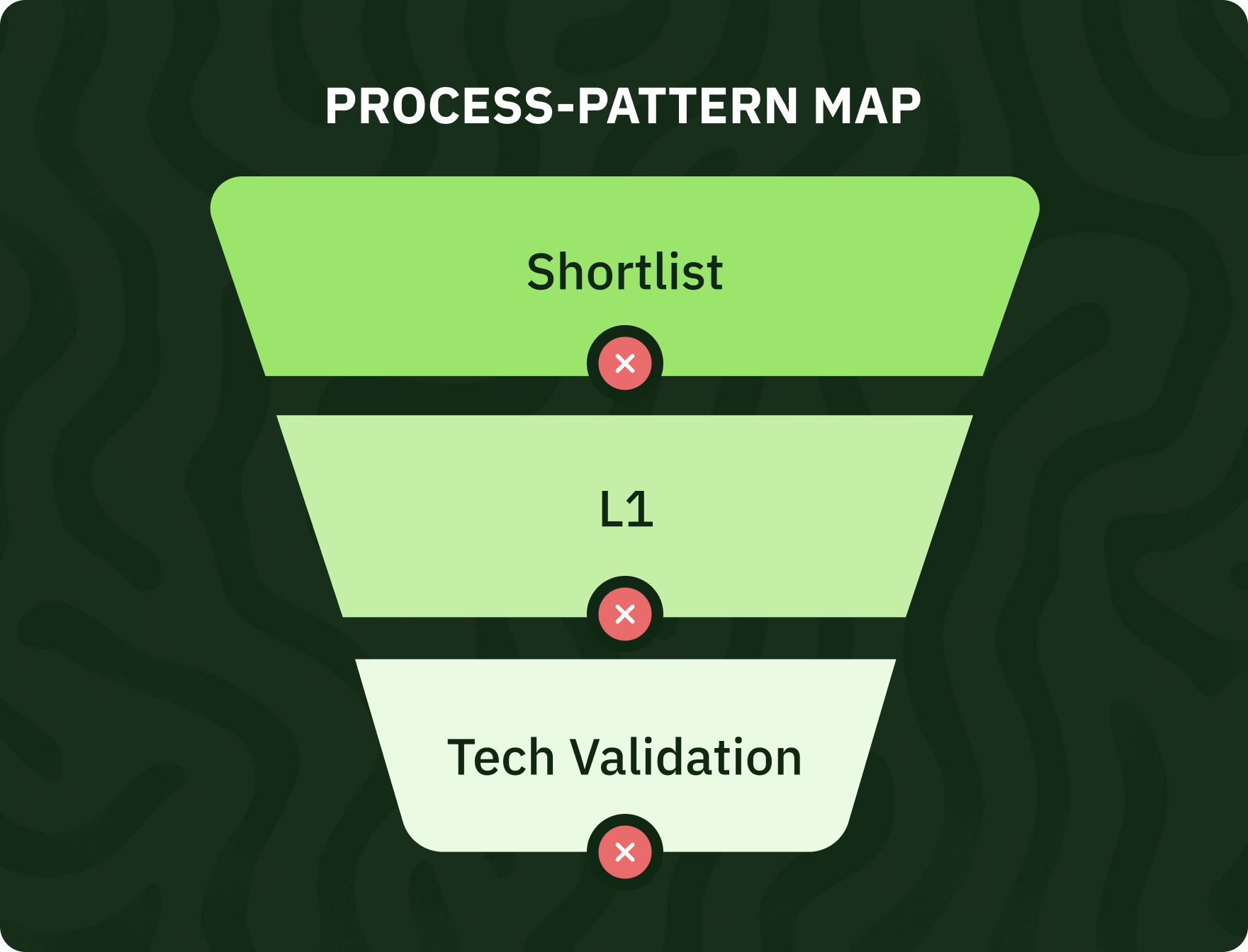
Hyring AI Agents
Mphasis's funnel has five stages where a candidate is being measured against a fixed rubric. Resume fit, communication baseline, structured responses, coding ability, English proficiency. None of these require a human to form a personal opinion about the candidate. They require a scoring system applied consistently at volume. That is what Hyring's agents do.
The line between AI and humans is the same line between measurement and judgment. Anything that can be graded against a rubric, the agent handles. The final call on whether to extend an offer stays with a person, always.
The AI Resume Screener
Instantly parse and rank resumes based on job-fit signals and technical requirements.
- Rapid high-volume parsing
- Objective skill ranking
- Bias-reduced shortlisting
The AI Phone Screener
Automated L1 verification calls to ensure basic qualifications and interest levels.
- 24/7 automated screening
- Consistent evaluation metrics
- Instant shortlist generation
The AI Coding Interviewer
Technical assessment with live coding environments and real-time logic evaluation.
- Real-time code analysis
- Plagiarism detection
- Automated logical scoring
English Proficiency Test
Standardized evaluation of communication skills, fluency, and professional vocabulary.
- Automated fluency scoring
- Grammar and clarity analysis
- CEFR aligned reporting
Funnel-to-agent
| HIRING STAGE | HYRING PRODUCT | WHAT IT DOES | OUTPUT (WHAT THE TEAM SEES) |
|---|---|---|---|
| SHORTLIST | AI Resume Screener | Scores applications against role-specific skill matrices and JD requirements for Mphasis lateral and campus pipelines. | Ranked candidate list with role-fit confidence scores. |
| L1 SCREENING | AI Phone Screener | Conducts concurrent phone interviews covering availability, communication, and baseline qualification checks. | Conversation transcript, composite score, and advance/hold flag. |
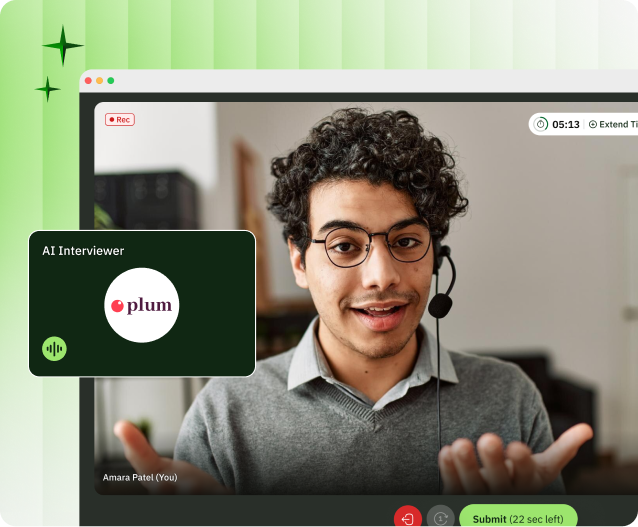
| STRUCTURED INTERVIEW | AI Video Interviewer | Runs recorded video interviews with competency-mapped question sets and behavioural scoring. | Scored interview report with response analysis and integrity flags. |
| TECH VALIDATION | AI Coding Interviewer | Administers live coding assessments calibrated to Mphasis role profiles (cloud, data, mainframe). | Code quality report with correctness, efficiency, and edge-case coverage metrics. |
| COMMUNICATION | English Proficiency Test | Measures spoken English across four dimensions relevant to client-facing Mphasis roles. | CEFR-aligned level score with per-dimension breakdown. |
HYRING PRODUCT
AI Resume Screener
WHAT IT DOES
Scores applications against role-specific skill matrices and JD requirements for Mphasis lateral and campus pipelines.
OUTPUT (WHAT THE TEAM SEES)
Ranked candidate list with role-fit confidence scores.
HYRING PRODUCT
AI Phone Screener
WHAT IT DOES
Conducts concurrent phone interviews covering availability, communication, and baseline qualification checks.
OUTPUT (WHAT THE TEAM SEES)
Conversation transcript, composite score, and advance/hold flag.
HYRING PRODUCT
AI Video Interviewer
WHAT IT DOES
Runs recorded video interviews with competency-mapped question sets and behavioural scoring.
OUTPUT (WHAT THE TEAM SEES)
Scored interview report with response analysis and integrity flags.
HYRING PRODUCT
AI Coding Interviewer
WHAT IT DOES
Administers live coding assessments calibrated to Mphasis role profiles (cloud, data, mainframe).
OUTPUT (WHAT THE TEAM SEES)
Code quality report with correctness, efficiency, and edge-case coverage metrics.
HYRING PRODUCT
English Proficiency Test
WHAT IT DOES
Measures spoken English across four dimensions relevant to client-facing Mphasis roles.
OUTPUT (WHAT THE TEAM SEES)
CEFR-aligned level score with per-dimension breakdown.
KPI Scoreboard — Mphasis Hiring Model
Time to Screen
Definition: Calendar days between application submission and first screening outcome.
Risk indicator: Persistent Systems and LTIMindtree screen the same pool in 48 hours. If Mphasis takes five days, the shortlist is stale before a recruiter touches it.
Screening Throughput
Definition: Number of completed first-stage screens per recruiter per week.
Risk indicator: Throughput above 250/week with no question bank refresh usually means skimming, not screening. Check next-stage pass rates first.
Interview Completion Rate
Definition: Share of candidates who receive an assessment invitation and finish it.
Risk indicator: Below 55% on video assessments typically points to broken links, unclear instructions, or sessions past 40 minutes.
Early Stage Drop-offs
Definition: The funnel step where candidates stop responding or withdraw.
Risk indicator: Drop-off spiking at the technical assessment (not scheduling) means the test difficulty is miscalibrated for the role grade.
Panel Hours per Hire
Definition: Total interviewer time consumed per accepted offer.
Risk indicator: If panel hours drop and 90-day retention also drops, the AI filter may be stripping signals that only a human conversation catches.
Pass-through Rate
Definition: Percentage of candidates who clear one stage and enter the next.
Risk indicator: A 15-point variance between two delivery centres hiring for the same role means the rubric needs local calibration.
Shortlist-to-Offer Ratio
Definition: How many shortlisted candidates it takes to produce one accepted offer.
Risk indicator: Compressing from 20:1 to 10:1 is progress. Hitting 5:1 in one quarter warrants checking whether viable candidates are being pruned.
Integrity Flag Rate
Definition: Percentage of assessments triggering a fraud alert.
Risk indicator: A steady 4-6% baseline is expected. A sudden jump from a specific campus batch needs a manual audit before drawing conclusions.
Time to First Touch
Definition: Hours between application receipt and first candidate interaction.
Risk indicator: Quick first touch followed by a week of silence creates worse perception than a moderate but consistent pace.
SLA Adherence
Definition: Share of candidates receiving status updates within the committed timeframe.
Risk indicator: When this drops, offer acceptance follows within the same cycle. Mid-tier IT candidates have options.
Model ROI for Mid-Volume Scenario
Every number below is an illustrative projection. The math uses publicly reported Mphasis data for employee count and revenue, with hiring volumes estimated from industry benchmarks for companies of comparable size. Internal cost structures will differ. Treat this as a starting model, not a budget line.
Estimated Annual Savings
$370K
in operational and hiring costs across the Mphasis recruitment process.
Time-to-Hire Reduction
55%
faster from application to accepted offer.
Break-even Period
Month 3
payback reached through operational efficiency gains.
5-Year ROI Projection
~350%
with compounding efficiency as lateral volume scales.
Note: ROI figures below are an illustrative model of potential savings in this specific scenario. Actual results vary by internal workflow costs.
Hours Recovered Across Three Funnel Stages
Manual effort in the Mphasis interview process concentrates in resume screening, L1 screens, and early technical panels.
Resume screening: 100,000 applications at 7 minutes = 11,700 person-hours. AI reduces to ~1,700 hours of review. Saved: ~10,000 hours.
L1 phone/video screens: 20,000 candidates at 20 minutes = 6,700 hours. AI leaves ~900 hours of follow-up. Saved: ~5,800 hours.
Early technical panels: 7,000 candidates at 35 minutes, 1.5 panelists = 6,100 hours. AI cuts volume to human panels by 55%. Saved: ~3,350 hours.
Total estimated hours recovered annually: ~19,000.
Hours by Stage (Manual vs. AI-Assisted)
Source: Hyring hiring model | Illustrative, based on estimated 100K+ annual applications
Manual Cost versus Target State with AI
To process 100,000 applications for Mphasis positions, the manual model carries heavy coordination and billable-hour leakage. AI-native assessment shifts that cost from high-value human time to scalable platform bandwidth.
| Metric | Current Manual Process | Target with Hyring AI Agents |
|---|---|---|
| L1 screening cost | ~$276K (recruiter hours at $15/hr loaded, coordinator overhead) | ~$77K (AI screens at ~$1 each plus recruiter review) |
| Engineering panel load | Engineers pulled from client projects, 3-4 sessions/day in peaks | Load drops to 1-2/day with stronger candidate relevance |
| Interview scalability | Limited by calendars, timezones, campus conflicts | Concurrent and asynchronous: candidates take assessments 24/7 |
| Candidate verification | Depends on interviewer alertness during live video | Automated monitoring of face, voice, and screen behaviour |
| Funnel completion rate | ~22% (mid-tier IT benchmark) | >60% projected from shorter waits and self-scheduling |
Where the $370K Savings Come From
At Mphasis's scale, the biggest cost is not in recruitment's budget. It is in engineering delivery margins eroded by panel duty, and in the replacement cost of candidates lost to slow processes.
Total impact reaches ~$370K annually, including $295K in direct cost recovery and ~$75K in secondary effects like improved fill rates and faster billable onboarding.
Annual Hiring Cost Savings Breakdown
Source: Hyring hiring model | All figures are illustrative.
Cumulative Savings versus Cost
At an estimated annual platform cost of $85K, break-even arrives around month 3 as savings begin to exceed fixed investment costs. Lateral hiring volumes compress this further because the marginal cost per screen is close to zero.
Cumulative Savings vs Investment (12-Month Model)
Month
Source: Hyring hiring model | Illustrative.
Mphasis Hiring Process Implementation
Mphasis runs leaner than the mega-cap IT firms with fewer legacy layers. However, comparison data is critical before trusting AI outputs. This 4-week plan builds that trust through data-driven benchmarks.
Week 2: Run AI agents in shadow mode alongside manual screens
Week 3: Layer in coding and language assessments
Week 4: Review, recalibrate, decide on expansion
Frequently Asked Questions
How does this hiring model handle Mphasis's mix of lateral and campus hiring?
Lateral and campus pipelines run through separate rubric configurations on the same platform. Both process concurrently with no queue dependency between them.
What does the AI phone screener output for a Mphasis recruiter?
A call transcript, a numerical score mapped to role requirements, a competency-organised response summary, and a forward/hold flag. A recruiter processes this in about 90 seconds instead of conducting a 20-minute call.
How does Hyring's system detect cheating in remote assessments?
The AI Video Interviewer tracks whether a second person appears on camera, eye movement patterns suggesting off-screen reading, voice consistency, browser focus changes, and paste activity during coding. These produce a composite integrity score. No single anomaly triggers automatic rejection.
Does using AI assessments make the candidate experience worse?
Candidates choose when to take their assessment within a defined window. Scoring runs within minutes of completion. Early feedback from companies using this approach shows candidate satisfaction holding steady or improving.
Can the coding assessment be configured for different Mphasis role families?
Yes. The environment supports multiple languages and frameworks with difficulty adjustable per role. A mainframe engineer and a cloud-native data engineer get completely different question sets.
Where do human interviewers fit after the AI stages?
Human panels handle the final evaluation. By that point, the candidate has passed automated checks for resume fit, communication, structured responses, coding, and English proficiency. Engineers focus their panel time on how candidates handle ambiguous problems and team dynamics.