TCS Hiring Process: Where Hyring's AI Agents Fit
TCS closed Q3 FY25 with approximately 607,354 employees and a target of onboarding 40,000+ fresh graduates in FY25 alone, with plans to push past 42,000 in FY26. Over 300,000 candidates register for the TCS National Qualifier Test (NQT) each cycle.
This blueprint maps where Hyring's AI agents can absorb manual workload across that recruitment funnel, what outputs they produce for hiring teams, and which KPIs keep the model measurable.

This article is a planning framework showing where AI can reduce manual effort across the funnel.
The Map
You know that a hiring model is real if the individuals in charge can point to a figure that changed last week. If they cannot, it is a strategy document gathering dust.
This blueprint was developed for the TCS hiring process, which operates at 300,000+ application volumes per NQT cycle. It has four parts:
- A funnel map shaped around TCS's high-volume campus workflow.
- A phased deployment plan with weekly milestones.
- A KPI scoreboard carrying risk indicators for each metric.
- An ROI module with adjustable inputs and a clear disclaimer on projections.
TCS runs the NQT across hundreds of engineering colleges and open registration channels. Candidates first progress through an aptitude and cognitive test, technical assessment, and then managerial and HR interview rounds, all on compressed timelines that overlap with competing campus drives from Infosys, Wipro, HCLTech, and Cognizant - a real binder!
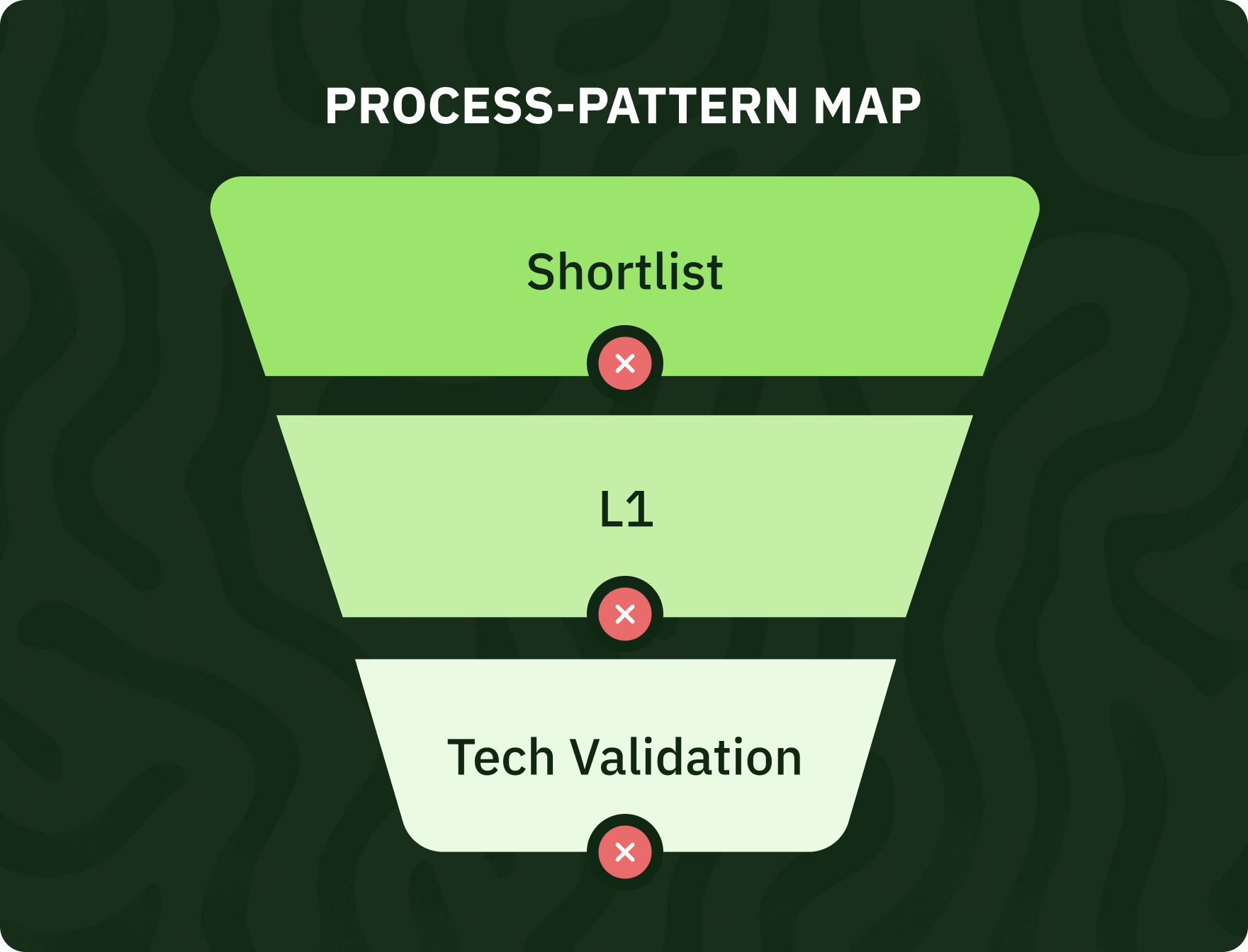
The friction stacks heaviest in the first three stages of that funnel. Those stages are repetitive, rubric-driven, and scored. That makes it an automatic case for automation without touching evaluative judgment.
Current State
TCS closed Q3 FY25 with approximately 607,354 employees as of December 31, 2024, per its quarterly earnings release. That figure represented a net decline of 5,370 from Q2 FY25. Trailing twelve-month IT services attrition stood at 13%, well below the 21.5% peak reached in Q2 FY23 but still generating replacement hiring demand on top of growth-driven intake.
Campus onboarding has a narrative of correction and recovery. In the post-pandemic hiring spree, TCS campus onboarding saw around 78,000 freshers get on-boarded in FY22. This was followed by a reduction to around 44,000 in FY23 as bench sizes swelled and deal ramps slowed down. FY24 was the first year in the last 19 years in which the company reported a net headcount reduction of 13,249 employees, ending the year with 601,546 employees. The management kept the fresher intake target at around 40,000 for FY24 and FY25 as well.
The CHRO indicated in a December 2024 Economic Times interview that FY26 fresher intake would rise above 42,000, driven by AI and GenAI project demand.
The application-to-offer math is stark. TCS NQT registrations exceed 300,000 annually, with a certified talent pool of over 600,000 candidates according to TCS iON.
For every campus position filled, TCS processes roughly eight to ten applications. A single NQT cycle targeting 20,000 hires can pull in 160,000 to 200,000 active test-takers. That volume hits the recruiter team's first-stage capacity all at once.
0
40k+
300k+
Headcount
Fresher Intake Trajectory
Problems In The TCS Hiring Process
While 200,000 candidates are trying to take the NQT in one window, a two-day delay in the shortlisting phase results in a week-long delay before any human interaction takes place. A week, in which Infosys, Wipro, HCLTech, Cognizant, and countless product startups are vying for the same talent pool, is enough to lose a fifth of your shortlisted talent to other job offers - which in the fast-paced world of tech innovation is bordering on criminal.
First-round screening is an 8,000+ hour fixed cost per cycle
Engineering panels absorb interview load that could be billed to clients
Offer-to-join gaps widen when round spacing exceeds 72 hours
Remote proctoring depends on interviewer stamina, which fades by interview six
Hyring AI Agents
Hyring's AI agents are versatile and have a range of targeted uses. It's the same pattern for any enterprise that is to compress the blurred steps, and for final decisions, a human-in-the-loop is essential.
The AI Resume Screener
Instantly parse and rank resumes based on job-fit signals and technical requirements.
- Rapid high-volume parsing
- Objective skill ranking
- Bias-reduced shortlisting
The AI Phone Screener
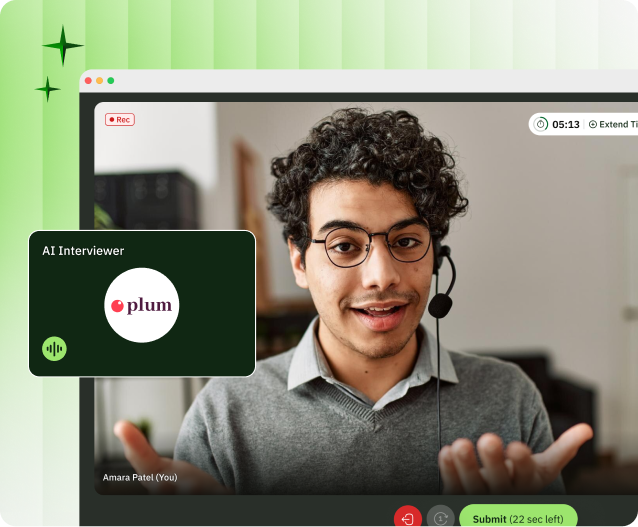
Automated L1 verification calls to ensure basic qualifications and interest levels.
- 24/7 automated screening
- Consistent evaluation metrics
- Instant shortlist generation
The AI Coding Interviewer
Technical assessment with live coding environments and real-time logic evaluation.
- Real-time code analysis
- Plagiarism detection
- Automated logical scoring
English Proficiency Test
Standardized evaluation of communication skills, fluency, and professional vocabulary.
- Automated fluency scoring
- Grammar and clarity analysis
- CEFR aligned reporting
Funnel-to-agent
| HIRING STAGE | HYRING PRODUCT | WHAT IT DOES | OUTPUT (WHAT THE TEAM SEES) |
|---|---|---|---|
| SHORTLIST | AI resume screener | Shortlists candidates using resume-based role-fit indicators. | Ranked shortlist + job fit signals. |
| L1 SCREENING | AI phone screener | Runs first-round phone screens and supports shortlisting. | Call summary + score + shortlist. |
| STRUCTURED INTERVIEW | AI video interviewer | Runs structured video interviews and generates candidate reports. | Interview automation + structured scoring. |
| TECH VALIDATION | AI coding interviewer | Conducts coding interviews for engineering roles. | Coding evaluation report. |
| COMMUNICATION | English proficiency test | Adds an English assessment step where roles require it. | Level + skill breakdown. |
HYRING PRODUCT
AI resume screener
WHAT IT DOES
Shortlists candidates using resume-based role-fit indicators.
OUTPUT (WHAT THE TEAM SEES)
Ranked shortlist + job fit signals.
HYRING PRODUCT
AI phone screener
WHAT IT DOES
Runs first-round phone screens and supports shortlisting.
OUTPUT (WHAT THE TEAM SEES)
Call summary + score + shortlist.
HYRING PRODUCT
AI video interviewer
WHAT IT DOES
Runs structured video interviews and generates candidate reports.
OUTPUT (WHAT THE TEAM SEES)
Interview automation + structured scoring.
HYRING PRODUCT
AI coding interviewer
WHAT IT DOES
Conducts coding interviews for engineering roles.
OUTPUT (WHAT THE TEAM SEES)
Coding evaluation report.
HYRING PRODUCT
English proficiency test
WHAT IT DOES
Adds an English assessment step where roles require it.
OUTPUT (WHAT THE TEAM SEES)
Level + skill breakdown.
KPI Scoreboard — TCS Hiring Model
Time to Screen
Definition: Elapsed time from NQT result to L1 screening decision.
Risk indicator: Getting below 48 hours is the target. If panel-stage rejection spikes after you compress this, the early filter may have swapped speed for accuracy.
Screening Throughput
Definition: Initial screen volume completed per recruiter per week.
Risk indicator: If throughput climbs but the next-stage advance rate drops, the intake criteria are too loose. Tighten them before scaling volume.
Interview Completion Rate
Definition: Percentage of candidates who receive an interview invite and finish the full evaluation.
Risk indicator: Below 60-70% completion usually points to unclear invite instructions, broken access links, or assessment length past 45 minutes.
Early Stage Drop-offs
Definition: The specific funnel step where candidates withdraw from participation.
Risk indicator: Heavy drop-off at the assessment stage (not the scheduling stage) often means the test feels too long or too hard relative to role level. Freshers abandon faster than lateral hires.
Panel Hours per Hire
Definition: Total human interviewer hours consumed per finalised hire.
Risk indicator: Track alongside 3-month retention. If panel hours drop and retention also drops, the AI filter may be pruning soft-skill signals that panels would have caught.
Pass-through Rate
Definition: Percentage of candidates advancing from one stage to the next.
Risk indicator: A 20-point variance between two campuses recruiting for the same role means the rubric needs campus-level calibration, not a single uniform threshold.
Shortlist-to-Offer Ratio
Definition: Shortlisted candidates needed to produce one accepted offer.
Risk indicator: Moving from 8:1 to 4:1 is solid. Moving from 8:1 to 3:2 means you are pruning viable candidates who would have performed.
Integrity Flag Rate
Definition: Percentage of AI interviews triggering fraud or cheating alerts.
Risk indicator: A baseline of around 5% is normal. A jump above 10% from a specific college or region needs a manual review before drawing quality conclusions about that source.
Time to First Touch
Definition: Lag between NQT completion and first outreach to the candidate.
Risk indicator: A fast first touch followed by silence for a week creates worse candidate perception than a consistently moderate pace. Touching base at two and three matter as much as touching base at one.
SLA Adherence
Definition: Percentage of candidates receiving status updates within X days.
Risk indicator: When this slips, offer acceptance rates fall within the same week. Slow updates lose candidates to faster-moving competitors.
Model ROI for High-Volume Scenario
Every number in this section is an illustrative projection. The math is grounded in publicly reported TCS hiring volumes, but internal cost structures vary. Treat this as a starting framework, not a guarantee.
Annual Savings Potential
$3.8M+
in operational and hiring costs.
Reduction in Time-to-Hire
60%
faster from NQT result to accepted offer.
Faster Interview Process
50%
acceleration in scheduling and evaluation throughput.
5-Year ROI Projection
~380%
with a 5-month payback period.
Note: ROI figures below are an illustrative model of potential savings in this specific scenario. Actual results vary by internal workflow costs.
Hours Saved Annually
Three stages account for the majority of manual effort in the TCS recruitment process — NQT result screening, L1 phone or video screens, and early technical panels. This is where the time is spent and how we will recover it.
- Resume and NQT score screening: 300,000 candidates, average review time 8 minutes per candidate, total time 40,000 person-hours. Using AI resume screening, we can reduce this to approximately 4,000 person-hours of recruiter review on AI-generated shortlists.
- L1 phone and video screens: 50,000 candidates remaining after shortlisting, 20 minutes per candidate, total 16,600 person-hours. AI phone and video agents completing these screens leave approximately 2,000 person-hours of recruiter review time.
- Early technical panels: 20,000 candidates remaining after L1, 35 minutes per candidate, 1.5 panelists average, total 17,500 person-hours. AI coding and video screening reduces the number reaching human panels by 55%, saving approximately 9,600 person-hours.
Total estimated hours recovered annually: ~58,000.
Hours by Stage (Manual vs. AI-Assisted)
Source: Hyring Hiring Model (Illustrative)
Current State Costing vs. Target State with AI
At an 8:1 application-to-hire ratio, every efficiency gain at the funnel top reduces cost at every stage below it.
| Metric | Current manual process | Target with Hyring AI agents |
|---|---|---|
| L1 screening cost | ~$2.1M (recruiter hours at $16/hr loaded, coordinator time, telephony) | ~$210K (at ~$1 per AI-conducted screen, plus ~$50K in recruiter review hours) |
| Engineering panel load | Heavy: engineers conduct early technical screens across campuses, averaging 4–5 interviews per day during peak sprints | Light: panels receive only candidates who cleared AI resume, phone, and coding gates. Interview load drops to 2 per day with higher relevance |
| Interview scalability | Capped by interviewer calendars, timezone coordination, and NQT cycle compression | Concurrent and asynchronous: candidates complete AI assessments on their own schedule within a defined window |
| Candidate verification | Interviewer observation during live video is inconsistent across fatigue levels and experience | Automated proctoring monitors face presence, voice matching, screen activity, gaze direction, and clipboard behaviour simultaneously |
| Funnel completion rate | ~25% of candidates who enter the shortlist stage reach the offer stage (estimated from industry benchmarks for large IT services) | >68% projected, driven by reduced wait times, self-scheduling, and faster status communication |
Where the $3.8M+ Savings Come From
The largest cost recovery does not sit in recruitment. It sits in engineering delivery margins and candidate acquisition overhead.
- L1 volume handled by AI Agents: At 300,000 registrations and a 20-minute average screen for those reaching L1, the manual screening stage costs roughly $2.1M in loaded recruiter time. AI phone and video agents conducting 90% of those screens at ~$1 each bring the figure to approximately $260K. Net recovery: ~$1.8M.
- Engineering hours returned to client delivery: TCS charges engineers based on practice and region, and the internal loaded cost for mid-level developers in India is typically in the range of $30 to $50/hour. Making up 9,600 panel hours at a midpoint of $40/hr is approximately $384K of delivery capacity restored.
- Scheduling and coordination overhead cut: NQT cycle coordination, which includes slot management, candidate communication, rescheduling loops, and no-show follow-ups, consumes an estimated 12,000 to 15,000 coordinator hours per year at this scale for TCS. Self-scheduling through AI assessment links eliminates approximately 60% of this process. Estimated recovery: ~$190K.
- Re-screening and integrity investigation costs mitigated: Manual fraud detection identifies problems too late, after a candidate has cleared two rounds of evaluation. Too many disqualifications occur too late in the process, causing all prior evaluation time to be for naught. Automating the first stage of the AI interview process for proctoring can save $120K in wasted evaluation time annually.
Total estimated annual savings: ~$3.8M (rounded conservatively, includes secondary effects across multiple NQT cycles and lateral hiring).
Where the Savings Come From
Source: Hyring Hiring Model (Illustrative)
Cumulative Savings vs Cost
The savings build up over each NQT cycle and hiring sprint. In this scenario, the break-even is achieved in month five. This timeframe can be compressed even further if the lateral hiring volume is added to the same Hyring deployment, as the marginal cost per additional AI interview is nearly zero.
What makes the TCS hiring process uniquely suitable for AI deployment is the type of first three stages of the hiring funnel that NQT drives.
These are not stages that require creative evaluation and relationship-based judgments.
Cumulative Savings vs Investment (12-Month Model)
Month
Source: Hyring Hiring Model (Illustrative)
TCS Hiring Process Implementation
A rollout attempt to accommodate 300,000 NQT registrations on day one will fail. Phased rollout maintains existing workflows, creates comparison data, and provides hiring panels with time to trust AI outputs before relying on them.
Week 2: Run AI screening agents alongside the existing manual process
Activate the AI Phone Screener and AI Video Interviewer for the pilot roles only. Run them in parallel with your existing manual process for the first 72 hours.
Compare Outputs — score distributions, time-to-decision, and candidate completion rates. Track these on a daily basis. Discrepancies in recommendations from AI systems and decisions from human evaluators can be identified in real-time, enabling rubric calibration before scale.
Week 3: Layer in coding and language assessments
Add AI Coding Interviewer as an option under the engineering track. Add the English Proficiency Test as an option for any role where English proficiency is a first-year course requirement. Start monitoring integrity flag rates.
Compare this to whatever level of fraud detection you're doing manually, even if this is a gut check, and note spikes in flag rates coming from specific colleges — this is not necessarily a reason to reject candidates, but a threshold check.
Week 4: Aggregate, calibrate, and decide on expansion
Key review questions: Did pass-through rates improve without panel satisfaction declining? Did candidate NPS hold steady or improve? Did time-to-offer compress measurably?
Adjust question banks, scoring weights, and flag sensitivity based on the data. Expand to the next batch of requisitions only after two consecutive review cycles show stable SLAs.
Frequently Asked Questions
How does this hiring model handle the volume of TCS NQT registrations?
Each candidate in a batch receives their assessment link at the same time. Thousands of phone and video sessions are handled at the same time by Hyring's AI agents, so a 200,000-candidate NQT process takes just a few days to clear L1, as opposed to the three to four weeks a human assessment team might take.
What does the first-round automated agent deliver for the TCS hiring process?
A report with the breakdown of the competency score, the summary of the responses, the areas that need to be probed further, and the advance or hold recommendation. This saves the recruiter's time as they can go through the report in just 90 seconds, as opposed to taking a 20-minute call.
How does the system prevent interview cheating?
The AI video interviewer monitors six signals in parallel — tab switches, secondary faces, voice mismatches, gaze anomalies, lip sync gaps, and clipboard pastes. These are combined to produce a composite integrity score. No single flag is used to reject videos automatically — we see which flags were triggered and make decisions accordingly.
Do automated interviews hurt the candidate experience?
Candidates pick their own assessment window, skip scheduling back-and-forth, and receive status updates faster because scoring happens immediately after completion. Feedback from platforms using this model indicates candidate satisfaction holds steady or improves relative to traditional phone screens.
Can we customize the coding validation for different TCS role profiles?
Yes. The AI Coding Interviewer supports Java, Python, C++, JavaScript, SQL, and other environments with configurable difficulty per role. A TCS Ninja backend developer and a TCS Digital data engineer see entirely different assessments without separate platform instances.
How do human technical panels fit into this workflow?
Panels only come in at the very end, at the final stage. That's because, by then, the candidate has already passed the resume screening, phone/video, coding, and language tests. The engineers use the interview time to assess problem-solving depth and culture fit, not to re-check the candidate's basic qualifications.