
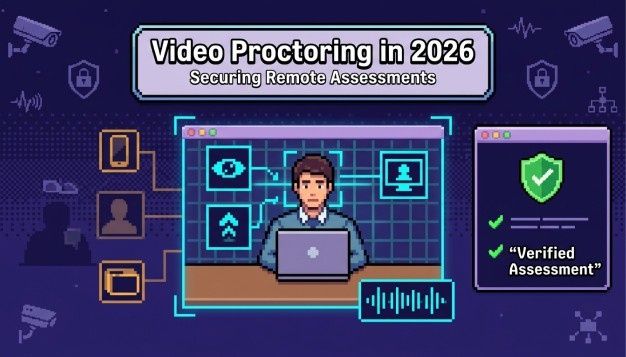
An overview:
The shift toward remote work and virtual hiring is complete. In 2026, talent acquisition teams are no longer restricted by geography. We can hire the best minds in the world, wherever they may be. This flexibility is a game-changer. It has, however, introduced a significant challenge to the integrity of online assessments and interviews.
When you cannot sit in the same room as a candidate, how do you know they are the ones taking the technical test? How do you ensure they are not receiving answers from off-camera?
This is where video proctoring becomes essential. It is the technology that bridges the trust gap in virtual hiring. This guide explains what video proctoring is, how it utilizes artificial intelligence, and how Hyring provides robust solutions for both assessments and interviews.
Understanding Video Proctoring: An Overview
At its simplest, video proctoring is the process of monitoring a candidate digitally during an online assessment or interview. Think of it as a digital invigilator. It uses the candidate’s webcam, microphone, and, in some cases, their screen activity to ensure the assessment process is fair.
The primary goal is integrity. We need to know that the skills a candidate demonstrates on an assessment are genuinely their own. Without proctoring, online evaluations are susceptible to various forms of academic dishonesty, which ultimately undermines the entire hiring process. A bad hire is expensive. It is far more cost-effective to verify competence at the initial stage than to manage a performance issue later.
How Video Proctoring Works: The Role of AI
The old model of proctoring relied on human reviewers. A recruiter would have to watch hours of recorded footage after the fact. This was slow. It was expensive. It was also prone to human error - a reviewer might miss a subtle cue.
In 2026, video proctoring is driven almost entirely by Artificial Intelligence (AI) and specialized computer vision algorithms. The AI does the heavy lifting, analyzing multiple data streams in real-time. It doesn't just record; it captures and processes what it is seeing and hearing.
Key AI capabilities in 2026 include:
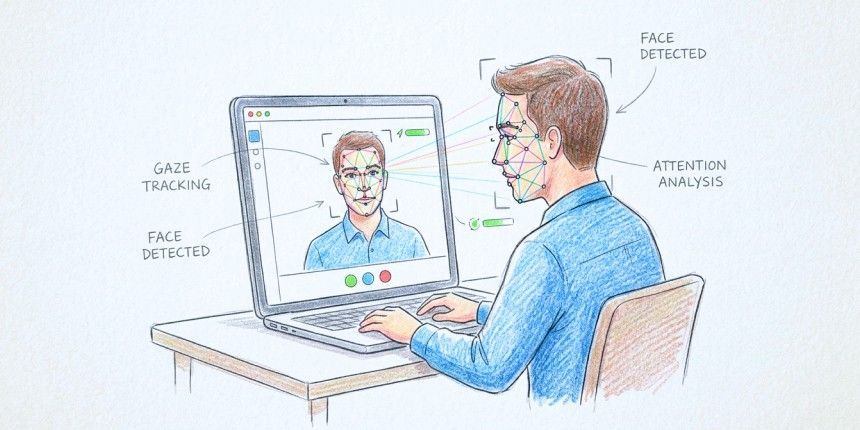
- Behavioral Monitoring and Gaze Tracking: This is where the system becomes intelligent. The AI is constantly mapping the landmarks on the candidate's face. If the candidate takes too long looking away from the screen (maybe checking their sources for answers), or their eye movement patterns indicate that they are looking at something else, the AI detects this.
- Audio Analysis: The microphone is not just listening for loud noises; it also captures impermissible noises (such as another person whispering or the sound of keys tapping out a search query).
- Secondary Device and "Hidden Helper" Detection: The AI looks for anomalies that might suggest someone else is in the room. This includes detecting reflections in glasses, sudden changes in room lighting (from another screen), or even detecting another person's voice that isn't the candidate’s.
Secure Every Step of the Hiring Process
At Hyring, we understand that a single solution doesn’t fit every stage of the hiring pipeline. You need different tools for a preliminary screening than you do for a final-stage technical panel. This is why we have integrated video proctoring into two distinct assessment formats.
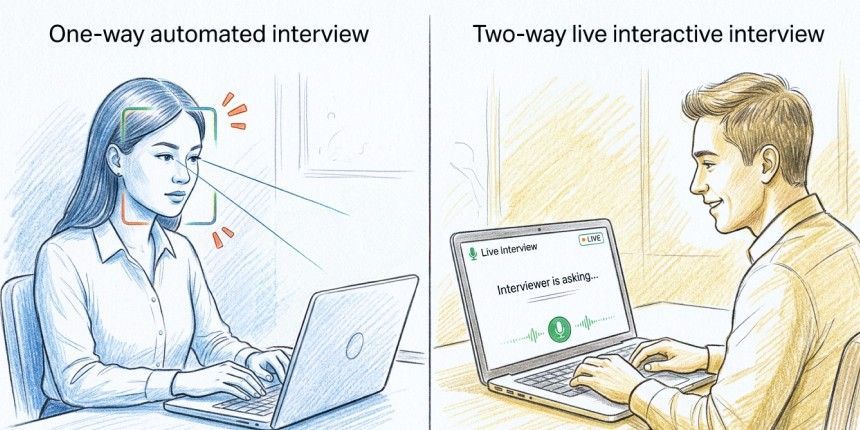
One-Way (Asynchronous) Proctored Interviews
The one-way video interview is the gold standard for preliminary screening. It replaces the initial screening, and candidates are presented with a series of questions. They then record their video responses in their own time.
Why Proctoring is Crucial for One-Way Interviews: This format is highly efficient, but it has historically carried a fraud risk. A candidate could, for example, have a friend provide the answer to a tricky technical question or even look up answers themselves.
The Hyring Solution: When a candidate starts a proctored one-way interview on Hyring, the system establishes a digital baseline of their identity. As they record their answers, the AI actively monitors their focus. If the candidate looks down at a cheat sheet while answering, the AI flags that response.
The hiring manager does not just receive a video. They receive a video with an accompanying integrity score. This allows the manager to quickly review any flagged behavior without watching the entire recording, saving invaluable time while maintaining security.
Two-Way (Live) Proctored Interviews
As the process moves forward, you need to engage in a live dialogue. Two-way interviews are the core of final-stage evaluations. These are typically used to understand the technical strengths, along with the cultural and technical fit.
Why Proctoring is Crucial for Live Interviews: Even in a live call, fraud happens. It often takes the form of proxy interviewing or coached responses, where someone off-camera is giving the candidate answers.
The Hyring Solution: Hyring’s live interview platform is fortified with integrated video and browser monitoring. Unlike generic video conferencing tools, Hyring Conduct is designed to detect cheating activities.
Throughout the live call, the platform provides real-time integrity alerts directly to the interviewer. These might include notifications that the candidate is receiving answers from an off-screen source or is attempting to look up information. The interviewer can then decide, in the moment, how to address the red flag. Crucially, the interviewer is also protected, as the system provides a tamper-proof recording and transcript of the entire session.
The Value of Verified Trust in Hiring
Verified trust makes the entire hiring process smoother and fairer for everyone involved.
For employers, it drastically reduces the cost of vacancy and the high cost of a bad hire. When you trust your early-stage filters, you can move faster. This gives you a critical edge in securing top-tier talent.
For candidates, video proctoring provides a fair, global stage. A qualified engineer in Lagos now has the same opportunity as one in Silicon Valley. Our system ensures that they are evaluated through skills-based hiring, protected from bias, and that their application won't be rejected just because someone else decided to cheat.
Security is Not an Option; It is a Necessity
In 2026, the question is not if you should use video proctoring, but how you can afford not to. The efficiency gains of remote hiring are only sustainable when they are paired with absolute integrity. Hyring provides the scalable, intelligent security you need to hire with confidence on a global scale. We verify the environment, and we verify the skill. That leaves you free to focus on the human side of the hire.
Frequently Asked Questions
1. Does video proctoring invade the candidate’s privacy?
We take privacy very seriously. We are compliant with global standards like GDPR. We only record what is strictly necessary for the assessment. The candidate is fully informed before the session begins, and no data is shared with third parties.
2. Can candidates cheat the proctoring system?
In 2026, it is extremely difficult to do so. Our AI looks for multi-modal signs of dishonesty. If a candidate uses an external device, it's flagged. If another person speaks, it's flagged. The system is designed to catch complex scenarios, not just obvious ones.
3. What happens if a candidate is flagged? Do they fail automatically?
No. Our AI is a supportive tool, not the final decision-maker. It flags suspicious behavior for human review. A hiring manager will always review the footage. They will determine if the candidate was truly looking at notes or if they were just looking at a household pet that walked in.
4. What are the browser proctoring and environmental checks?
Browser proctoring ensures the candidate doesn't navigate away from the test. It captures all activities from copy-pasting to opening new search tabs. It does not stick to looking into the candidates’ browser activities and their behavior, but also their background for other voices or faces.
5. How much time does proctoring add to the process for recruiters?
It reduces the time. Instead of manually watching all candidates, recruiters only focus their time on those that the AI has already verified as high-integrity. The flagged summaries make reviewing anomalies incredibly fast.