
Key Takeaways
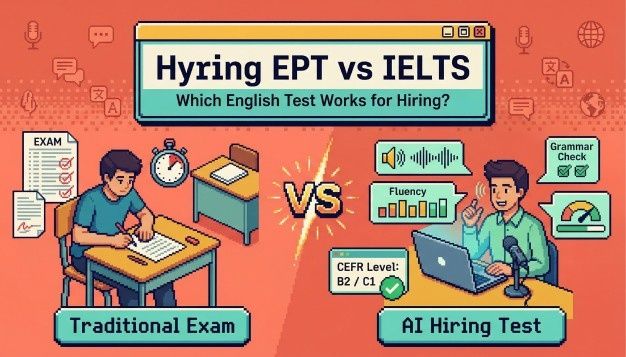
- The Hyring English Test vs IELTS comparison comes down to purpose, not quality.
- IELTS is the right standard for academic entry and immigration documentation
- Hyring English Test is built for recruitment, scenario-based, scalable, and job-aligned
- Predictive hiring improves when the assessment mirrors what the role actually demands.
- For high-volume hiring, digital assessments reduce cost, delay, and scoring inconsistency.
Here's the honest answer to the Hyring English Test vs IELTS debate: they were built for completely different worlds. IELTS was designed to get people into universities and across borders. The Hyring English Proficiency Test was built to get the right people into the right jobs. For recruiters, that distinction is everything.
English fluency shapes how your team handles customer complaints, closes sales calls, writes internal reports, and collaborates across time zones. So why are so many companies still using an exam designed for academic admissions to make those calls?
This guide breaks down both tests, structure, scoring, predictive value, and real-world hiring utility, so you can make a decision based on evidence, not habit.
What Is IELTS and How Does It Work?
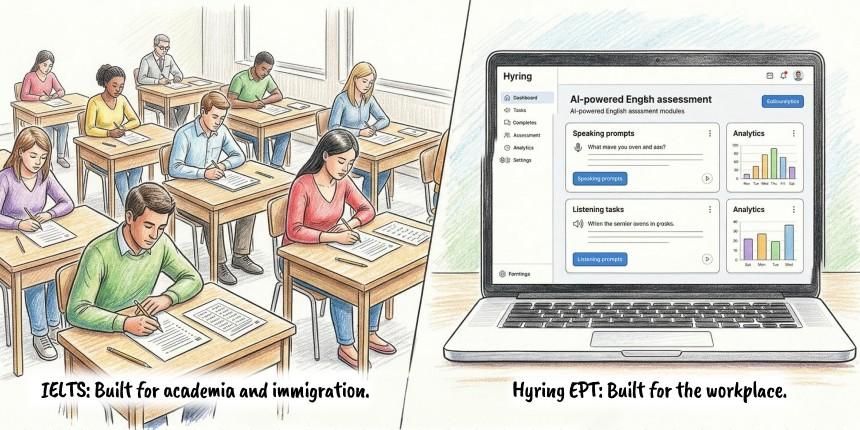
The International English Language Testing System (IELTS), better known as IELTS, is the global standard for measuring English proficiency in academic and immigration contexts. It's jointly managed by the British Council, IDP Education, and Cambridge Assessment English, and it's trusted by thousands of universities and governments worldwide.
The test covers four modules:
- Listening – comprehension across accents and scenarios
- Reading – navigating complex, formal texts
- Writing – structured essays and reports
- Speaking – a face-to-face or recorded interview
Scores run from Band 1 to Band 9. Universities set minimum entry thresholds. Immigration departments use it to verify language competency for visa applications.
What IELTS doesn't do, and was never designed to do, is evaluate how someone performs in a job.
A candidate can walk in with a Band 7.5 and still go blank when a frustrated customer calls to cancel their account. IELTS measures academic command of English. It doesn't measure whether someone can think on their feet in a sales conversation or articulate clearly under pressure in a live support call.
That gap is exactly where hiring teams run into trouble.
What Is the Hyring English Proficiency Test?
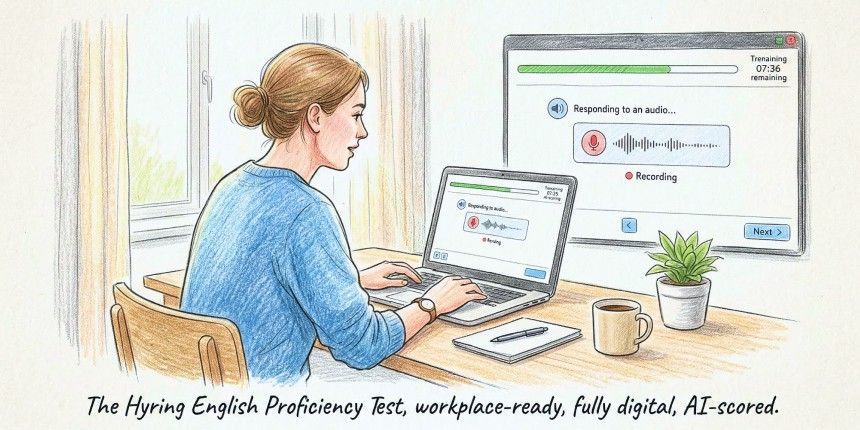
The Hyring English Proficiency Test takes a fundamentally different approach. Instead of testing grammar and essay structure, it tests how candidates actually communicate in workplace situations.
Built on an AI-driven recruitment framework, the assessment is designed to evaluate:
- Spoken clarity in role-relevant scenarios
- Structured articulation under timed conditions
- Real-world response quality, not textbook answers
- Consistency through AI-standardized scoring, which removes examiner bias entirely
Because it's fully digital, it plugs directly into existing recruitment pipelines. No test centers. No scheduling windows. No coordination across time zones.
For teams hiring at scale, think BPO operations, sales floors, remote support roles, that kind of flexibility changes the math on hiring entirely.
Hyring English Test vs IELTS: Core Differences
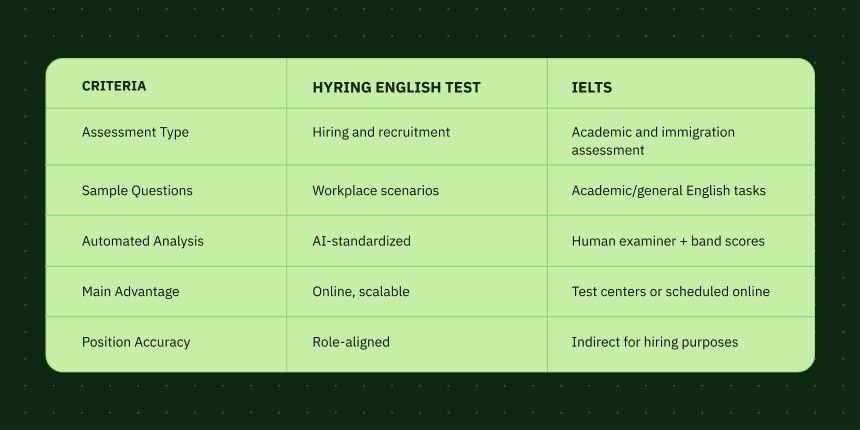
The sharpest distinction isn't about which test is harder or more prestigious. It's about what each one is actually measuring.
IELTS measures language knowledge. Hyring measures how well someone can use language to do a job.
If your hires need to write academic papers, IELTS is the right lens. If they need to de-escalate a tense client call or pitch confidently to a prospect, you need a test that reflects that reality.
Which Test Predicts Job Performance Better?
Predictive validity is the term researchers use to describe how well an assessment forecasts actual performance. And here, the context of the test matters enormously.
The U.S. Department of Labor estimates that a single bad hire can cost at least 30% of that employee's first-year salary. In customer-facing and communication-heavy roles, weak language skills are one of the most common culprits.
IELTS is a strong predictor of academic success. It is a poor predictor of whether someone will thrive in a client-facing role.
The Hyring English Test is designed around the communication behaviors that actually matter in the workplace:
- Can they articulate a clear response quickly?
- Do they stay composed and coherent under pressure?
- Can they structure their thoughts in real time without a script?
- Does their communication inspire confidence in the person on the other end?
These aren't things you can reliably predict from an essay written at a test center. They are things you observe when someone responds to a scenario that mirrors their actual job.
Cost, Scalability, and Screening Efficiency
Let's talk logistics, because they matter more than most recruiters admit.
IELTS comes with real constraints:
- Scheduling delays – candidates must book slots in advance, often weeks out
- Per-candidate costs – test fees add up quickly across a large applicant pool
- Limited volume control – you're working around test center capacity, not your hiring timeline
For a team trying to fill 200 customer support roles in Q1, those constraints can push your entire hiring calendar back by weeks.
The Hyring English Test runs asynchronously. Candidates complete it on their own time, and recruiters get scored results without waiting for a test center's schedule. At high volume, that's not just a convenience; it's a competitive advantage.
Recruitment speed has a direct impact on revenue. Every day a seat stays empty in a customer support team is a day that service quality takes a hit. Screening efficiency isn't a nice-to-have; it's part of the business case.
When Should You Choose IELTS?
IELTS remains the right choice in specific, well-defined situations:
- You're hiring for roles that require formal academic credentials or published writing
- You're supporting employees through professional registration processes in regulated industries
- You need documentation accepted by government bodies or international institutions for immigration or visa purposes
In those contexts, IELTS is the recognized standard, and no internal assessment will substitute for it. Its global credibility is real, and for the purposes it was designed for, it delivers.
When Should You Choose the Hyring English Test?
If your hiring goals look anything like this, the Hyring English Test is the more practical tool:
- You're screening candidates for customer-facing, sales, or remote collaboration roles
- You need to assess large volumes of applicants quickly and consistently
- Communication quality directly affects your team's output and client satisfaction
- You want scoring that doesn't vary from one interviewer to the next
The Hyring English Test isn't trying to compete with IELTS on prestige or global recognition. It's solving a different problem entirely, helping recruiters find people who can actually do the job, not just pass a language exam.
One test measures proficiency. The other measures performance. Know which one your hiring process actually needs.
Final Verdict: Hyring's EPT vs IELTS for Hiring
If you're vetting candidates for university programs or immigration pathways, IELTS is exactly what you need. Its credibility is earned, and its scope is clear.
But if you're trying to build a high-performing team, one where communication quality shows up in NPS scores, close rates, and client retention, then you need an assessment that reflects what your team actually does every day.
The Hyring English Test was built for that outcome. IELTS wasn't.
Choose the test that matches your actual hiring goal, not just the one with the most name recognition.
Frequently Asked Questions
1. Is IELTS valid for hiring decisions?
It can be used as a general language benchmark, but it wasn't built to evaluate workplace communication. A Band 7 score tells you someone can write an academic essay; it doesn't tell you how they'll handle a difficult client conversation.
2. Does the Hyring English Test replace IELTS?
No, and it doesn't try to. They serve fundamentally different purposes. If you need a globally recognized certification for immigration or academic admission, IELTS is still the standard. If you need job-relevant language screening, Hyring is the better fit.
3. Which test is more cost-effective for high-volume recruiting?
For most recruitment teams, hiring-focused online assessments significantly reduce both per-candidate cost and time-to-screen. IELTS logistics, test center coordination, scheduling, registration, add friction that doesn't exist in digital-first tools.
4. Can IELTS scores predict whether someone will succeed in a customer-facing role?
Indirectly, and imperfectly. Strong language ability helps across the board, but IELTS doesn't assess the specific communication behaviors, clarity under pressure, structured responses, conversational confidence, that matter most in those roles.