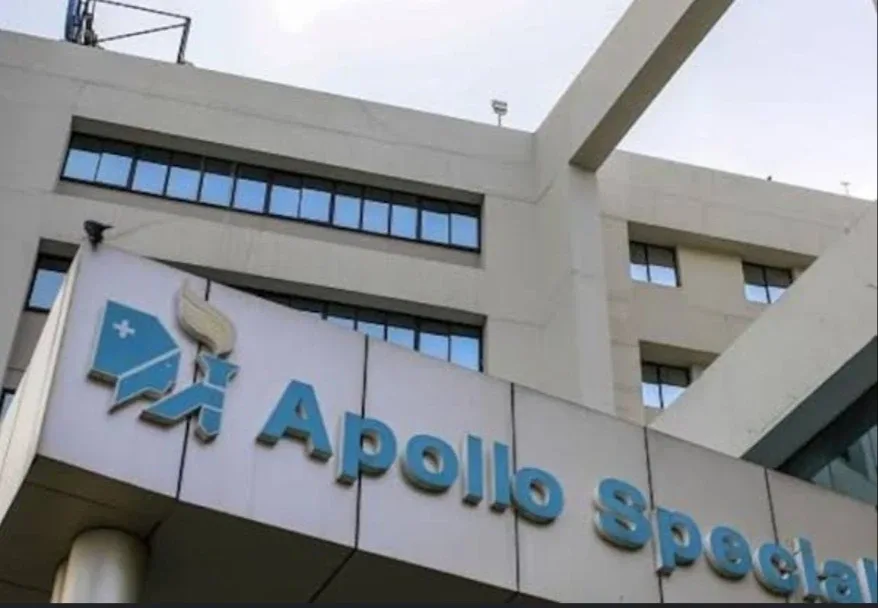
Apollo Hospitals Enterprise Limited is India's largest private hospital chain, founded by Dr. Prathap C. Reddy, who opened the group's first hospital in Chennai in 1983. The parent entity was incorporated on 5 December 1979 and is headquartered at R A Puram in Chennai, Tamil Nadu. It operates a network of owned and managed hospitals along with pharmacies, diagnostics, and telehealth services across India and neighbouring regions.
The company is publicly listed, trading on the NSE under APOLLOHOSP and on the BSE under code 508869, and is a constituent of the NIFTY 50 index. For the financial year ending March 2025, Apollo reported consolidated revenue of about ₹21,794 crore (roughly US$2.3 billion). Its market capitalization stood at approximately ₹1,28,349 crore as of 22 July 2026.
Leadership is led by Founder-Chairman Dr. Prathap C. Reddy, with his daughters holding senior executive roles: Suneeta Reddy as Managing Director, Preetha Reddy as Executive Vice Chairperson, and Sangita Reddy as Joint Managing Director. Krishnan Akhileswaran serves as Group Chief Financial Officer. The registered corporate identification number (CIN) is L85110TN1979PLC008035.
Key People
Prathap C. Reddy
Founder-Chairman
Suneeta Reddy
Managing Director
Preetha Reddy
Executive Vice Chairperson
Krishnan Akhileswaran
Group Chief Financial Officer
Photos
Interview process at Apollo Hospitals
(1,022 interviews)
Interview experience
Positive (7/10)
Interview difficulty
Medium (5/10)
Interview process length
About a day or two
Overall experience
PoorExcellent
EasyDifficult
About a day or two49%
About a week25%
About a month9%
More than one month9%
See all Apollo Hospitals interview questions & answers
Browse question banks by role, round and company, with answers and examples.
Apollo Hospitals Salaries in India (Updated 2026)
Physician
Reported average
₹50,224/month
26 salaries Salaries submitted
Physician Assistant
Reported average
₹22,574/month
3 salaries Salaries submitted
Resident Medical Officer
Reported average
₹540,000/year
2 respondents Salaries submitted
Registered Nurse
Reported average
₹19,807/month
12 salaries Salaries submitted
Registered Nurse (NICU)
Reported average
₹18,199/month
3 salaries Salaries submitted
Pharmacist
Reported average
₹17,265/month
9 salaries Salaries submitted
Know your worth at Apollo Hospitals
See how your salary compares and find roles that pay what you deserve.
Free guides to AI video screens, coding tests and how scoring works.
Benefits
Paid sick leave
Paid holidays and vacation
Paid weekly off
Life insurance and disability cover
ESI medical insurance
Free or discounted treatment for staff and family
Education, training and certification reimbursement
Flexible schedule and flex-time
Optional work from home
Provident Fund (PF)
Night shift and overtime allowance
Annual increment and bonus
Latest News & Updates
July 21, 2026
Apollo Hospitals sets Aug 12 board meeting to review Q1 FY27 results
Apollo Hospitals will declare unaudited Q1 FY27 results (quarter ended June 30, 2026) at a board meeting on August 12, 2026, followed by an analyst earnings call on August 13 led by MD Suneeta Reddy and Group CFO A. Krishnan.
Apollo Hospitals sets June 24 shareholder meeting for demerger scheme
Apollo scheduled NCLT-convened meetings of shareholders and creditors on June 24, 2026 to approve demerging its pharmacy and digital health business into Apollo Healthtech Limited, with amalgamation of Apollo HealthCo and Keimed. Approvals from BSE, NSE and CCI were secured.
Apollo posts FY26 revenue of Rs 25,229 crore, PAT up 34%
Apollo Hospitals reported FY26 consolidated revenue of Rs 25,229 crore, up 16% year on year, and profit after tax of Rs 1,942 crore, up 34%, with Q4 occupancy at 68% across 8,131 beds. Apollo HealthCo turned profitable for the full year.
Apollo plans 4,400 new beds over five years, opens Hyderabad smart hospital
Apollo intends to add about 4,400 beds over five years, funding roughly Rs 5,100 crore of capex from internal resources. A 400-bed smart hospital at Hyderabad Financial District was commissioned in April 2026, with a 270-bed Kolkata facility among the pipeline.
Apollo subsidiary completes Rs 1,650 million Bengaluru hospital buy
Apollo's 90% owned subsidiary Imperial Hospital and Research Centre completed the acquisition of Belenus Champion Hospitals in Marathahalli, Bengaluru for Rs 1,650 million. The 125-bed facility will reopen as a 175-bed multi-specialty hospital in Q1 FY27, taking total investment to Rs 3,000 million.
Apollo Hospitals Enterprise Limited is India's largest private hospital chain. It runs owned and managed hospitals along with pharmacies, diagnostics, and telehealth services across India and neighbouring regions.